Category: Uncategorized

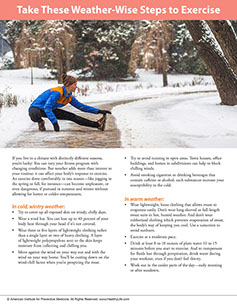
  • Cold Weather Exercise

    BE FIT

    Cold weather can put a damper on outdoor exercise. But, continuing to exercise during the winter months has many benefits. Exercise combats seasonal depression, increases energy, and boosts immunity against illness.

    Here’s how to stay comfortable while you exercise in the cold:

    *  Wear layers so you can adjust your temperature as needed.

    *  Protect your hands and feet with warm gloves and socks.

    *  Wear sunglasses to protect your eyes from snow or ice glare.

    *  Stay hydrated. You may feel less thirsty in the cold but still need plenty of fluids.

    *  Stay indoors if the temperature is 0ºF or below or the wind chill is below zero.

    *  Choose the proper footwear for snowy or icy conditions.

    *  Cover your mouth with a breathable wrap to warm the air you breathe.

    *  Start slow. Your body will adapt to cold conditions but progress gradually.

    *  Check with your doctor to make sure cold-weather exercise is right for you.

    © American Institute for Preventive Medicine

  • Define Your Exercise Goals

    Fitness

    Your goals are about you and for you. Other people’s fitness goals should not interfere with ones you set for yourself.

    *  Write down your goals.

    *  Your goals need to be clear and measurable. In other words, will they be easy to identify and actually reach? Clearly defined goals are more readily achieved.

    *  Review and adjust your goals as needed. It is not uncommon to change goals.

    *  Although this may seem time consuming, it will help you reach your goals. Unwritten goals tend to be vague and easy to forget.

    Write Down Your Short-Term Goals

    Chart showing how to track your short term goals.

    Write Down Your Long-Range Goals

    Read the following example: “I want to increase my endurance level so that I can run in a 5 Kilometer race 6 months from now.

    Resources

    CDC (Center for Disease Control and Prevention)

    800.CDC.INFO (232.4636)

    www.cdc.gov

    Healthfinder.gov

    www.healthfinder.gov

    Page image from the HealthyLife Weigh book by the American Institute for Preventive Medicine. www.HealthyLife.com. All rights reserved.

    © American Institute for Preventive Medicine

  • Hydrate To Feel Great

    Fitness

    Drink fluids before, during, and after exercising.

    How much water and other fluids do you need?

    To stay hydrated, your needs vary and depend on:

    *  How hard you exercise

    *  How long you exercise

    *  The temperature and humidity

    *  How much you sweat and how much weight you lose from sweat

    Know the signs of dehydration:

    *  Severe thirst (sometimes)

    *  Headache

    *  Weakness

    *  Muscle cramps

    *  Dry mouth and eyes. Sweating may stop.

    *  Nausea

    With severe dehydration, you may also feel very weak, confused, dizzy, or lightheaded. These symptoms require emergency medical care.

    Action Step

    To keep from getting dehydrated, drink water throughout the day. Drink sports beverages if you sweat a lot. Limit coffee, tea, and colas. Don’t rely on thirst alone to tell you if your body needs more fluid.

    Page image from the Ways to Well-Being book by the American Institute for Preventive Medicine. www.HealthyLife.com. All rights reserved.

    © American Institute for Preventive Medicine
  • Tired Of Doing The Same Exercises?

    Fitness

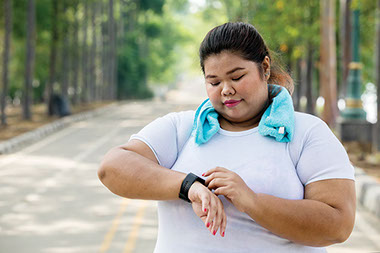
    Man jogging outside.

    *  Vary the activities you do.

    –  Choose ones unique to the four seasons.

    –  Select both indoor and outdoor exercises.

    –  Try ones you do alone and ones you do with others.

    *  Pair exercise with other things you like, such as your favorite music, being with friends, etc.

    *  Check out new ways to exercise. Take dance lessons. Learn yoga. Exercise to a kick-boxing video.

    Page from HealthyLife Weigh book by the American Institute for Preventive Medicine. www.HealthyLife.com. All rights reserved.

    © American Institute for Preventive Medicine
  • Busting Diet Myths

    HEALTHY EATING

    Salad bowl.

    Losing weight can be challenging. It means you have to change your eating and exercise habits. But does it mean you have to give up all the foods you love?

    Many myths about a healthy diet can make the task harder than it needs to be. But the truth is, you can change your diet for the better and still enjoy your food.

    Learn to recognize these common diet myths. You can make a healthy change to your eating habits.

    Myth:Dieting means I can’t eat my favorite foods.

    Fact:You can use moderation to still enjoy your favorite foods. Moderation means you can have a small amount once in a while. It means you may have to cut back, but you don’t have to give it up.

    Having your favorite high-calorie foods in small amounts can be fine for most people. A small piece of cake at a birthday party or a little piece of dark chocolate can still fit into your healthy eating plan.

    Myth:To lose weight, you have to give up breads, pasta and other grains.

    Fact:Many grains can be part of your healthy diet. You should limit refined, processed grains like white bread and white pasta. But whole grains contain fiber and nutrients you need. Examples of healthy grains include:

    *  Whole wheat bread and pasta

    *  Brown rice

    *  Quinoa

    *  Oats

    Read the nutrition label on whole grain products to help avoid high-calorie choices and added sugars.

    Myth:Gluten-free foods are healthier options for weight loss.

    Fact:Only people who have celiac disease or sensitivities to gluten need to avoid gluten.

    Just because a food says it is “gluten-free” does not mean it’s healthier or has fewer calories than a food that contains gluten. In fact, if you avoid gluten, you could miss out on important nutrients. See a doctor if you think you have a gluten sensitivity.

    Myth:You should avoid fat to lose weight.

    Fact:Some fat in your food is necessary and healthy. Try to eat foods that contain healthy monounsaturated or polyunsaturated fats. Eating small amounts of healthy fat can even help you feel full.

    These foods contain healthy fats that are important for overall health:

    *  Olive oil

    *  Avocadoes

    *  Nuts

    *  Seeds

    *  Eggs

    *  Salmon, trout

    Source: National Institute of Diabetes and Digestive and Kidney Diseases

    © American Institute for Preventive Medicine
  • Easy Food Swaps For A Healthy Heart

    HEALTHY EATING

    Image of a healthy vegetable wrap.

    Eating better for your heart doesn’t have to be complicated. In fact, making some small substitutions in your diet each day can add up to better health. It doesn’t require a big investment of time or money to make these changes:

    Instead of: Crackers or chips

    Try: Unsalted nuts and seeds

    Crackers and chips are processed foods with few vitamins and minerals. They’re often loaded with salt, sugar or excess fat.

    Nuts and seeds, on the other hand, contain heart healthy unsaturated fats that can improve blood cholesterol levels. They also contain fiber, which can help lower cholesterol and fight constipation. They’re convenient to take on the go and offer a satisfying crunch.

    Instead of:  White dinner rolls or pasta

    Try: Whole grain breads and pasta

    White “refined” breads and pastas have much of the natural nutrients stripped out during processing. They usually have little to no fiber. This means they don’t help you feel full and they can cause a drop in blood sugar a short time after they are eaten.

    Instead of white pasta and bread, try a whole grain option. Whole wheat pasta, quinoa and brown rice contain fiber, nutrients and even protein that’s great for your heart. Eating whole grains instead of refined grains may lower the risk of heart attack, stroke and obesity.

    Instead of: Cheesy pasta or sandwiches

    Try: Avocado sliced or spread

    Cheese can be eaten in moderation as part of a healthy diet. But many processed cheeses contain saturated fat, salt and artificial ingredients.

    Instead of processed cheese, try creamy avocado. Diced avocado pairs well with cherry tomatoes and herbs as a pasta topping. Try ripe avocado on a sandwich in place of sliced cheese. Avocado contains monounsaturated fats, which are heart health superstars. It also has antioxidants to help fight heart disease.

    Instead of:  Lunch meat sandwiches

    Try: Hummus and vegetable wraps

    Most deli meats contain a large amount of salt. A diet high in salt can lead to high blood pressure, which increases the risk of heart disease and stroke. They may also contain saturated fat, which may raise the risk of heart problems.

    Skip the meat and try a plant-based sandwich that still offers protein without the extra salt and unhealthy fat. Almond butter and peanut butter taste great on whole grain bread. Hummus offers protein and fiber, and pairs well with vegetables on whole grain wrap bread.

    Source: American Heart Association

    © American Institute for Preventive Medicine
  • Go Nuts For A Healthy Heart

    HEALTHY EATING

    Variety of nuts shaped into a heart.

    Nuts often get a reputation as being unhealthy. We add them to cookies and ice cream. People eat them by the handful at parties. But do nuts deserve a bad rap?

    Concerns about calories

    For years, many people avoided nuts because they are high in calories and fat. However, newer research finds that nuts can be an important part of a healthy diet. They contain many nutrients needed for body functions.

    The key is to eat nuts in moderation. This means you may need to eat smaller portions. Then, you can avoid eating too many calories from nuts.

    Look at the serving size on a package of nuts to get an idea of how much to eat. One serving may be quite small (2-4 tablespoons).

    Some Fats are Healthy

    Yes, most nuts are high in total fat. But these fats found in nuts actually promote good health! Most are high in healthy monounsaturated or polyunsaturated fats.

    Monounsaturated and polyunsaturated fats can help lower bad cholesterol, which can lower the risk of heart disease and stroke. The American Heart Association recommends people eat more of these fats from healthy sources like nuts and seeds.

    Protein packed

    Nuts are a good source of plant-based protein. Protein is an essential nutrient that the body needs for building muscle, repairing tissues and making hormones.

    It takes longer for the body to digest proteins than carbohydrates. That’s why eating some protein could help you feel less hungry than if you ate only carbohydrates, like crackers or bread.

    The Dietary Guidelines for Americans recommend that people eat healthy sources of protein, like those that come from nuts and seeds, and plant foods.

    Which types to eat

    Of course, there are many different kinds of nuts. Each type tastes different and may contain a variety of nutrients. As long as you’re not coating nuts with sugar and salt, any type can be healthy.

    Take a look at your favorite nut’s nutrition facts and go from there. For instance, macadamia nuts are one of the highest in calories and fat per ounce. But take those calories into account, and eat them instead of chips or cookies.

    Replace unhealthy, processed foods with nuts. You’ll get more nutrients and might even feel more full.

    Sources: Academy of Nutrition and Dietetics, National Institutes of Health, U.S. Department of Agriculture

    © American Institute for Preventive Medicine

  • Nuts & Allergies

    HEALTHY EATING

    Image of hands holding sign that says "Nut Free".

    Food allergies affect millions of people. With a food allergy, the immune system reacts to the food like it’s an invader. It may cause swelling, trouble breathing, hives and itching.

    Nut allergy dangers

    Nut allergies can be life-threatening.

    A person who is allergic to nuts could have a reaction from being near someone eating nuts. Even a tiny crumb of nuts left on a table could be life-threatening. This is why many schools do not allow nuts in classrooms or lunchrooms.

    If you or your family member has a nut allergy, you can still enjoy some nut alternatives. They can be just as delicious – and nutritious – as nuts.

    Nut alternatives

    Nuts contain plant-based protein, healthy fats and some vitamins and minerals. If you can’t eat nuts, don’t worry. There are other foods with these benefits!

    *Legumes:Soybeans, peas, lentils and chickpeas are legumes. They can be roasted as a snack or in salads. Some people are allergic to some types of legumes, however. Be sure to ask about legume allergies before using them for passing dishes or at school.

    *Seeds:There are so many kinds to choose from, like sunflower, pumpkin, chia, flax and hemp. They go well with salads, in smoothies or as a snack.

    *Avocadoes:Although not a significant source of protein, avocadoes are rich in healthy fats, B vitamins, potassium and magnesium. Avocadoes can go on many foods, from toast to salads to  stir-frys.

    Nut-Free butter Options

    Many nut-free butters make a great sandwich or spread for fruit. They taste a lot like peanut butter but without the peanuts.

    Today’s nut-free butters may contain soybeans, sunflower seeds, chickpeas or peas. These can all be healthy alternatives to nuts. Most contain some healthy fats and protein. Check the label for added salt or sugar.

    The Bottom Line

    Nuts are a healthy choice – and there are allergy-free options available. If you have an allergy to nuts, read all food labels. Look at allergen information and ingredients to stay safe.

    © American Institute for Preventive Medicine
  • Recipe: Green Smoothie

    HEALTHY EATING

    Two glasses of spinach smoothie.

    Ingredients

    *  1 cup kale or spinach

    *  1 banana, medium

    *  1 cup low-fat milk  (or optional coconut milk or almond milk)

    *  1 cup plain yogurt

    *  1 apple, medium  (cored and sliced)

    *  1 cup frozen fruit (all one fruit or a combination of mixed frozen fruits)

    *  1 tablespoon flax seeds (optional)

    *  1 tablespoon chia seeds (optional)

    Directions

    1.  In a blender, blend the kale or spinach and the liquid of your choice.

    2.  Add in the rest of the ingredients, blending after each item.

    3.  Serve and enjoy, cold.

    4.  Reserve the leftover smoothie in the refrigerator to drink later in the day or the next day.

    Nutrition information: 299 calories, 4g total fat, 2g saturated fat, 156 mg sodium, 56 g carbohydrates, 7g fiber, 13 g protein

    © American Institute for Preventive Medicine

  • The Skinny On Processed Foods

    HEALTHY EATING

    Turkey deli on cutting board.

    White bread, packaged cookies and turkey bacon. What do these foods have in common? They are all processed foods. Processed food is the opposite of “whole food,” or food in its natural state.

    What does “processed foods” mean?

    It means the food has been changed from its natural state. White bread, for instance, may contain wheat flour that has been bleached and stripped of some of its nutrients. Packaged cookies may have bleached and stripped flour in addition to added sweeteners, artificial colors, preservatives and flavors. Turkey bacon is cured, processed and packaged.

    Not all processed  foods are bad

    There is a difference between foods that are minimally processed and “junk foods.” Frozen vegetables, for instance, may be considered “minimally processed.” They are not quite the same as picking the vegetables right from a garden. But if they don’t have added sugar or salt, frozen vegetables are a very healthy option.

    In addition, some foods that are considered “processed” can help people eat better. Canned fruit (without added sugar) or bagged salads are a convenient option for many people. They eliminate the extra work of gathering the food, washing it and cutting it.

    Sugar & salt overload

    Many processed “junk” foods contain too much added sugar or salt. Also, they may have little to no fiber or vitamins.

    Processed foods, including crackers and packaged snacks, are a major reason that people get too much sodium in their diets. Too much sodium raises the risk of high blood pressure and heart disease.

    Many processed foods also contain added sugars. The American Heart Association says we should limit added sugars to 6 teaspoons a day for women and 9 teaspoons for men. One 12-ounce soda exceeds that amount. Too much added sugar increases risk for type 2 diabetes and heart disease.

    Processed = weight gain?

    A recent study by the National Institutes of Health suggests that processed foods can cause weight gain. Participants who were given processed foods ate about 500 calories more per day than people who ate unprocessed foods. They also gained weight, while the people who ate unprocessed foods lost weight. You don’t have to cut all processed foods out of your diet. But cutting back on them – and eating more whole foods – will help you work toward a healthier weight.

    Sources: Academy of Nutrition and Dietetics, American Academy of Family Physicians, American Heart Association, National Institutes of Health

    © American Institute for Preventive Medicine