Category: Uncategorized

  • 10 Action Steps For Adult Vaccines

    Medical Exams

    A vaccine bottle.

    1.  Get a yearly flu vaccine and stay current with COVID-19 booster shots.

    2.  If you have not had chicken pox or two doses of Varicella (chicken pox) vaccine, ask your doctor if you need this vaccine.

    3.  If you are age 26 or younger, get three doses of human papillomavirus (HPV) as advised by your doctor. These protect women against cervical and other cancers, and help protect women and men against genital warts.

    4.  If you are younger than age 55 years old, ask your doctor if you need vaccines to prevent meningococcal disease.

    5.  Get one dose of Tetanus/Diphtheria/Pertussis (Tdap) – adult whooping cough vaccine – if you have not yet had this. You also need a tetanus/diphtheria (Td) vaccine every 10 years.

    6.  If you were born in 1957 or later, you may need at least one dose of measles, mumps, rubella (MMR) vaccine.

    7.  Get a pneumcoccal vaccine once at age 65 years or older. If you smoke or have certain medical conditions, you need more than one dose, starting before age 65.

    8.  To prevent shingles or have a milder form of it, get two doses of RZV (Shingrix) vaccine at age 50 years old or older. You may not need this if you have not had chicken pox.

    9.  Talk to your doctor about the need for hepatitis A and  hepatitis B vaccines.

    10. Before you travel to other countries, find out if you need any other vaccines from your doctor and from 800.CDC.INFO (232.4636) orcdc.gov/travel.

    ays to Well-Being book by the American Institute for Preventive Medicine. www.HealthyLife.com. All rights reserved.

    © American Institute for Preventive Medicine
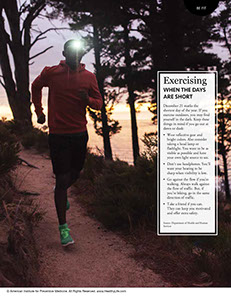
  • After-Dark Joggers, Heed This Advice

    Personal Safety

    Image of people walking/jogging in the dark.

    If you walk, run, or jog after sundown, the following tips help motorists spot you.

    *  Attach reflective tape to the front and back of your clothes.

    *  Carry a lit flashlight.

    *  Don’t use the road; stay on the shoulder, or preferably the sidewalk. Move against (facing) traffic if you must use the shoulder.

    *  Be aware of your surroundings and plan to jump to safety if a vehicle veers toward you.

    A Year of Health Hints book by the American Institute for Preventive Medicine. www.HealthyLife.com. All rights reserved.

    © American Institute for Preventive Medicine

  • Relationship / Marital Problems

    Mental Health

    Signs & Causes

    Few, if any, relationships are perfect. Problems are bound to occur. The problems most often linked with marriage and other relationships include:

    *  Failures in communicating

    *  Misunderstandings

    *  Negative feelings, such as being hurt, put down, ignored, abused and/or lonely

    *  Power struggles

    *  Acting out to get attention. Ways to do this include pouting, whining, nagging and complaining

    *  Addictive behaviors

    Other problems arise when partners have different needs in a relationship. Common differences include:

    *  Money

    *  Sex

    *  Work

    *  Child-rearing

    *  “In-law” or other family problems

    *  Time and how it is spent (i.e., studying, partying, golfing, watching TV)

    Most of the time, these problems can be worked out by the persons involved. Professional help should be sought, though, if any of the following apply:

    *  The problems are severe

    *  The problems keep you from doing your daily tasks

    *  You cannot resolve the problems on your own

    *  You want to strengthen your relationship(s)

    Questions to Ask

    Self-Help

    Ways to Improve Communication

    *  Avoid blaming the other person. This puts him or her on the defensive and prevents communication. When blaming starts, listening stops.

    *  Take 51% of the responsibility for listening to what is being said. Ask questions to clear up what you don’t understand.

    *  Be sincere, honest, and show concern in your conversation. Don’t be sarcastic or make fun of the other person.

    *  Try to let go. Before getting into an argument, ask yourself if the issue can simply be “let go.” Ask the other person, too. If you both say yes, drop it and don’t let it re-surface at a later time.

    *  It’s alright to discuss problem issues, but be certain that you focus on how to solve the problem, not placing blame for it.

    *  Put yourself in the other person’s shoes. Try to see his or her point of view.

    *  Remind each other of the many positive strengths of the relationship. Build on these strong points. Don’t dwell on the negative ones.

    *  Don’t bring up old issues, disputes or grudges. When past problems enter in, the  conversation can get out of hand.

    *  Timing is critical. Ask yourself if it is the right time to bring up an issue. If the other person is undergoing problems with work, school, kids, health and/or family, adding yet another problem to their burden is not likely to solve the issue. It may serve to cause them more anguish. If possible, wait until the other person’s burden has lightened to bring up yet another problem.

    *  Don’t approach an issue with the idea of changing the other person’s mind or convey an attitude that you’re right and he or she is wrong.

    *  Share the issue. The problem belongs to both you and the other person. Work to understand your partner’s position first, then to have him or her understand your position.

    *  Omit distractions. Don’t attempt to discuss an issue while driving a car, taking care of children, doing a household chore or doing anything that will take your attention away from the issue and the other person.

    *  Make sure you know your own position and   be ready to state it clearly to the other person.

    *  Communicate in an assertive way.

    – State your position in terms of what your feelings about the issue are.

    – Don’t make demands of the other person or put them down.

    – Use “I” rather than “you” messages. For example, if you are upset by the fact that the other person has begun to neglect their appearance, instead of saying “You look like a slob,” it would be better to state “I like it better when your appearance is neat.”

    *  Listen with your heart. Hear what the other person is saying regardless of how they say it. Allow him or her to be comfortable while they are stating their position. Don’t take an “attack” position and wait tensely for your turn to talk. Don’t interrupt them while they are speaking.

    *  Make a plan. This should consist of what you can do to solve the issue and what you are willing to do. Knowing these things in advance can speed the solution and reconciliation process.

    *  Go in peace. Let the discussion of a problem run its course and end in peace with both of you at ease. Don’t continue to “stew” over who said what, the decisions that came out of the argument and whether the other person gained more than you did in the bargaining session. If you still feel uncomfortable with the solutions, re-state your position and try again. Be aware, however, that some issues may not be able to be changed. For example, in the case of differing sexual desires/needs, forcing or asking that your partner engage in sexual activity beyond their desire for it will not benefit you or your partner and will only cause more tension.

    Jealousy

    *  If you experience abnormal jealousy in relation to situations or persons in your life, the following suggestions may be helpful:

    *  Admit your jealousy. Pretending there is no problem or that it is not a serious problem only compounds the issue.

    *  Look for the cause of the jealousy. Some of the causes may be:

    – Your present or a past partner cheated on you which has caused you to feel insecure. Your partner seems to pay more attention to others, work or social friendships. Members of the opposite sex find your partner attractive and pay a lot of attention to him or her. You fear your partner may one day lose interest in you and seek another partner.

    *  Express your fears and concerns to your partner.

    *  Learn about jealousy. Read books on the subject, talk to people who live with jealous persons to get an idea of what it’s like to experience a partner’s jealous responses. Or, talk to other people who experience extreme jealous feelings themselves.

    *  Communicate. Talk to your spouse/partner about your feelings. Perhaps they are doing something they are not aware of that is causing you distress.

    *  Talk to a counselor if you cannot curb your jealous responses on your own.

    *  If you are the victim of someone’s abnormal jealousy or if you know someone who is abnormally jealous, the following suggestions may help you deal with them:

    – Be supportive. Recognize that your partner has a problem and encourage them to work on their behavior. Give them positive feedback as they progress.

    – Hold your ground. If your partner questions you, state your explanation clearly and without anger.

    – Be objective. Try to see the situation from your jealous partner’s point of view when possible. Avoid doing things that may be causing their jealousy and spend quality time together as a couple.

    – Don’t provoke jealousy. If you know your partner is prone to certain jealous reactions, don’t flirt with people in their presence, don’t ridicule, antagonize or tease your spouse/partner about their jealousy. Don’t leave “fake clues” to an alleged infidelity.

    – Don’t isolate yourself. Do not withdraw or avoid other social relationships. This can be the consequence of dealing with a violent or  otherwise abusive jealous person.

    *  Seek professional help. If you and your partner cannot work out your jealousy problems through communication, companionship and trying to create an otherwise satisfying relationship, consult a counselor.

    Sex

    *  Discuss your sexual needs with your partner.

    *  Ask your partner about his or her sexual needs.

    *  Develop areas where both you and your partner have compatible needs/desires.

    Money Matters

    *  Set financial goals. Decide together what you want to accomplish within a certain time (example: 6 months, 5 years, throughout life). Continue to review and modify your plans, if necessary.

    *  Organize financial records. Keep track of statements, check stubs and receipts. These can help monitor spending.

    *  Establish a credit history in both partners’ names.

    *  Limit the number of credit cards you have, how much you charge on them or get rid of them entirely. Opt for credit cards with the lowest interest rates, if you use them.

    *  Get professional help from an accountant, financial planner or other specialist if you need help managing your money.

    *  Develop a realistic budget. You can do this in one of two ways:

    – Single Fund – Both partners have a joint account and agree that “what’s mine is yours.” This works if both of you can agree on a budget and spending practices.

    – Separate Finances – This works well if both partners work. Each person is responsible for an agreed-on portion of the household costs. They are then free to do whatever  they wish with the rest of their money with no resentments from the other partner.

    Minding Your Mental Health Book. Published by the American Institute for Preventive Medicine. www.HealthyLife.com. All rights reserved.

    © American Institute for Preventive Medicine
  • Plan For Emergencies

    Medication

    Close up of hands filling a medication pill holder.

    Do you have a plan for what to do about your medicines during an emergency?

    One-week supply:Have a 7-day supply of medications and other medical supplies. Check expiration dates every six months.

    Storage tips:Store medications in labeled, child-proof containers in a dry, cool place. For refrigerated medicines, plan for some temporary storage.

    An important list:Include a medication list (prescription and non-prescription) and phone numbers for your doctors and pharmacies. Include copies of current prescriptions.

    ID cards:Always keep health insurance and prescription drug cards with you to replace damaged or lost medication, if needed.

    A Year of Health Hints book by the American Institute for Preventive Medicine. www.HealthyLife.com. All rights reserved.

    © American Institute for Preventive Medicine

  • Disappearing Hair: Know About Alopecia

    SELF-CARE CORNER

    Women showing hair loss.

    Hair loss is a normal part of life and aging. The average person loses 100 strands of hair from their scalp every day. Usually, these hairs grow back as part of a hair follicle’s lifecycle.

    However, as people get older, hair loss usually outpaces hair regrowth. In addition, some people may be susceptible to losing their hair early in life.

    Alopecia, another name for hair loss, can be frustrating, embarrassing, and tough to manage. But, there may be options available to slow, halt, or reduce the appearance of thinning hair.

    Causes of alopecia

    There are many different types of alopecia, each with a different cause.

    For example, androgenetic alopecia, commonly known as pattern baldness, is linked to your genetics. If your dad or mom experienced pattern baldness, the likelihood is you will too.

    Other causes include:

    *  Aging

    *  Genetics

    *  Hormones

    *  Stress

    *  Thyroid dysfunction

    *  Medications

    *  Chemical hair treatments

    *  Autoimmune reactions

    Treatment options

    The best way to manage hair loss depends on the cause. While some forms of alopecia may be slowed or halted, others are irreversible. Your medical doctor or dermatologist is your best resource when exploring treatments for alopecia.

    Options may include:

    *  Topical medications or shampoos

    *  Oral medications

    *  Corticosteroid injections

    *  Hair transplant

    *  Wigs or hairpieces

    Caring for your hair

    How you treat your hair may contribute to alopecia in some cases. The better care you take of the hair you have, the healthier it will be.

    *  Use a gentle shampoo that won’t remove moisture from your hair.

    *  Apply conditioner after every shampoo.

    *  Limit how long and how often you blow-dry your hair.

    *  Avoid wearing your hair in a tight bun, ponytail, or braid.

    *  Brush or comb your hair gently. Avoid tugging.

    If you are dealing with alopecia, talk to your doctor to find out the cause and discuss the best treatment options for you.

    © American Institute for Preventive Medicine
  • Keeping An Eye Out For Retinal Detachment

    SELF-CARE CORNER

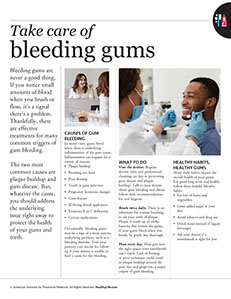
    Close up of eye.

    Retinal detachment means your retina is pulled away from its normal position at the back of your eye. If a retinal detachment happens, it is a medical emergency. It can cause permanent vision loss.

    See the signs

    Retinal detachment may cause symptoms that come on suddenly. You may see things like:

    *  A lot of gray or black “floaters” that look like squiggly lines or specks of dirt

    *  Flashes of bright light

    *  A dark area or shadow

    Will it happen to me?

    Retinal detachment can happen to anyone. But you are more likely to get it if:

    *  Someone in your family has had a retinal detachment

    *  You’ve had any kind of eye surgery

    *  You’ve had a serious eye injury

    *  You have diabetic retinopathy

    *  You have other eye diseases

    The best way to know your risk is to talk to your eye doctor. Most of the time, retinal detachment happens from aging or an eye injury.

    Can I prevent it?

    You can lower your risk by protecting your eyes. Wear safety goggles during sports or when using power tools.

    You should also get a dilated eye exam regularly. Always see your eye doctor after any eye injury.

    Good news

    Retinal detachment is treatable. An eye doctor or surgeon can often fix the retina and reattach it. The earlier it is found, the better the outcome. Don’t ignore the signs – save your vision!

    Source: National Eye Institute

    © American Institute for Preventive Medicine

  • What To Do When Your Heel Hurts

    SELF-CARE CORNER

    Image of heel walking on bare floor.

    Heel pain is the most common foot and ankle problem. Often, a sore heel is not serious. But if you ignore it and keep using the foot, it could get worse.

    When it comes to heel pain, the first clue is where the heel hurts. Pain at the bottom of the heel is different from pain behind the heel.

    Pain underneath the heel

    *  Plantar fasciitis. This happens when activity inflames the tissue band that runs along the bottom of the foot. Sometimes, people get plantar fasciitis from wearing shoes that don’t properly support their foot. It’s often worse when you first get up in the morning. It can usually be resolved with rest, wearing special inserts in the shoes and/or physical therapy.

    *  Heel spur. A heel spur is a buildup of calcium that causes a bony bump on the heel bone. It usually happens if a person has plantar fasciitis for a long time. Treatment is usually similar to plantar fasciitis treatment.

    *  Stone bruise. Stepping on a hard object like a stone can injure the bottom of the heel. If you stepped on something recently, try to rest and protect the foot for a few days until it feels better. Wear shoes when you go outside to prevent this from happening in the future.

    Pain behind the heel

    Pain in the back of the heel is usually due to a problem with the Achilles tendon. This tendon connects the heel bone to the calf muscle. Heavy activity or exercise can put too much stress on the tendon too quickly. This can cause Achilles tendinitis, which includes small tears and inflammation in the tendon. Treatment may include:

    *  Physical therapy

    *  Rest

    *  Ice

    *  Orthotic(s) (shoe inserts)

    *  Night splint (device worn at night to protect the foot and tendon)

    People who have Achilles tendinitis may need to avoid the activity that caused it, such as running or jumping.

    Respect your feet

    Many people ignore heel pain, hoping it will go away. But, untreated problems with the foot may only get worse over time without treatment. If your heel pain lasts more than a couple of days, or if you have a health condition like diabetes, see a doctor right away.

    Source: American Academy of Orthopaedic Surgeons, American College of Foot and Ankle Surgeons

    © American Institute for Preventive Medicine

  • Crossfit Faq

    BE FIT

    Man in gym working out.

    CrossFit is a high-intensity strength and conditioning workout. It emphasizes dynamic exercises such as Olympic lifting, plyometrics, and kettlebells.

    Who can do CrossFit?

    CrossFit can be modified for a variety of ages and fitness levels. There are even CrossFit classes for kids and seniors.

    Is CrossFit safe?

    Because CrossFit is a high-intensity form of exercise, it may not be the best choice for everyone. Check with your doctor to make sure CrossFit is right for you.

    What are the benefits of CrossFit?

    Regular CrossFit workouts can build strength and improve cardiovascular endurance. It counts towards your recommended 150 minutes of moderate to vigorous-intensity exercise.

    Are there risks to CrossFit?

    Any form of high-intensity exercise carries the potential for injury. To reduce your risk, get clearance from your doctor first and remember to increase gradually.

    © American Institute for Preventive Medicine

  • How Much Exercise Kids Need

    BE FIT

    Father and young daughter about to exercise.

    Being inactive isn’t good for children’s health. Kids can have health problems related to being inactive, such as:

    *  Sleep problems

    *  Type 2 diabetes

    *  Excess weight

    *  High blood cholesterol

    How much exercise is enough?

    Preschool children should be active throughout the day. School aged children should get at least one hour of moderate to intense activity every day. Some exercise is better than none. If your child isn’t active now, start with a few minutes of exercise each day. Gradually increase the time and intensity of their exercise as they get more fit.

    What is ‘moderate to intense activity’ for children?

    When your child is doing moderate to intense activity, their heartbeat will speed up. They will breathe much harder than normal.

    This type of activity can be walking or biking at a brisk pace. It can also be more intense, like jumping on a trampoline or swimming. Whatever your child likes to do, encourage them to do it every day!

    Know the types of exercise

    Exercise doesn’t have to be the same thing all the time. Try to encourage your child to do all three types throughout each week:

    Aerobic exercise

    Anything that speeds up your child’s heart rate. It can include:

    *  Brisk walking

    *  Bike riding

    *  Swimming

    *  Running

    *  Dancing

    *  Playing games that require running and throwing

    Muscle-strengthening exercise

    These exercises build up muscles, which is important for lifelong fitness. Examples include:

    *  Climbing

    *  Push-ups

    *  Lunges

    *  Yoga

    *  Resistance bands

    *  Hand-held weights

    Bone-strengthening

    This puts pressure on bones. Pressure from exercise helps the bones rebuild and stay strong. Exercises include:

    *  Jumping

    *  Running

    *  Skipping

    *  Sports that require running and stopping, like basketball or soccer

    Source: Centers for Disease Control and Prevention

    © American Institute for Preventive Medicine