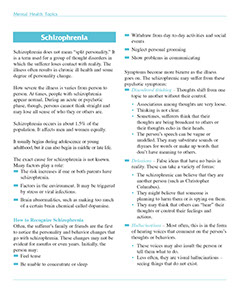
Schizophrenia does not mean “split personality.” It is a term used for a group of thought disorders in which the sufferer loses contact with reality. The illness often results in chronic ill health and some degree of personality change.
Causes
How severe the illness is varies from person to person. At times, people with schizophrenia appear normal. During an acute or psychotic phase, though, persons cannot think straight and may lose all sense of who they or others are.
Schizophrenia occurs in about 1.5% of the population. It affects men and women equally.
It usually begins during adolescence or young adulthood, but it can also begin in middle or late life.
The exact cause for schizophrenia is not known. Many factors play a role:
* The risk increases if one or both parents have schizophrenia.
* Factors in the environment. It may be triggered by stress or viral infections.
* Brain abnormalities, such as making too much of a certain brain chemical called dopamine.
Recognize Schizophrenia
Types of Schizophrenia
* Paranoid schizophrenia – The main symptom is a constant suspicion with the fear that someone is plotting to harm or destroy them.
* Disorganized schizophrenia – The main symptoms are incoherence, loose thought associations, or grossly disorganized behavior.
* Catatonic schizophrenia – The main symptom is marked psychomotor problems, such as stupor, rigidity, negativism, posturing, excitement.
How to Recognize Schizophrenia
Often, the sufferer’s family or friends are the first to notice the personality and behavior changes that go with schizophrenia. These changes may not be evident for months or even years. Initially, the person may:
* Feel tense
* Be unable to concentrate or sleep
* Withdraw from day-to-day activities and social events
* Neglect personal grooming
* Show problems in communicating
Symptoms become more bizarre as the illness goes on. The schizophrenic may suffer from these psychotic symptoms:
Disordered thinking
Thoughts shift from one topic to another without their control.
* Associations among thoughts are very loose.
* Thinking is not clear.
* Sometimes, sufferers think that their thoughts are being broadcast to others or their thoughts echo in their heads.
* The person’s speech can be vague or muddled. They may substitute sounds or rhymes for words or make up words that don’t have meaning to others.
Delusions
False ideas that have no basis in reality. These can take a variety of forms:
* The schizophrenic can believe that they are another person (such as Christopher Columbus).
* They might believe that someone is planning to harm them or is spying on them.
* They may think that others can “hear” their thoughts or control their feelings and actions.
Hallucinations
Most often, this is in the form of hearing voices that comment on the person’s thoughts or behaviors.
* These voices may also insult the person or tell them what to do.
* Less often, they are visual hallucinations – seeing things that do not exist.
Catatonic state
Tendency to stay in a fixed physical position or extreme agitation. This state may include:
* Stupor (decrease in reaction to the environment)
* Rigid or bizarre posture
Treatment
Schizophrenia cannot be cured. It can, though, be controlled. Treatment for it depends on its type and severity. Severe cases need treatment in a hospital. This usually includes medication, therapy, and rehabilitation. Medications most often used are anti-psychotics or major tranquilizers, also called neuroleptics. These help to alter abnormal brain chemistry. They reduce or get rid of the chance of relapse for many people when taken regularly. They also help the person better utilize therapy.
These medications can have many side effects so they should only be given under the care and monitoring of a physician, most often a psychiatrist. Therapy can help the sufferer and their family and friends cope with the emotional aspects of the disorder. Its goal is to also help the person learn how to deal with stress and prevent future stresses from leading to further illness. This is very important because schizophrenic attacks come and go in cycles of relapse and remission.
The combination of medication and therapy should be tailored to the person’s needs. While some 10% of schizophrenics remain severely impaired for life, many persons function well within the community with proper treatment.
Medical care, not self-help, is needed to treat schizophrenia.
What You Can Do to Help Someone
* If you suspect someone you know has signs of schizophrenia, get them to see a physician for proper diagnosis and treatment. This may not be easy. They may not realize or want to admit that they need help. They may also be afraid of being “put away.”
* Contact a physician or mental health professional or agency for assistance in how to get help for them if they refuse it.
* Do not leave a person alone who seems to be extremely disturbed.
* Take part in family therapy sessions, if necessary, to learn what you can do to help both you and the sufferer cope with the illness.
* See that your family member or friend takes their medication as ordered. If side effects occur, let their doctor know.
Note: There are many different medications for schizophrenia. It may take trials on different ones to find the medicine or combination of medicines that works best for a person.