Category: Uncategorized

  • Why Memories Change

    MEDICAL NEWS

    Image of older man looking out a window thinking.

    Memory is like the old telephone game, according to researchers at Northwestern University School of Medicine. You remember when kids took turns whispering a message into the ear of the next person in line? By the time the last person spoke it out loud, the message had radically changed. It’s been altered with each retelling.

    Every time you remember an event from the past, your brain networks change in ways that can alter the later recall of the event. Thus, the next time you remember it, you might recall not the original event but what you remembered the previous time. The Northwestern study is the first to show this.

    “A memory is not simply an image produced by time traveling back to the original event-it can be an image that is somewhat distorted because of the prior times you remembered it,” said Donna Bridge, lead author of the study published in the Journal of Neuroscience. “Your memory of an event can grow less precise even to the point of being totally false with each retrieval.”

    The reason for the distortion, Bridge said, is the fact that human memories are always adapting. Take note, lawyers and eyewitnesses.

    © American Institute for Preventive Medicine

  • Avoid Bed Bugs

    WELL-BEING

    Image of a bed.

    Upon entering a hotel room, place your luggage in the bathtub or on the toilet seat. Bed bugs can’t crawl up these surfaces and attach to your bags. While in the room, keep luggage on the luggage rack, off the floor. Hard-sided luggage lacks the folds and creases of soft-sided bags making it more difficult for the pests to hide in your bags.

    Since bed bugs are large enough to see, check the mattress and bed frame for any signs that the pests have been hiding there. Do you notice any tiny black spots? Spots and stains are good indicators of either a current or prior presence. Pull back sheets, inspect mattress seams and examine any other upholstered items in the room.

    Bed bugs are drawn to wood-don’t neglect the nightstand and dresser. If it appears as though the critters have invited themselves into your hotel room, ask the management for another room.

    Before packing the car for the trip home, place luggage in large plastic bags and knot securely. Once home, immediately wash all clothing on the hottest temperature setting suggested by the care labels. Dry on high heat for at least  30 minutes. Avoid packing items that can only be laundered on a cold-water setting, suggest The Maids, a residential cleaning service.

    © American Institute for Preventive Medicine

  • How To Make Those New Year’s Resolutions Stick

    WELL-BEING

    Image of top resolutions written on small paper notes.

    Tap into your company’s wellness program to help you make and achieve your New Year’s goals, suggests Alere Health.

    Identify your core values.

    Make a list of your core values-such as vitality, health, honesty, compassion, security-to get a sense of what is really important to you.

    Set your priorities.

    Target 3 or 4 of those values to focus on. Base your decision on values that you know would make you happier and improve your quality of life. Then look at what you are doing or not doing that is keeping that value from manifesting in your life.

    Establish specific, measurable goals.

    After you determine the changes you want to make, set specific, measurable goals to track your progress. One of the reasons that many people fail with resolutions is that their goals are too vague. Track your daily progress.

    Be realistic.

    The best health and wellness programs teach you to gradually reduce your unhealthy habits so that you can learn behaviors that will last. Go for ridiculously easy ones, and you’ll achieve your goal every time.

    Be creative.

    Who says resolutions have to be about weight loss or exercise? Getting plenty of sleep can also promote better health and vitality. Or walk around the office if you sit all day. Pledge to stand up once an hour or when you take a phone call.

    Chill out more.

    Stress is the enemy to feeling better and being more productive. Stress management programs can provide the tips and support to manage those life situations that may anger, sadden or worry you and help to keep you on goal.

    Do something for someone else.

    Many stress management programs offered by employers encourage employees to manage stress and improve happiness by doing something for others. Employers are recognizing that employees that are active and engaged in helping others in their community are often more productive and healthier than those who do not. If your company supports a special cause, or if you have one important to you, make the effort to spend a few hours a month volunteering or helping in some way.

    © American Institute for Preventive Medicine

  • Prevent Clothes Dryer Fires

    WELL-BEING

    Image of a man cleaning dryer duct.

    Built-up lint blocks air flow in your clothes dryer, which leads to high heat and a potential fire. Thousands of fires occur each year, according to the U.S. Fire Administration.

    Take these simple steps to keep your home safe:

    *  Clean the lint screen every time you use the dryer.

    *  If you use fabric softener, wash the screen in warm soapy water periodically to get rid of film build-up that restricts air flow.

    *  Make sure the lint screen has no tears (otherwise lint gets into the duct system and restricts air flow).

    *  Inspect the duct, dampers, and access covers for damage every 3 months. Clean all removable parts. Vacuum the duct to remove excess lint build-up.

    Don’t dry items that have been cleaned or soaked in gasoline, dry cleaning solvents, vegetable or cooking oil, machine oil, or other chemicals such as mop heads, which can be explosive when heated.

    © American Institute for Preventive Medicine

  • Stay Healthy When Swimming

    WELL-BEING

    Image of beach ball in swimming pool.

    Did you know you can get sick from swimming? Whether it’s a pool, hot tub, water park, fountain, lake, river or ocean, some water can have germs or chemicals in it that cause recreational water illness (RWI). And, the number of RWI outbreaks have increased steadily in the last 30 years.

    RWIs can ruin summer fun

    RWIs most often cause diarrhea, but they can make you sick in other ways too. They can also cause nausea and vomiting, skin rashes, and infections of the eyes, ears, skin and respiratory system.

    Most healthy people will recover from RWIs, but they can be dangerous to pregnant women, young children, and people with weakened immune systems.

    Healthy swimming guidelines

    Many times, the water may look clean and safe when it contains dangerous germs or unsafe chemicals. Though proper chlorine levels are important, some germs are not killed by chlorine. Some water may be treated with too much chlorine or an improper balance that can make people sick. So what can you do to enjoy the water this summer and stay healthy?

    *  Don’t swim when you have diarrhea or you’ve been vomiting. Even a tiny, invisible amount of germs can get in the water and make others sick.

    *  Never get swimming water in your mouth. Keep your mouth closed when underwater.

    *  Shower with soap before you swim and wash your hands after using the toilet or changing diapers. Have your children wash their hands as well.

    *  Don’t allow kids to play in fountains that haven’t been treated with chlorine.

    *  Stop swimming at least once every hour for bathroom breaks and/or diaper changes. Use swim diapers on kids who aren’t potty trained. Many kids will have “accidents” in the water if they don’t get out to use the bathroom.

    *  Don’t change diapers near the swimming area. Do it in a bathroom or away from the water.

    *  If you own a pool, check chlorine levels regularly. Use pool test strips to check for proper pH levels and chemical balances.

    *  Ask to see the last pool inspection report before swimming in a public pool or water park.

    The germ that survives chlorine

    Cryptosporidium, commonly called crypto, is a bacteria that can be spread in swimming water. Chlorine won’t kill crypto, and people with weakened immune systems can get very sick from it. It can cause severe watery diarrhea and is a leading cause of RWIs. To avoid getting or spreading crypto, follow the healthy swimming guidelines on this page. It is not killed by hand sanitizer, so washing hands with soap and water is critical.

    © American Institute for Preventive Medicine

  • Turn Awareness Into Action

    WELL-BEING

    Image of 2 women holding a sign with the word "Prevent" written.

    Breast cancer screening guidelines vary with different health groups. The U.S. Preventive Service Task Force advises women ages  50-74 to get a mammogram every 2 years.

    Women ages 40-49 and 74+ should discuss their breast cancer risk and the pros and cons of breast cancer screening with their doctors or health care providers. Women at a high risk for breast cancer should seek expert medical advice about breast cancer screening and prevention.

    Many women can survive breast cancer if it’s found and treated early.

    Your doctor can help you decide if you should take medication to help prevent breast cancer and if you should seek genetic counseling.

    Even though you cannot control breast cancer risk factors such as aging and inheriting certain breast cancer gene mutations, you can take action to help prevent breast cancer.

    *  If you have babies, breast-feed them.

    *  Talk to your doctor about the risks and benefits of taking hormone therapy using estrogen and progestin for menopausal symptoms. Taking both estrogen and progestin for more than five years increases breast cancer risk.

    *  Lose weight if you are overweight, especially if you have reached menopause.

    *  Limit alcohol. The more alcohol you drink, the greater the risk.

    *  Be physically active. Strenuous exercise for more than four hours a week may help lower breast cancer risk.

    © American Institute for Preventive Medicine

  • 3 “S”S For Taking Supplements

    WELL-BEING

    Close up image of hand with supplements.

    Many people use vitamins, herbs, and other supplements. But sometimes, supplements aren’t safe or helpful. Follow these 3 S’s before you take vitamins, herbs, or natural remedies.

    1.Say something to your doctor.Supplements can interact with medications. Some are not safe if you have health conditions. Your doctor can tell you whether certain supplements are safe for you.

    2.Skip them if pregnant or breastfeeding.Some supplements are not safe for women who are pregnant or breastfeeding. Always ask your obstetrician or gynecologist before taking supplements.

    3.Stop taking them before surgery.Some supplements can cause problems if you take them before surgery. They may make bleeding worse or change how you respond to medicines. You may need to stop them two weeks or more before your surgery.

    © American Institute for Preventive Medicine

  • Caregiver’s Guide

    Mature Health: Over Age 50

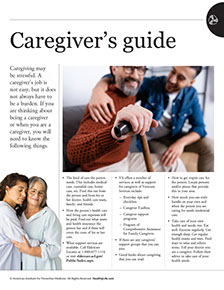
    Caregiving may be stressful. A caregiver’s job is not easy, but it does not always have to be a burden. If you are thinking about being a caregiver or when you are a caregiver, you will need to know the following things:

    *  The kind of care the person needs. This includes medical care, custodial care, home care, etc. Find this out from the person and from his or her doctor, health care team, family, and friends.

    *  How the person’s health care and living care expenses will be paid. Find out what assets and health insurance the person has and if these will cover the costs of his or her care.

    *  What support services are available. Call Eldercare Locator at 1-800-677-1116 or accesswww.eldercare.gov.

    *  If there are any caregivers’ support groups that you can join

    *  Good books about caregiving that you can read. Contact the National Institute on Aging for a list. Accesswww.nih.gov/niaor call 1-301-496-1752.

    *  How to get respite care for the person. Locate persons and/or places that provide this in your area.

    *  How much you can truly handle on your own and when the person you are caring for needs residential care.

    *  That it is necessary that you take care of your own health and needs, too. Eat well. Exercise regularly. Get enough sleep. Get regular health exams and tests. Tell your doctor you are a caregiver. Follow his or her advice to take care of your health needs.

    *  VA offers a number of services, as well as support for caregivers of Veterans. Services include:

    – Everyday tips and checklists

    – Caregiver Toolbox

    – How to find out about Adult Day Health Care (ADHC) Centers near you

    – Homemaker and Home Health Aide Program and Respite Care

    Resources

    The Alzheimer’s Association

    1-800-272-3900

    www.alz.org

    VA Caregiver Support

    1-855-260-3274

    www.caregiver.va.gov

    Health at Home Lifetime book by the American Institute for Preventive Medicine. www.HealthyLife.com. All rights reserved.

    © American Institute for Preventive Medicine