Category: Uncategorized

  • Vaccinations For Adults

    SELF-CARE CORNER

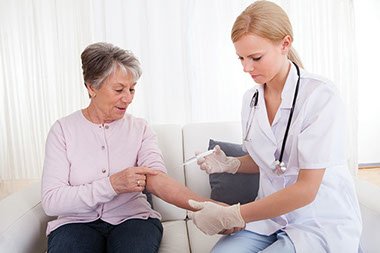
    Image of nurse giving a patient a shot.

    Do you think shots are only for kids? Actually, there are several important vaccines you need as an adult.

    Vaccinations protect yourself from disease, but also protect people around you. Young babies who aren’t yet vaccinated or people with weak immune systems can benefit from your vaccination. You will be less likely to spread an illness, such as whooping cough, to someone who is more likely to get sick.

    Don’t wait until it’s too late. Ask your doctor about which vaccines you may need at your next well visit.

    Adults may get shots for a variety of reasons:

    *  You need to be vaccinated for something that affects adults, such as the flu.

    *  You need boosters of vaccines you got as a child. This is because many vaccines start to lose their protection over time.

    *  You didn’t receive the complete set of vaccines in your youth and want to be protected now.

    The CDC says that all adults should get:

    *Influenza vaccine.This helps prevent influenza, or the flu. You get this every year.

    *Td vaccine.This protects you from tetanus and you should get one every 10 years.

    *Tdap vaccine instead of Td vaccine (one time only).This protects against tetanus and diphtheria plus whooping cough (pertussis). Pregnant women should get the Tdap vaccine during each pregnancy.

    *Pneumonia vaccine.This helps prevent certain bacteria that can cause pneumonia. Ask your doctor when you should get this vaccine.

    *Shingles vaccine.This can prevent shingles, a painful rash that can develop from a previous chickenpox infection.

    Other shots may also be recommended for you. Not every adult needs the same vaccines. Some will depend on your past vaccines, your age, lifestyle and health. Talk with your doctor about whether you need other shots.

    © American Institute for Preventive Medicine
  • Abs: The Core Of A Healthy Body

    BE FIT

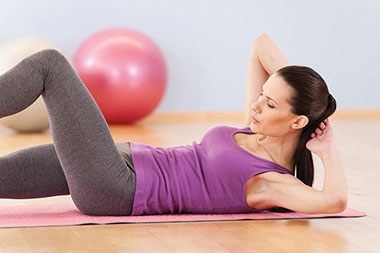
    Image of women doing abdominal exercises.

    Strong abdominal muscles can do more than just make you look slimmer. Healthy ab muscles can help you improve posture and alleviate back pain. For those who thought ab exercises were only for achieving a “six pack,” it’s time to discover all the benefits of a strong midsection.

    Your abdominal muscles are part of the body’s core muscles, which support your entire body when you sit, stand and move. For those who don’t like sit-ups or can’t get on the floor, there are other options to strengthen and tone these important muscles. In fact, “vertical” core exercises may be even more effective than sit-ups.

    Try this standing core exercise that’s suitable for beginners:

    *  Stand facing a wall. Place your feet shoulder-width apart and push your hands against the wall.

    *  Bend your knee and bring your leg toward the wall. Keep the other foot flat on the floor at all times.

    *  Step your leg across the other one in front. Then, step the same leg out to the side.

    *  Bend the knee again and open your leg to the outside, using your hip. Then, swing the leg to the inside.

    Repeat these exercises with the other leg. Concentrate on keeping your abs tight each time you lift and move your leg. Try to repeat them several times, and increase the number of reps as you get stronger.

    Source: American College of Sports Medicine

    © American Institute for Preventive Medicine

  • Don’t Just Sit There

    BE FIT

    Image of man running.

    When you’re upright and active, even briefly, your body is at work. “You’re engaging a wide range of systems in your body when you move throughout your day,” says Dr. Charles E. Matthews, who studies physical activity and cancer risk at NIH. “Your muscles are contracting, you’re maintaining your balance, and you’re resisting the force of gravity.”

    When you’re sitting, he says, “Muscle contractions go way down, and your body’s resistance to gravity decreases.” When you sit for long periods, your body adapts to the reduced physical demand and slows down its metabolism. When metabolism slows, you burn fewer calories and boost the chance that extra energy will be stored as fat.

    The best way to raise your metabolism is simply by  moving. The more you move, the better.

    A new study led by NIH’s Dr. Steven Moore looked at data on more than 650,000 adults, mostly age 40 and older. The researchers found that leisure-time physical activity was linked to a longer life expectancy, regardless of how much people weighed.

    “We found that even a low level of physical activity-equivalent to about 10 minutes a day of walking-was associated with a gain of almost 2 years in life expectancy. High levels of activity-equivalent to about 45 minutes a day of walking-were associated with a gain of 4 years or more,” says Dr. Moore.

    Look for opportunities to be active throughout your day. Get moving as much as you can.

    © American Institute for Preventive Medicine
  • Get Fit While Cleaning House

    BE FIT

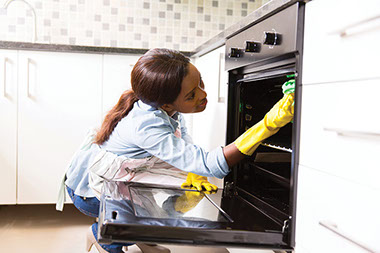
    Image of women cleaning the oven.

    If you have a home, you probably spend a good amount of time cleaning it. What if you spent that time not only cleaning your house, but cleaning up your health too?

    If you do your chores with a few fitness upgrades, you could burn extra calories and feel great when you’re done. Here’s how you can do it:

    1. Turn on the tunes.

    Use upbeat music to get motivated and set it for 30 minutes of play time. Or, set an oven timer for 30 minutes. Then, dance and move around the house as you organize, sweep, wash dishes or put laundry away. Keep your body moving as much as possible but make it fun!

    2. Focus on a muscle group while working.

    If you’re vacuuming or mopping floors, you’re already burning some calories. But, take it up a notch by working your muscles even harder during the task. For instance, hold your abdominal core (belly) muscles tight as you do your task. Try holding them for 10 seconds. Then, take a 10-second break. If this becomes too easy, increase the time to 20 seconds.

    3. Do squats as you pick up.

    If you’re spending time getting toys, clothes or other items off the floor, use this chore to work your lower body. After you pick up something, do a squat. Keeping your back straight and belly tight, slowly bend your knees and lower your bottom slightly toward the floor. Don’t let your knees reach over your toes. Come back up slowly. If this hurts your knees or back, you should stop.

    Remember, exercise doesn’t have to be a workout at the gym. You can move your body while doing everyday jobs and multitask for your health!

    Sources: Calorie Control Council, Compendium of Physical Activities

    © American Institute for Preventive Medicine

  • What’s Your Excuse?

    BE FIT

    Image of gym shoes with the words "No Excuses".

    So you want to be physically active, but something is holding you back. Figure out what’s standing in your way, and then clear a path because you can make regular physical activity part of your life, says the government’s Weight-control Information Network (WIN).

    Excuse #1: I’m too busy to exercise because I have work, family, and other demands.

    *  Make physical activity a priority. Carve out some time each week to be active and put it on your calendar. Try waking up a half-hour earlier to walk, schedule lunchtime workouts, or take an evening fitness class.

    *  Build physical activity into your routine chores. Rake the yard, wash the car, or do energetic housework. That way you do what you need to do around the house and move around too.

    *  Make family time physically active. Plan a weekend hike through a park, a family softball game, or an evening walk around the block.

    Excuse #2: I’m too tired to work out at the end of a long day.

    *  Think about the other health benefits of physical activity. Regular physical activity may help lower cholesterol and blood pressure. It may also lower your risk of having heart disease, type 2 diabetes, or cancer. Research shows that people who are overweight, active, and fit live longer than people who are not overweight but are inactive and unfit. Also, physical activity may lift your mood and increase your energy level.

    *  Do it just for fun. Play a team sport, work in a garden, or learn a new dance. Make getting fit something fun and that you look forward to.

    *  Train for a charity event. Work to help others while you work out.

    Excuse #3: Getting on a treadmill or stationary bike is boring.

    *  Meet a friend for workouts. If your buddy is on the next bike or treadmill, your workout will be less boring.

    *  Watch TV or listen to music or an audio book while you walk or pedal indoors. Check out music or audio books from your local library or download to your phone or iPod.

    *  Get outside. A change in scenery can relieve your boredom.

    © American Institute for Preventive Medicine
  • Staying Active When School’s Out

    BE FIT

    Image of little girl playing tennis.

    When summer arrives, kids often want to spend time in front of the TV or on their computer and digital devices. But, exercise is important year-round. In fact, most kids need at least an hour of vigorous exercise each day. How can you get your kids to exercise during the summer?

    *  Get them together with friends. Older kids may enjoy a bike ride or walking the dog if they have a buddy alongside them. When friends come over, make all screens off-limits.

    *  Find summer camps. If your child likes a sport, many programs offer camps that give them social time as well as exercise. Also, there may be programs for dance, gymnastics, swimming and other activities.

    *  Talk to your sitter about rules. If you have a babysitter during the summer, make your screen-time limits clear. Have the babysitter take them outside or to the local park, if possible. Choose a sitter who is willing to play with them outside and encourage them to be active.

    Source: U.S. National Library of Medicine

    Why kids need exercise

    Kids of all sizes, shapes and ages need exercise every day. Exercise helps kids:

    *  Learn and grow in school

    *  Build healthy bones, muscles and joints

    *  Get better sleep, which is important for their overall health and mental well-being

    *  Develop a healthy habit that is important throughout life

    *  Feel more confident and happier

    *  Deal with stress

    If your child isn’t active, it’s never too late to start. Find an activity they like and help them get moving.

    © American Institute for Preventive Medicine

  • Arm Yourself With A Vegetable Scrubber

    HEALTHY EATING

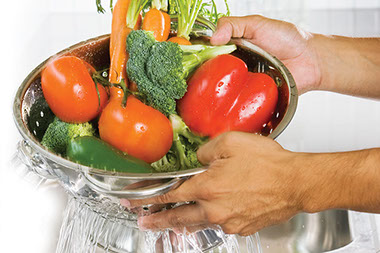
    Image of vegetables being washed in a scrubber.

    A University of Nebraska-Lincoln food safety specialist said it is important to properly wash fresh produce before eating to reduce harmful microorganisms that could cause foodborne illness.

    Wash produce with running water and then let that water go down the drain. Do not just soak the produce, said Julie Albrecht, UNL Extension food safety specialist at the Institute of Agriculture and Natural Resources.

    If there is something on the outside of a food, soaking it could allow the microorganisms to spread to other parts of the food or to other produce in the same sink. Running water washes the microorganisms down the drain.

    “It’s really just about preventing cross contamination,” Albrecht said. “Always use a colander or strainer so the water goes through the produce instead of just letting produce sit in water.”

    It is important to wash all fresh produce, even ones with rinds that are not eaten, Albrecht said. Bacteria could be living on the surface and then spread to the inside of the fruit when the rind is cut.

    Scrub foods with tough surfaces, such as melons and potatoes, with a vegetable scrubber.

    Immediately refrigerate fresh produce after cutting it. Most fruits and vegetables can be stored at 40ºF or below, which is cold enough to prevent microorganisms from growing.

    “Once you cut something or peel it, keep it cold, refrigerate it. Do not let it sit out at room temperature because microorganisms grow best around temperatures of 80 to 100. Plus, your food will be crisper and of a better quality,” Albrecht said.

    Leafy vegetables and tomatoes have been linked to foodborne illness outbreaks in recent years, so take extra care to wash them and keep them cold, Albrecht said.

    Be sure to also wash hands, surfaces, and utensils before handling raw produce.

    While shopping, only buy the best-looking produce that will stay fresh the longest. “Pick high-quality produce with no bumps or scratches at the peak of ripeness or maybe a little under ripe,” Albrecht said. “And make sure there is no mold, especially on berries.”

    © American Institute for Preventive Medicine
  • Do “Meal Replacement” Diets Work?

    HEALTHY EATING

    Image of a nutrition bar.

    It seems simple enough: to cut calories, sip a shake or eat a bar instead of a meal. There’s no risk of accidentally eating too much, and you don’t have to spend time preparing a meal or measuring portions.

    Also known as meal replacement diets, these programs have their pros and cons. A study published in The Journal of the Academy of Nutrition and Dietetics showed they can help people effectively lose weight. But, no single diet works for everyone. Before you try meal replacement, here’s what you should know:

    *  Talk with your doctor before you start any diet plan.

    *  Eat plenty of whole foods daily. Fruits, vegetables, whole grains, lean protein, low-fat dairy and healthy fats are recommended by the USDA. Bars and shakes cannot fully replace the nutrients you get from whole foods.

    *  Get the right amount of calories. There’s a healthy range of calories based on your age, weight and activity level. Learn yours by going to the USDA’s SuperTracker Tool atsupertracker.usda.gov.

    *  Drink plenty of water between meals to stay hydrated. This can improve your energy levels and may help you fight off hunger.

    If you follow the guidelines, you may find success with a meal replacement plan. Be sure to follow the plan as recommended and still eat nutritious foods at other meals. If you find you’re too hungry or it’s not working for you, talk with your doctor or a dietitian about another option.

    © American Institute for Preventive Medicine

  • Fiberize Your Kitchen

    HEALTHY EATING

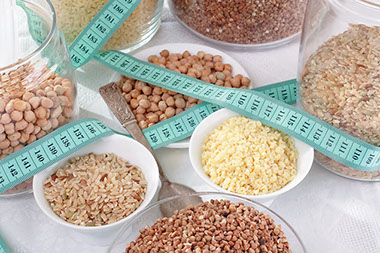
    Image of different grains in bowls and jars.

    To stock your kitchen with whole grains and fiber-containing foods from cupboard to refrigerator to freezer, use this handy list to get started, suggests Anita Kobuszewski, RD, author of Food: Field to Fork, How to Grow Sustainably, Shop Wisely, Cook Nutritiously, and Eat Deliciously. She reminded, “Remember-nutrition doesn’t begin until the food passes your lips.”

    *  Fresh and canned fruits and vegetables

    *  Dried fruits such as raisins and cranberries

    *  Preserves made with whole fruit

    *  Whole wheat, rye, cornmeal, soy, and buckwheat flours

    *  Whole-grain and fortified breads, crackers, bagels, and 100% whole wheat or whole-grain rolls

    *  Ready-to-eat fortified and whole-grain breakfast cereals

    *  Cooked cereals including quick-cooking whole-grains like oatmeal and quinoa

    *  Brown long-grain, brown short-grain, and wild rice

    *  Whole-grain spaghetti, macaroni, and other pastas

    *  Corn and whole wheat tortillas

    *  Air popped popcorn and lower fat microwave varieties

    *  Canned or dried garbanzo beans, pinto, black and lima beans; split peas, and black-eyed peas; refried beans, hummus

    *  Peanut butter

    *  Nuts (such as pecans, almonds, and walnuts) and seeds (such as flax seed, sesame, pumpkin, and sunflower seeds)

    *  Vegetable soups, chili with beans, minestrone

    *  Canned or frozen vegetarian dishes such as chili or cheese lasagna

    © American Institute for Preventive Medicine

  • Healthier Super Bowl Snacks

    HEALTHY EATING

    Image of football.
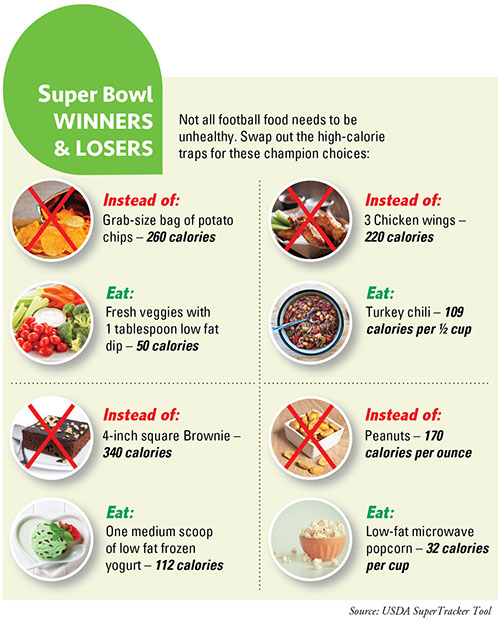
    Chart showing healthy options for super bowl snacks.

    On Super Bowl Sunday, people across the country will gather at homes, restaurants, and bars to watch the big game and enjoy game-day food. Sadly, traditional football fare tends to be high in fat and calories and low in nutrition. The Calorie Control Council says many Super Bowl fans will consume 2,000 calories or more during the game. That’s about a full day’s worth of calories in just a few hours.

    So how can you enjoy the game without the unhealthy side effects? Here are a few tips to help:

    *  Keep a zero-calorie drink like water in your hand, and sip on it throughout the day instead of snacking on food.

    *  Keep your distance from the kitchen or wherever the food is sitting out. If it’s out of sight, you’ll be less likely to mindlessly reach for snacks when you’re not hungry.

    *  If fresh fruit and veggies are available, fill your plate with those. This leaves little room for other choices.

    Be mindful of how much you’re eating, and stick to only a small serving of the high-calorie foods. If you’re cooking, take the opportunity to prepare a variety of healthy but fun choices for your guests.

    © American Institute for Preventive Medicine