Category: Personal Safety

  • Keep A Survival Kit In Your Car

    Personal Safety

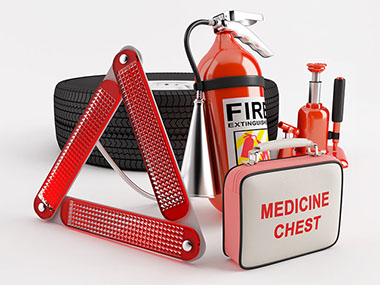
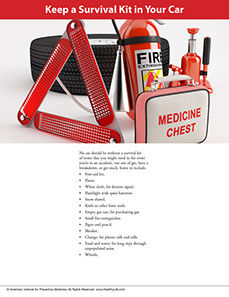
    Image of a car kit.

    No car should be without a survival kit of items that you might need in the event you’re in an accident, run out of gas, have a breakdown, or get stuck. Items to include:

    *  First-aid kit.

    *  Flares.

    *  White cloth, for distress signal.

    *  Flashlight with spare batteries.

    *  Snow shovel.

    *  Knife or other basic tools.

    *  Empty gas can, for purchasing gas.

    *  Small fire extinguisher.

    *  Paper and pencil.

    *  Blanket.

    *  Change, for phone calls and tolls.

    *  Food and water, for long trips through unpopulated areas. Whistle.

    A Year of Health Hints book by the American Institute for Preventive Medicine. www.HealthyLife.com. All rights reserved.

    © American Institute for Preventive Medicine

  • The Keys To Physical Well-Being Are Healthy Habits

    Personal Safety

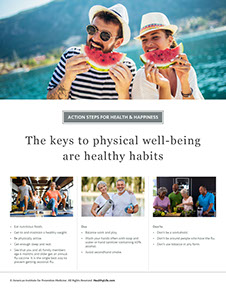
    Couple eating watermelon.

    *  Eat nutritious foods.

    *  Get to and maintain a healthy weight.

    *  Be physically active.

    *  Get enough sleep and rest.

    *  See that you and all family members age 6 months and older get an annual flu vaccine. It is the single best way to prevent getting seasonal flu.

    Dos

    *  Balance work and play.

    *  Wash your hands often with soap and water or hand sanitizer containing 60% alcohol.

    *  Avoid secondhand smoke.

    Don’ts

    *  Don’t be a workaholic.

    *  Don’t be around people who have the flu.

    *  Don’t use tobacco in any form.

    A Year of Health Hints book by the American Institute for Preventive Medicine. www.HealthyLife.com. All rights reserved.

    © American Institute for Preventive Medicine

  • Wellness Gifts 2

    Personal Safety

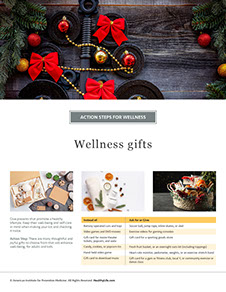
    Fitness tools shaped into a Christmas tree.

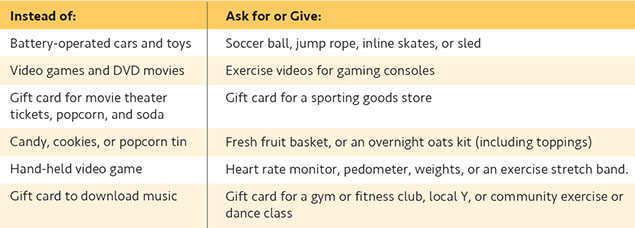
    Give presents that promote a healthy lifestyle. Keep their well-being and self-care in mind when making your list and checking it twice.

    Action Step:There are many thoughtful and joyful gifts to choose from that will enhance well-being, for adults and kids.

    A Year of Health Hints book by the American Institute for Preventive Medicine. www.HealthyLife.com. All rights reserved.

    © American Institute for Preventive Medicine

  • 10 Action Steps For Safe & Healthy Holidays

    Personal Safety

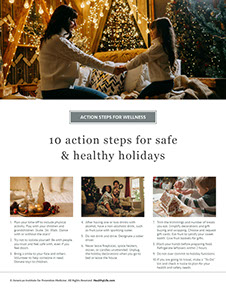
    Mother and daughter holding hands with lights hund all around.

    1.  Plan your time off to include physical activity. Play with your children and grandchildren. Skate. Ski. Walk. Dance with or without the stars!

    2.  Try not to isolate yourself. Be with people you trust and feel safe with, even if you feel down.

    3.  Bring a smile to your face and others. Volunteer to help someone in need. Donate toys to children.

    4.  After having one or two drinks with alcohol, have a non-alcoholic drink, such as fruit juice with sparkling water.

    5.  Do not drink and drive. Designate a sober driver.

    6.  Never leave fireplaces, space heaters, stoves, or candles unattended. Unplug the holiday decorations when you go to bed or leave the house.

    7.  Trim the trimmings and number of treats you eat. Simplify decorations and gift buying and wrapping. Choose and request gift cards. Eat fruit to satisfy your sweet tooth. Give fruit baskets for gifts.

    8.  Wash your hands before preparing food. Refrigerate leftovers within 2 hours.

    9.  Do not over commit to holiday functions.

    10. If you are going to travel, make a “To-Do” list and check it twice to plan for your health and safety needs.

    A Year of Health Hints book by the American Institute for Preventive Medicine. www.HealthyLife.com. All rights reserved.

    © American Institute for Preventive Medicine

  • 5 Wellness Factors

    Personal Safety

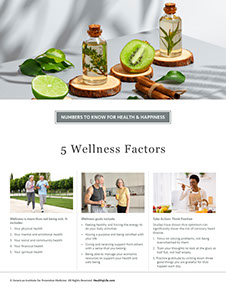
    Slices of lime and kiwi, with bottles of oil and herbs.

    Wellness is more than not being sick. It includes:

    1.  Your physical health

    2.  Your mental and emotional health

    3.  Your social and community health

    4.  Your financial health

    5.  Your spiritual health

    Wellness goals include:

    *  Feeling healthy and having the energy to do your daily activities

    *  Having a purpose and being satisfied with your life

    *  Giving and receiving support from others with a sense that you belong

    *  Being able to manage your economic resources to support your health and well-being

    Take Action: Think Positive

    Studies have shown that optimism can significantly lower the risk of coronary heart disease.

    1.  Focus on solving problems, not being overwhelmed by them.

    2.  Train your thoughts to look at the glass as half full, not half empty.

    3.  Practice gratitude by writing down three good things you are grateful for that happen each day.

    A Year of Health Hints book by the American Institute for Preventive Medicine. www.HealthyLife.com. All rights reserved.

    © American Institute for Preventive Medicine

  • Six Things You Should Never Do In Your Car

    Personal Safety

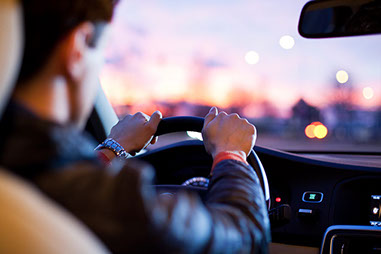
    Image of man driving.

    Driving takes total concentration. If you try to text message, talk on a cell phone, and do other things while driving, you risk having an accident.

    *  Adjust your child’s safety belt before, not after, you start driving.

    *  Don’t peer into the rearview mirror to comb your hair or touch up your makeup.

    *  Don’t drive with one hand holding the wheel and the other holding a hamburger. If you’re hungry, stop and eat.

    *  If a bee or flying insect distracts you or your passengers, pull off the road and get rid of it. Don’t swat at the bug while maneuvering through traffic.

    *  Don’t try to drive and read a road map at the same time. If you’re lost or need to get your bearings, pull off the road and look at a map, or have a passenger help you follow directions. Use a global positioning system (GPS), if you have one.

    *  If your children start to misbehave, don’t turn around to discipline them. Pull off the road and settle the problem, and teach your children how dangerous it is to misbehave in a car.

    Note: You should always wear a safety belt, use approved child safety seats, and heed the warning for air bags given by your car manufacturer. Doing so can make the difference between surviving a car crash intact or not surviving at all, between walking away with just a scratch or never walking again.

    A Year of Health Hints book by the American Institute for Preventive Medicine. www.HealthyLife.com. All rights reserved.

    © American Institute for Preventive Medicine

  • Accident-Free Boating

    Personal Safety

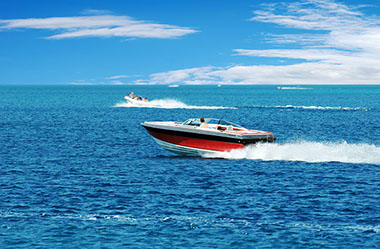
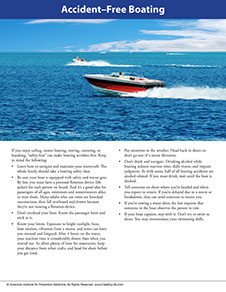
    Image of boat on the water.

    If you enjoy sailing, motor boating, rowing, canoeing, or kayaking, “safety first” can make boating accident-free. Keep in mind the following:

    *  Learn how to navigate and maintain your watercraft. The whole family should take a boating safety class.

    *  Be sure your boat is equipped with safety and rescue gear. By law, you must have a personal flotation device (life jacket) for each person on board. And it’s a good idea for passengers of all ages, swimmers and nonswimmers alike, to wear them. Many adults who can swim are knocked unconscious, then fall overboard and drown because they’re not wearing a flotation device.

    *  Don’t overload your boat. Know the passenger limit and stick to it.

    *  Know your limits. Exposure to bright sunlight, heat, boat motion, vibration from a motor, and noise can leave you stressed and fatigued. After 4 hours on the water, your reaction time is considerably slower than when you started out. So allow plenty of time for maneuvers, keep your distance from other crafts, and head for shore before you get tired.

    *  Pay attention to the weather. Head back to shore-or don’t go out-if a storm threatens.

    *  Don’t drink and navigate. Drinking alcohol while boating reduces reaction time, dulls vision, and impairs judgment. As with autos, half of all boating accidents are alcohol-related. If you must drink, wait until the boat is docked.

    *  Tell someone on shore where you’re headed and when you expect to return. If you’re delayed due to a storm or breakdown, they can send someone to rescue you.

    *  If you’re towing a water-skier, the law requires that someone in the boat observes the person in tow.

    *  If your boat capsizes, stay with it. Don’t try to swim to shore. You may overestimate your swimming skills.
    A Year of Health Hints book by the American Institute for Preventive Medicine. www.HealthyLife.com. All rights reserved.

    © American Institute for Preventive Medicine

  • After-Dark Joggers, Heed This Advice

    Personal Safety

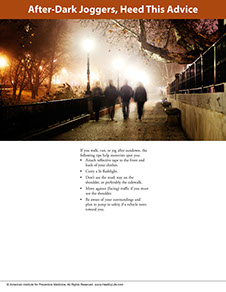
    Image of people walking/jogging in the dark.

    If you walk, run, or jog after sundown, the following tips help motorists spot you.

    *  Attach reflective tape to the front and back of your clothes.

    *  Carry a lit flashlight.

    *  Don’t use the road; stay on the shoulder, or preferably the sidewalk. Move against (facing) traffic if you must use the shoulder.

    *  Be aware of your surroundings and plan to jump to safety if a vehicle veers toward you.

    A Year of Health Hints book by the American Institute for Preventive Medicine. www.HealthyLife.com. All rights reserved.

    © American Institute for Preventive Medicine

  • Be Safe − Drive Safely Checklist

    Personal Safety

    *  Focus on the road when you are driving.

    *  Don’t talk on a cell phone or text message while driving.

    *  Always wear your seatbelt when you drive or ride in cars and trucks.

    *  Wear a helmet when riding on a motorcycle or a bicycle.

    *  Drive sober or with a driver who is.

    *  Discuss, with your care team, if any medication or supplement you take can make it unsafe for you to drive.

    *  Avoid driving at night if you have limited night vision.

    *  Keep emergency supplies in your car or truck. These include:

    – A cell phone

    – A flashlight and flares

    – Blankets

    – Bottled water

    Find out more about safe driving fromwww.safedriving.va.gov/resources/driving.asp

    Other Safety Tips

    *  Wear a medical alert tag to identify health concerns you have. Get one from a drug store or from: MedicAlert Foundation International at 1-888-633-4298 orwww.medicalert.org.

    *  Keep medicines and vitamins in “child-safe” containers and where children cannot reach them.

    *  Never be out of reach of a child in or near the water. Make sure children wear approved flotation devices. Adults should wear these, too.

    *  Lock guns in one place and bullets in another. Make sure children cannot get the keys.

    Resources

    VA National Center for Patient Safety

    www.patientsafety.gov

    National Safety Council

    www.nsc.org

    Health at Home Lifetime book by the American Institute for Preventive Medicine. www.HealthyLife.com. All rights reserved.

    © American Institute for Preventive Medicine

  • Reduce Environmental Risk Factors For Chronic Diseases

    Personal Safety

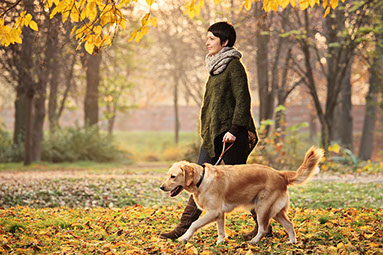
    Women walking dog.

    Chronic diseases include arthritis, asthma, cancer, diabetes, heart disease, emphysema, multiple sclerosis, Parkinson’s disease, and stroke. An unhealthy diet, inactivity and overweight, and tobacco use are common risk factors for many chronic diseases.

    *  Live a healthy lifestyle. Be active. Walk. Rake leaves.

    *  Limit exposure to air pollution to reduce the risk for problems with asthma, heart disease, stroke, emphysema and other respiratory diseases.

    *  Choose organic foods. Pick apples at an apple orchard. Enjoy the fruits of your labor.

    *  Reduce exposure to pesticides. Chronic, low-dose exposure to pesticides has been linked to Parkinson’s disease (PD), brain tumors, lymphomas, asthma, and birth defects. Pesticides are in lawn and garden sprays, insect repellants, flea collars, and non-organic foods. Find out about earth-friendly fertilizers from a fertilizer specialist at your local Extension Office. Ask your vet how to keep your pet from getting fleas without the use of pesticides.

    *  Use a digital or ear thermometer. Find out what to do about mercury spills, disposal, and cleanup fromepa.gov/mercury/spills/index.htm.

    A Year of Health Hints book by the American Institute for Preventive Medicine. www.HealthyLife.com. All rights reserved.

    © American Institute for Preventive Medicine