Category: Stress Management

  • 10 Action Steps To Tame Stress

    Stress Management

    Wooden tray with stacked rocks and a candle.

    1.  Take deep breaths. Hold it in for four seconds. Then blow the breath out. Repeat several times.

    2.  Accept the things you cannot change in yourself and others.

    3.  Meditate. Practice yoga or tai chi.

    4.  Exercise and move your body for fitness and to relax your mind.

    5.  Set realistic goals. Don’t bite off more than you can chew.

    6.  Try to eat at regular times during the day to keep blood sugar levels steady.

    7.  Request help from others when you need it. Delegate tasks.

    8.  Escape to a place (or picture a scene) where you feel calm, happy, and secure.

    9.  Set time aside for 100% relaxation, such as a vacation.

    10. Spend time with cheerful people. Laugh a lot. Keep a sense of humor. Try to stay positive and see the silver lining in a negative situation.

    Page from HealthyLife Weigh book by the American Institute for Preventive Medicine. www.HealthyLife.com. All rights reserved.

    © American Institute for Preventive Medicine

  • Prevent Burnout

    Stress Management

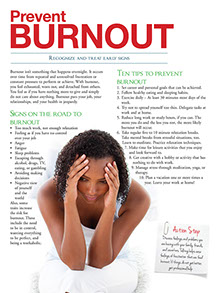
    Image of women with head in her hands.

    Recognize and treat early signs.

    Burnout isn’t something that happens overnight. It occurs over time from repeated and unresolved frustration or constant pressure to perform or achieve. With burnout, you feel exhausted, worn out, and detached from others. You feel as if you have nothing more to give and simply do not care about anything. Burnout puts your job, your relationships, and your health in jeopardy.

    Ten tips to prevent burnout:

    1.  Set career and personal goals that can be achieved.

    2.  Follow healthy eating and sleeping habits.

    3.  Exercise daily – At least 30 minutes most days of the week.

    4.  Try not to spread yourself too thin. Delegate tasks at work and at home.

    5.  Reduce long work or study hours, if you can. The more you do and the less you rest, the more likely burnout will occur.

    6.  Take regular five to 10 minute relaxation breaks. Take mental breaks from stressful situations, too. Learn to meditate. Practice relaxation techniques.

    7.  Make time for leisure activities that you enjoy and look forward to.

    8.  Get creative with a hobby or activity that has nothing to do with work.

    9.  Manage stress through meditation, yoga, or therapy.

    10. Plan a vacation one or more times a year. Leave your work at home!

    Signs on the road to burnout:

    *  Too much work, not enough relaxation

    *  Feeling as if you have no control over your job

    *  Anger

    *  Fatigue

    *  Sleep problems

    *  Escaping through alcohol, drugs, TV, eating, or gambling

    *  Avoiding making decisions

    *  Negative view of yourself and the world

    Also, some traits increase the risk for burnout. These include the need to be in control, wanting everything to be perfect, and being a workaholic.

    Action Step

    Discuss feelings and problems you are having with your family, friends, and coworkers. Talking helps ease feelings of frustration that can feed burnout. If things do not get better, get professional help.

    Page from Ways to Well-Being book by the American Institute for Preventive Medicine. www.HealthyLife.com. All rights reserved.

    © American Institute for Preventive Medicine

  • Reduce Outdoor Air Pollution To Breathe Cleaner Air

    Stress Management

    Looking up at a forrest of trees.

    *  Plant trees and other greenery to add oxygen and help lower carbon dioxide in the air. Replace some lawn with shrubs and trees that shade the house to save on cooling and heating costs.

    *  Create a garden and maintain it. Use manual tools for lawn and garden work, if possible. If not, use electric equipment. If you use gas powered equipment, avoid spilling gas at the gas station and when pouring it into the mower.

    *  Combine errands and reduce trips. Limit engine idling.

    *  Drive green to lower emissions of pollutants from your car. Obey the speed limit. Don’t accelerate hard and brake hard. Get regular tune-ups. Keep tires inflated. Open windows and use the vents to cool off before you turn on the air conditioner. When buying a new car, choose a low-polluting vehicle.

    *  Get air conditioners and heat pumps serviced by technicians who are EPA-certified to handle refrigerants. If you buy these items new, choose ones that use non-ozone-depleting refrigerants.

    Page from HealthyLife Weigh book by the American Institute for Preventive Medicine. www.HealthyLife.com. All rights reserved.

    © American Institute for Preventive Medicine