First Aid

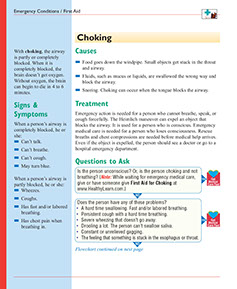
With choking, the airway is partly or completely blocked. When it is completely blocked, the brain doesn’t get oxygen. Without oxygen, the brain can begin to die in 4 to 6 minutes.
Signs & Symptoms
When a person’s airway is completely blocked, he or she:
* Can’t talk.
* Can’t breathe.
* Can’t cough.
* May turn blue.
When a person’s airway is partly blocked, he or she:
* Wheezes.
* Coughs.
* Has fast and/or labored breathing.
* Has chest pain when breathing in.
Causes
* Food goes down the windpipe. Small objects get stuck in the throat and airway.
* Fluids, such as mucus or liquids, are swallowed the wrong way and block the airway.
* Snoring. Choking can occur when the tongue blocks the airway.
Treatment
Emergency action is needed for a person who cannot breathe, speak, or cough forcefully. The Heimlich maneuver can expel an object that blocks the airway. It is used for a person who is conscious. Emergency medical care is needed for a person who loses consciousness. Rescue breaths and chest compressions are needed before medical help arrives. Even if the object is expelled, the person should see a doctor or go to a hospital emergency department.
Questions to Ask
Self-Care / First Aid
First Aid for Choking When Able to Breathe and Speak (or an infant or child can cry)
* Cough to clear the airway.
* Take a slow, deep breath to get a lot of air into the lungs.
* Give a deep, forceful cough. Breathe in deeply enough to be able to cough out 2 or 3 times in a row before taking a second breath.
* Don’t slap a person on the back. Doing this can drive the object down deeper.
* Have the person sit or stand. Bending forward may cause the object to fall against the vocal cords. Get emergency care right away!
Prevention
* Chew all foods well before swallowing. Eat at a slow pace.
* Limit alcoholic drinks before you eat. This lessens the chance of swallowing large pieces of food.
* If you wear dentures, make sure they fit well. Since your mouth sensation is lessened, you are at a higher risk of choking. Eat slower. Chew food more thoroughly.
* Try not to laugh and eat at the same time. Laughing can draw food into the windpipe.
* Don’t run or play sports with objects in the mouth.
* For children under 5 years old, cut hot dogs, sausages, seedless grapes, and caramels into small pieces before you give these to them. And don’t give them nuts; popcorn; foods with pits, (e.g., cherries); gum (especially bubble gum); hard candy, throat lozenges, and cough drops.
* Don’t let your child chew or suck on rubber balloons or pieces of them.
* Keep small, solid objects, such as paper clips, away from children 3 years old and younger. Make sure, too, that they don’t get toys that have small parts, such as eyes on stuffed animals, game pieces, dice, etc. A young child should not play with any object smaller than his or her closed fist.
* Put childproof latches on cupboards that have harmful items.
* Store all medicines and vitamins out of children’s reach and in containers with childproof lids. Keep these items in locked cabinets, if needed.
* Remove plastic labels and decals from baby walkers and other kiddy furniture before children can peel them off.
© American Institute for Preventive Medicine