Respiratory conditions
One important way to limit the spread of COVID-19 (COVID) in your home is to improve ventilation or air flow. This helps prevent virus particles from building up in the air if virus particles are present. Increasing ventilation can be part of a plan to protect you and your family from COVID. Here are five ways to improve ventilation in your home to help clear out virus particles.
1. Fresh is Best
Bring as much fresh outdoor air into your home as possible.
* Open doors and windows if it is safe to do so. Use screens when possible. Even having them opened a crack can help. Open more than one to move more outside air inside.
* If it is unsafe to open windows, consider other options. Unsafe conditions may include having young children and pets, risk of falling or triggering asthma symptoms, and high levels of air pollution.
* Caution: Avoid ventilation with outdoor air when it makes your home too cold, hot, or humid.
2. Filter for Trapping
If your home has a central heating, ventilation, and air conditioning system (HVAC system) that has a filter, it can be used to help trap virus particles.
* If your HVAC fan can be controlled by a thermostat, set the fan to the “on” position instead of “auto” when you have visitors. The fan will run continuously, even if the heat or air conditioning is not on.
* Use pleated furnace filters, which are more efficient than ordinary furnace filters. Every three months, change the filter according to the manufacturer’s instructions.
* Have the ventilation system inspected and adjusted yearly.
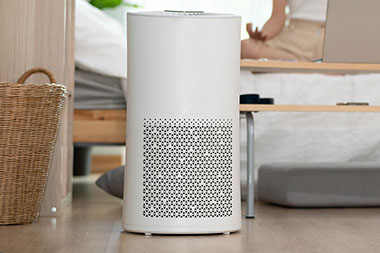
* If you don’t have a HVAC system, or you just want extra filtration, consider using a portable high-efficiency particulate air (HEPA) cleaner. They are the most efficient filters available to trap virus particles. Check that its Clean Air Delivery Rate (CADR) meets or exceeds the square footage of the room where it will be used. For more information, see EPA’s Guide to Air Cleaners in the Home.
3. Use Fans for Better Air Flow
Fans help improve air flow inside your home, even if you don’t have windows open.
* Use a window exhaust fan that fits securely in the window. Some window air conditions have an outdoor air intake or vent to bring more outside air in.
* Place a box fan or tower fan as close as possible to an open window or door. Use ceiling fans as well.
* Operate a whole house fan or an evaporative cooler (or “swamp cooler”) if your home has one.
* Always point fans away from people to avoid blowing air directly at them.
4. Turn On Exhaust Fans
Other exhaust fans in your house can also help move air outside.
* Turn on exhaust fans located above your stovetop and in your bathroom when you have visitors. Even if they don’t vent to the outside, they can still help keep virus particles from being concentrated in one place.
* Keep exhaust fans turned on for an hour after visitors leave to help clear out virus particles that may have accumulated in the air.
5. Limit Visitors
* When you have visitors, try to gather in larger rooms where you can stay 6 feet apart.
* When you have visitors, have everyone wear a mask, including the people who usually live in your home. Do not put a mask on children younger than 2 years old.
* Try to keep visits as short and as small as possible.
* Learn more ways to stay safe while doing indoor and outdoor activities with others and safer ways for hosting gatherings at:cdc.gov/coronavirus/2019-ncov/daily-life-copingandcdc.gov/coronavirus/2019-ncov/daily-life-coping/holidays/celebrations.
Remember, the more ways you use to ventilate, the faster you can clear out COVID virus particles from your home if they are present.
© American Institute for Preventive Medicine