Systematic Stress Management Program
Step 7: Communication & Stress Section
Introduction
What is Your Ear-Q?
Ten Blocks to Effective Listening
Listening Blocks in My Life
Skills for Active Listening
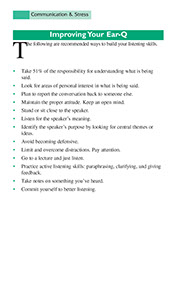
Improving Your Ear-Q
Assertiveness
Assertiveness Inventory
Assertiveness with Other People
The Benefits of Assertiveness
Assertiveness Training – The L.A.D.D.E.R. Technique
My Practice L.A.D.D.E.R.

The following are recommended ways to build your listening skills.
* Take 51% of the responsibility for understanding what is being said.
* Look for areas of personal interest in what is being said.
* Plan to report the conversation back to someone else.
* Maintain the proper attitude. Keep an open mind.
* Stand or sit close to the speaker.
* Listen for the speaker’s meaning.
* Identify the speaker’s purpose by looking for central themes or ideas.
* Avoid becoming defensive.
* Limit and overcome distractions. Pay attention.
* Go to a lecture and just listen.
* Practice active listening skills: paraphrasing, clarifying, and giving feedback.
* Take notes on something you’ve heard.
* Commit yourself to better listening.
Listening Exercises
Exercise #1: List 3 new skills you’d like to try to become a more effective listener.
Exercise #2: Ask someone to tell you a 3 – 5 minute story. Use the three skills of active listening (paraphrasing, clarifying, and feedback) as well as the skills listed in “Improving Your Ear-Q.” Ask the storyteller to rate you as a listener afterward.
Scoring – The score is based on the speaker’s assessment of the 3 – 5 minute exchange.
3 = Used the skill well
2 = Made an effort to use the skill
1 = Needs improvement
© American Institute for Preventive Medicine
Step 1: Understanding Stress
Step 3: Type A & B Behavior Patterns
Step 5: Thinking Differently
Step 7: Communication & Stress
Step 2: Stress Management at Work
Step 4: Biofeedback Training & Relaxation
Step 6: Time Management
Steps to Systematic Stress Management™
RELATED ARTICLES
© American Institute for Preventive Medicine – All Rights Reserved.Disclaimer|www.HealthyLife.com