Systematic Stress Management Program
Step 7: Communication & Stress Section
Introduction
What is Your Ear-Q?
Ten Blocks to Effective Listening
Listening Blocks in My Life
Skills for Active Listening
Improving Your Ear-Q
Assertiveness
Assertiveness Inventory
Assertiveness with Other People
The Benefits of Assertiveness
Assertiveness Training – The L.A.D.D.E.R. Technique
My Practice L.A.D.D.E.R.
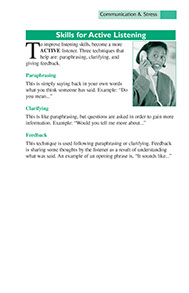
To improve listening skills, become a more ACTIVE listener. Three techniques that help are: paraphrasing, clarifying, and giving feedback.
Paraphrasing
This is simply saying back in your own words what you think someone has said. Example: “Do you mean…”
Clarifying
This is like paraphrasing, but questions are asked in order to gain more information. Example: “Would you tell me more about…”
Feedback
This technique is used following paraphrasing or clarifying. Feedback is sharing some thoughts by the listener as a result of understanding what was said. An example of an opening phrase is, “It sounds like…”
© American Institute for Preventive Medicine
Step 1: Understanding Stress
Step 3: Type A & B Behavior Patterns
Step 5: Thinking Differently
Step 7: Communication & Stress
Step 2: Stress Management at Work
Step 4: Biofeedback Training & Relaxation
Step 6: Time Management
Steps to Systematic Stress Management™
RELATED ARTICLES
© American Institute for Preventive Medicine – All Rights Reserved.Disclaimer|www.HealthyLife.com