Tag: Abdominal & Urinary

  • Cirrhosis: Be Kind To Your Liver

    Abdominal & Urinary Conditions

    The liver is probably the most versatile organ you’ve got. It performs many tasks, including:

    *  Producing bile (a substance that aids digestion of fats).

    *  Producing blood proteins.

    *  Helping blood clot.

    *  Metabolizing cholesterol.

    *  Maintaining normal blood sugar levels.

    *  Forming and storing glycogen (the body’s short-term energy source).

    *  Manufacturing more than 1,000 enzymes necessary for various bodily functions.

    *  Detoxifying substances such as alcohol and many drugs.

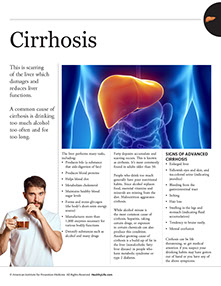
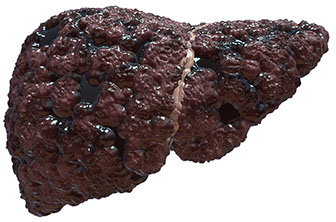
    Image of liver with cirrhosis.

    Liver with Cirrhosis

    The liver is equipped to handle a certain amount of alcohol without much difficulty. But drink too much alcohol, too often, for too long, and the vital tissues in the liver break down. Fatty deposits accumulate and scarring occurs. This is known as cirrhosis. It’s most commonly found in men over 45, yet the number of women developing cirrhosis is steadily increasing.

    To make matters worse, people who drink too much generally have poor nutritional habits. Since alcohol replaces food, essential vitamins and minerals are missing from the diet. Malnutrition aggravates cirrhosis.

    While alcohol abuse is the most common cause of cirrhosis, hepatitis, taking certain drugs, or exposure to certain chemicals can also produce this condition.

    Doctors recognize the following as signs of advanced cirrhosis.

    *  Enlarged liver.

    *  Yellowish eyes and skin, and tea-colored urine (indicating jaundice). Bleeding from the gastrointestinal tract.

    *  Itching.

    *  Hair loss.

    *  Swelling in the legs and stomach (indicating fluid accumulation).

    *  Tendency to bruise easily.

    *  Mental confusion.

    Cirrhosis can be life threatening, so get medical attention if you suspect your drinking habits may have gotten out of hand or you have any of the above symptoms. And needless to say, you (or anyone you suspect of having cirrhosis) should abstain from alcohol.

    A Year of Health Hints book by the American Institute for Preventive Medicine. www.HealthyLife.com. All rights reserved.

    © American Institute for Preventive Medicine

  • Rectal Problems

    Abdominal & Urinary Conditions

    The rectum is the lowest part of the large bowel (colon). The opening of the rectum is the anus. Stool are passed from the anus.

    Signs & Symptoms

    *  Rectal pain.

    *  Rectal bleeding.

    *  Anal itching.

    *  Redness, swelling, or a rash in the rectal area.

    Causes

    Often there is no clear cause. Persons with diabetes and liver disease are more prone to rectal itching.

    For Anal / Rectal Pain and/or Bleeding

    *  Constipation. Straining to pass stool. Hemorrhoids.

    *  Anal fissures. These are splits or tears in the skin around the anus.

    *  Polyps or small growths.

    *  Injury due to anal intercourse or the insertion of a foreign object.

    *  Blockage in the intestines.

    *  Colon or rectal cancer.

    For Anal / Rectal Itching

    *  Dry skin. Products that irritate or cause a skin allergy in the anal area. Examples are over-the-counter anesthetic ointments that end in “caine,” such as benzocaine.

    *  Hemorrhoids.

    *  Psoriasis. This is a chronic skin disease. With this, itchy, scaly red patches form on a part of the body.

    *  Pinworms. These are intestinal parasites. They usually affect children. The anal itching is at night and can be painful.

    *  A fungal infection.

    Treatment

    Treatment for rectal problems depends on the cause. Any sign of rectal bleeding should be evaluated by a doctor. This includes blood on toilet paper. Colon cancer should be checked for, despite the person’s age or family history of this disease.

    Questions to Ask

    Self-Care / Prevention

    For Anal / Rectal Bleeding

    *  Don’t lift heavy things.

    *  Stop taking anti-inflammatory medicines and/or aspirin (unless prescribed and monitored by your doctor).

    *  Don’t strain to pass stool.

    For Anal / Rectal Itching

    *  Practice good hygiene. Clean the rectal area daily.

    *  Use an over-the-counter ointment, such as one with zinc oxide or one for hemorrhoids, such as Preparation H. Follow package directions.

    *  Wear clothes and undergarments that fit loosely.

    *  Take a warm bath or sitz bath. A sitz bath is a shallow, warm water bath. You can get a sitz bath device from a medical supply company and some drug stores. Then dry the rectal area well. Use talcum powder, as needed.

    *  Take warm tub baths.

    *  Lose weight if you are overweight.

    *  If you are diabetic, keep blood sugar under control.

    *  For pinworms:

    – Check for pinworms in this way: In a dark room, a few hours after bedtime, shine a flashlight on the anus. Pinworms, if present, will go back into the anus when the flashlight is shined on them.

    – Wash the hands often.

    – Keep fingernails closely trimmed.

    – Try to get your child to not suck his thumb and not bite his nails.

    – Wash underwear and bed linen in hot soapy water.

    – If medication for pinworms is prescribed, use it as directed.

    For Rectal Pain

    *  Take warm baths.

    *  Use a warm water sitz bath for 15 minutes, 2 to 3 times a day.

    *  Put towels soaked in warm water on the anal area. Or, apply a cold compress to the painful area, if this helps with the pain. You can buy a sitz bath from a medical supply or drug store.

    *  Follow measures to prevent constipation.

    *  Don’t strain to pass stool.

    *  Keep the rectal area clean.

    *  Use soft, plain, unscented, two-ply toilet paper. Take your own toilet paper to work or other places that may use harsh paper. Use wet, not dry, toilet paper, if that helps.

    *  Use an over-the-counter wipe, such as Tucks, after using toilet paper.

    *  Don’t sit for long periods of time. When you do sit, raise your legs, as often as you can.

    *  If needed, take an over-the-counter medicine for pain as directed.

    Healthier at Home book by the American Institute for Preventive Medicine. www.HealthyLife.com. All rights reserved.

    © American Institute for Preventive Medicine

  • Colon & Rectal Cancers

    Abdominal & Urinary Conditions

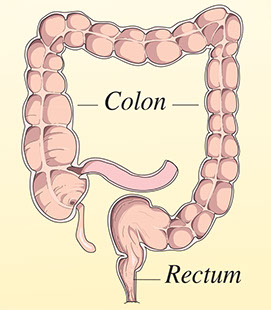
    The colon and rectum form the large bowel. The colon is the upper 5 to 6 feet. The rectum is the last 6 to 8 inches. When abnormal cells grow in the colon, a cancerous tumor may form. Colon tumors grow slowly. They may get big and block the bowel.

    Illustration of colon and rectum.

    Signs & Symptoms

    Colon and rectal cancers can occur without clear symptoms. For this reason, screening is important. When symptoms occur, they include:

    *  A change in bowel habits for 2 or more weeks or constipation or diarrhea for 1 or more weeks.

    *  Frequent gas pains, cramps, bloating, or feelings of fullness in the abdomen

    *  Red or dark blood in or on the stool or rectal bleeding. Pencil thin stools.

    *  Fatigue and/or iron deficiency anemia in men and older women

    *  A feeling that the bowel does not empty completely

    *  Weight loss for no known reason

    Causes, Risk Factors & Care

    Risk factors for colon and rectal cancers:

    *  Polyps (benign growths that can become cancerous over time). Most colon and rectal cancers develop from polyps.

    *  Family history of colon or rectal cancer. Unless it is treated, an inherited condition called Familial Polyposis puts a person at a very high risk.

    *  Having ulcerative colitis or Crohn’s disease.

    *  Aging. Colon and rectal cancers occur most often in people over age 50.

    *  Smoking. Heavy alcohol use.

    *  Eating a diet high in animal fat and low in fiber

    *  Lack of exercise and/or being very overweight

    Finding and treating the cancer early is vital. Treatment includes surgery, chemotherapy, and radiation therapy.

    Self-Care / Prevention

    Self-Care:

    *  Schedule and go to follow-up exams.

    *  Join a cancer support group.

    *  Follow a high fiber, low-fat diet. Eat whole-grain breads and cereals. Have at least 5 servings of vegetables and fruits a day.

    Prevention

    Colon and rectal cancers are completely curable if found early. Have screening tests as advised by your doctor.

    *  High-sensitivity fecal occult blood test

    *  Flexible sigmoidoscopy

    *  Colonoscopy

    How often testing needs to be done depends on the test(s) given. {Note: If you have a family history of colon polyps or colon or rectal cancers, screening tests may need to be started sooner than age 50.}

    *  Have colon polyps removed.

    *  Eat plenty of fruits, vegetables, and whole grains. Limit fat.

    When to Seek Medical Care

    Contact Doctor When:

    *  You have any symptoms of colon and rectal cancer listed on this page.

    *  You need to schedule screening tests for colon and rectal cancer. Follow the schedule your doctor advises.

    Resources

    The National Cancer Institute

    800.4.CANCER (422-6237)

    www.cancer.gov

    The American Cancer Society

    800.227.2345

    www.cancer.org

    Healthier at Home book by the American Institute for Preventive Medicine. www.HealthyLife.com. All rights reserved.

    © American Institute for Preventive Medicine

  • Urinary Incontinence

    Abdominal & Urinary Conditions

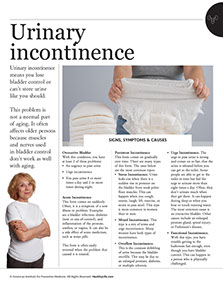
    Urinary incontinence means you lose bladder control or can’t store urine like you should. This problem is not a normal part of aging. It often affects older persons because muscles used in bladder control don’t work as well with aging.

    Signs, Symptoms & Causes

    For Acute Incontinence

    This form comes on suddenly. Often, it is a symptom of a new illness or problem. Examples are a bladder infection, diabetes (new or out-of- control), and inflammation of the prostate, urethra, or vagina. It can also be a side effect of some medicines, such as water pills.

    This form is often easily reversed when the problem that caused it is treated.

    For Persistent Incontinence

    This form comes on gradually over time. It lingers or remains, even after other problems have been treated. There are many types of this form. The ones below cause 80% of cases.

    *  Stress Incontinence. Urine leaks out when there is a sudden rise in pressure in the abdomen. This can happen when you cough, sneeze, laugh, lift, jump, run, or strain to pass stool. This type is more common in women than in men.

    *  Urge Incontinence. With this type, the urge to pass urine is so strong and comes on so fast, that the urine is released before you can get to the toilet. This type can be caused by an enlarged prostate gland, a spinal cord injury, or an illness, such as Parkinson’s disease.

    *  Mixed Incontinence. This type is a mix of stress and urge types of incontinence.

    *  Overflow Incontinence. This is the constant dribbling of urine because the bladder overfills. This may be due to an enlarged prostate, diabetes, or multiple sclerosis.

    *  Functional Incontinence. With this type, you have trouble getting to the bathroom fast enough, even though you have bladder control. This can happen in a person who is physically challenged.

    *  Total Incontinence. This is a rare type with complete loss of bladder control. Urine leakage can be constant.

    Treatment

    The first step is to find out if another problem causes the incontinence and to treat that problem. Other treatments include:

    *  Pelvic floor exercises, called Kegel exercises. (SeeSelf-Care/Prevention.)

    *  Medication.

    *  Collagen injections. These treat a certain type of stress incontinence.

    *  Surgery, as needed, to correct the problem.

    Overactive Bladder

    With this condition, you have at least 2 of these problems:

    *  An urgency to pass urine.

    *  Urge incontinence.

    *  You pass urine 8 or more times a day and 2 or more times during night.

    Questions to Ask

    Self-Care / Prevention

    *  Don’t have caffeine. Limit or avoid fluids 2 to 3 hours before bedtime.

    *  Limit carbonated drinks, alcohol, citrus juices, greasy and spicy foods, and items with artificial sweeteners.

    *  Empty your bladder before you leave the house, take a nap, or go to bed.

    *  Go to the bathroom often, even if you don’t feel the urge. When you pass urine, empty the bladder as much as you can. Relax for 1 to 2 minutes. Then try to pass urine again.

    *  Keep a diary of when you leak urine. If you find that you have accidents every 3 hours, empty your bladder every 2 hours. Use an alarm clock or wristwatch with an alarm to remind you.

    *  Wear clothes you can pull down easily when you use the bathroom. Wear elastic-waist bottoms. Wear items with velcro closures or snaps instead of buttons and zippers.

    *  Wear absorbent pads or briefs, if needed.

    *  Keep the pathway to your bathroom free of clutter and well lit. Leave the bathroom door open until you use it. Use a night light in the bathroom when it is dark.

    *  Use an elevated toilet seat and grab bars if these will make it easier for you to get on and off the toilet.

    *  Keep a bedpan, plastic urinal (for men), or portable commode chair near your bed.

    *  Ask your doctor if your type of incontinence could be managed by using self-catheters. These help to empty your bladder all the way. A doctor needs to prescribe self-catheters.

    Kegel Exercises

    *  Kegel exercises are pelvic floor exercises. These help treat or cure stress incontinence. Persons who have leaked urine for years can benefit greatly from these exercises. How do you do them?

    *  First, start to urinate, then hold back and try to stop. If you can slow the stream of urine, you are using the right muscles. You should feel muscles squeeze around the urethra and the anus. The urethra is the tube through which urine is passed. The anus is the opening through which stool is passed.

    *  Next, relax your body, and close your eyes. Imagine that you are going to pass urine, but hold back from doing so. You should feel the muscles squeeze like you did in the step before this one.

    *  Squeeze the muscles for 3 seconds. Then relax them for 3 seconds. When you squeeze and relax, count slowly. Start out doing this 3 times a day. Gradually work up to 3 sets of 10 contractions. Hold each one for 10 seconds at a time. You can do them when you lie down, and/or stand.

    *  When you do these exercises, do not tense the muscles in your belly or buttocks. Do not hold your breath, clench your fists or teeth, or make a face.

    *  Squeeze your pelvic floor muscles right before and during whatever it is (coughing, sneezing, jumping, etc.) that causes you to lose urine. Relax the muscles once the activity is over.

    *  Women can also use pelvic weights prescribed by their doctor. A women inserts a weighted cone into the vagina and squeezes the correct muscles to keep the weight from falling out.

    It may take several months to benefit from pelvic floor exercises. They should be done daily.

    Resources

    National Association for Continence (NAFC)

    800.BLADDER (252.3337)

    www.nafc.org

    Urology Care Foundation

    www.urologyhealth.org
    Healthier at Home book by the American Institute for Preventive Medicine. www.HealthyLife.com. All rights reserved.

    © American Institute for Preventive Medicine

  • Constipation

    Abdominal & Urinary Conditions

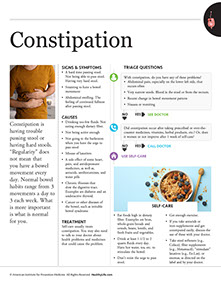
    Constipation is having trouble passing stool or having hard stools. “Regularity” does not mean that you have a bowel movement every day. Normal bowel habits range from 3 movements a day to 3 each week. What is more important is what is normal for you.

    Signs & Symptoms

    *  A hard time passing stool. Not being able to pass stool. Having very hard stool.

    *  Straining to have a bowel movement.

    *  Abdominal swelling. The feeling of continued fullness after passing stool.

    Causes

    *  Drinking too few fluids. Not eating enough dietary fiber.

    *  Not being active enough.

    *  Not going to the bathroom when you have the urge to pass stool.

    *  Misuse of laxatives.

    *  A side effect of some heart, pain, and antidepressant medicines, as well as, antacids, antihistamines, and water pills.

    *  Chronic illnesses that slow the digestive tract. Examples are diabetes and an underactive thyroid.

    *  Cancer or other diseases of the bowel.

    Treatment

    Self-care usually treats constipation. You may also need to talk to your doctor about health problems and medicines that could cause the problem.

    Questions to Ask

    Self-Care / Prevention

    *  Eat foods high in dietary fiber. Examples are bran, whole-grain breads and cereals, and fresh fruits and vegetables.

    *  Drink at least 1-1/2 to 2 quarts fluids every day. Have hot water, tea, etc. to stimulate the bowel.

    *  Get enough exercise.

    *  Don’t resist the urge to pass stool.

    *  If you take antacids or iron supplements and get constipated easily, discuss the use of these with your doctor.

    *  Take stool softeners (e.g., Colace), fiber supplements (e.g., Metamucil), “stimulant” laxatives (e.g., Ex-Lax), or enemas, as directed on the label and by your doctor.

    Healthier at Home book by the American Institute for Preventive Medicine. www.HealthyLife.com. All rights reserved.

    © American Institute for Preventive Medicine

  • 4 Reasons To Get Your Colonoscopy

    MEDICAL NEWS

    Illustration of doctor's hand with the word "Colonoscopy."

    If you’re age 50 or older, your doctor may have recommended you get a colonoscopy. This test, which uses a thin, lighted tube to view inside the colon and rectum, checks for:

    *  Polyps, which are growths or bumps that could turn into cancer

    *  Colorectal cancer (cancer in the colon and/or rectum)

    A colonoscopy gives the doctor a chance to remove polyps and possible cancerous growths during the test.

    Even though a colonoscopy is a safe and effective way to help prevent colorectal cancer or find it early, many people put off getting one. This is often because they are nervous about the test or they don’t want to do the “prep.” Preparing for a colonoscopy usually means you take medicines that cause diarrhea the day before the test. This can be inconvenient, but it’s worth the hassle.

    Here are 4 good reasons you should call your doctor about scheduling it today:

    1.Early colon cancer has no symptoms.Many people have polyps or even colon cancer for months or years and don’t know it. A colonoscopy can find these things early and increase the chances of a good outcome. The earlier colon cancer is found, the higher the likliehood of successful treatment.

    2.One day of prep could save your life.No one likes to have diarrhea. But, one day of prep means you’re getting a test that checks for a common and sometimes deadly cancer. In fact, the American Cancer Society says more than 50,000 Americans will die from colorectal cancer in 2018. It is the third most common cancer in the U.S.

    3.There are ways to make the prep easier.Ask your doctor about adding certain flavorings to your medicine to make it taste better. Also, there are many clear liquids other than water you may be able to drink. Sports drinks, tea, coffee, popsicles and some broths may be allowed. Usually, red, blue and purple dyes need to be avoided, but other flavors are fine.

    4.Can’t put a price on peace of mind.With so many people being diagnosed with colorectal cancer, isn’t it worth a day of discomfort to know that you’ve been screened? Even if a polyp or possible sign of cancer is found, you can get on the path to treatment that could be life-saving.

    Sources: Centers for Disease Control and Prevention, National Institutes of Health, American Cancer Society

    © American Institute for Preventive Medicine

  • Diarrhea

    Abdominal & Urinary Conditions

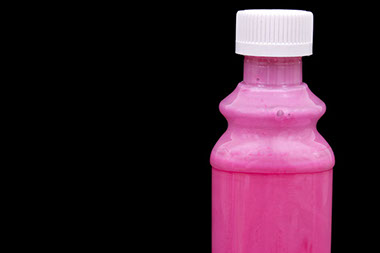
    Image of medicine in pink bottle.

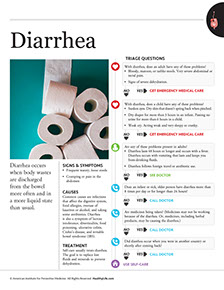
    Diarrhea occurs when body wastes are discharged from the bowel more often and in a more liquid state than usual.

    Signs & Symptoms

    *  Frequent watery, loose stools.

    *  Cramping or pain in the abdomen.

    Causes

    Common causes are infections that affect the digestive system, food allergies, overuse of laxatives or alcohol, and taking some antibiotics. Diarrhea is also a symptom of lactose intolerance, diverticulitis, food poisoning, ulcerative colitis, Crohn’s disease, and irritable bowel syndrome (IBS).

    Treatment

    Self-care usually treats diarrhea. The goal is to replace lost fluids and minerals to prevent dehydration.

    Questions to Ask

    Self-Care / Prevention

    *  If vomiting is also present, treat for vomiting first.

    *  To prevent dehydration:

    – Drink plenty of water and other fluids, such as sports drinks, broths, and Kool-Aid (which usually has less sugar than soda).

    – Avoid drinks with caffeine or alcohol.

    – Avoid having high “simple” sugar drinks, like apple juice, grape juice, and sodas. These can make the diarrhea persist. Or, dilute juices and sodas with water.

    If you have signs of dehydration seek medical care. Until you get care, drink fluids:

    *  Broths and sports drinks.

    *  For children less than 2 years old, give over- the-counter mixtures, such as Pedialyte as advised by their doctors.

    *  If you breast-feed, give only as much milk as your baby wants. Feed every 2 hours.

    *  Avoid caffeine and alcohol.

    *  Choose foods that don’t upset your stomach.

    *  Do not have foods that are greasy, high in fiber, or very sweet.

    *  Avoid milk, but try yogurt that has live cultures of lactobacillus acidophilus (unless you are lactose intolerant).

    *  Follow a light diet. Eat foods that are easy to digest, such as:

    – Bananas.

    – Plain rice.

    – Boiled potatoes.

    – Toast.

    – Crackers.

    – Cooked carrots.

    – Baked chicken without the skin or fat.

    – Soups with vegetables and noodles or rice.

    *  Don’t exercise too hard.

    *  Adults can try an over-the-counter medicine, such as Imodium A-D or Pepto-Bismol. Follow the directions on the label. {Note: Stools can become black after taking Pepto- Bismol. Also, do not give aspirin or any medication that has salicylates, such as Pepto- Bismol, to anyone under 19 years of age, due to the link to Reye’s syndrome.}

    *  Wash your hands after you go to the toilet and before you prepare food. Use paper towels to dry your hands. Throw the towels away.

    Resources

    National Institute of Diabetes and Digestive and Kidney Diseases (NIDDK)www2.niddk.nih.gov

    Healthier at Home book by the American Institute for Preventive Medicine. www.HealthyLife.com. All rights reserved.

    © American Institute for Preventive Medicine

  • Calming An Irritable Bowel

    SELF-CARE CORNER

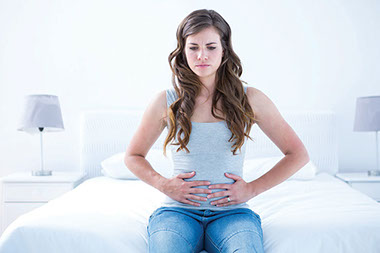
    Image of a women holding stomach in pain.

    Irritable bowel syndrome (IBS) is a disorder of the digestive system. Experts believe that IBS happens when there is a problem with how the brain and the gut work together. IBS can have bothersome symptoms like stomach pain, diarrhea and constipation. But, IBS does not damage the digestive tract like the effects of ulcerative colitis or Crohn’s disease.

    Millions of people in the U.S. have IBS. And some people have severe symptoms that require medication or other medical care. IBS should be diagnosed by a doctor to ensure your symptoms are not caused by other diseases.

    Fortunately, mild to moderate symptoms of IBS can often be improved with some self-care and lifestyle changes.

    Foods to skip

    Some foods are known to cause more cramping and diarrhea. People with IBS may wish to avoid these foods, which include:

    *  Fried foods or high-fat meals

    *  Artificial sweeteners

    *  Caffeine, such as coffee or tea

    *  Alcohol

    You should also avoid eating large meals.

    Keep a food diary

    It may be a good idea to keep a food diary to identify other problem foods and eating habits, especially during flare-ups.

    Feel fiber-fabulous

    Fiber is one of the most effective ways to help calm an irritable bowel. Fiber can improve constipation because it softens stool and makes it easier to pass. And, it may help “bulk up” stool to reduce diarrhea.

    The 2015-2020 Dietary Guidelines for Americans says that adults should be eating 22 to 34 grams of fiber per day. Soluble fiber may be the best choice for those with IBS.

    Good sources of soluble fiber include:

    *  Oats

    *  Nuts

    *  Lentils

    *  Beans

    *  Fruits & Vegetables

    If you’re not used to eating fiber, don’t eat too much at first. This could lead to gas, bloating, and more IBS symptoms. Gradually increase the amount of fiber you eat by 2 to 3 grams per day until you’re eating the recommended amount. Be sure to drink plenty of fluids to absorb the extra fiber.

    Get better sleep

    Sleep helps the body restore itself, and poor sleep may aggravate IBS symptoms. Help your body rest by practicing good sleep hygiene. You can do this by:

    *  Shutting off computers, smart phones and other screens two hours before bedtime

    *  Going to bed and getting up at the same time every day

    *  Avoiding alcohol and heavy meals in the evening

    *  Not smoking

    *  Getting regular exercise (even light exercise can help you sleep better)

    *  Avoiding naps if you have trouble sleeping at night

    Get help from your doctor

    If these self-care steps don’t help, it may be time to talk to your doctor about other solutions. Some people find success by avoiding gluten, a protein found in wheat, barley, rye, oats and many other foods.

    A low-FODMAP diet may also be helpful. FODMAPS are carbohydrates that can be harder for the intestines to digest. Avoiding these foods helps some people with IBS. Ask your doctor before you begin any diet that eliminates certain foods.

    Sources: International Foundation for Functional Gastrointestinal Disorders, National Institute of Diabetes and Digestive and Kidney Diseases, National Sleep Foundation

    © American Institute for Preventive Medicine

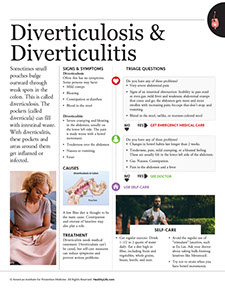
  • Diverticulosis & Diverticulitis

    Abdominal & Urinary Conditions

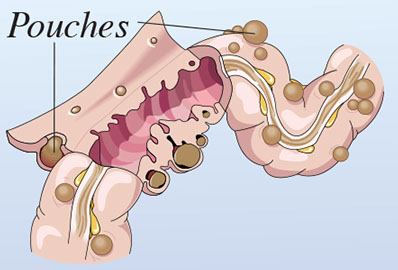
    Illustration of diverticulosis in colon.

    Diverticulosis in Colon

    Sometimes small pouches bulge outward through weak spots in the colon. This is called diverticulosis. The pockets (called diverticula) can fill with intestinal waste. With diverticulitis, these pockets and areas around them get inflamed or infected.

    Signs & Symptoms

    For Diverticulosis

    Often this has no symptoms. Some persons may have:

    *  Mild cramps.

    *  Bloating

    *  Constipation.

    *  Blood in the stool.

    For Diverticulitis

    *  Severe cramping and bloating in the abdomen, usually on the lower left side. The pain is made worse with a bowel movement.

    *  Tenderness over the abdomen.

    *  Nausea.

    *  Fever.

    Causes

    A low fiber diet is thought to be the main cause. Constipation and overuse of laxatives may also play a role.

    Treatment

    Diverticulitis needs medical treatment. Diverticulosis can’t be cured, but self-care measures can reduce symptoms and prevent serious problems.

    Questions to Ask

    Self-Care / Prevention

    *  Get regular exercise. Drink 1-1/2 to 2 quarts of water daily. Eat a diet high in fiber, but avoid foods that bother you (e.g., corn, nuts, etc.).

    *  Avoid the regular use of “stimulant” laxatives, such as Ex-Lax. Ask your doctor about taking bulk-forming laxatives like Metamucil.

    *  Try not to strain when you have bowel movements.

    Healthier at Home book by the American Institute for Preventive Medicine. www.HealthyLife.com. All rights reserved.

    © American Institute for Preventive Medicine

  • Do You Have Celiac Disease?

    SELF-CARE CORNER

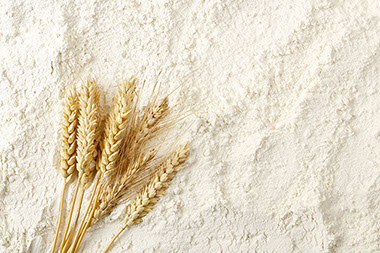
    Image of wheat on top of white flour.

    If you can’t eat bread or anything containing wheat, rye, and barley because of gluten-a protein found in these grains-you may have celiac disease. Different people have different symptoms, but talk with your doctor if you or your child has one or more of these problems after eating bread or cookies, for example:

    *  Gas

    *  Bloating, belly pain

    *  Ongoing diarrhea

    *  Pale, foul-smelling or fatty stool

    *  Weight loss or weight gain

    *  Fatigue

    *  Bone or joint pain

    *  Bone loss or weakening

    *  Anemia (lower red blood cell count)

    *  Behavior changes (children become irritable)

    *  Tingling, numbness in the legs

    *  Muscle cramps

    *  Seizures

    *  Itchy skin rash

    © American Institute for Preventive Medicine