Tag: Abdominal & Urinary

  • Flatulence (Gas)

    Abdominal & Urinary Conditions

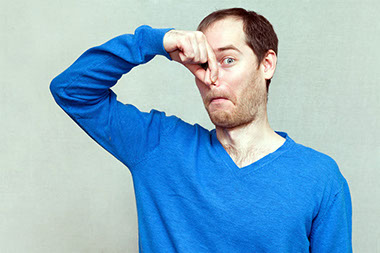
    Image of man plugging his nose with hand.

    Flatulence is passing gas through the anus. For the average adult, this happens about 6 to 20 times a day.

    Signs & Symptoms

    *  Pressure or discomfort in the lower abdomen or anal area.

    *  Passing gas. A foul odor occurs sometimes.

    Causes

    Gas is caused by swallowing air and digesting foods. Eating high fiber foods like beans, peas, and whole-grains create more gas than other foods. Dairy foods can create large amounts of gas in some people.

    Gas may signal other problems, too. These include lactose intolerance, taking certain antibiotics, and abnormal muscle movement in the colon.

    Gas can also be a symptom of celiac disease. With this, the lining of the small intestine is damaged from eating gluten. This is a protein in wheat, barley, and rye. Other symptoms of celiac disease are pain and bloating in the abdomen; diarrhea; weight loss; anemia; and a certain skin rash. Treatment is a gluten-free diet. Find out about celiac disease fromwww.celiac.nih.gov.

    Treatment

    Self-care treats most cases of gas. If the gas is due to another problem, treating the problem reduces or gets rid of the gas.

    Questions to Ask

    Self-Care / Prevention

    *  Try not to swallow air. Don’t have carbonated drinks and chewing gum. These can cause more air to get into your stomach.

    *  When you add fiber to your diet, do so gradually.

    *  When you pass gas, note which foods you have eaten. Eat less of the foods that often cause gas. Common ones are apples, bran, whole-wheat foods, cabbage-family vegetables, eggs, dairy products, prunes, and beans.

    *  To prevent getting gas from many “gassy” foods, try an over-the-counter product, such as Beano. This helps prevent gas from beans, bran, nuts, onions, soy, and many vegetables.

    *  Try an over-the-counter medicine with simethicone, such as Gas-X.

    *  Release the gas when you need to. Go to another room if it will help you be less embarrassed.

    Healthier at Home book by the American Institute for Preventive Medicine. www.HealthyLife.com. All rights reserved.

    © American Institute for Preventive Medicine

  • Kidney Stones Hurt

    MEDICAL NEWS

    Image of male doctor.

    Although they can be painful, kidney stones rarely cause permanent damage, and you may be able to prevent them, according to the National Institutes of Health. Back or side pain that won’t go away is the primary symptom of a kidney stone. You may also have pinkish or foul-smelling urine, a fever, or painful urination. Caucasians are more prone to kidney stones than African Americans, and men are more prone than women. Age is also a factor. The chance of getting a kidney stone rises as men enter their 40s and continues to rise into their 70s. For women, the risk peaks in their 50s.

    Each day, about 50 gallons of blood flows through your kidneys. The kidneys remove waste products including various minerals and other substances from the blood and transfer them into urine so your body can get rid of these waste products. In people who get stones, certain minerals in the urine combine with other waste products and start to form a stone.

    Kidney stones aren’t all the same. The most common type is made of the mineral calcium, combined with either oxalate or phosphate. Less common types of stones are made of uric acid or other chemicals, all of which are naturally found in the body. No one knows why these substances form kidney stones in some people but not in others, since we all have them in our urine.

    Most kidney stones eventually pass out of the body during urination. But some can grow large enough to begin blocking the flow of urine. That causes intense pain and may also put you at risk for infection. Most kidney stones that don’t pass on their own are treated in an outpatient setting. The most common procedure is called lithotripsy. Greek for “stone crushing,” this technique uses shock waves to reduce kidney stones into small fragments, which then easily flow away in urine.

    If you’ve had more than one kidney stone, you’re at higher risk for forming another. But there are ways to help prevent most types of kidney stones. First, your doctor needs to know what type of stone it is. If you pass a stone, try to catch it in a strainer. A laboratory analysis can help your doctor plan a strategy to prevent more stones. Other tests, which may include urine and blood tests, can help your doctor figure out why you had a kidney stone.

    Drinking more water may help prevent kidney stones. Depending on the type of stone you’re at risk for, your doctor may also advise you to avoid certain foods or drinks. For example, people prone to forming calcium oxalate stones should avoid spinach, peanuts, and chocolate. People prone to forming uric acid stones should cut back on meat. Doctors can also prescribe certain medications to help prevent these types of stones.

    Stone watch

    Call a doctor if you have any of the following signs of a kidney stone:

    *  Extreme pain in your back or side that won’t go away

    *  Blood in your urine (it will look pink)

    *  Fever and chills

    *  Vomiting

    *  Urine that smells bad or looks cloudy

    *  A burning feeling when you urinate

    © American Institute for Preventive Medicine

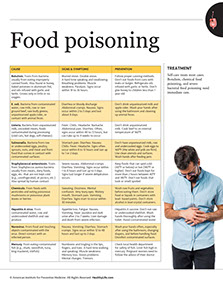
  • Food Poisoning

    Abdominal & Urinary Conditions

    Self-care treats most cases. Botulism, chemical food poisoning, and severe bacterial food poisoning need immediate care.

    Botulism

    Cause

    Toxin from bacteria usually from eating improperly canned foods. Also found in honey and oils infused with garlic. Grows only in little or no oxygen.

    Signs & Symptoms

    Blurred vision. Double vision. A hard time speaking and swallowing. Breathing problems. Muscle weakness. Paralysis. Signs occur within 4 to 36 hours.

    Prevention

    Follow proper canning methods. Boil home-canned food for 10 or more minutes. Don’t eat foods from cans with leaks or bulges. Refrigerate oils infused with garlic or herbs. Don’t give honey to children less than 1 year old.

    E. coli

    Cause

    Bacteria from contaminated water, raw milk, raw or rare ground beef, unpasteurized apple juice or cider, or contact with contaminated animal feces.

    Signs & Symptoms

    Diarrhea or bloody discharge. Abdominal cramps. Nausea. Signs occur within 2 to 5 days and last about 8 days.

    Prevention

    Don’t drink unpasteurized milk and apple cider. Wash your hands after using the bathroom and cleaning up animal feces.

    Listeria

    Cause

    Bacteria from unpasteurized milk, uncooked meats, foods contaminated during processing (cold cuts, hot dogs, soft cheeses).

    Signs & Symptoms

    Fever. Chills. Headache. Backache. Abdominal pain. Diarrhea. Often, signs occur within 48 to 72 hours, but can take up to 3 weeks to occur.

    Prevention

    Don’t drink unpasteurized milk. Cook beef to an internal temperature of 160ºF.

    Salmonella

    Cause

    Bacteria from raw or undercooked eggs, poultry, and meat and from food that comes in contact with contaminated surfaces.

    Signs & Symptoms

    Stomach pain. Diarrhea. Nausea. Chills. Fever. Headache. Signs occur within 8 to 12 hours and last up to 1 or 2 days.

    Prevention

    Don’t have unpasteurized milk, raw and undercooked eggs. Cook eggs to 160ºF (the white and yolk are firm). Use clean utensils and surfaces.

    Staphylococcal enterotoxin

    Cause

    Toxin from bacteria usually from meats, dairy foods, eggs, etc. that are not kept cold (e.g., unrefrigerated, at picnics, etc.) Also spread by human contact.

    Signs & Symptoms

    Severe nausea. Abdominal cramps. Diarrhea. Vomiting. Signs occur within 1 to 6 hours and last up to 3 days. Signs last longer if severe dehydration occurs.

    Prevention

    Keep foods that can spoil cold (40ºF or below) or hot (140ºF or higher). Don’t eat foods kept for more than 2 hours between 40ºF and 140ºF. Don’t eat foods that look or smell spoiled. Wash your hands often. Use clean utensils and surfaces.

    Chemicals

    Cause

    From foods with pesticides and eating poisonous mushrooms or poisonous plant leaves or berries.

    Signs & Symptoms

    Sweating. Dizziness. Mental confusion. Very teary eyes. Watery mouth. Stomach pain. Vomiting. Diarrhea. Signs start to occur within 30 minutes.

    Prevention

    Wash raw fruits and vegetables before eating them. Don’t store food or liquids in containers with lead- based paints. Don’t store alcohol in lead crystal containers.

    Hepatitis A virus

    Cause

    From contaminated water, raw and undercooked shellfish, oysters, clams, mussels, scallops, etc.

    Signs & Symptoms

    Appetite loss. Nausea. Vomiting. Fever. Jaundice and dark urine after 3 to 10 days. Liver damage and death from severe infection.

    Prevention

    Hepatitis A vaccine. Don’t eat raw or undercooked shellfish, oysters, etc.

    Norwalk-like viruses

    Cause

    From food and touching objects contaminated with the virus. Direct contact with an infected person.

    Signs & Symptoms

    Nausea. Vomiting. Diarrhea. Stomach cramps. Signs occur within 12 to 48 hours and last up to 2 days.

    Prevention

    Wash your hands often, especially after using the bathroom, changing diapers, and before handling food. Disinfect contaminated surfaces.

    Mercury

    Cause

    From eating contaminated fish (e.g., shark, swordfish, tuna, king mackerel, tilefish).

    Signs & Symptoms

    Numbness and tingling in the lips, fingers, and toes. A hard time walking and speaking. Muscle weakness. Memory loss. Mental changes. Tremors.

    Prevention

    Check local health department for safety of fish. Limit fish high in mercury. Pregnant women need to follow the advice of their doctor.

    Questions to Ask

    Self-Care / Prevention

    *  For chemical food poisoning, call the Poison Control Center (800.222.1222).

    *  Heed warnings for food products that could be harmful. News reports list these items. So does the FDA atwww.fda.gov.
    Healthier at Home book by the American Institute for Preventive Medicine. www.HealthyLife.com. All rights reserved.

    © American Institute for Preventive Medicine

  • Ulcers Not Caused By Stress

    MEDICAL NEWS

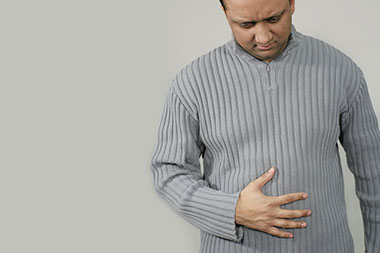
    Image of man holding this stomach.

    The lining of your stomach makes acid and enzymes that help break down food into the nutrients you need. The lining protects itself from acid damage by releasing mucus. But sometimes the lining gets inflamed and starts making less acid, enzymes, and mucus. This type of inflammation is called gastritis.

    You may have gastritis if you have pain or an uncomfortable feeling in your upper stomach. You could have nausea or vomiting. Or you may have no symptoms at all.

    Untreated, some types of gastritis can lead to ulcers. These are sores in the stomach lining.

    Some people think ulcers are caused by stress and spicy foods. But according to the NIH in Health, bacteria called H. pylori are often to blame. These bacteria break down the inner protective coating in the stomach and can cause inflammation.

    H. pylori can spread by passing from person to person or through contaminated food or water. Infections can be treated with antibiotics.

    One type of gastritis, called erosive gastritis, wears away the stomach lining. The most common cause of erosive gastritis is long-term use of medications called non-steroidal anti-inflammatory drugs. These include aspirin and ibuprofen. Stop taking these pain relievers and the gastritis usually clears up.

    Less common causes of gastritis include digestive disorders (such as Crohn’s disease) and autoimmune disorders in which the body’s protective immune cells attack healthy cells in the stomach lining.

    Gastritis can be diagnosed with an endoscope. A thin tube with a tiny camera on the end is inserted through the patient’s mouth or nose and into the stomach. The doctor looks at the stomach lining and may remove some tissue samples for testing. Treatment will depend on the type of gastritis found.

    Although stress and spicy foods don’t cause gastritis and ulcers, they can make symptoms worse. Milk might provide brief relief, but it also increases stomach acid, which can worsen symptoms. Your doctor may advise taking antacids or other drugs to  reduce acid in the stomach.

    Gastritis can lead to ulcers over time. Symptoms of ulcers include pain between the belly button and breastbone that starts between meals or during the night. It briefly stops if you eat or take antacids, lasts for minutes to hours, and comes and goes for several days or weeks.

    Contact your doctor right away if you have sudden sharp stomach pain that doesn’t go away, black or bloody stools, or vomit that is bloody or looks like coffee grounds.

    © American Institute for Preventive Medicine

  • Gallstones

    Abdominal & Urinary Conditions

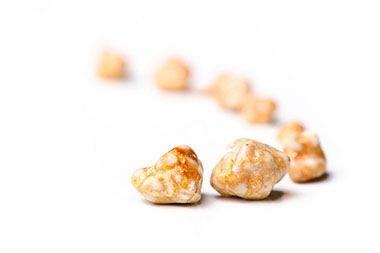
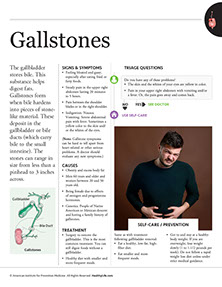
    Image of gallstones.

    The gallbladder stores bile. This substance helps digest fats. Gallstones form when bile hardens into pieces of stone-like material. These deposit in the gallbladder or bile ducts (which carry bile to the small intestine). The stones can range in size from less than a pinhead to 3 inches across.

    Signs & Symptoms

    *  Feeling bloated and gassy, especially after eating fried or fatty foods.

    *  Steady pain in the upper right abdomen lasting 20 minutes to 5 hours.

    *  Pain between the shoulder blades or in the right shoulder.

    *  Indigestion. Nausea. Vomiting. Severe abdominal pain with fever. Sometimes a yellow color to the skin and/or the whites of the eyes.

    {Note: Gallstone symptoms can be hard to tell apart from heart-related or other serious problems. A doctor should evaluate any new symptoms.}

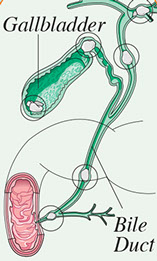
    Gallstones

    Illustration of gallbadder with gallstones.

    Causes

    *  Ethnic background (i.e., Native Americans) and family history of gallstones. Being middle age.

    *  Obesity. Very rapid weight loss.

    *  Being female. Having had many pregnancies. Taking estrogen.

    *  Having diabetes. Having diseases of the small intestine.

    Treatment

    *  A low-fat diet.

    *  Surgery to remove the gallbladder. This is the most common treatment. You can still digest foods without a gallbladder.

    Questions to Ask

    Self-Care / Prevention

    *  Avoid high-fat foods. Don’t eat large meals.

    *  Get to and stay at a healthy body weight. If you are overweight, lose weight slowly (1 to 1-1/2 pounds per week). Do not follow a rapid weight loss diet unless under strict medical guidance.

    *  Eat a high fiber, low-fat diet.

    Healthier at Home book by the American Institute for Preventive Medicine. www.HealthyLife.com. All rights reserved.

    © American Institute for Preventive Medicine

  • Understanding Your Gallbladder

    MEDICAL NEWS

    Image of man talking to his doctor.

    The hardest working digestive helper might well be your gallbladder, a pear-sized organ that sits just under the liver and next to the pancreas.

    The gallbladder stores bile, a thick liquid that’s produced by the liver to help digest fat. When you eat, the gallbladder’s thin, muscular lining squeezes bile into the small intestine through the main bile duct. The more fat you eat, the more bile the gallbladder injects into the digestive tract.

    Bile has a delicate chemical balance. It’s full of soluble cholesterol produced by the liver. This is a different type of cholesterol than the kind related to cardiovascular disease. If the chemical balance of bile gets slightly off, the cholesterol can crystalize and stick to the wall of the gallbladder. Over time, these crystals can combine and form gallstones.

    Gallstones can range from the size of a grain of sand to that of a golf ball. When the gallbladder injects bile into the small intestine, the main bile duct can become blocked by these stones. That may cause pressure, pain, and nausea, especially after eating meals.

    Gallstones can cause sudden pain in the upper-right abdomen, called a gallbladder attack. In most cases, though, people with gallstones don’t realize they have them.

    The causes of gallstones are unclear, but you’re more likely to have gallstone problems if you have too much body fat, especially around your waist, or if you’re losing weight very quickly.

    If left untreated, a blocked main bile duct and gallbladder can become infected and lead to a life-threatening situation. A surgeon can remove the gallbladder. You can live normally without it.

    Symptoms of a gallstone attack

    Talk with your doctor if you have:

    *  Severe pain in the upper-right side of the abdomen that starts suddenly and lasts from 30 minutes to many hours

    *  Pain under the right shoulder or in the right shoulder blade

    *  Indigestion after eating foods high in fat or protein, including desserts and fried foods

    Seek help right away if you have these signs of a serious attack:

    *  Abdominal pain that lasts more than 5 hours

    *  Nausea and vomiting

    *  Fever or chills

    *  Yellowish color of the skin or the whites of the eyes

    *  Dark urine or light-colored stools

    © American Institute for Preventive Medicine

  • Heartburn & Indigestion

    Abdominal & Urinary Conditions

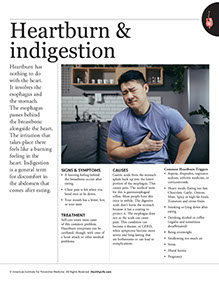
    Heartburn has nothing to do with the heart. It involves the esophagus and the stomach. The esophagus passes behind the breastbone alongside the heart. The irritation that takes place there feels like a burning feeling in the heart. Indigestion is a general term for discomfort in the abdomen that comes after eating.

    Signs & Symptoms

    *  A burning feeling behind the breastbone occurs after eating.

    *  Chest pain is felt when you bend over or lie down.

    *  Your mouth has a bitter, hot, or sour taste.

    Causes

    Gastric acids from the stomach splash back up into the lower portion of the esophagus. This causes pain. The medical term for this is gastroesophageal reflex disease (GERD). The digestive acids don’t harm the stomach. It has a coating to protect it. The esophagus doesn’t. Acids there cause pain.

    Common Heartburn Triggers

    *  Aspirin, ibuprofen, naproxen sodium, arthritis medicine, or corticosteroids.

    *  Heavy meals. Eating too fast. Chocolate. Garlic. Onions. Peppermint. Tomatoes and citrus fruits.

    *  Smoking or lying down after eating.

    *  Drinking alcohol or coffee (regular or decaffeinated).

    *  Being very overweight.

    *  Wearing tight clothing.

    *  Swallowing too much air.

    *  Stress.

    *  Hiatal hernia.

    *  Pregnancy.

    Treatment

    Self-care treats most cases of this common problem. Heartburn symptoms can be confused, though, with ones of a heart attack or other medical problems.

    Questions to Ask

    Self-Care / Prevention

    *  Sit straight while you eat. Stand up or walk around after you eat. Bending over or lying down after you eat makes it too easy for stomach acids to move up to the esophagus.

    *  Don’t smoke.

    *  Lose weight if you are overweight.

    *  If heartburn bothers you at night, raise the head of the bed. Put the head of your bed up on 6-inch blocks. You can also buy a special wedge that is made to be placed between the mattress and box spring. Don’t just prop your head up with pillows. This makes the problem worse by putting pressure on your stomach.

    *  Don’t wear garments that fit tight around the abdomen.

    *  Eat small meals. Limit alcohol.

    *  Limit foods and drinks with air. Examples are whipped cream and carbonated drinks.

    *  Don’t eat or drink for 2 to 3 hours before bedtime.

    *  If you take aspirin, ibuprofen, naproxen sodium, or arthritis medicines, take them with food.

    *  If other treatments fail, take antacids, such as Tums. If these don’t bring relief, take an over-the-counter acid controller, such as Pepcid AC, Tagamet HB, etc. These prevent and relieve heartburn. {Note: Read labels before taking antacids or acid controllers. Check with your doctor, too. Adverse side effects are more likely and more severe in older persons who take some acid controllers, such as Tagamet HB.}

    *  Don’t take baking soda. It is high in sodium and is not effective.

    Resources

    National Institute of Diabetes and Digestive and Kidney Diseases (NIDDK)

    www.niddk.nih.gov

    Healthier at Home book by the American Institute for Preventive Medicine. www.HealthyLife.com. All rights reserved.

    © American Institute for Preventive Medicine

  • Hemorrhoids

    Abdominal & Urinary Conditions

    Hemorrhoids are veins in or outside of the anus that may become dilated or swollen.

    Signs & Symptoms

    *  Bright red blood on or in the stool, on toilet paper, or in the toilet.

    *  Anal or rectal tenderness. Anal itching.

    *  Uncomfortable, painful bowel movements, especially with straining.

    *  A lump can be felt at the anus.

    *  Mucus passes from the anus.

    Causes

    Hemorrhoids are usually caused by repeated pressure in the rectal or anal veins. Often this is due to repeated straining to pass stool. The risk for getting hemorrhoids increases with:

    *  Prolonged sitting on the toilet and straining to have a bowel movement.

    *  Constipation.

    *  A low dietary fiber intake.

    *  Obesity.

    *  Pregnancy.

    Treatment

    Hemorrhoids are common. They are not likely to be a serious health problem. Most people have some bleeding from them once in a while.

    Don’t assume that rectal bleeding is “just hemorrhoids.” See your doctor to find out the cause.

    If symptoms of hemorrhoids are not relieved with self-care or with time, medical care may be needed. This includes:

    *  Laser heat or infrared light.

    *  Rubber band ligation. A rubber band is placed around the base of the hemorrhoid inside the rectum. The band cuts off blood flow to the hemorrhoid.

    *  Surgery.

    *  Cryosurgery. This freezes the affected tissue.

    Questions to Ask

    Self-Care / Prevention

    *  Drink at least 6 to 8 cups of fluid per day.

    *  Eat foods with good sources of dietary fiber, such as bran, whole- grain breads and cereals, vegetables, and fruits.

    *  Add bran to your foods. Add about 3 to 4 tablespoons per day.

    *  Eat prunes. Drink prune juice.

    *  Lose weight if you are overweight.

    *  Get regular exercise.

    *  Pass stool as soon as you feel the urge. If you wait and the urge goes away, your stool could become dry and hard. This makes it harder to pass.

    *  Don’t strain to pass stool.

    *  Don’t hold your breath when trying to pass stool.

    *  Keep the anal area clean. Use moist towelettes or wet (not dry) toilet paper after you pass stool.

    *  Don’t sit too much. This can restrict blood flow around the anal area. Don’t sit too long on the toilet. Don’t read while on the toilet.

    *  For itching or pain, put a cold compress on the anus for 10 minutes at a time. Do this up to 4 times a day.

    *  Take warm baths or use a sitz bath with hot water. A sitz bath is a basin that fits over the toilet. Get one at a medical supply or drug store.

    *  Check with your doctor about using over-the-counter products, such as:

    – Stool softeners.

    – Zinc oxide or anesthetic (numbing) products, such as Preparation H.

    – Medicated wipes, such as Tucks.

    – Suppositories.

    Resources

    National Institute of Diabetes and Digestive and Kidney Diseases (NIDDK)

    www.niddk.nih.gov

    Healthier at Home book by the American Institute for Preventive Medicine. www.HealthyLife.com. All rights reserved.

    © American Institute for Preventive Medicine

  • Hernias

    Abdominal & Urinary Conditions

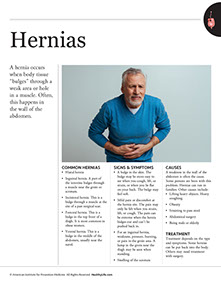
    A hernia occurs when body tissue “bulges” through a weak area or hole in a muscle. Often, this happens in the wall of the abdomen.

    Signs & Symptoms

    *  A bulge in the skin. The bulge may be more easy to see when you cough, lift, or strain, or when you lie flat on your back. The bulge may feel soft.

    *  Mild pain or discomfort at the hernia site. The pain may only be felt when you strain, lift, or cough. The pain can be extreme when the hernia bulges out and can’t be pushed back in.

    *  For an inguinal hernia, weakness, pressure, burning, or pain in the groin area. A lump in the groin near the thigh may be seen when standing.

    *  Swelling of the scrotum.

    Causes

    A weakness in the wall of the abdomen is often the cause. Some persons are born with this problem. Hernias can run in families. Other causes include:

    *  Lifting heavy objects. Heavy coughing.

    *  Obesity.

    *  Straining to pass stool.

    *  Abdominal surgery.

    *  Being male or elderly.

    Treatment

    Treatment depends on the type and symptoms. Some hernias can be put back into the body. Others may need treatment with surgery.

    Questions to Ask

    Self-Care / Prevention

    *  Don’t smoke. If you smoke, quit. Avoid secondhand smoke.

    *  Maintain a healthy diet. Lose weight if you are overweight.

    *  Avoid constipation. Don’t strain to pass stool.

    *  Exercise to keep abdominal muscles strong. Follow your doctor’s advice.

    *  When you do sit ups, keep your knees bent and your feet flat on the floor.

    *  Follow proper lifting techniques.

    *  Wear a weight lifting belt to support the back when lifting.

    *  Wear a truss. This is a device that holds a hernia in place.

    *  For mild pain, take an over-the-counter medicine for pain. If even mild pain lasts longer than a week, see your doctor.

    Common Hernias Include

    *  Hiatal hernia.

    *  Inguinal hernia. A part of the intestine bulges through a muscle near the groin or scrotum.

    *  Incisional hernia. This is a bulge through a muscle at the site of a past surgical scar.

    *  Femoral hernia. This is a bulge in the top front of a thigh. It is most common in obese women.

    *  Ventral hernia. This is a bulge in the middle of the abdomen, usually near the navel.

    Healthier at Home book by the American Institute for Preventive Medicine. www.HealthyLife.com. All rights reserved.

    © American Institute for Preventive Medicine