Tag: accountability

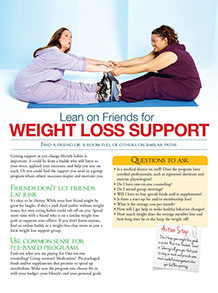
  • Lean On Friends For Weight Loss Support

    Weight Control

    Find a friend or a room full of others on similar paths.

    Getting support as you change lifestyle habits is important. It could be from a buddy who will listen to your woes, applaud your successes, and help you stay on track. Or you could find the support you need in a group program where others’ successes inspire and motivate you.

    Friends don’t let friends eat junk.

    Image of two friends eating healthy.

    It’s okay to be choosy. While your best friend might be great for laughs, if she’s a junk food junkie without weight issues, her own eating habits could rub off on you. Spend more time with a friend who is on a similar weight loss path or supports your efforts. If you don’t know anyone, find an online buddy in a weight-loss chat room or join a local weight loss support group.

    Use common sense for fee-based programs.

    Find out what you are paying for. One-on-one counseling? Group sessions? Medication? Pre-packaged foods and/or supplements that promise to speed up metabolism. Make sure the program you choose fits in with your budget, your lifestyle, and your personal goals.

    Questions to ask:

    *  Is a medical doctor on staff? Does the program have certified professionals, such as registered dietitians and exercise physiologists?

    *  Do I have one-on-one counseling?

    *  Do I attend group meetings?

    *  Will I have to buy special foods and/or supplements?

    *  Is there a start-up fee and/or membership fees?

    *  What is the average cost per month?

    *  How will I get help to make healthy behavior changes?

    *  How much weight does the average member lose and how long does he or she keep the weight off?

    Action Step

    Don’t keep your weight loss goals a secret. Post it on Facebook. Tweet it. Sharing will give you that push to stay on track and provide some much needed encouragement when you feel like quitting.
    Page from Ways to Well-Being book by the American Institute for Preventive Medicine. www.HealthyLife.com. All rights reserved.

    © American Institute for Preventive Medicine
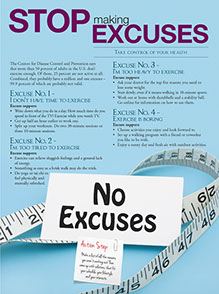
  • Stop Making Excuses

    Fitness

    Take control of your health.

    The Centers for Disease Control and Prevention says that more than 50 percent of adults in the U.S. don’t exercise enough. Of those, 25 percent are not active at all. Combined, they probably have a million and one excuses – 99.9 percent of which are probably not valid.

    Excuse No. 1 – I don’t have time to exercise.

    Excuse zappers:

    *  Write down what you do in a day. How much time do you spend in front of the TV? Exercise while you watch TV.

    *  Get up half an hour earlier to work out.

    *  Split up your workouts. Do two 30-minute sessions or three 10-minute sessions.

    Excuse No. 2 – I’m too tired to exercise.

    Excuse zappers:

    *  Exercise can relieve sluggish feelings and a general lack of energy.

    *  Something as easy as a brisk walk may do the trick.

    *  Do yoga or tai chi to feel physically and mentally refreshed.

    Excuse No. 3 – I’m too heavy to exercise.

    Excuse zappers:

    *  Ask your doctor for the top five reasons you need to lose some weight.

    *  Start slowly, even if it means walking in 10-minute spurts.

    *  Work out at home with dumbbells and a stability ball. Go online for information on how to use them.

    Excuse No. 4 – Exercise is boring.

    Excuse zappers:

    *  Choose activities you enjoy and look forward to.

    *  Set up a walking program with a friend or coworker you like to be with.

    *  Enjoy a sunny day and fresh air with outdoor activities.

    Action Step

    Make a list of all the reasons you aren’t working out. Then come up with solutions that fit your schedule, your lifestyle, and your interests.

    Page image from the Ways to Well-Being book by the American Institute for Preventive Medicine. www.HealthyLife.com. All rights reserved.

    © American Institute for Preventive Medicine

  • It Takes A Village

    Healthylife® Weigh

    Part 4

    Three friends at the beach.

    Build support around you. Support from others can help:

    *  Motivate you and lift you up when you stumble.

    *  Hold you accountable.

    *  Give you new ideas and inspiration.

    *  Make activities more fun.

    Start With One Person

    Find someone you know and trust. This could be anybody-a family member, friend, or coworker. Perhaps this person already motivates you to make positive changes in your life.

    1. Let them know what you are trying to do.

    2. Ask them if they would be willing to support you.

    3. If “yes,” say “thank you!”

    4. Let them know how to help you. This may change over time.

    5. Thank this person often. Let them know the impact they are having on your lifestyle change.

    Let Others Know How to Help You

    Even when someone wants to help you, they may not know how. You have probably experienced this already, like when someone gives you cliché advice or gives you a sweet treat to cheer you up.

    Be specific when you tell others how to help you. Here are a few ideas.

    *  Remind you of your strengths and talents.

    *  Share healthy recipes for easy meals and snacks.

    *  Plan social times that don’t involve food. For example, go for a walk or go to the same exercise class.

    *  Give you non-food gifts only.

    *  Take care of your children so you can do your planned exercise. Or, plan an event where your families can be active together.

    © American Institute for Preventive Medicine
  • Take Responsibility For Change

    Healthylife® Weigh

    Part 5

    Determined female jogging along road in the rain.

    Recognize your role in making changes. Other factors may have a role in your ability to do something. However, name something that IS in your power to change. Take control of your goals. Don’t wait for someone else to do it for you.

    Depending on someone or something else for change:

    *  I will meet my daily recommendation for vegetables when my kids start liking them more at meals.

    *  I will start a daily exercise routine when summer and warmer temperatures arrive.

    *  I will drink enough water every day when my office fixes the drinking fountain.

    Actively taking responsibility for change:

    *  I will meet my daily recommendation for vegetables when I swap my afternoon crackers for carrots and try a new vegetable at dinner each week.

    *  I will start a daily exercise routine when I set my alarm for an hour earlier and go for a brisk stroll in the morning before work.

    *  I will drink enough water every day when I fill up my water bottle one more time each day.

    Find a statement you wrote that doesn’t start with “I.” Re-write this statement to name something within your control.

    If you wait for perfect conditions, you’ll never get anything done.

    © American Institute for Preventive Medicine

  • Set A Resolution That Works For You

    BE FIT

    Image of young women jogging in the winter.

    “What’s your New Year’s resolution?” It’s a question many people hear – and ask – when Jan. 1 approaches. But, after a couple of weeks of hard work, life often interferes and that resolution gets forgotten.

    But what if you could stick with that resolution this year? Try these tips from the American Diabetes Association:

    *Be realistic.Rather than push yourself to do several major things, pick just one – such as walking.

    *Be specific.For instance, write down how often you will work out (5 days a week for 30 minutes) or that you will eat fruit instead of sweets. Schedule it in your calendar so other things are less likely to interfere.

    *Get back on track after setbacks.If you slip up, forgive yourself and start new tomorrow. Don’t abandon your healthy goals because of one mistake.

    Good health is a great goal to work towards – at New Year’s or any time of the year.

    © American Institute for Preventive Medicine
  • Tips For Keeping A Food Diary

    HEALTHY EATING

    Image of young man writing in a journal.

    If you’re trying to lose weight or simply want to eat healthier, keeping a food diary can help. Often times, we eat little bites here and there that don’t seem like much, but calories from them can add up quickly. A food diary will help you see everything you eat and drink so you can be more aware of extra calories or unhealthy choices. It can also help you see if you are eating because of stress or emotions. Then, you can find ways to stop these habits.

    A food diary doesn’t have to be complicated. Food diary apps are available, but they’re not necessary. The American Academy of Family Physicians and the CDC say you should write down these things:

    *  What you ate and drank

    *  The time you ate meals and snacks

    *  Where you ate and any other activity you were doing (watching TV, checking emails, etc.)

    *  Who you were with

    *  How you were feeling (before, during, and after eating)

    Don’t rely on your memory at the end of the day. It’s too difficult to remember every bite or sip. Instead, have the diary with you and write things down as soon as you can. Being honest and taking note of everything you eat and drink can help you see your eating patterns and pinpoint ways you can make healthy changes.

    © American Institute for Preventive Medicine