Tag: acid

  • Cool That Heartburn

    SELF-CARE CORNER

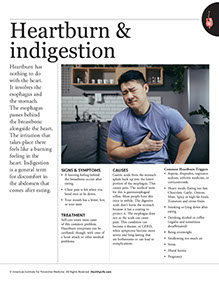
    Man suffering from heartburn.

    Do you get a burning feeling in your chest after eating or at night? Does it get worse if you lie down or bend over?

    Many people have heartburn once in a while.

    Don’t ignore frequent heartburn

    When heartburn keeps happening, it could hurt your health. Frequent heartburn that lasts longer than two weeks is called gastroesophageal reflux disease (GERD). This condition can damage your throat or even cause breathing problems.

    See a doctor about frequent heartburn so you can get treatment.

    If you get occasional heartburn, there are several ways you can reduce it or avoid it:

    *  Stay upright after eating. Don’t lie down after a meal. This can cause the acid and food to come up and into your esophagus.

    *  Avoid activities that use the tummy muscles right after eating. This includes activities like hard exercise or lifting heavy objects.

    *  Eat smaller meals. Eat your food slowly and stop before you feel overly full.

    *  Avoid heartburn triggers. This includes caffeine, chocolate, fatty foods, fried foods and spicy foods.

    *  Work toward a healthy weight if you are overweight.

    *  Ask your doctor about using an antacid for occasional heartburn.

    Heartburn drug recall

    Recently, the Food and Drug Administration (FDA) found that an acid reflux (GERD) medicine contained a “probable human carcinogen” at low levels. This means that these medicines contain something that could potentially cause cancer.

    The drug, known as ranitidine or Zantac, is an H2-blocker. It works by reducing the amount of acid in the stomach. After FDA’s announcement, some drug companies recalled their ranitidine products. Some pharmacies also pulled the medicine off their shelves.

    If you are taking ranitidine or Zantac, talk to your doctor. There are other FDA-approved medicines that could work for you. Your doctor can help you choose the best treatment.

    FDA continues to evaluate the safety of ranitidine and will provide more information as it becomes available.

    Source: Food and Drug Administration

    © American Institute for Preventive Medicine
  • Heartburn & Indigestion

    Abdominal & Urinary Conditions

    Heartburn has nothing to do with the heart. It involves the esophagus and the stomach. The esophagus passes behind the breastbone alongside the heart. The irritation that takes place there feels like a burning feeling in the heart. Indigestion is a general term for discomfort in the abdomen that comes after eating.

    Signs & Symptoms

    *  A burning feeling behind the breastbone occurs after eating.

    *  Chest pain is felt when you bend over or lie down.

    *  Your mouth has a bitter, hot, or sour taste.

    Causes

    Gastric acids from the stomach splash back up into the lower portion of the esophagus. This causes pain. The medical term for this is gastroesophageal reflex disease (GERD). The digestive acids don’t harm the stomach. It has a coating to protect it. The esophagus doesn’t. Acids there cause pain.

    Common Heartburn Triggers

    *  Aspirin, ibuprofen, naproxen sodium, arthritis medicine, or corticosteroids.

    *  Heavy meals. Eating too fast. Chocolate. Garlic. Onions. Peppermint. Tomatoes and citrus fruits.

    *  Smoking or lying down after eating.

    *  Drinking alcohol or coffee (regular or decaffeinated).

    *  Being very overweight.

    *  Wearing tight clothing.

    *  Swallowing too much air.

    *  Stress.

    *  Hiatal hernia.

    *  Pregnancy.

    Treatment

    Self-care treats most cases of this common problem. Heartburn symptoms can be confused, though, with ones of a heart attack or other medical problems.

    Questions to Ask

    Self-Care / Prevention

    *  Sit straight while you eat. Stand up or walk around after you eat. Bending over or lying down after you eat makes it too easy for stomach acids to move up to the esophagus.

    *  Don’t smoke.

    *  Lose weight if you are overweight.

    *  If heartburn bothers you at night, raise the head of the bed. Put the head of your bed up on 6-inch blocks. You can also buy a special wedge that is made to be placed between the mattress and box spring. Don’t just prop your head up with pillows. This makes the problem worse by putting pressure on your stomach.

    *  Don’t wear garments that fit tight around the abdomen.

    *  Eat small meals. Limit alcohol.

    *  Limit foods and drinks with air. Examples are whipped cream and carbonated drinks.

    *  Don’t eat or drink for 2 to 3 hours before bedtime.

    *  If you take aspirin, ibuprofen, naproxen sodium, or arthritis medicines, take them with food.

    *  If other treatments fail, take antacids, such as Tums. If these don’t bring relief, take an over-the-counter acid controller, such as Pepcid AC, Tagamet HB, etc. These prevent and relieve heartburn. {Note: Read labels before taking antacids or acid controllers. Check with your doctor, too. Adverse side effects are more likely and more severe in older persons who take some acid controllers, such as Tagamet HB.}

    *  Don’t take baking soda. It is high in sodium and is not effective.

    Resources

    National Institute of Diabetes and Digestive and Kidney Diseases (NIDDK)

    www.niddk.nih.gov

    Healthier at Home book by the American Institute for Preventive Medicine. www.HealthyLife.com. All rights reserved.

    © American Institute for Preventive Medicine
  • Peptic Ulcers

    Abdominal & Urinary Conditions

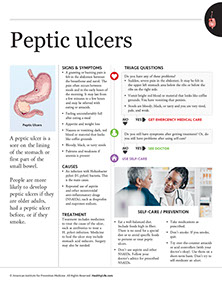
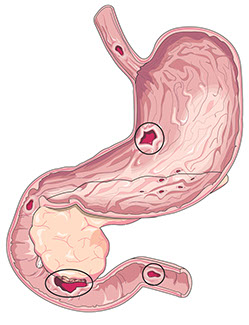
    Illustration of a peptic ulcer.

    A peptic ulcer is a sore in the stomach or first part of the small bowel.

    Peptic Ulcers

    Signs & Symptoms

    *  A gnawing or burning pain is felt in the abdomen between the breastbone and navel. The pain often occurs between meals and in the early hours of the morning. It may last from a few minutes to a few hours and may be relieved with eating or antacids.

    *  Appetite and weight loss.

    *  Nausea or vomiting dark, red blood or material that looks like coffee grounds.

    *  Bloody, black, or tarry stools.

    *  Paleness and weakness if anemia is present.

    Causes

    *  An infection with Helicobacter pylori (H. pylori) bacteria. This is the main cause.

    *  The repeated use of aspirin and other nonsteroidal anti-inflammatory drugs (NSAIDs), such as ibuprofen and naproxen sodium.

    A small percentage of peptic ulcers are caused by Zollinger-Ellison Syndrome. With this rare disorder, the body makes excess acid.

    Family history, smoking, caffeine, and making excess digestive acids play a role in peptic ulcers. So does stress, especially some types of physical stress (e.g., severe burns and major surgery).

    Treatment

    Treatment includes medicines to treat the problem and surgery, if needed.

    Questions to Ask

    Self-Care / Prevention

    *  Take medications as prescribed.

    *  Eat healthy foods. Include foods high in fiber.

    *  Don’t have coffee (regular and decaffeinated); tea and soft drinks with caffeine; and fruit juices high in acid like tomato juice. Don’t have alcohol or foods that bother you.

    *  Don’t use aspirin and other NSAIDs. Follow your doctor’s advice for prescribed NSAIDs.

    *  Try over-the-counter antacids or acid controllers (with your doctor’s okay). Use them on a short-term basis. Don’t try to self- medicate an ulcer.

    *  Don’t smoke. If you smoke, quit.

    Healthier at Home book by the American Institute for Preventive Medicine. www.HealthyLife.com. All rights reserved.

    © American Institute for Preventive Medicine