Tag: assessment

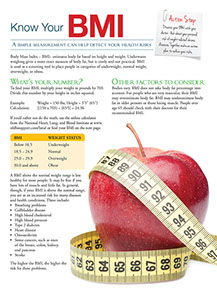
  • Know Your Bmi

    Weight Control

    A simple measurement can help detect your health risks.

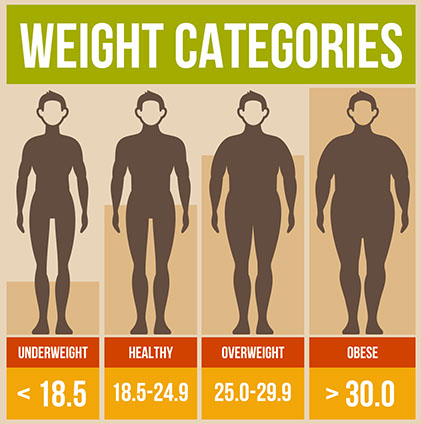
    Body Mass Index − BMI− estimates body fat based on height and weight. Underwater weighing gives a more exact measure of body fat, but is costly and not practical. BMI is used as a screening tool to place people in categories of underweight, normal weight, overweight, or obese.

    Illustration of BMI weight categories.

    What’s your number?

    To find your BMI, multiply your weight in pounds by 703.

    Divide this number by your height in inches squared.

    Example: Weight = 150 lbs; Height = 5’5″ (65″)

    Calculation: [(150 x 703) ÷ (65²)] = 24.96

    If you’d rather not do the math, use the online calculator  from the National Heart, Lung, and Blood Institute atwww.nhlbisupport.com/bmi.

    BMI – WEIGHT STATUS

    Below 18.5 – Underweight

    18.5 – 24.9 – Normal

    25.0 – 29.9 – Overweight

    30.0 and above Obese

    A BMI above the normal weight range is less healthy for most people. It may be fine if you have lots of muscle and little fat. In general, though, if your BMI is above the normal range, you are at an increased risk for many diseases and health conditions. These include:

    *  Breathing problems

    *  Gallbladder disease

    *  High blood cholesterol

    *  High blood pressure

    *  Type 2 diabetes

    *  Heart disease

    *  Osteoarthritis

    *  Some cancers, such as ones   of the breast, colon, kidney,  and pancreas

    *  Stroke

    The higher the BMI, the higher the risk for these problems.

    Other factors to consider

    Bodies vary. BMI does not take body fat percentage into account. For people who are very muscular, their BMI may overestimate body fat. BMI may underestimate body fat in older persons or those losing muscle. People over age 65 should check with their doctors for their  recommended BMI.

    Action Step

    Discuss your BMI with your doctor.  Ask about your personal risk of weight-related chronic diseases. Together, make an action plan to reduce your risks.

    Page from Ways to Well-Being book by the American Institute for Preventive Medicine. www.HealthyLife.com. All rights reserved.

    © American Institute for Preventive Medicine

  • Test Your Fitness Level

    Fitness

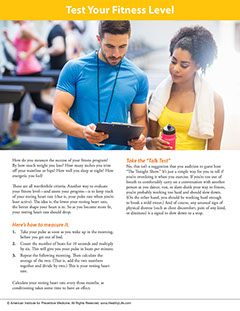
    Image of women talking to her fitness trainer.

    How do you measure the success of your fitness program? By how much weight you lose? How many inches you trim off your waistline or hips? How well you sleep at night? How energetic you feel?

    These are all worthwhile criteria. Another way to evaluate your fitness level-and assess your progress-is to keep track of your resting heart rate (that is, your pulse rate when you’re least active).

    The idea is, the lower your resting heart rate, the better shape your heart is in. So as you become more fit, your resting heart rate should drop.

    Here’s how to measure it.

    1.  Take your pulse as soon as you wake up in the morning, before you get out of bed.

    2.  Count the number of beats for 10 seconds and multiply by six. This will give you your pulse in beats per minute.

    3.  Repeat the following morning. Then calculate the average of the two. (That is, add the two numbers together and divide by two.) This is your resting heart rate.

    Calculate your resting heart rate every three months, as conditioning takes some time to have an effect.

    Take the “Talk Test”

    No, this isn’t a suggestion that you audition to guest host “The Tonight Show.” It’s just a simple way for you to tell if you’re overdoing it when you exercise. If you’re too out of breath to comfortably carry on a conversation with another person as you dance, run, or slam-dunk your way to fitness, you’re probably working too hard and should slow down. (On the other hand, you should be working hard enough to break a mild sweat.) And of course, any unusual sign of physical distress (such as chest discomfort, pain of any kind, or dizziness) is a signal to slow down to a stop.

    Page image from A Year of Health Hints book by the American Institute for Preventive Medicine. www.HealthyLife.com. All rights reserved.

    © American Institute for Preventive Medicine

  • First Aid Precautions

    First Aid

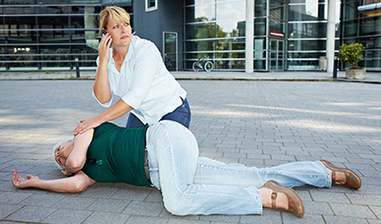
    Image of women on phone beside someone who is unresponsive.

    First Aid Safety Steps

    1.  LOOK around. Is it safe to help? If not, call  9-1-1, have someone else call, or seek medical help. If it is safe to help, stay calm and go to step 2.

    2.  CHECK for a response.

    *  Gently tap the person. Ask, “Are you okay?” Ask loudly. Call the person by name if you know it.

    *  If the person responds or moves, attend to his or her problem, as needed. If the person is injured or the problem is serious, call for emergency medical care. Give first aid as needed, until medical help arrives.

    *  If the person does not respond or move, begin CPR.

    3.  PROTECT yourself from hepatitis B virus and HIV, the virus that causes AIDS. You can get these from an infected person’s blood or other body fluids if they enter your body. These organisms can enter through cuts or breaks in your skin or through the lining of your mouth, nose, and eyes. When you give first aid or do CPR, take these steps, especially if you don’t know the person:

    *  Use plastic wrap or a plastic bag that you can throw away whenever you touch another person’s body fluids, blood, or other objects that may be soiled with his or her blood. If possible, have the person apply pressure to the wound with his or her own hand.

    *  Cover the person’s open wounds with dressings, extra gauze, or waterproof material.

    *  Using a mouth-to-mouth barrier device when you give rescue breaths may or may not protect you from picking up an infection. You do not need to give rescue breaths with Hands-Only CPR.

    *  Within 1 to 2 hours, report every incident that exposes you to another person’s blood or other body fluids to your doctor and EMS personnel.

    4.  FIND out if the person has certain medical needs.

    *  Ask if he or she has prescribed medicine, such as nitroglycerin, to take for a heart condition. Ask where he or she keeps the medicine. Find out how much to give. Ask the person or read the directions on the medicine’s label, if there is one.

    *  Ask the person if you can give the medicine to him or her.

    *  Look for a medical alert tag to find out about health problems the person has.

    *  Find out if the person is allergic to any medicine.

    Healthier at Home book by the American Institute for Preventive Medicine. www.HealthyLife.com. All rights reserved.

    © American Institute for Preventive Medicine

  • Survey Your Starting Point

    Healthylife® Weigh

    Part 1

    Man smiling.

    Complete the survey below by tracking it in your journal or using the “Print on Demand”. This survey looks at the “big picture” – your overall goals, current habits, strengths, weaknesses, support system, and other factors that influence behavior. Each question has a purpose. Complete all sections. This is one of many opportunities in this guide for self-discovery and reflection.

    Be honest with yourself. If you are working with a coach, answers to these questions may help your coach tailor the program to your needs. If you are using HealthyLife® Weigh on your own, the prompts throughout the guide will help you “coach” yourself!

    My Current Habits Survey

    Today’s Date:

    My Height:

    My Current Weight:

    Have you been told to lose weight for health reasons?

    Which medical conditions that apply to you:

    *   Diabetes

    *   Prediabetes

    *   High blood pressure

    *   High cholesterol

    *   Heart disease

    *   Heart attack

    *   Stroke

    *   Cancer

    *   Chronic back pain

    *   Arthritis

    *   Asthma

    *   Sleep apnea

    REMEMBER:The guidelines in HealthyLife® Weigh do not take the place of medical advice. If you are managing a chronic health condition or taking medication, it is important to let your doctor know of any changes you are making to your diet and exercise habits.

    Indicate how strongly you agree or disagree with the following statements. If how you feel varies, select how you feel on most days.

    *  My current weight puts me at higher risk for health problems.

    *  I know the benefits of a well-balanced diet.

    *  I know the benefits of making regular physical exercise a part of my daily lifestyle.

    *  I am confident in my ability to reach my physical activity goals.

    *  I am confident in my ability to improve my eating habits.

    *  I eat for emotional reasons (stress, boredom, joy, etc.) several times a week.

    *  Making changes to my health is a priority for me.

    *  Choices I make daily affect my health risks in the future.

    *  I am confident in my ability to improve how I manage stress.

    *  I have control over the direction my life is taking.

    *  It is not wise to plan too far ahead because many things turn out to be a matter of luck anyway.

    *  When I make plans or set goals, I am almost certain that I can make them work and achieve my goals.

    Identify the habits you have already adopted, those you are in the process of changing, and those you do not intend to change right now.

    *  Exercise five times per week for 30 minutes at a moderate intensity.*

    *  Take the stairs or park a little farther away.

    *  Eat five servings of fruits & vegetables daily.**

    *  Choose foods high in fiber (such as whole grains, oatmeal, beans, & lentils).

    *  Limit added sugars to fewer than 25 grams (6 tsp.) per day.

    *  Keep healthy food options in my kitchen and limit unhealthy options.

    *  Choose restaurants that offer healthy menu options.

    *  Moderate intensity exercise includes brisk walking, active gardening/yard work, or any  activity that raises your heart rate.

    **A serving of fruits and vegetables equals one small piece of fruit (about the size of a baseball), ½ cup cooked vegetables, or 1 cup of raw vegetables.

    Which cooking skills you feel confident doing:

    *  Cooking on the stove

    *  Cooking in the microwave

    *  Cooking in the oven

    *  Chopping vegetables

    *  Boiling water

    *  Opening a can

    *  Using the toaster

    *  Using a blender

    *  Using measuring utensils

    *  Following a recipe

    *  Using a food scale

    *  Using a toaster oven

    *  Cooking on the grill

    *  Freezing leftovers

    *  Modifying a recipe

    What cooking skills do you want to learn or improve? This guide gives some tips to prepare foods. For more recipes, tips, and demonstrations, consider taking a cooking class, watch videos online, or watch cooking shows on TV.

    What are your favorite ways to prepare food? In this guide, you will learn healthy ways to prepare foods. You don’t have to completely change how you like to prepare food. Often, a small step can make a big difference-and be just as convenient!
    © American Institute for Preventive Medicine