Tag: autism

  • Understanding Autism

    MEDICAL NEWS

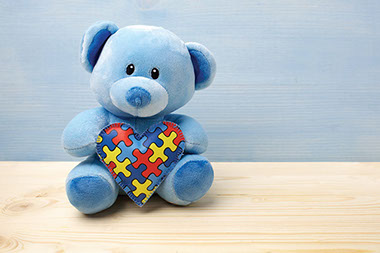
    Blue teddy bear holding heart with autism puzzle icon.

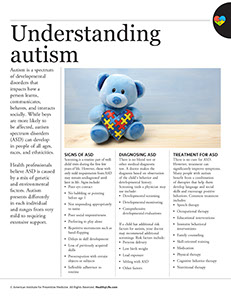
    Autism is a spectrum of developmental disorders that impacts how a person learns, communicates, behaves, and interacts socially. While boys are more likely to be affected, autism spectrum disorders (ASD) can develop in people of all ages, races, and ethnicities.

    Health professionals believe ASD is caused by a mix of genetic and environmental factors. Autism presents differently in each individual and ranges from very mild to requiring extensive support.

    Signs of ASD

    Screening is a routine part of well-child visits during the first few years of life. However, those with only mild impairments from ASD may remain undiagnosed until later in life. Signs include:

    *  Poor eye contact

    *  No babbling or pointing before age 1

    *  Not responding appropriately to name

    *  Poor social responsiveness

    *  Preferring to play alone

    *  Repetitive movements such as hand-flapping

    *  Delays in skill development

    *  Loss of previously acquired skills

    *  Preoccupation with certain objects or subjects

    *  Inflexible adherence to routine

    Diagnosing ASD

    There is no blood test or other medical diagnostic test. A doctor makes the diagnosis based on observation of the child’s behavior and developmental history. Screening tools a physician may use include:

    *  Developmental screening

    *  Developmental monitoring

    *  Comprehensive developmental evaluations

    If a child has additional risk factors for autism, your doctor may recommend additional screenings. Risk factors include:

    *  Preterm delivery

    *  Low birth weight

    *  Lead exposure

    *  Sibling with ASD

    *  Other factors

    Treatment for ASD

    There is no cure for ASD. However, treatment can significantly improve symptoms. Many people with autism benefit from a combination of therapies that help them develop language and social skills and encourage positive behaviors. Common treatment includes:

    *  Speech therapy

    *  Occupational therapy

    *  Educational interventions

    *  Intensive behavioral interventions

    *  Family counseling

    *  Skill-oriented training

    *  Medication

    *  Physical therapy

    *  Cognitive behavior therapy

    *  Nutritional therapy
    © American Institute for Preventive Medicine

  • Vaccines & Autism: The Facts

    MEDICAL NEWS

    Young child and teacher.

    Autism spectrum disorder (ASD) is a brain disorder that happens while the brain is developing. It can cause challenges with social, communication and behavioral skills.

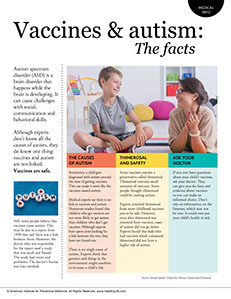
    Although experts don’t know all the causes of autism, they do know one thing: vaccines and autism are not linked. Vaccines are safe.

    Still, some people believe that vaccines cause autism. This may be due to a report from 1998 that said there was a link between them. However, the doctor who was responsible for the report used a study that was small and flawed. The study had errors and problems. The doctor’s license was later revoked.

    The causes of autism

    Sometimes, a child gets diagnosed with autism around the time of getting vaccines. This can make it seem like the vaccines caused autism.

    Medical experts say there is no link to vaccines and autism. Numerous studies found that children who get vaccines are not more likely to get autism than children who don’t get vaccines. Although experts have spent years looking for a link between the two, they have not found one.

    There is no single cause of autism. Experts think that genetics and things in the environment might combine to increase a child’s risk.

    Thimerosal and safety

    Some vaccines contain a preservative called thimerosal. Thimerosal contains small amounts of mercury. Some people thought thimerosal could be causing autism.

    Experts removed thimerosal from most childhood vaccines just to be safe. However, even after thimerosal was removed from vaccines, cases of autism did not go down. Experts found that kids who had vaccines which contained thimerosal did not have a higher risk of autism.

    Ask your doctor

    If you ever have questions about your child’s vaccines, ask your doctor. They can give you the facts and evidence about vaccines so you can make an informed choice. Don’t rely on information on the Internet, which may not be true. It could even put your child’s health at risk.

    Source: Autism Speaks, Centers for Disease Control and Prevention

    © American Institute for Preventive Medicine
  • Know The Signs Of Autism

    MEDICAL NEWS

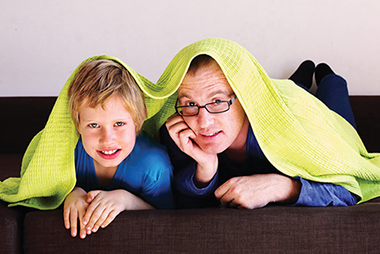
    Image of father and young son.

    Autism affects about 1 in 68 children in our country today, according to the CDC. Autism is a developmental disability that can affect how a person interacts with others, learns, and behaves. For some people, the symptoms are severe. Others can lead fairly normal, independent lives.

    Although experts don’t know what causes autism in many cases, they do know that treating it early can help improve symptoms. Many children with autism show some signs between one and two years of age.

    Now is a great time to learn the early signs of autism and talk to your child’s physician if needed. Some signs to watch for are if your child:

    *  Doesn’t respond to his or her name

    *  Doesn’t point, wave, or gesture

    *  Doesn’t look people in the eye or respond to facial expressions

    *  Doesn’t like physical contact with others

    *  Repeats words or phrases over and over, often without knowing what they mean

    *  Performs repeated body movements such as rocking, spinning, or twirling hands or fingers

    *  Has obsessive interests in only a few activities

    *  Gets very upset with change or differences in routines

    *  Is very interested in organization, such as lining things up in a certain way

    *  Talks in a “robot-like” voice with no emotion or change in tone

    If your child has one of these signs or you notice any unusual behavior, it doesn’t mean your child has autism. But, you should talk with your child’s doctor if you are concerned or have questions about your child’s well-being.

    © American Institute for Preventive Medicine