Introduction
Work Stress Factors
Burnout Self Inventory
Identify Your Burnout Traits
Work Stressor Questionnaire
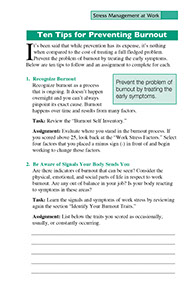
Ten Tips for Preventing Burnout
It’s been said that while prevention has its expense, it’s nothing when compared to the cost of treating a full-fledged problem. Prevent the problem of burnout by treating the early symptoms. Below are ten tips to follow and an assignment to complete for each.
1. Recognize Burnout
Recognize burnout as a process that is ongoing. It doesn’t happen overnight and you can’t always pinpoint its exact cause. Burnout happens over time and results from many factors.
Task: Review the “Burnout Self Inventory“.
Assignment: Evaluate where you stand in the burnout process. If you scored above 25, look back at the “Work Stress Factors“. Select four factors that you placed a minus sign (-) in front of and begin working to change those factors.
2. Be Aware of Signals Your Body Sends You
Are there indicators of burnout that can be seen? Consider the physical, emotional, and social parts of life in respect to work burnout. Is your body reacting to symptoms in these areas?
Task: Learn the signals and symptoms of work stress by reviewing again the section “Identify Your Burnout Traits“.
Assignment: List the traits you scored as occasionally, usually, or constantly occurring.
3. Have Realistic Goals
Reconsider your work goals and life priorities. Did you set these goals when you were young and inexperienced? Have you updated them? Are they realistic goals? Have you pushed or stretched yourself too far? Have you set yourself up for failure? Changing goals is not always lowering standards. It’s adjustment. Each day, have goals that are reasonable. Share your goals with someone else.
Task: How realistic are your daily work goals? Rate them on the scale below:
1 2 3 4 5 6 7 8 9 10
1 being totally unrealistic; 5 being somewhat realistic; 10 being extremely realistic
Assignment: Re-check your goals. Check what you plan to do:
* Attend a time management course.
* Read a book on time management.
* Attend a goal setting course.
* Read up on goal setting.
4. Think About What’s Really Important To You
It’s easy to be vague on this topic, but re-thinking goals should be a regular event in everyone’s life.
Task: What are your life priorities at this moment? Rate the ones listed below on a scale of 1 – 8. (1 = most important 8 = least important)
* family/parenting
* social/recreational
* education
* spiritual
* out-of-home work
* fitness/wellness
* in-home work
Assignment: What changes do you think need to be made?
5. Reduce Long Work Hours
There is a definite link between the amount of overtime you work and your stress levels. The more hours you work, the more likely you are to burn out. Some workers put in extra hours because they feel that no one else can handle their tasks. Whatever the reason for excessive overtime, increased tension levels and burnout often result.
Task: Think about your most effective hours for work. This is your “prime time” for being productive. List these hours here. My “prime time” is _________________. Schedule your top priority work in that time slot for one week. Your productivity should improve.
Assignment: What changes could you reasonably make in your work schedule?
6. Get Involved In Exercise
Non-competitive physical activity is a healthy release for an overworked person. It reduces the effects of stress in general and does not have to be strenuous. Regular walking is a good example. It allows your body to release tension through muscle activity. On the other hand, competitive activities, such as tennis or racquetball, can produce even higher stress levels in some people. However, if you find your work is too dull, competition in sports may suit you. You are the best judge.
Task: What is your current weekly level of physical activity? Are you satisfied with this frequency?
Assignment: Set a goal for frequency of physical activity for the next six weeks.
7. Give Yourself A Special Treat
It doesn’t have to be costly, but it should be special. It should be a break in your routine. Pamper yourself.
Task: List the last time you gave yourself a special treat.
Assignment: List personal, special treats for you.
8. Start Your Day Slowly
Early morning activities can set the mood for the whole day. It’s a great planning time and can help you prepare or rehearse for the rest of the day. Include a healthy breakfast to prevent low blood sugar levels. Enjoy the morning and look forward to a productive day.
Task: Indicate how much time you generally give yourself from the time you get up to when you actually begin work. Are you rushed?
Assignment: List changes in your morning schedule you want to make. Indicate how much time you will need for each.
9. Use Relaxation Skills
Relaxation skills provide a sense of well-being. Sit in a comfortable chair. Think about relaxing muscles in your face, neck, and shoulders. Take off your shoes and gently close your eyes. Take a deep breath, hold it three seconds, then blow the breath out. Repeat several times. Relaxation techniques can give you renewed energy for the rest of the day.
Task: Indicate what you currently do to relax.
Assignment: Learn and practice additional relaxation techniques. List which technique you will use.
10. Mentally Remove Yourself from Your Job
Step back and try to look at your job from an outsider’s point of view. Imagine how others might handle your responsibilities.
Task: Review your job description.
Assignment: Write a realistic job description below. Discuss making changes in your job with your supervisor.
Conclusion to Step 2
This concludes the unit on Stress Management at Work. The questionnaires, exercises, and self-help material are all designed to keep work stress in balance with other parts of daily living. Practice skills that minimize the risk of burnout along with the other stress management tools that you’ve learned.