Introduction
The Mind/Body Bridge
Biofeedback Training Record
Breathing Exercises
The Relaxation Response
The Relaxation Reflex
Mental Imagery
Personal Mental Imagery
Auto-Suggestion
Stretching the Stress Triangle
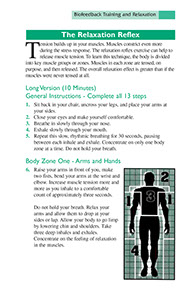
Tension builds up in your muscles. Muscles constrict even more during the stress response. The relaxation reflex exercise can help to release muscle tension. To learn this technique, the body is divided into key muscle groups or zones. Muscles in each zone are tensed, on purpose, and then released. The overall relaxation effect is greater than if the muscles were never tensed at all.
Long Version (10 Minutes)
General Instructions – Complete all 13 steps
1. Sit back in your chair, uncross your legs, and place your arms at your sides.
2. Close your eyes and make yourself comfortable.
3. Breathe in slowly through your nose.
4. Exhale slowly through your mouth.
5. Repeat this slow, rhythmic breathing for 30 seconds, pausing between each inhale and exhale. Concentrate on only one body zone at a time. Do not hold your breath.
Body Zone One – Arms and Hands
6. Raise your arms in front of you, make two fists, bend your arms at the wrist and elbow. Increase muscle tension more and more as you inhale to a comfortable count of approximately three seconds. Do not hold your breath. Relax your arms and allow them to drop at your sides or lap. Allow your body to go limp by lowering chin and shoulders. Take three deep inhales and exhales. Concentrate on the feeling of relaxation in the muscles.
Body Zone Two – Head and Neck
7. Scrunch your eyes, nose, cheeks, and brows; stretch your mouth and grit your teeth; tuck your chin down towards your chest. Hold for three to seven seconds. Do not hold your breath. Release the face and neck muscles. Allow your body to go limp by releasing head and shoulders. Take three deep inhales and exhales. Concentrate on the feeling of relaxation in the muscle zone.
Body Zone Three – Middle Torso
8. Thrust your shoulder blades back, tighten the muscles in your stomach and in the small of your back. Hold for three to seven seconds. Do not hold your breath. Release the muscles of the shoulders, back, and abdomen. Allow your body to go limp by releasing your head and shoulders. Take three deep inhales and exhales while concentrating on the feeling of relaxation in the muscles. Discontinue if any pain or discomfort is felt.
Body Zone Four – Legs and Feet
9. Lift one foot off the floor; hold the leg straight; point your toes back towards your face; increase muscle tension as you inhale slowly. Hold for three to seven seconds. Do not hold your breath. Relax each leg and allow it to drop to the floor. Allow your body to go limp by releasing your head and shoulders. Take three deep inhales and exhales. Concentrate on the feeling of relaxation in the muscles.
Final Steps
10. Imagine a warm, heavy wave of relaxation flowing in your head.
11. Now imagine the warmth and heaviness of the wave of relaxation as it flows down through your neck, down your shoulders, out your arms to your hands and fingers, through your chest, back, stomach and hips, down your legs to your feet and toes.
12. Feel the warmth and heaviness from the wave of relaxation throughout your body. Note the warm, tingling sensation in your hands and feet.
13. Slowly open your eyes and resume your normal activities.
Short Version (12 Seconds)
Not everyone has ten full minutes to reduce muscular tension. This twelve-second version of the Relaxation Reflex can be learned after three to four weeks of practicing the ten-minute version. Your body will quickly respond to the familiar signals to relax.
1. Become aware of body tension. Focus on your breathing.
2. Inhale slowly for a count of three seconds.
3. Slowly exhale to a count of 3 seconds and at the same time allow your body to go limp by dropping your head and shoulders.
4. Again, inhale slowly to a count of three seconds. Hold for a count of three.
5. Slowly exhale to a count of three. Imagine the warm, heavy wave of relaxation energy flowing down from your head through your body. Allow the wave of relaxation to reach your toes.
Note of Caution:
Do not tense any part of the body that is weakened, such as a bad back. Do not use this technique if you have a history of heart problems.