Tag: balance

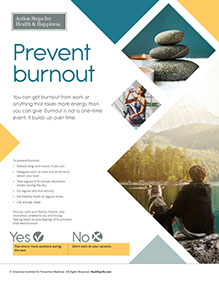
  • Prevent Burnout

    Stress Management

    Image of women with head in her hands.

    Recognize and treat early signs.

    Burnout isn’t something that happens overnight. It occurs over time from repeated and unresolved frustration or constant pressure to perform or achieve. With burnout, you feel exhausted, worn out, and detached from others. You feel as if you have nothing more to give and simply do not care about anything. Burnout puts your job, your relationships, and your health in jeopardy.

    Ten tips to prevent burnout:

    1.  Set career and personal goals that can be achieved.

    2.  Follow healthy eating and sleeping habits.

    3.  Exercise daily – At least 30 minutes most days of the week.

    4.  Try not to spread yourself too thin. Delegate tasks at work and at home.

    5.  Reduce long work or study hours, if you can. The more you do and the less you rest, the more likely burnout will occur.

    6.  Take regular five to 10 minute relaxation breaks. Take mental breaks from stressful situations, too. Learn to meditate. Practice relaxation techniques.

    7.  Make time for leisure activities that you enjoy and look forward to.

    8.  Get creative with a hobby or activity that has nothing to do with work.

    9.  Manage stress through meditation, yoga, or therapy.

    10. Plan a vacation one or more times a year. Leave your work at home!

    Signs on the road to burnout:

    *  Too much work, not enough relaxation

    *  Feeling as if you have no control over your job

    *  Anger

    *  Fatigue

    *  Sleep problems

    *  Escaping through alcohol, drugs, TV, eating, or gambling

    *  Avoiding making decisions

    *  Negative view of yourself and the world

    Also, some traits increase the risk for burnout. These include the need to be in control, wanting everything to be perfect, and being a workaholic.

    Action Step

    Discuss feelings and problems you are having with your family, friends, and coworkers. Talking helps ease feelings of frustration that can feed burnout. If things do not get better, get professional help.

    Page from Ways to Well-Being book by the American Institute for Preventive Medicine. www.HealthyLife.com. All rights reserved.

    © American Institute for Preventive Medicine

  • Pick Healthy Proteins

    HEALTHY EATING

    Close up on dinner table with food and hands with silverware about to eat.

    Protein is a powerhouse. Proteins act as building blocks for bones, muscles, cartilage, skin and blood. Proteins also provide calories. It is important that you eat enough protein every day. But when you are choosing proteins to eat, it is important that those proteins come from heart-healthy sources.

    How Much You Need Each Day?

    The amount of protein you need varies, depending on your age, sex, height, weight and physical activity. Being pregnant may also affect how much you need. Visitmyplate.gov/myplate-planto find out how much you need.

    Talk to your doctor about what your daily recommended allowance of protein should be and take steps to meet that goal regularly.

    What Kinds of Proteins?

    Most people eat enough protein, but much of it comes from meat sources that are high in saturated fat. Choose lean meats and plant-based proteins to get your daily allowance and to maintain a healthy lifestyle. These include:

    *  Poultry

    *  Seafood

    *  Lentils

    *  Beans

    *  Nuts

    *  Soy

    *  Eggs

    *  Seeds

    These foods are also packed with nutrients, such as B vitamins (niacin, thiamin, riboflavin and B6), vitamin E, iron, zinc and magnesium.

    © American Institute for Preventive Medicine

  • Control Portion Sizes

    Weight Control

    Smiling women holding 4 pre-prepped meals.

    It’s all about portion control!

    *  First, learn how much food you need. Get a personalized MyPlate Plan atmyplate.gov/eat-healthy/what-is-myplatethat identifies how many cups, ounces, etc. of different foods you should eat for your daily needs.

    *  Use measuring cups, spoons, etc.

    *  Estimate portions. One cup of cereal is about the size of 2 hands, cupped. Three ounces of meat is about the size of a computer mouse. One Tbsp. is the size of 1 thumb.

    *  Limit second helpings, especially of foods high in fat and sugar.

    Page from HealthyLife Weigh book by the American Institute for Preventive Medicine. www.HealthyLife.com. All rights reserved.

    © American Institute for Preventive Medicine

  • Deal With Debt

    Financial Health

    Get out of debt on your own or with help.

    Whether it’s from living above your means, expensive medical bills, a job loss, or supporting your parents, you can eliminate debt. The first step is to avoid getting deeper in debt. Limit spending to essentials and follow a plan to pay down the debt.

    On your own:

    *  Cut up credit cards or put them away until they are paid off.

    *  Rank order what needs to be paid off – student and other loans, credit cards, etc.

    *  Contact your creditors right away to work out payment plans that you can manage. Do this before debt collectors get involved. If you can’t work out a plan with your mortgage company, contact the local office of the Department of Housing and Urban Development or the housing authority in your state, city, or county for help in finding a legitimate housing counseling agency near you.

    *  Bring in more income from a part time job and selling household items you no longer need at a garage sale or online site, such as Ebay. Consider selling some of your gold and silver jewelry for cash.

    Get professional help from:

    *  A professional financial planner through work

    *  The Financial Planning Association (FPA) at 800.647.6340 orwww.fpanet.org

    *  The National Foundation for Credit Counseling at 800.388.2227 orwww.nfcc.org/FirstStep/firststep_03.cfm.

    Beware of any debt relief service that*:

    *  Charges any fees before it settles your debts

    *  Pressures you to make “voluntary contributions,” another name for fees

    *  Touts a “new government program” to bail out personal credit card debt

    *  Guarantees it can make your debt go away

    *  Tells you it can stop all debt collection calls and lawsuits

    *  Guarantees that your credit card and any other debt not tied to an asset, such as your house, can be paid off for just pennies on the dollar

    *  Offers to enroll you in a debt management program (DMP) without teaching you skills to budget and manage your money

    *  Adapted fromwww.ftc.gov/bcp/edu/pubs/consumer/credit/cre19.shtm

    Action Step

    Pay off the credit card or other debt with the lowest balance first. After this is paid in full, pay down the next debt with the lowest balance.

    Ways to Well-Being book by the American Institute for Preventive Medicine. www.HealthyLife.com. All rights reserved.

    © American Institute for Preventive Medicine

  • Plant-Forward Eating

    HEALTHY EATING

    Variety of plant based foods.

    A plant-forward style of eating is one that features plant foods as the star of most meals. Animal foods such as meat and dairy may be included but are not the main focus. There are many ways to be plant-forward and improve the health of your diet.

    How it works

    Plant-forward eating is less of a diet prescription and more of a healthy food mindset.

    Each meal begins with the question: “what plants can I add to my plate?” Animal products should be a secondary consideration and eaten in small amounts.

    A plant-forward diet focuses on:

    *  Whole grains such as brown rice, quinoa, amaranth, bulger, whole wheat, millet, and oatmeal

    *  Plant proteins such as nuts, nut butter, seeds, soy, beans, peas, and lentils

    *  A variety of vegetables of every color

    *  Whole fruits

    *  Quality plant fats such as olive oil, avocados, canola oil, and nuts

    Benefits

    Plant-forward eating has many benefits to physical health. Diets high in plant foods are linked to improved health and a lower risk of disease. Eating less meat reduces your risk of:

    *  Obesity

    *  Heart disease

    *  Stroke

    *  Type 2 diabetes

    *  High blood pressure

    *  High blood lipids

    *  Certain cancers

    In addition, a plant-focused diet benefits the environment. Fewer animal products may translate to lower greenhouse gas emissions and more responsible land, energy, and water usage.

    Getting started

    Gradual change over time is the best way to create healthy habits. It also helps to get family members on board with “plant forward.” Here’s how to get started:

    *  Take it one meal at a time. Start with just breakfast or lunch being meat-free.

    *  Find a few simple, meatless recipes to try. Look for those big on flavor.

    *  Add more of the plant foods you already love to your plate and shopping cart. Gradually branch out for more variety.

    *  Swap out the meat in a recipe for a plant protein like beans or tofu.

    *  Aim to make three-fourths of your plate plant foods.

    *  Reduce your meat portions by half.

    © American Institute for Preventive Medicine