Tag: Bone & Muscle

  • Back Care

    Bone & Muscle Problems

    Back pain can be sharp, dull, acute, or chronic. It can be felt on one or both sides of the back.

    Causes

    Low Back Problems

    Back pain occurs most often in the lower back. That is where the human body absorbs the most weight and stress. About half of working age adults have low back problems. Having an acute low back problem means lower back or back-related leg symptoms for less than 3 months. About 90 percent of persons with acute low back problems resume normal activity within a month with or without medical treatment. Often, acute low back pain goes away on its own in a few days or weeks.

    Sprains and Strains

    A sprain is an injury to a ligament (fibrous tissue that connects bones). A strain is an injury to a muscle or tendon (tissue that connects muscle to bone). Most backaches come from strained muscles in the lower back or from sprained ligaments that support the spine.

    Poor Posture

    People who slouch put strain on their backs. Poor posture can cause back pain and limit recovery efforts. The back has three natural curves: one at the neck, one at the middle back, and one at the lower back. A healthy spine and flexible muscles support the spine and keep the body in proper alignment. With good posture, all three curves are balanced and the ears, shoulders, and hips are aligned.

    Lack of Exercise

    Muscles that aren’t worked out regularly are more prone to injury. Do whole body exercises, such as swimming and/or walking. Do exercises that stretch and strengthen your back, too.

    Excess Weight

    Ten extra pounds of body weight puts 30 pounds of strain on the lower back. Being very overweight increases the weight on the spine, putting increased pressure on the discs in the spine. The discs allow the vertebrae to move more smoothly.

    Stress

    Stress can worsen back pain that already exists. Back spasms may even be caused by worries and fatigue. These exercises can help reduce stress:

    *  Sit comfortably. Breathe deeply. Tighten and relax each muscle of your body from head to toe. Hold each muscle tight for five seconds and then relax.

    *  Picture relaxing scenes and go there in your mind.

    Other Causes of Back Pain

    *  Arthritis

    *  Back injury, such as from a fall or an accident

    *  Fibromyalgia

    *  Kidney stones

    *  Infections (bladder, kidney, lung, etc.)

    *  Osteoporosis

    *  Ruptured disc or other mechnical problem in the spine

    *  Sciatica. This is inflammation of the sciatic nerve. This nerve starts in the lower spine and goes down the back of the legs.

    Prevention

    When You Lift Things

    Do’s

    *  Wear good shoes (not sandals) with low heels.

    *  Stand close to the object.

    *  Plant your feet squarely, shoulder width apart.

    *  Bend at the knees, not at the waist. As you lift, slowly straighten your knees.

    *  Hold the object close to your body.

    *  Lift slowly. Let your legs carry the weight.

    *  Get help or use a dolly to move something that is too big or very heavy.

    Don’ts

    *  Don’t lift an item that is too heavy. Get help or use a mechanical lifting device.

    *  Don’t lift anything heavy if you’re not steady on your feet.

    *  Don’t bend at the waist to pick something up.

    *  Don’t arch your back when you lift or carry.

    *  Don’t lift too fast or with a jerk.

    *  Don’t twist your back when you are holding something. Turn your whole body, from head to toe.

    *  Don’t lift something heavy with one hand and something light with the other.

    *  Don’t try to lift one thing while you hold something else. For example, don’t pick up a child while you are holding a grocery bag. Put the bag down and lift the bag and the child together.

    When You Reach for Things

    Do’s

    *  Get close to the object you are reaching for.

    *  Use a sturdy step stool or a ladder to reach higher than your shoulders. Or use a tool made for reaching things.

    *  Tighten your stomach muscles.

    *  Let your arms and legs do the work.

    *  Turn your whole body to move the object.

    Don’ts

    *  Don’t stretch your back or overstretch your arms to reach an object.

    *  Don’t twist your upper body.

    When You Sit

    Do’s

    *  Sit on chairs that are low enough so both of your feet are flat on the floor or use a footrest. Keep your knees level with your hips.

    *  Sit against the back of the chair.

    *  Use a lumbar support or rolled towel for lower back support.

    *  Take frequent mini-breaks to walk, stretch, and change your activity.

    Don’ts

    *  Don’t slouch.

    *  Don’t lean forward and arch your back in a chair that’s too high or too far from your desk.

    When You Sleep

    Do’s

    *  Sleep on a firm mattress or surface.

    *  Get comfortable when you lie down or sleep.

    *  If you sleep on your back, keep your upper back flat, but your hips and knees bent. Keep your feet flat on the bed. Tip your hips down until you find the best spot. Put a pillow under your knees if that feels good to you.

    *  If you sleep on your side, keep your knees bent. Put a pillow between your knees.

    *  When you get up from bed, move slowly, roll on your side and swing your legs to the floor. Push off the bed with your arms.

    Don’ts

    *  Avoid soft, sagging mattresses.

    *  Don’t sleep on your stomach.

    When You Walk or Stand

    Do’s

    *  When standing for long periods, prop one foot up.

    *  Shift your weight from one foot to the other.

    *  When standing and walking, keep all 3 curves of the back balanced and the ears, shoulders, and hips aligned.

    *  Wear low-heeled, comfortable shoes.

    *  Use proper posture. (Head high, chin tucked, and toes straight ahead.)

    Don’ts

    *  Don’t stay in one position too long.

    *  Don’t bend forward when your legs are straight.

    *  Don’t walk with poor posture.

    *  Avoid high-heeled or platform shoes.

    When You Drive

    Do’s

    *  Keep your knees level with your hips. Adjust the car seat forward, if you need to.

    *  Sit up straight and keep both hands on the wheel.

    *  Use a lumbar support or rolled towel for lower back support.

    Don’ts

    *  Don’t sit too far from the wheel. Stretching for the pedals and steering wheel strains the back.

    If you are overweight, lose weight.

    *  Get regular physical activity.

    *  Stretch before and after you exercise or work.

    *  Don’t smoke. If you smoke, quit. Smoking increases the risk of osteoporosis. It also slows the healing of damaged disks of the spine.

    *  Reduce emotional stress that causes muscle tension. Learn to deal with stress.

    – Several times a day, do a “body check” for tensed muscles and let them relax.

    – Balance work and play. Plan some “me” time.

    – Do relaxation and deep breathing exercises. Do yoga, tai chi, or meditate.

    – Seek professional help for stress, if needed.

    Back Exercises

    You can help improve a bad back, maintain a healthy back, and decrease your risk of back injury by exercising your back. Contact your doctor or health care provider before you start a new exercise program. Start slowly. Stop if pain increases.

    Ask your health care provider about other back exercises. Ask, too, about an aerobic exercise program, such as walking, running, swimming, or biking.

    Do back exercises for 15 minutes a day, 3 to 5 times a week.

    Pelvic Tilt

    This strengthens front and back muscles and helps prevent swayback. Lie on your back with knees bent. Keep your feet flat on the floor. Breathe slowly and deeply. Rest your arms at your sides. Get comfortable and relaxed. Tighten your stomach muscles so the small of your back is flat on the floor. Next, begin to tighten the buttock muscles. Tilt the hips or pelvis upward, and relax. Hold for a count of 5. Repeat 5 times.

    Knee-to-Chest Raise
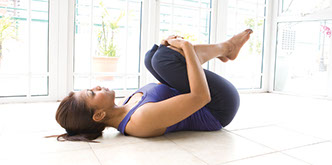
    Image of women doing a knee-to-chest raise.

    This limbers up a stiff back. Lie on your back with knees bent, feet flat on the floor. Breathe deeply. Get comfortable and relaxed. Raise your right knee to your chest and grasp it with both arms. Hug your knee in order to feel a slight stretching in the lower back region. Hold for a count of 5. Do this 5 times. Repeat with your left leg. Repeat with both legs. Be careful not to arch your back. Don’t use your arms to lift your legs.
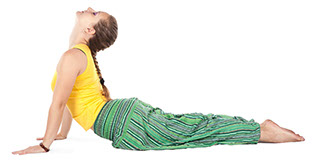
    Image of women doing a spinal stretch.

    Spinal Stretch

    This increases flexibility of the spinal column. Stand erect and raise both hands over your head. Stretch towards the ceiling. Focus on your upper body. Use your arms, hands, and fingers to reach upward as though you were being pulled upward. Keep your feet flat on the floor. Hold for a count of 5.

    Curl Up
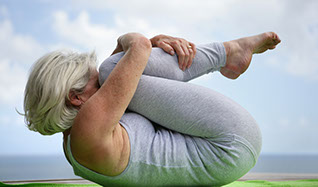
    Image of women doing a curl up.

    This strengthens the lower back. Lie on your back while on a firm surface. Slowly bring both knees to your chest and bring your chin forward to your chest. Your arms should be extended straight at your sides. Hold for a count of 5. Gradually return to your starting position.

    Elbow Props

    These strengthen low back muscles and help maintain the normal curve of the lower back. Lie on your stomach. Turn your head to one side. Relax your arms at your sides. Relax like this for 3 minutes. Prop up on your elbows with your head facing forward. Keep your lower back completely relaxed and flat. Hold this position for 2 minutes. Return to the starting position for 1 minute. Repeat 3 times.

    Sitting Hamstring Stretch
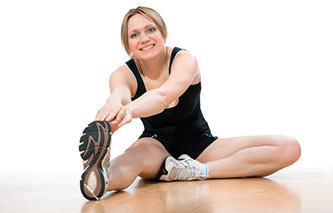
    Image of a women doing a sitting hamstring stretch.

    This warms up and limbers the back muscles and stretches the hamstring muscles. Sitting on the floor, stretch your right leg out directly in front of you. Place your left foot under your right knee. The toes of your right leg should be pointed upward. Slowly reach forward to grasp the tips of your right toes. Be careful to bend over from the hip. Hold for a count of 10. Repeat 5 times. Then switch leg positions.

    Treatment for Low Back Pain

    Continue your regular activities as much as you can. Back muscles can get weak if you don’t use them. Rest your back, if you must, but don’t rest in bed for more than 1 to 2 days, even if your back hurts a lot. Bed rest should only be used for persons with severe limitations (due mostly to leg pain).

    {Note: Before you seek treatment for back pain on your own, check with your doctor or health care provider. Discuss the benefits and risks for treatments, such as spinal manipulation, different forms of massage, and herbal remedies.}

    Medication

    *  Over-the-counter (OTC) pain relievers. Examples are acetaminophen, aspirin, ibuprofen, ketoprofen, and naproxen sodium. These relieve back pain, but only for a short time. All but acetaminophen also reduce swelling and are called NSAIDs+. This stands for nonsteroidal anti-inflammatory drugs.

    *  Prescribed NSAIDs+ and other medicines, such as muscle relaxants.

    + NSAIDs can cause stomach upset, indigestion, and ulcers in the stomach and intestines. Discuss the benefits and risks of taking NSAIDs, as well as other medicines, with your doctor.

    Cold Treatment
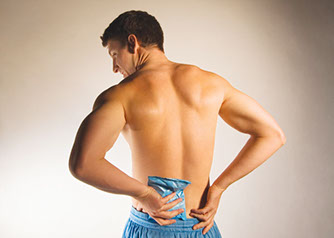
    Image of man holding a cold pack on lower back.

    Injury to the back can cause blood vessels to tear. This leaves a bruise. Cold inhibits bruising and swelling and numbs pain. Cold packs, like crushed ice wrapped in a towel, can help. Apply a cold pack for 5 to 10 minutes at a time, several times a day. For best results, lie on your back with your knees bent and place the ice pack under your lower back. Start right after a back strain. Do this for 10 minutes every 2 hours for the first 48 hours.

    Heat Treatment
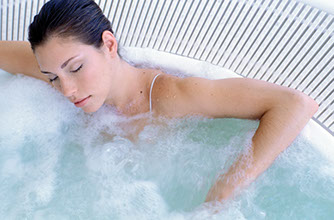
    Image of women in a hot tub.

    Unlike cold, heat increases blood flow to the affected area. This promotes healing. Wait at least 48 hours after back symptoms start to apply heat. If heat is  used sooner, the increased blood flow can add to the swelling. Heat can be applied with moist heating pads,  hot-water bottles, hot compresses, hot tubs, and hot baths or showers. Use heat for 10 minutes at a time. Do this several times a day.

    Massage
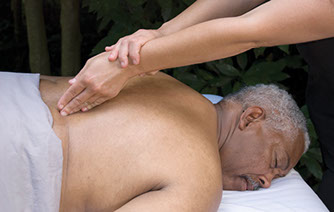
    Image of a man getting a massage.

    Massage won’t cure a backache. It can increase blood flow to tight muscles and loosen them.

    Braces or Corsets

    Braces and corsets support the back and keep you from moving it too much. They won’t make your back stronger, though.

    Medical Care

    Reasons to Get Immediate Medical Care

    *  Back pain spreads to the chest, neck, arm, or lower jaw.

    *  The pain started in the chest and moved to the upper back.

    *  The pain follows a fall or impact injury to the back.

    *  Back pain occurs with passing out, lightheadedness, or difficulty with balance or coordination.

    *  You can’t move due to the pain or it is hard to move an arm or a leg after a fall or back injury.

    *  A new loss of bowel or bladder control occurs with back pain.

    *  Back pain occurs with severe abdominal or pelvic pain.

    *  A “tearing” type of pain is felt in the back or a pulsating mass is felt in the abdomen.

    *  Loss of sensation is felt in the rectal area.

    Reasons to Contact a Doctor

    *  Severe back pain occurs for more than 7 days or the pain travels down a leg below a knee.

    *  Weakness, numbness, or tingling in the feet or toes occurs with back pain.

    *  Back pain occurs with: Pain, burning, or itching when you urinate; increased urge to urinate;  urinating often; foul-smelling urine; or blood in the urine.

    *  An unusual discharge from the vagina or urethra occurs with back pain.

    *  A sharp pain is felt in a buttock and may spread to the thigh, knee, or foot.

    *  Back pain occurs with: A fever; nausea or vomiting; a skin rash; or mild to moderate abdominal or pelvic pain.

    *  Pain increases with moving, coughing, lifting, or straining.

    Resources

    National Institute of Arthritis and Musculoskeletal and Skin Diseases (NIAMS)

    877.22.NIAMS (226.4267)
    www.niams.nih.gov

    Back Care brochure by the American Institute for Preventive Medicine. www.HealthyLife.com. All rights reserved.

    © American Institute for Preventive Medicine
  • Back Pain

    Bone & Muscle Problems

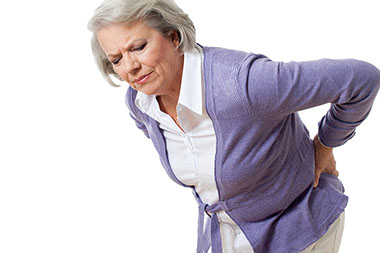
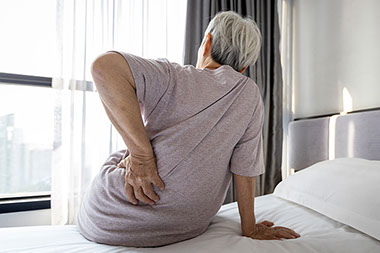
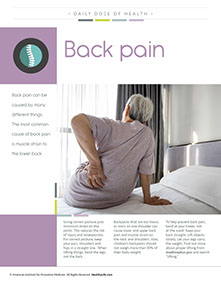
    Back side of older person holding lower back in pain.

    Back pain can be caused by many different things. The most common cause of back pain is muscle strain to the lower back.

    Using correct posture puts minimum stress on the joints. This reduces the risk of injury and osteoporosis. For correct posture, keep your ears, shoulders and hips in a straight line.  When lifting things, bend the legs, not the back.

    Backpacks that are too heavy or worn on one shoulder can cause lower and upper back pain and muscle strain on the neck and shoulders. Also, children’s backpacks should not weigh more than 10% of their body weight.

    To help prevent back pain, bend at your knees, not at the waist. Keep your back straight. Lift objects slowly. Let your legs carry the weight. Find out more about proper lifting frommedlineplus.govand search “lifting.”

    Health at Home Lifetime book by the American Institute for Preventive Medicine. www.HealthyLife.com. All rights reserved.

    © American Institute for Preventive Medicine
  • Fibromyalgia

    Bone & Muscle Problems

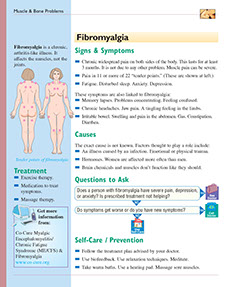
    Fibromyalgia is a chronic, arthritis-like illness. It affects the muscles, not the joints.

    Signs & Symptoms

    *  Chronic widespread pain on both sides of the body. This lasts for at least 3 months. It is not due to any other problem. Muscle pain can be severe.

    *  Pain in 11 or more of 22 “tender points.” (These are shown at right.)

    *  Fatigue. Disturbed sleep. Anxiety. Depression.

    These symptoms are also linked to fibromyalgia:

    *  Memory lapses. Problems concentrating. Feeling confused.

    *  Chronic headaches. Jaw pain. A tingling feeling in the limbs.

    *  Irritable bowel. Swelling and pain in the abdomen. Gas. Constipation. Diarrhea.

    Causes

    The exact cause is not known. Factors thought to play a role include:

    *  An illness caused by an infection. Emotional or physical trauma.

    *  Hormones. Women are affected more often than men.

    *  Brain chemicals and muscles don’t function like they should.

    Treatment

    *  Exercise therapy.

    *  Medication to treat symptoms.

    *  Massage therapy.

    Questions to Ask

    Self-Care / Prevention

    *  Follow the treatment plan advised by your doctor.

    *  Use biofeedback.

    *  Use relaxation techniques. Meditate.

    *  Take warm baths.

    *  Use a heating pad.

    *  Massage sore muscles.

    Resources

    National Institute of Arthritis and Musculoskeletal and Skin Diseases (NIAMS)

    www.niams.nih.gov

    Healthier at Home book by the American Institute for Preventive Medicine. www.HealthyLife.com. All rights reserved.

    © American Institute for Preventive Medicine
  • Foot Problems

    Bone & Muscle Problems

    Some foot problems are due to years of wear and tear on your feet. Others can be due to shoes that do not fit well or trimming your toenails too close to your skin. Circulation problems and diseases, such as diabetes, can lead to foot problems, too.

    {Note: If you have diabetes or circulation problems, contact your doctor for any foot problems.}

    To Help Prevent Foot Problems

    *  Maintain a healthy weight to avoid excess strain on your feet.

    *  Wear shoes that fit well. Don’t wear shoes with pointed toes or ones that fit too tightly.

    *  Wash and dry your feet daily.

    *  Keep your feet moisturized.

    *  Inspect your feet daily for signs of problems.

    *  Rest your feet by elevating them.

    *  Persons with diabetes and/or circulation problems need to take special care of their feet. Good foot care can prevent some foot infections. It may be necessary for a health care professional to cut the toenails.

    R.I.C.E.

    *  Rest the injured area for 24 to 48 hours.

    *  Ice the area as soon as possible. Keep doing this for 10 minutes every 2 hours for the first 48 hours. Use an ice pack, ice in a heavy plastic bag with a little water, a bag of frozen vegetables, etc. Put a thin towel between the ice pack and the skin.

    *  Compress the area. Wrap with an elastic bandage. Do not cut off circulation. Remove the bandage every 3 to 4 hours, for 15 to 20 minutes each time.

    *  Elevate the area above heart level, if possible. Place it on a pillow, folded blanket, stack of newspapers, etc.

    Athlete’s Foot

    Signs & Symptoms

    Moist, soft, red, or gray-white scales on the feet, especially between the toes. Cracked, peeling, dead skin area. Itching. Sometimes small blisters on the feet.

    What to Do

    SeeAthlete’s Foot.

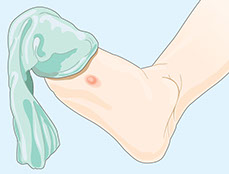
    Blisters

    Illusration of a blister on the foot.

    Signs & Symptoms

    Red, sometimes fluid-filled sores caused by shoes that rub the foot.

    Self-Care / Prevention

    *  Don’t break a blister. If it breaks on its own, apply an antibacterial spray or ointment and cover with a bandage or sterile dressing.

    *  Don’t cut away or pull off the broken blister’s loose skin. This protects the new skin below it.

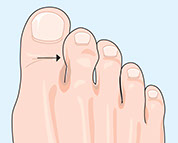
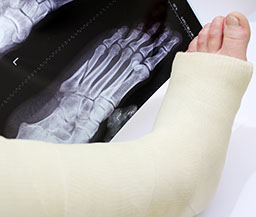
    Broken Bone(s) in the foot (not just a toe).

    Image of broken foot.

    Signs & Symptoms

    Pain from a fall or injury to your foot (not just a toe) with any of these problems:

    *  Severe bleeding.

    *  Your foot is misshaped.

    *  You can’t move your foot.

    *  Your foot looks blue or pale and is cold and numb.

    *  Your foot is so painful and/or swollen that you can’t put any weight on it.

    What to Do

    Get medical care fast!

    Broken or Sprained Toe

    Image of a broken or sprained toe.

    Signs & Symptoms

    Pain in only one toe after an injury to the toe.

    Buerger’s Disease

    Signs & Symptoms

    Open sores (ulcers) on the toes. Pain on the instep and cold, pale skin color which improves with rest.

    What to Do

    See doctor.

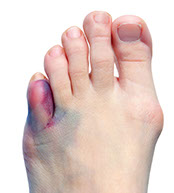
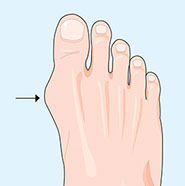
    Bunion

    Illustration of a bunion.

    Signs & Symptoms

    The big toe points inward or outward. A bony bulge at side of the big toe. Thickened skin. Possible fluid build-up near the big toe. Stiffness or pain.

    Self-Care / Prevention

    *  Don’t wear high heels or shoes with narrow toes.

    *  Wear sandals.

    *  Use moleskin or padding to separate overlapped toes.

    *  Try arch supports to reduce pressure.

    *  Use ring-shaped pads over a bunion.

    *  Cut out an old pair of shoes to wear in the house.

    *  Soak your feet in warm water.

    *  If needed, take an over-the-counter pain reliever as directed.

    Callus

    Signs & Symptoms

    Thickened skin on the ball or heel of the foot. Usually no pain.

    Cellulitis

    Signs & Symptoms

    The bottom of the foot is red and swollen and feels warm and tender.

    What to Do

    SeeCellulitis.

    Corn

    Signs & Symptoms

    Thickened skin on tops of and between toes where rubbing is constant. Feels hard to the touch and looks round. Small, clear spot (hen’s eye) may appear in the center.

    Cut or Puncture Wound

    Signs & Symptoms

    Cut or puncture from a dirty or contaminated object, such as a rusty nail or other object in the soil.

    Foot Cramp

    Signs & Symptoms

    Charley horse or muscle spasm in the foot. Often, this occurs at bedtime.

    Self-Care / Prevention

    *  Stretch the foot muscles.

    *  Pull the foot back into a flexed position.

    *  Push the foot into the floor.

    Frostbite (if signs occurs after cold exposure).

    Signs & Symptoms

    Toes turn white then red in response to cold. Tingling. Numbness.

    What to Do

    Contact doctor for an appointment right away.

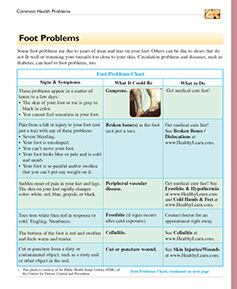
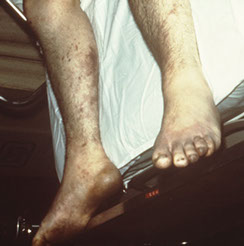
    Gangrene

    Image of gangrene.

    Signs & Symptoms

    These problems appear in a matter of hours to a few days:

    *  The skin of your foot or toe is gray to black in color.

    *  You cannot feel sensation in your foot.

    What to Do

    Get medical care fast!

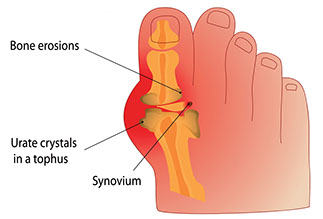
    Gout

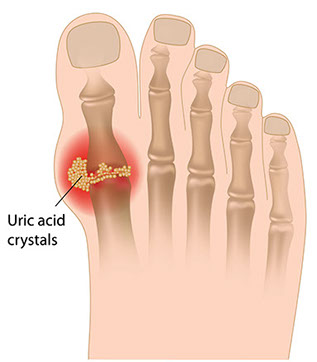
    Illustration of gout.

    Signs & Symptoms

    Severe pain in foot joint, often the big toe. The pain is not due to an injury. The joint hurts a lot when anything touches it. The area is red, swollen, and tender.

    What to Do

    See doctor.

    Hammertoe

    Illustration of a hammertoe.

    Signs & Symptoms

    Curled or claw-like position in a toe (usually the 2nd toe). A corn forms on the top of the toe. Pain.

    Self-Care / Prevention

    *  Wear wide, roomy shoes.

    *  Massage the toes or get a foot rub.

    *  Change shoes during the day. Try athletic shoes.

    *  Use small pads over the center of the toe to lessen pressure.

    Heel Spur

    Signs & Symptoms

    Tenderness and pain under the heel bone.

    What to Do

    See doctor.

    Self-Care / Prevention

    *  Use a cushion or heel cup under the heel.

    *  Do not jog or run. Avoid prolonged standing.

    *  Lose weight, if overweight.

    *  Roll a tennis ball under ball of the foot.

    *  Put ice on the heel for 10 minutes. Remove it for 10 minutes. Repeat many times.

    *  If needed, take an over-the-counter pain reliever as directed.

    Infection

    Signs & Symptoms

    A foot wound with: Fever; redness, tenderness, or warmth; swelling; pain; and/or pus.

    What to Do

    See doctor.

    Self-Care / Prevention for Minor Infections

    *  Soak the foot in warm, soapy water for 20 minutes, 4 to 6 times a day. Pat the infected area dry. Use extra care if you have peripheral vascular disease. Make sure the water is not hot.

    *  Apply an over-the-counter antibiotic ointment, such as Neosporin. Cover with a sterile cloth or bandage.

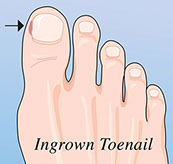
    Ingrown Toenail

    Illustration of ingrown toenail.

    Signs & Symptoms

    Discomfort, pain, tenderness, and/or redness under the corner of a toenail and nearby skin.

    Morton’s Neuroma

    This is thickening of nerve tissue, usually between the third and fourth toes.

    Signs & Symptoms

    Sharp and burning pain on the ball of the foot.

    Self-Care / Prevention

    *  Wear wide shoes with soft insoles.

    *  Put pads or arch supports in your shoes. These help take pressure off the area.

    *  Take an over-the-counter medicine for pain as directed.

    *  See your doctor if the above measures don’t bring relief.

    Peripheral Vascular Disease

    Signs & Symptoms

    Sudden onset of pain in your feet and legs. The skin on your feet rapidly changes color: white, red, blue, grayish, or black.

    What to Do

    Get medical care fast!

    Planter Fasciitis

    This is a problem with ligaments and tissues in the foot arch.

    Signs & Symptoms

    Pain between the heel and the ball of the foot. Often this is due to walking, running, or putting weight on the foot.

    Self-Care / Prevention

    *  Rest the foot as much as you can.

    *  Use R.I.C.E.

    *  Take an over-the-counter medicine for pain and swelling as directed.

    *  Wear shoes with a solid arch support.

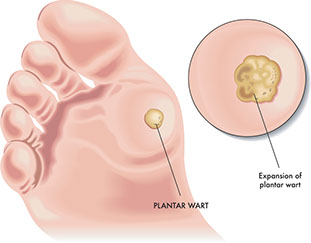
    Planter Wart

    Illustration of plantar wart.

    Signs & Symptoms

    Painful growth on the ball or heel of the foot. Black pinholes or spots in the center.

    Self-Care / Prevention

    *  Try salicylic acid plasters or other over-the- counter products, such as Wart-Off. Follow package directions.

    *  Use cushions in shoes.

    *  Wash your hands after touching warts to avoid re-infection.

    *  Wear sandals in the shower or public areas, such as pools.

    *  Do not pick at plantar warts.

    Rheumatoid Arthritis

    Signs & Symptoms

    Joint pain and morning stiffness in joints that lasts more than 1 hour. Fatigue.

    What to Do

    See doctor.

    Toenail Fungus

    Signs & Symptoms

    White, brown, or yellow toenail. The nail can thicken, then get soft and weak. It may tear away from the nail bed or look deformed.

    What to Do

    See doctor.

    Healthier at Home book by the American Institute for Preventive Medicine. www.HealthyLife.com. All rights reserved.

    © American Institute for Preventive Medicine
  • Gout: Relief At Last

    Abdominal & Urinary Conditions

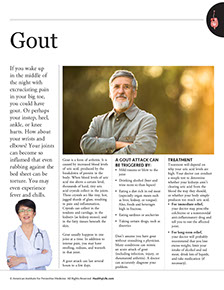
    If you wake up in the middle of the night with excruciating pain in your big toe, you could have gout. Or perhaps your instep, heel, ankle, or knee hurts. How about your wrists and elbows? Your joints can become so inflamed that even rubbing against the bed sheet can be torture. You may even experience fever and chills.

    Gout is a form of arthritis most common in men in their fifties. It is caused by increased blood levels of uric acid, produced by the breakdown of protein in the body. When blood levels of uric acid rise above a critical level, thousands of hard, tiny uric acid crystals collect in the joints. These crystals act like tiny, hot, jagged shards of glass, resulting in pain and inflammation. Crystals can collect in the tendons and cartilage, in the kidneys (as kidney stones), and in the fatty tissues beneath the skin.

    A gout attack can last several hours to a few days and can be triggered by:

    *  Mild trauma or blow to the joint.

    *  Drinking alcohol (beer and wine more so than distilled alcohol).

    *  Eating a diet rich in red meat (especially organ meats such as liver, kidney, or tongue).

    *  Eating sardines or anchovies.

    *  Taking certain drugs, such as diuretics.

    Illustration of gout.

    Don’t assume you have gout without consulting a physician. Many conditions can mimic an acute attack of gout (including infection, injury, or rheumatoid arthritis). A doctor can accurately diagnose your problem.

    If you do have gout, treatment will depend on why your uric acid levels are high. Your doctor can conduct a simple test to determine whether your kidneys aren’t clearing uric acid from the blood the way they should, or whether your body simply produces too much uric acid.

    The first goal, then, is to relieve the acute gout attack. The second goal is to normalize the uric acid levels to prevent a recurrence.

    *  For immediate relief, your doctor may prescribe colchicine or a nonsteroidal anti-inflammatory drug and tell you to rest the affected joint.

    *  For long-term relief, your doctor will probably recommend that you lose excess weight, limit your intake of alcohol and red meat, drink lots of liquids, and take medication (if necessary).

    A Year of Health Hints book by the American Institute for Preventive Medicine. www.HealthyLife.com. All rights reserved.

    © American Institute for Preventive Medicine
  • Leg Pain & Ankle Pain

    Bone & Muscle Problems

    Pain in the legs or ankles can range from mild to severe. The type and amount of pain depends on the cause.

    For Pain, in General

    *  Take an over-the-counter medicine for pain as directed on the label. If the pain is not better after a few doses, call your doctor.

    *  Use a heating pad (set on low), a hot pack, or a moist, warm towel on the area of pain. If the pain is due to an injury, don’t use heat for 48 hours. Use R.I.C.E.

    To Help Prevent Leg Pain & Ankle Pain

    *  Get to and stay at a healthy weight.

    *  Get regular exercise. This helps to keep ankle and leg muscles strong.

    *  Before you exercise, stretch and warm up your muscles. When you are done, cool them down.

    *  Protect your knees. Use knee pads when you garden or kneel. Always land on bent knees when jumping. Avoid deep knee bend exercises.

    *  Don’t wear high-heeled shoes. Keep your shoes in proper shape.

    *  Take good care of your feet.

    R.I.C.E.

    *  Rest the injured area for 24 to 48 hours.

    *  Ice the area as soon as possible. Keep doing this for 10 minutes every 2 hours for the first 48 hours. Use an ice pack, ice in a heavy plastic bag with a little water, a bag of frozen vegetables, etc. Put a thin towel between the ice pack and the skin.

    *  Compress the area. Wrap with an elastic bandage. Do not cut off circulation. Remove the bandage every 3 to 4 hours, for 15 to 20 minutes each time.

    *  Elevate the area above heart level, if possible. Place it on a pillow, folded blanket, stack of newspapers, etc.

    Baker’s Cyst

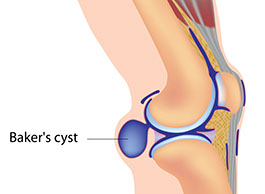
    Illustration of baker's cyst.

    Signs & Symptoms

    Painless or painful swelling behind the knee. May feel like a water-filled balloon.

    What to Do

    Call doctor.

    Broken Bone or Dislocation

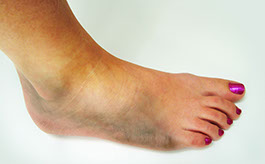
    Image of broken foot bone.

    Signs & Symptoms

    Any of the signs that follow occur after a leg or ankle injury. A bone sticks out or bones in the injured limb make a grating sound. The injured limb looks deformed, crooked, or the wrong shape. You lose feeling in the injured limb. The skin under the affected injured area is cold and blue. The limb is very painful and/or swollen or you can’t bear weight on the limb or move it.

    Bursitis

    Signs & Symptoms

    Pain and swelling around a knee or hip joint. The pain gets worse with movement. Fever (maybe).

    What to Do

    See doctor.

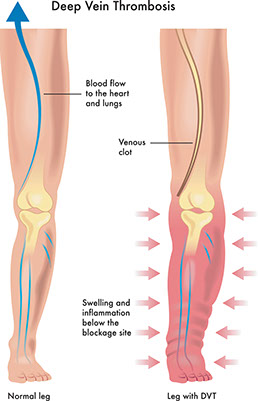
    Deep-vein thrombosis (DVT) with or without a blood clot to the lung

    Illustration of deep vein thrombosis.

    Signs & Symptoms

    Pain, redness (may have shades of red, purple, and blue), or swelling in one ankle or leg. May be followed by severe shortness of breath that came on all of a sudden. May include coughing up blood or pink-frothy sputum. Chest pain.

    What to Do

    Get medical care fast!

    Flu

    Signs & Symptoms

    Aches in leg muscles and joints with fever and/or chills. Headache. Dry cough. Sore throat. Fatigue.

    Gout

    Illustration of gout.

    Signs & Symptoms

    Sudden, severe pain in a toe, knee, or ankle joint. The pain can be felt even when clothing is rubbed against the joint. The joint area is swollen, red, or purplish in color. It also feels warm, and is very tender to the touch.

    What to Do

    See doctor.

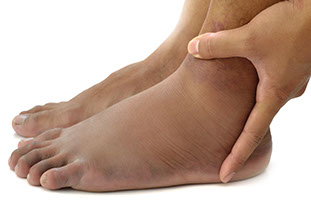
    Heart Failure

    Image of swollen feet.

    Signs & Symptoms

    Swelling of both ankles at the same time. Shortness of breath. May have a dry cough or a cough with pink, frothy mucus.

    What to Do

    Get medical care fast!

    Infection. Could also be Cellulitis.

    Signs & Symptoms

    Pain with fever, redness, tenderness, warmth and pus at a wound site. A red streak up the leg (rarely).

    What to Do

    See doctor.

    Leg Cramp

    Signs & Symptoms

    Sudden, sharp, tightening pain in the leg, often the calf. The muscle feels hard to the touch. The pain subsides after a minute or so and the muscle relaxes.

    Self-Care

    *  Walk on the leg.

    *  Shake the leg and then elevate it.

    *  Sit with your leg flat on the floor. Flex your foot upward, then toward your knee. Reach for your toes and pull them toward your knee. This stretches the calf muscles.

    *  Have someone massage the cramped muscle gently, but firmly.

    *  Apply a heating pad (set on low), a hot pack, or moist, warm towel to the muscle cramp.

    *  Rub the muscle that is cramping. Rub upward from the ankle toward the heart.

    (Note: Do not rub a leg if you suspect phlebitis or thrombosis.)

    To Prevent Leg Cramps

    *  Get good sources of calcium, potassium, and magnesium. See lists at left. Take calcium, potassium, and magnesium as advised by your doctor.

    *  Drink plenty of water and other fluids. Limit drinks with caffeine. Avoid drinks with alcohol. Doing these things can help prevent dehydration which could cause leg cramps.

    *  Warm up your muscles before you exercise. Cool down your muscles when you are done.

    *  With your doctor’s okay, wear elastic stockings while you are awake.

    *  Another way to stretch your calf muscles is to ride a stationary bicycle for a few minutes.

    *  Take a warm bath before bedtime.

    *  Sleep with loose-fitting blankets and night clothes. Keep your legs warm.

    *  If you have severe leg cramps or get them often, tell your doctor. Ask if any medication you take could cause your leg cramps. Ask for ways to treat your leg cramps.

    *  Before you go to bed, stretch your calf muscles. Here’s one way to do this:

    – Stand an arm’s length away from a wall. Lean against it with the palms of your hands.

    – Bend your left knee. Keep your right leg straight behind you. Keep both feet flat on the floor and your back straight.

    – Lean forward. Feel your right calf muscle stretch. Hold the stretch as you count to 10 slowly.

    – Repeat, switching leg positions.

    Lyme Disease

    Signs & Symptoms

    Muscle or joint pain and chronic swelling of the knee joints. These problems develop months or years after a deer-tick bite and a bulls-eye red rash with pale centers.

    What to Do

    See doctor.

    Osteoarthritis

    Signs & Symptoms

    Pain, stiffness, and sometimes swelling of the knee or ankle joints. Often, the joint has gotten tender over months or years and may look enlarged or deformed.

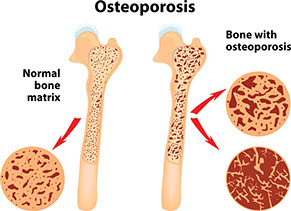
    Osteoporosis

    Illustration of osteoporosis.

    Signs & Symptoms

    Leg or ankle pain with gradual loss of height; stooped posture; backache; and/or past bone fractures, especially in the wrists and hips.

    Paget’s Disease

    This is a bone disorder that progresses slowly. Most persons with this disease do not develop symptoms.

    Signs & Symptoms

    Leg pain that radiates from the lower back. Pain or stiffness in the knees. Bowing of the legs or other bone deformity. Unexplained bone fractures. May have headache, dizziness, hearing loss, and/or ringing in the ears.

    What to Do

    See doctor.

    Self-Care / Prevention

    *  If needed, take an over-the-counter medicine for pain as directed on the label.

    *  Take other medicines as prescribed by your doctor.

    *  Get regular checkups to detect hearing loss.

    Peripheral Vascular Disease

    Signs & Symptoms

    Sudden and severe pain in a leg that is not relieved with rest.

    What to Do

    Get medical care fast!

    Signs & Symptoms

    Muscle pain in one or both legs. Fatigue in the thighs, calves, and feet. This improves with rest. Open sores on the lower leg, ankles, or toes. Weak or no pulse in the affected limb. Cold or numb feet. Pale, bluish-colored toes.

    What to Do

    See doctor.

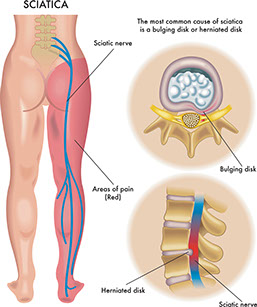
    Sciatica

    Illustration of sciatica.

    Signs & Symptoms

    Sharp pain from the buttocks down the leg. Numbness and tingling in the leg.

    Sprain, Strain, or Sport Injury

    Signs & Symptoms

    Pain in the leg or ankle after an injury that does not keep you from moving the limb.

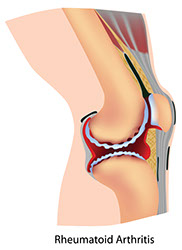
    Rheumatoid Arthritis

    Illustration of rheumatoid arthritis.

    Signs & Symptoms

    Pain, stiffness, and swelling, usually in both knees or ankle joints. The joint looks deformed. Weakness and fatigue. Dry mouth and dry, painful eyes.

    Varicose Veins

    Signs & Symptoms

    Pain or itching in the legs with swollen and twisted veins that look blue and are close to the surface of the skin. The veins bulge and feel heavy. Swelling in the legs and ankles.

    Healthier at Home book by the American Institute for Preventive Medicine. www.HealthyLife.com. All rights reserved.

    © American Institute for Preventive Medicine
  • Repetitive Motion Injuries

    Bone & Muscle Problems

    Repetitive motion injuries (RMIs) are also called repetitive strain injuries (RSIs). They result from doing the same activity over and over for a long period of time. This can be at work, at home, during sports, and/or with hobbies.

    Signs & Symptoms

    Signs and symptoms depend on the injury.

    For Carpal Tunnel Syndrome (CTS)

    *  Thumb, index, middle, and ring fingers feel numb.

    *  Tingling feeling in the hand(s).

    *  Pain is felt in the thumb and fingers. The pain may be worse at night. It can wake you up.

    *  Pain starts in the hand and spreads to the arm. The pain can even travel to the shoulder.

    *  The fingers swell. It feels like your fingers are swollen. Your hands feel weak in the morning.

    *  You have trouble holding on to things. You drop things.

    *  You have a hard time writing with a pencil or pen, opening a jar, buttoning a blouse, etc.

    Causes

    In general, RMIs are caused by repeated movements that involve:

    *  Drilling or hammering.

    *  Lifting.

    *  Pushing or pulling.

    *  Squeezing.

    *  Twisting.

    *  Wrist, finger, and hand movements.

    For Carpal Tunnel Syndrome (CTS)

    Repeated motions, typing vibrations, etc. cause swelling of the tendons inside the carpal tunnel. This is the narrow tunnel in the wrist. The swelling puts pressure on the nearby nerves.

    Treatment

    For Carpal Tunnel Syndrome (CTS)

    This is easier to treat and less likely to cause future problems if it is found early. Women are more likely to get CTS than men, because their carpal tunnel is usually smaller. Once diagnosed, CTS can be treated with:

    *  Preventing further damage.

    *  Wearing a wrist brace, splint, etc. as advised. It may need to be worn while you sleep and during the day.

    *  Over-the- counter medicines to reduce pain and swelling. Examples are aspirin, ibuprofen, and naproxen sodium.

    *  Physical therapy.

    *  Occupational therapy.

    *  Cortisone shots in the wrist area.

    *  Surgery, if needed.

    Questions to Ask

    Self-Care / Prevention

    For Preventing Wrist and Hand Injuries

    Whenever your hands and wrists do the same activity time and again, you increase your risk for CTS and tendinitis. Change how you do a task and you may avoid some of these injuries.

    *  Do not hold an object in the same position for a long time. Even simple tasks, such as hammering nails, can cause injury when done over a period of time.

    *  Give your hands a break. Rest them for a few minutes each hour.

    *  Lift objects with your whole hand or with both hands. Gripping or lifting with the thumb and index finger puts stress on your wrist.

    *  If your line of work causes pain in your hands and wrists, alternate the stressful tasks with other work.

    *  Exercise your hands and wrists as often as you can. Here are two examples:

    – Place your hands in front of you. Spread your fingers as far apart as possible. Hold for 5 seconds. Relax. Repeat 5 times with each hand.

    – Turn your wrists in a circle, palms up and then palms down. Relax your fingers and keep your elbows still. Repeat 5 times.

    For Carpal Tunnel Syndrome

    *  Lose weight. CTS is linked to obesity.

    *  Take an over-the-counter medicine to reduce the pain and swelling as directed.

    *  Use a wrist splint. Many drug and medical supply stores carry splints that keep the wrist angled slightly back with the thumb parallel to the forearm. This position helps to keep the carpal tunnel open.

    Other Tips

    *  Keep your head upright and your ears, shoulders, and hips in a straight line.

    *  Keep your work within reach without having to stretch or strain your arms, shoulders, or back. Don’t stretch to reach items on an assembly line. Wait for the items to reach you.

    *  Change positions or tasks often. This avoids repeated stress on a single body part.

    *  Use the proper tools for the job. Use tools made to reduce vibration and/or pressure, if needed.

    Resources

    National Institute of Arthritis and Musculoskeletal and Skin Diseases (NIAMS)

    877.22.NIAMS (226.4267)

    www.niams.nih.gov

    Healthier at Home book by the American Institute for Preventive Medicine. www.HealthyLife.com. All rights reserved.

    © American Institute for Preventive Medicine
  • Shoulder Pain & Neck Pain

    Bone & Muscle Problems

    Signs & Symptoms

    *  The pain can be mild to severe. It can be felt in one spot, in a large area, or travel to another area. Movement can cause the pain or make it worse.

    *  Stiffness and/or swelling may occur.

    Causes

    *  Overuse and wear and tear on neck and shoulder muscles and joints.

    *  Strains. Broken or dislocated shoulder.

    *  Poor posture. Awkward sleeping positions. Sleeping on a soft mattress.

    *  Pinched nerve. Pain from a pinched nerve usually runs down one side of the arm.

    *  Frozen shoulder. This can result from lack of use due to pain from an injury. At first, pain occurs with movement. Over time, the pain gets better, but stiffness remains.

    *  Torn rotator cuff. This is a tear in a ligament that holds the shoulder in place. Symptoms are pain at the top and outer sides of the shoulders, especially when you raise or extend your arm. You may also feel or hear a click when the shoulder is moved.

    *  Tendinitis. This is swelling of a tendon (tissue that connects a muscle to bone). Left untreated, tendinitis can turn into “frozen shoulder.” “Wry” neck is a similar problem.

    *  Bursitis. This is swelling of the sac (bursa) that surrounds the shoulder joint. Bursitis can be caused by injury, infection, overuse, arthritis, or gout.

    *  A whiplash injury.

    *  Osteoarthritis.

    *  Infections that cause swollen lymph nodes in the neck.

    Treatment

    Treatment for shoulder pain and/or neck pain depends on the cause. Emergency medical care is needed for:

    *  A serious injury.

    *  A broken bone.

    *  A heart attack.

    *  Meningitis. This is an infection of the membranes that surround the brain.

    Self-care can treat less serious causes of shoulder pain and/or neck pain.

    Questions to Ask

    Self-Care / Prevention

    For Pain

    *  Take an over-the-counter medicine for pain and/or swelling.

    *  To relieve tension and improve circulation, take walks. Start with 3 to 5 walks a day, each lasting 5 to 10 minutes. Gradually increase walking times.

    For Bursitis, Tendinitis, or an Injury That Does Not Appear Serious

    *  Use R.I.C.E.

    *  Try liniments and balms. These provide a cooling or warming sensation, but only mask the pain. They do not promote healing.

    To Treat Neck Pain from a Whiplash Injury or Pinched Nerve

    See a doctor anytime your motor vehicle is hit from the rear because the accident can cause a whiplash injury. After first checking with your doctor, do these things to ease neck discomfort:

    *  Rest as much as you can by lying on your back.

    *  Use cold and hot packs.

    *  Improve your posture. When you sit, use a chair with a straight back. Make sure your buttocks go all the way to the chair’s back. When you stand, pull in your chin and stomach.

    *  Use a cervical (neck) pillow or a rolled hand towel under your neck.

    *  Avoid activities that may aggravate your injury.

    *  Cover your neck with a scarf if you go outside when the weather is cold.

    Ways to Prevent Shoulder Pain & Neck Pain

    *  Avoid repeated activities that twist or put strain on the neck and shoulders. When you do repeated tasks, use proper posture, equipment, and techniques.

    *  Wear seat belts in vehicles. Use protective gear when you take part in sporting events.

    *  If you are out of condition, strengthen your muscles gradually.

    *  Don’t sleep on your stomach. You may twist your neck in this position. Use a firm polyester pillow, a neck (cervical) pillow, or a rolled towel under your neck.

    *  Practice good posture. Stand straight. Don’t let your shoulders slump, your head droop, or your lower back slouch.

    *  When you carry things, such as a shoulder bag, switch from one shoulder to the other.

    *  Don’t prop a telephone between your ear and shoulder.

    *  Stretch and warm up before activities that require joint movement, such as sports.

    *  Do stretching and strengthening exercises to keep your shoulder, neck, and arm muscles strong and flexible.

    – Shoulder Stretch: Reach your right arm across your chest. With your left hand, grasp your arm just above the elbow. Gently pull your arm farther across your body until you feel a stretch in the back of your shoulder. Hold for 30 seconds. Rest and repeat. Do the same with your left arm.

    – Neck and Shoulder Stretch: Tilt your head forward and let it hang. Relax your neck and shoulders. Slowly, roll your head to one side then back to the front and then slowly roll it to the other side. (Do not roll your neck backward.) Repeat 10 times.

    Resources

    National Institute of Arthritis and Musculoskeletal and Skin Diseases (NIAMS)

    877.22.NIAMS (226.4267)

    www.niams.nih.gov

    Healthier at Home book by the American Institute for Preventive Medicine. www.HealthyLife.com. All rights reserved.

    © American Institute for Preventive Medicine
  • Put Your Tennis Elbow On Ice

    Bone & Muscle Problems

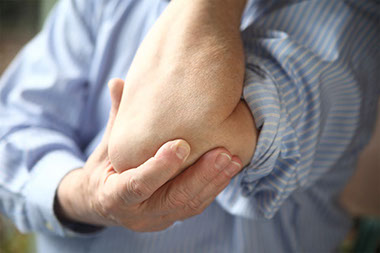
    Close up image of elbow.

    If you’re a tennis player with a hard, single-handed backhand shot, you can end up with a painful condition known as tennis elbow. Pain originates in the outer portion of the elbow and works its way down the forearm. Tennis players who are new to the game or use their forearms instead of the force of their whole bodies to swing the racket are most vulnerable.

    Other factors that contribute to the problem include:

    *  Using a racket that’s too heavy.

    *  Using a racket that’s too tightly strung.

    *  Using played out, deflated tennis balls or ones that are wet and heavy.

    *  Using an improper grip.

    *  Trying to put spin on the ball with improper wrist action.

    *  Using poor backhand technique.

    Continuing to use the arm aggravates the situation. Even several weeks of rest won’t prevent repeat episodes. The best game plan is to rest, then strengthen your forearm muscles and get coaching to improve your skill level.

    To relieve tennis elbow pain:

    *  Apply ice for the first two or three days.

    *  Take an over-the-counter medicine to reduce pain and inflammation. Examples are aspirin, ibuprofen, and naproxen sodium. Take as directed.

    If you still have pain after three weeks, see a doctor for proper diagnosis and treatment.

    To prevent repeat bouts of tennis elbow:

    *  Wait until the pain is gone and your grip strength is normal before resuming play.

    *  Wear an elastic bandage or counter-force brace around the forearm,  as directed.

    *  To strengthen your forearm muscles, lift small 1- to 2-pound weights by alternately flexing and extending your wrists with the palms facing down and your forearms resting on a flat surface. Start with 10 repetitions and work up to 40, three or four times a week.

    A Year of Health Hints book by the American Institute for Preventive Medicine. www.HealthyLife.com. All rights reserved.

    © American Institute for Preventive Medicine
  • Back In Action

    MEDICAL NEWS

    Image of older women holding her back in pain.

    Back pain. In the last 3 months, about 1 in 4 adults has had at least one day of back pain, mostly in the lower back, according to NIH in Health.

    The good news is that most back pain goes away by itself-in time. If pain continues for more than 3 months, you have chronic back pain. If doctors can find out the source of your pain, you may be treated effectively with certain surgeries.

    But even chronic pain can clear up without surgery. Don’t let the pain take over. Doctors advise:

    *  Stay active and maintain a healthy weight.

    *  Stretch before exercise or other strenuous physical activity.

    *  Don’t slouch when standing or sitting.

    *  Make sure your work surface is at a comfortable height for you.

    *  Wear comfortable, low-heeled shoes.

    *  Lift, if you must, with your back straight, bend at the knees, and put the stress on your legs and hips.

    *  Don’t smoke.

    *  Talk with your doctor to make sure you’re getting enough calcium and vitamin D.

    © American Institute for Preventive Medicine