Tag: breathe

  • Keeping Cool When Work Heats Up

    WORK LIFE

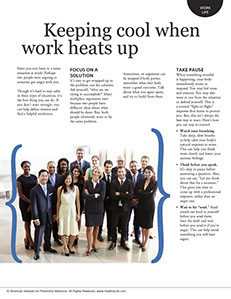
    Image of a great of employees.

    Have you ever been in a tense situation at work? Perhaps two people were arguing or someone got angry with you.

    Though it’s hard to stay calm in these types of situations, it’s the best thing you can do. If you don’t react strongly, you can help defuse tension and find a helpful resolution.

    Focus on a solution

    It’s easy to get wrapped up in the problem, not the solution. Ask yourself, “what are we trying to accomplish?” Many workplace arguments start because two people have different ideas about what should be done. But, both people ultimately want to fix the same problem.

    Sometimes, an argument can be stopped if both parties remember what they both want: a good outcome. Talk about what you agree upon, and try to build from there.

    Take pause

    When something stressful is happening, your body immediately wants to respond. You may feel tense and anxious. You may also want to run from the situation or defend yourself. This is a normal “fight-or-flight” response that wants to protect you. But, this isn’t always the best way to react. Here’s how you can stay in control:

    *  Watch your breathing. Take deep, slow breaths to help calm your body’s natural response to stress. This can help you think more clearly and lower your anxious feelings.

    *  Think before you speak. It’s okay to pause before answering a question. Also, you can say, “Let me think about that for a moment.” This gives you time to come up with a professional response, rather than an angry one.

    *  Wait to hit “send.” Read emails out loud to yourself before you send them. Save the draft and wait before you send it if you’re angry. This can help avoid something you will later regret.
    © American Institute for Preventive Medicine

  • How To Reduce Stress At Work

    WORK LIFE

    Image of smiling employee.

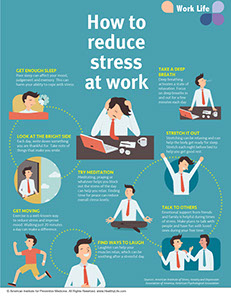
    Get enough sleep:Poor sleep can affect your mood, judgement and memory. This can harm your ability to cope with stress.

    Look at the bright side:Each day, write down something you are thankful for. Take note of things that make you smile.

    Get moving:Exercise is a well-known way to reduce stress and improve mood. Walking just 20 minutes a day can make a difference.

    Try meditation:Meditating, praying or whatever helps you block out the stress of the day can help you relax. Finding time for peace can reduce overall stress levels.

    Find ways to laugh:Laughter can help your muscles relax, which can be soothing after a stressful day.

    Take a deep breath:Deep breathing activates a state of relaxation. Focus on deep breaths in and out for a few minutes each day.

    Stretch it out:Stretching can be relaxing and can help the body get ready for sleep. Stretch each night before bed to help you get good rest.

    Talk to others:Emotional support from friends and family is helpful during times of stress. Make plans to talk with people and have fun with loved ones during your free time.

    Sources: American Institute of Stress, Anxiety and Depression Association of America, American Psychological Association

    © American Institute for Preventive Medicine
  • Overwhelmed At Work? How To Handle It

    WORK LIFE

    Image of stressed women at work.

    No matter what your job, you’re bound to feel overwhelmed sometimes. Whether you have new responsibilities, are worried about a certain project, or just have too much on your plate, it’s normal to feel the pressure occasionally. Though you may not be able to change what’s causing these feelings, you can find ways to deal with these situations in a healthy way.

    Jot it down.

    If your mind is swimming with a list of to-dos, put it on paper. Sometimes seeing the list can help you come up with a plan to get it done. You can figure out what needs to be done first, and then you have a starting point.

    Take a break from work when you’re off-duty.

    If your life revolves around the buzzing of your phone with emails and work demands, try to take some time each day to turn it off. You may find you feel more relaxed and ready to focus when you return to work.

    Start with just one step.

    If a huge project feels too difficult to start, then just think about the first thing you need to do. It can be something minor, such as sending an email or writing down a task list. Every big project begins with one step. Consider what needs to be done right now, and do that first. Once you get started, it may be easier to keep going.

    Talk to your supervisor.

    If possible, bring up your main concerns to your boss. Be specific about your problem, and focus on what you can do to help solve it. For instance, if you have too many tasks, tell them what you are able to do in the time you have, and suggest alternate ways to get the rest done. Perhaps you can ask for more time to get a project done. Or, see if you can delegate the task to a co-worker.

    An organized desk gives you control

    If you’re feeling buried at work, look in front of you. A messy desk can create more stress and anxiety. Clean up your space by:

    *  Going through papers as you get them, rather than letting them pile up

    *  Creating a “pending” or “in progress” folder for things you need to do

    *  Clean up your space before you leave each day

    *  Put things back as soon as you’re done using them

    A tidy desk can brighten your outlook and boost your productivity.

    Source: American Psychological Association

    © American Institute for Preventive Medicine

  • After You Quit Smoking

    WELL-BEING

    Hand refusing cigarettes.

    No matter what your age is, or how long you’ve smoked, you can reap benefits of quitting today!

    Here’s what happens in your body after you quit:

    *  12 hours later, carbon monoxide in your blood drops to normal levels.

    *  2 weeks to 3 months later, your circulation improves and your lungs work better.

    *  1 year later, your risk of developing heart disease is slashed in half.

    You’ll also lower your risk for lung cancer when you quit. And the health benefits continue the longer you stay smoke-free. Visitsmokefree.govto start your quit journey!

    © American Institute for Preventive Medicine