Tag: breathing

  • Use Mindfulness At Work

    WORK LIFE

    Concept image of co-workers with graphics above them.

    With mindfulness-being focused and fully present in the here and now-you can replace multitasking habits with more directed practices to reduce stress and increase productivity,” said Dr. Romie Mushtaq, a neurologist with expertise in mind-body medicine. The result? You’ll be sharper, more efficient, and more creative.

    To clear away distractions and live in the moment, Dr. Mushtaq offers these tips for practicing mindfulness in a multitasking business:

    Focus on a single task for an allotted amount of time.

    You might say, “For 15 minutes, I’m going to read through my emails, and then for one hour, I’m going to make my phone calls.” If your job comes with constant interruptions that demand your attention, take several deep breaths and then prioritize them. Resist the urge to answer the phone every time it rings-unless it’s your boss. If someone asks you to drop what you’re doing to help with a problem, it’s okay to say, “I’ll be finished with what I’m doing in 10 minutes, then I’m all yours.”

    When you get “stuck” in a task, change your physical environment to stimulate your senses.

    Sometimes we bounce from one task to another because we just don’t have the words to begin writing that strategic plan, or we’re staring at a problem and have no ideas for solutions. That’s the time to get up, take a walk outside and look at the flowers and the birds or turn on relaxing music. Offering your senses pleasant and different stimulation rewires your brain for relaxation and reduces the effects of stress hormones, which helps to unfreeze your creativity center.

    Delegate!

    We often have little control over the external stresses in our life, particularly on the job. Have compassion for yourself, and reach out for help. If you can assign a task to somebody else who’s capable of handling it, do so. If you need to ask a colleague to help you out, ask.

    © American Institute for Preventive Medicine

  • Be A Safe Swimmer

    BE FIT

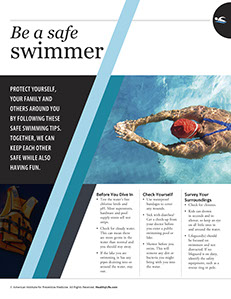
    Bird eye view of female swimming.

    Protect yourself, your family and others around you by following these safe swimming tips. Together, we can keep each other safe while also having fun.

    Before You Dive In

    *  Test the water’s free chlorine levels and pH. Most superstores, hardware and pool supply stores sell test strips.

    *  Check for cloudy water. This can mean there are more germs in the water than normal and you should stay away.

    *  If the lake you are swimming in has any pipes draining into or around the water, stay out.

    Check Yourself

    *  Use waterproof bandages to cover any wounds.

    *  Sick with diarrhea? Get a check-up from your doctor before you enter a public swimming pool or lake.

    *  Shower before you swim. This will remove any dirt or bacteria you might bring with you into the water.

    Survey Your Surroundings

    *  Check for closures.

    *  Kids can drown in seconds and in silence, so keep an eye on all little ones in and around the water.

    *  Lifeguard(s) should be focused on swimmers and not distracted. If no lifeguard is on duty, identify the safety equipment, such as a rescue ring or pole.

    © American Institute for Preventive Medicine

  • Cpr

    First Aid

    Conventional CPR ─ Chest Compressions and Rescue Breaths {Note: Doing Hands-Only CPR is advised for persons not trained in CPR. Take a training course in CPR to learn how to do it the right way. Find out about training course in CPR to learn how to do it the right way. Find out about training atwww.cpr.heart.org.} Do CPR when the person is not responsive, is not breathing, and does not have a pulse.

    Hands Only CPR

    This is giving chest compressions with no rescue breaths. It can be used for adults and teens who suddenly collapse.

    Hands-Only CPR is not for:

    *  All infants and children.

    *  Adults and teens who have collapsed due to near-drowning, a drug overdose, or breathing problems.

    *  Adults and teens who are already unconscious and not breathing normally when found.

    Hands-Only CPR – 2 Steps:

    1.  Call 9-1-1 or get someone else to call!

    2.  Push hard and push fast in the center of the chest. Give 100 compressions per minute, such as to the tune of “Staying Alive” by the Bee Gees. Keep this up until an automated external defibrillator (AED) is used or EMS arrives.

    See the Hands-Only™ CPR video atwww.cpr.heart.org.

    CPR for Adults & Teens

    Shout for help! Call or have someone else call 9-1-1 and get an automated external defibrillator (AED) if one is nearby. If another person is around, one of you stay with the person. The other one call 9-1-1 and get the AED. Follow the 9-1-1 dispatcher’s advice. Do CPR until the AED is used or EMS takes over.

    1. Begin Chest Compressions:

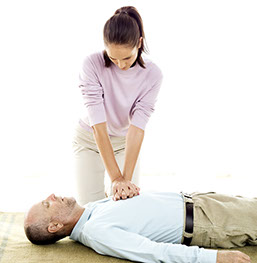
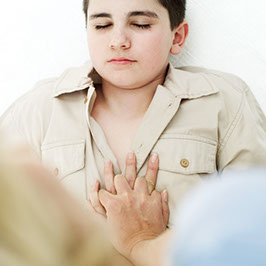
    *  Kneel at the person’s side. Place the heel of one hand ½ inch above where the ribs join the breastbone. Place your other hand on top of this one. Using the heels of your hands, depress the middle of the chest between the nipples at least  2 inches, but not more than 2.4 inches deep. Keep your arms straight. See image A.

    *  Push hard and push fast! Give at least 100 chest compressions in one minute. Relax pressure completely after each compression.

    Image of chest compressions.

    Image A

    2. Open the person’s airway.

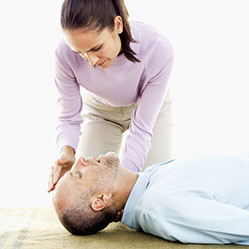
    With one hand, tilt the person’s head back. With 2 fingers of your other hand, lift the chin up. See image B. If the airway is blocked,  tilt the person’s head gently and slowly until the airway is open.

    Image of opening a person's airway.

    Image B

    3. If the person is breathing, keep the airway open.

    Look for other problems.

    4. If the person is not breathing, take a normal, (not deep) breath, and give him or her “Rescue Breaths.”

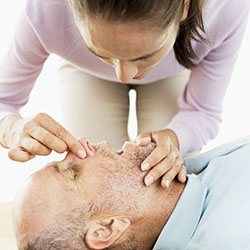
    *  Pinch the nose shut. Forming a tight seal, place your mouth over the person’s open mouth. See image C.

    *  Give 1 full breath for 1 second. If the chest doesn’t rise, repeat head tilt chin lift. See image B. Give the 2nd full breath for 1 second. Look to see if the person’s chest rises.

    Image of Rescue Breaths.

    Image C

    5. Give cycles of 30 chest compressions and 2 rescue breaths, without a break, until the person starts to move, an AED is used, or EMS provides care.

    Children Ages 1 to Puberty

    Shout for help! If you are alone, do CPR for 2 minutes before you call 9-1-1. If the child does not appear to have a serious injury, carry the child to nearest phone and call 9-1-1! Put the phone on speaker mode. Follow the dispatcher’s advice. If you are not alone, someone start CPR; someone else call 9-1-1 and get an AED, if one is nearby.

    1. Place the child on his or her back.

    2. Start Chest Compressions:

    *  Put one hand on the child’s breastbone right between his or her nipples.

    *  Using the heel of your hand (or both hands like in image A under Adults & Children Who Reached Puberty) push straight down about 2 inches (at least one-third of the depth of the child’s chest). See image D. Let the chest rise back up after each push.

    *  Push hard and push fast! Give at least 100 chest compressions in one minute. Relax pressure completely after each compression.

    Image of child chest compressions.

    Image D

    3. Follow steps 2, 3, 4, and 5 under CPR For Adults and Children who Have Reached Puberty on this page.

    {Note: Chest compressions alone are better than doing nothing, but it is best to give chest compressions plus rescue breaths. Why? Airway problems are the main cause of cardiac arrest in infants and children.}

    Babies Up to 1 Year Old

    1. If you are alone, do CPR for 2 minutes before you call 9-1-1.

    If the child does not appear to have a serious injury, carry the child to nearest cell or other phone and call 9-1-1!  Put the phone on speaker mode. Follow the dispatcher’s advice. If you are not alone, someone start CPR; someone else call 9-1-1!

    2. Start Chest Compressions:

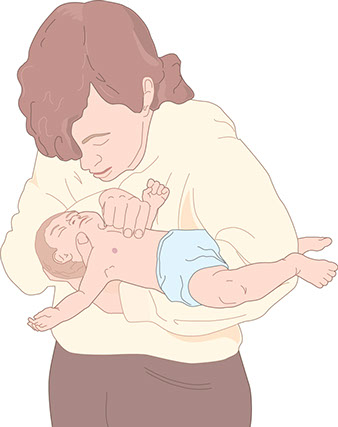
    *  Put the tips of your middle and ring fingers on the baby’s breastbone right between his or her nipples. See image E.

    *  Slip your other hand underneath the baby’s back for support.

    *  Push straight down about 1½ inches (at least one-third of the depth of the baby’s chest). Push at a rate of at least 100 compressions per minute. Let the chest rise back up after each push.

    Illustration of baby chest compressions.

    Image E

    3. If the baby is not breathing, or you are not sure he or she is breathing, give Rescue Breaths:

    *  Cover the infant’s mouth and nose with your mouth, forming a tight seal.

    *  Give 1 full breath for 1 second. Look to see if the chest rises. Give the 2nd full breath for 1 second and look to see if the chest rises.

    *  If the chest does not rise, go back to giving chest compressions. See step 2 listed above. After 30 more compressions, try rescue breaths again. {Note: If you can’t give rescue breaths, just keep giving chest compressions.}

    4. Give cycles of 30 chest compressions and 2 rescue breaths, without a break.

    Do this until the baby starts to move or until EMS provides care.

    Healthier at Home book by the American Institute for Preventive Medicine. www.HealthyLife.com. All rights reserved.

    © American Institute for Preventive Medicine

  • Recovery Position

    First Aid

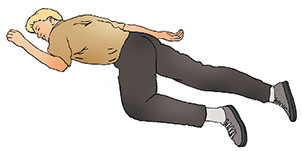
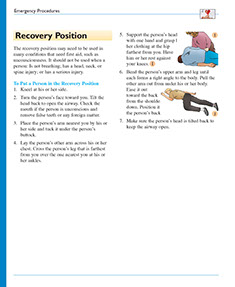
    The recovery position may need to be used in many conditions that need first aid, such as unconsciousness. It should not be used when a person: Is not breathing; has a head, neck, or spine injury; or has a serious injury.

    To Put a Person in the Recovery Position

    1.  Kneel at his or her side.

    2.  Turn the person’s face toward you. Tilt the head back to open the airway. Check the mouth if the person is unconscious and remove false teeth or any foreign matter.

    3.  Place the person’s arm nearest you by his or her side and tuck it under the person’s buttock.

    4.  Lay the person’s other arm across his or her chest. Cross the person’s leg that is farthest from you over the one nearest you at his or her ankles.

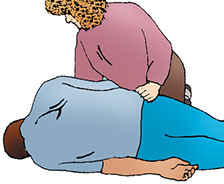
    5.  Support the person’s head with one hand and grasp his or her clothing at the hip farthest from you. Have him or her rest against your knees. See image A.

    6.  Bend the person’s upper arm and leg until each forms a right angle to the body. Pull the other arm out from under his or her body. Ease it out toward the back from the shoulder down. Position it parallel to the person’s back. See image B.

    7.  Make sure the person’s head is tilted back to keep the airway open.

    Illustration on how to place a person in the recovery position.

    Image A

    Illustration on how to put a person in a recovery position.

    Image B

    Healthier at Home book by the American Institute for Preventive Medicine. www.HealthyLife.com. All rights reserved.

    © American Institute for Preventive Medicine

  • Practice Relaxation Techniques

    Healthylife® Weigh

    Part 6

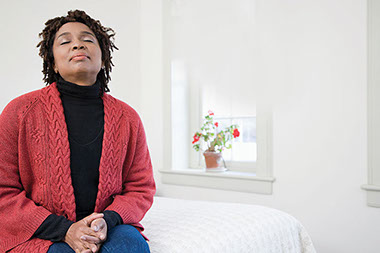
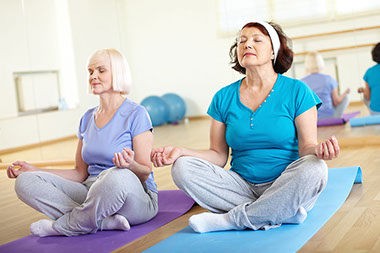
    Women deep breathing.

    Use relaxation techniques to manage emotional eating triggers.

    Learn These Four Skills to Relax

    1. Relaxation Reflex: Get rid of muscle tension.

    2. Mindfulness: Be fully present in the moment.

    3. Deep Breathing: Feel relaxed by breathing in more oxygen.

    Plan Relaxation Time

    Plan 15 minutes during the day to intentionally relax. You can also do relaxation exercises as needed throughout the day. Practice these techniques before eating or to cope with an emotion that is triggering you to eat. Relaxation techniques can help reduce stress-related health problems, such as high blood pressure, headaches, and pain. These tools also help you to have greater mental and physical control and improve your response to negative emotions.

    How the mind can control the body:

    *  It can slow brain wave patterns.

    *  It can reduce heart and breathing rates.

    *  It can increase blood flow to the limbs.

    *  It can relax muscles.

    © American Institute for Preventive Medicine

  • Yoga

    Healthylife® Weigh

    Part 5

    Senior women doing yoga.

    Yoga is excellent for improving flexibility, relaxation, and stress reduction. Find a good instructor who can modify yoga to suit your individual needs. Develop your skills slowly. You can also find free yoga resources online or at your library. Watch YouTube videos or DVDs for demonstrations of movements.

    © American Institute for Preventive Medicine

  • 5 Things To Know About Yoga

    BE FIT

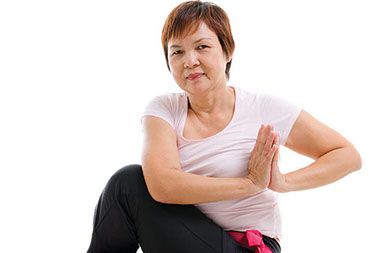
    Image of women in yoga position.

    Yoga typically combines physical postures, breathing exercises, and meditation or relaxation. Researchers are studying how yoga may be used to help improve health and to learn more about its safe use. If you’re thinking about practicing yoga, here are 5 things you should know from the National Center for Complementary and Alternative Medicine:

    1. Studies suggest that yoga may be beneficial for a number of conditions. Recent studies in people with chronic low-back pain suggest that a carefully adapted set of yoga poses can help reduce pain and improve function. Other studies also suggest that practicing yoga (as well as other forms of regular exercise) might have other health benefits such as reducing heart rate and blood pressure, and may also help relieve anxiety and depression.

    2. Research suggests that yoga is not helpful for asthma, and studies looking at yoga and arthritis have had mixed results.

    3. Yoga is generally considered to be safe in healthy people when practiced appropriately. However, people with high blood pressure, glaucoma, or sciatica, and women who are pregnant should modify or avoid some yoga poses.

    4. Practice safely and mindfully. Everyone’s body is different, and yoga postures should be modified based on individual abilities. Inform your instructor about any medical issues you have, and ask about the physical demands of yoga.

    5. Talk to your doctor about any complementary health practices you use, including yoga. Give them a full picture of what you do to manage your health. This will help ensure coordinated and safe care.

    © American Institute for Preventive Medicine

  • Cold Temps & Exercise: A Great Pair

    BE FIT

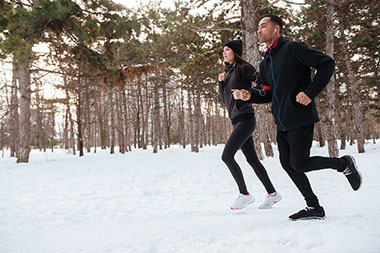
    Image of couple jogging in the winter.

    Has cold weather got you hiding under the blankets? Don’t let it turn you into a couch potato. Your body needs exercise year-round to be healthy. And, exercising in the cold can be enjoyable if you know how to prepare for it.

    Why cold weather workouts are cool

    Cold air can be refreshing! Stepping out into a chilly day may help you stay moving. There’s no sweltering heat or sticky humidity to slow you down. If fact, the lack of heat may help you work out a little longer and harder. You could burn even more calories and give your energy levels a boost.

    Getting out in the daylight can improve your mood. This can help you get through the long winter with good mental health. Your immune system will thank you, too. Just a few minutes a day of exercise may help you stave off colds and flu.

    How to work out when it’s cold

    Not sure what you should or shouldn’t do in the winter? Try these activities:

    *  Brisk walking or hiking

    *  Ice skating

    *  Sledding

    *  Cross-country skiing

    *  Snowshoeing

    Safety first

    Staying warm and dry is key during winter workouts. Hypothermia and frostbite are dangerous and are more likely to happen if you’re not properly dressed for the weather. These steps can help you avoid getting dangerously cold:

    *  Use a moisture-wicking fabric as the first layer against your skin. Never use cotton, as it traps moisture and will make you feel colder.

    *  The next layer should be a warm material, like fleece.

    *  The outside layer of clothing should be windproof to keep out moisture and chilly gusts.

    Don’t forget to drink plenty of water! Even if you don’t feel hot, your body needs hydration during exercise.

    Indoor workouts work, too

    If it’s simply too cold, icy or otherwise unsafe to exercise outdoors, you can still get off the couch and get healthier. Indoor workouts include:

    *  Going up and down stairs

    *  Dancing

    *  Vacuuming, mopping or other active housework

    *  Roller skating

    *  Yoga

    *  Workout classes at a local gym or community center

    People who have had a heart attack or stroke, or are at risk of either one, should ask their doctor about safe ways to exercise.

    Signs of hypothermia

    Hypothermia means the body temperature has dropped too low. Seek immediate care and/or go to an emergency room if hypothermia is suspected. Signs to look for include:

    *  Sudden clumsiness, lack of coordination

    *  Confusion

    *  Shivering

    *  Sleepiness

    *  Slurred speech

    *  Very cold feet or hands

    Source: American Heart Association

    © American Institute for Preventive Medicine