Tag: budget

  • Debt-To-Income Ratio: Faqs

    FINANCIAL HEALTH

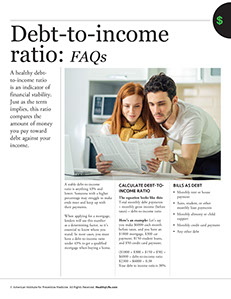
    Young couple looking over bills together.

    A healthy debt-to-income ratio is an indicator of financial stability. Just as the term implies, this ratio compares the amount of money you pay toward debt against your income.

    A stable debt-to-income ratio is anything 43% and lower. Someone with a higher percentage may struggle to make ends meet and keep up with their payments.

    When applying for a mortgage, lenders will use this number as a determining factor, so it’s essential to know where you stand. In most cases, you must have a debt-to-income ratio under 43% to get a qualified mortgage when buying a home.

    Calculate debt-to-income ratio

    The equation looks like this: Total monthly debt payments ÷ monthly gross income (before taxes) = debt-to-income ratio

    Here’s an example: Let’s say you make $6000 each month before taxes, and you have an $1800 mortgage, $300 car payment, $150 student loans, and $50 credit card payment.

    ($1800 + $300 + $150 + $50) ÷ $6000 = debt-to-income ratio

    $2300 ÷ $6000 = 0.38

    Your debt to income ratio is 38%.

    Bills as debt

    *  Monthly rent or house payment

    *  Auto, student, or other monthly loan payments

    *  Monthly alimony or child support

    *  Monthly credit card payment

    *  Any other debt

    © American Institute for Preventive Medicine

  • Reevaluate Your Budget

    FINANCIAL HEALTH

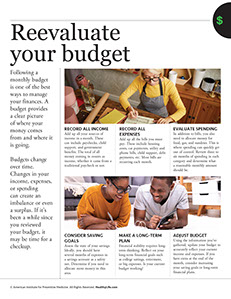
    Women working on a budget.

    Following a monthly budget is one of the best ways to manage your finances. A budget provides a clear picture of where your money comes from and where it is going.

    Budgets change over time. Changes in your income, expenses, or spending can create an imbalance or even a surplus. If it’s been a while since you reviewed your budget, it may be time for a checkup.

    Record all income

    Add up all your sources of income in a month. These can include paychecks, child support, and government benefits. The total of all money coming in counts as income, whether it came from a traditional paycheck or not.

    Record all expenses

    Add up all the bills you must pay. These include housing costs, car payments, utility and phone bills, child support, debt payments, etc. Most bills are recurring each month.

    Evaluate spending

    In addition to bills, you also need to allocate money for food, gas, and sundries. This is where spending can quickly get out of control. Review three to six months of spending in each category and determine what a reasonable monthly amount should be.

    Consider saving goals

    Assess the state of your savings. Ideally, you should have several months of expenses in a savings account as a safety net. Determine if you need to allocate more money in this area.

    Make a long-term plan

    Financial stability requires long-term thinking. Reflect on your long-term financial goals such as college savings, retirement, or big expenses. Is your current budget working?

    Adjust budget

    Using the information you’ve gathered, update your budget to accurately reflect your current income and expenses. If you have extra at the end of the month, consider increasing your saving goals or long-term financial plans.

    © American Institute for Preventive Medicine
  • Save At The Supermarket

    FINANCIAL HEALTH

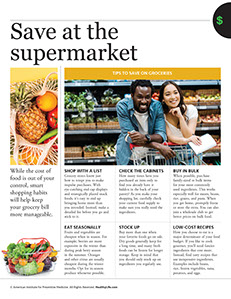
    Couple at the grocery store.

    While the cost of food is out of your control, smart shopping habits will help keep your grocery bill more manageable.

    Tips to save on groceries

    Shop with a list

    Grocery stores know just how to tempt you to make impulse purchases. With eye-catching end cap displays and strategically placed snack foods, it’s easy to end up bringing home more than you intended. Instead, make a detailed list before you go and stick to it.

    Check the cabinets

    How many times have you purchased an item only to find you already have it hidden in the back of your pantry? As you make your shopping list, carefully check your current food supply to make sure you really need the ingredients.

    Buy in bulk

    When possible, purchase family-sized or bulk items for your most commonly used ingredients. This works especially well for meats, beans, rice, grains, and pasta. When you get home, promptly freeze or store the extra. You can also join a wholesale club to get better prices on bulk food.

    Eat seasonally

    Fruits and vegetables are cheapest when in season. For example, berries are more expensive in the winter than during peak berry season in the summer. Oranges and other citrus are usually cheapest during the winter months. Opt for in-season produce whenever possible.

    Stock up

    Buy more than one when your favorite foods go on sale. Dry goods generally keep for a long time, and many fresh foods can be frozen for longer storage. Keep in mind that you should only stock up on ingredients you regularly use.

    Low-cost recipes

    How you choose to eat is a major determinant of your food budget. If you like to cook gourmet, you’ll need fancier ingredients that cost more. Instead, find tasty recipes that use inexpensive ingredients. Examples include beans, rice, frozen vegetables, tuna, potatoes, and eggs.

    © American Institute for Preventive Medicine

  • Saving Food, Saving Money

    FINANCIAL HEALTH

    Image of couple at the grocery store.

    In the U.S., we throw out millions of tons of food each year. Most people have thrown out food that spoiled or was simply never eaten. This harms the environment because it adds up to more waste, and it’s also harmful to your budget. It’s a lot like throwing money in the garbage! In addition, some of that wasted food could have gone to people who don’t have enough to eat.

    Shopping, planning, saving

    The number one way to stop wasting food is to plan meals and shop for only those meals. You’ll need to make a shopping list and stick to it when you go to the store.

    Your list should have ingredients for all your meals, including main dishes, sides, drinks and snacks. Then, buy only what’s on the list. This requires some extra time and planning, but the savings can add up.

    Some people like to shop for the whole week, while others shop for only a few days at a time. This is up to you. No matter how you like to shop, having a list can save you money and cut down on food waste.

    In the end, your budget and the environment will thank you. As an added bonus, you will be eating healthier by planning your meals ahead of time.

    Keep the pantry organized

    Have you ever bought a can of beans, only to find that you already had three at home? Having an organized pantry can help avoid this.

    Try putting your pantry into sections. You may wish to divide up canned foods into categories like fruit, vegetables, beans and other foods. Have another section for pasta, one for rice and so on. Being able to quickly glance at the pantry when you’re making your shopping list can save time and prevent buying duplicates.

    Other tips to prevent food waste

    *  Buying bulk portions can be a big saving – but only if you eat it. Only buy these large portions if you plan to use or freeze it all before it expires.

    *  Eat leftovers! Have a leftover dinner night, rather than cooking another meal. Get creative and use leftovers to make a casserole, soup or sandwiches.

    *  Check your fridge first. Before you go shopping, see what you already have in your fridge. Eat what you have on hand before buying more.

    *  Ask local food banks about their needs. Donate food that you don’t think you will use instead of throwing it away.

    Source: Environmental Protection Agency

    © American Institute for Preventive Medicine
  • Stay Warm, Save Money

    FINANCIAL HEALTH

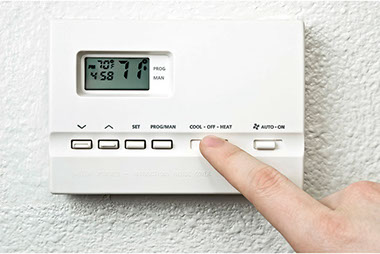
    Image of thermostat being set at 71 degrees.

    When temperatures drop, energy bills are higher. Duke Energy offers some simple energy (and money) saving tips:

    *  Check your heating system’s ductwork to ensure that it is well insulated and completely covered. Ductwork should be properly sealed and not allowed to hang loose under the house.

    *  Keep your thermostat at a comfortable setting. If you are going to be away for several days, turn the thermostat to a lower setting, but not off.

    *  Have your heating or cooling system checked each season by a qualified technician to make sure it is operating properly. Heating and cooling account for at least half of your energy bill.

    *  Check insulation, seal cracks, and weather-strips between heated and unheated areas such as garages, basements, and attics.

    *  If you have a window air conditioning unit, remove it for the winter months to prevent heat from escaping through and around the unit. If it cannot be moved, cover it to prevent drafts.

    *  Always make sure the fireplace damper seals tightly and remains closed except when a fire is burning or smoldering in the fireplace.

    *  Insulate your water heater with at least R-6 insulation. The water heater is the second-largest energy user in your home. You can save enough money in energy bills to pay back the cost of materials within months and then keep on saving.

    *  Ceiling fans help keep you comfortable in the summer and winter. Reversing the direction of the blades pushes warm air down into the room. Fans should turn counter-clockwise in the summer and clockwise in the winter.

    *  On sunny days, leave the draperies open to allow the sun’s rays to warm your house.

    © American Institute for Preventive Medicine

  • Stop The Spending Cycle

    WELL-BEING

    Image of colorful shopping bags.

    Going overboard on one shopping trip, especially around the holidays, does not mean you have a shopping addiction. It’s normal to overdo it once in a while. And, everyone buys things that aren’t truly needed at times.

    But, if you think you or a loved one might have a shopping addiction, there is help. Often times, a shopping addiction is the result of another health issue like depression. Talk with your doctor about your feelings and symptoms. Antidepressants or other medications may be helpful.

    Or, you may wish to talk with a counselor about things that are bothering you. Sometimes, emotional burdens or troubles can make you look for happiness in things like shopping. If you are able to deal with those problems, you may not feel the need to shop as much.

    There are also support groups for people with a variety of addictions. Debtors Anonymous can help people who have gone into debt from too much spending.

    Don’t be afraid to seek help. The sooner you can address the problem, the sooner you can get your life back on track.

    © American Institute for Preventive Medicine
  • Teaching Kids To Manage Money

    FINANCIAL HEALTH

    Image of boy holding money in one hand and thumbs up with the other hand.

    Good money management habits start early. In fact, even preschool age children can begin to learn about money and how to use it responsibly. Parents and caregivers have the power to teach children about proper spending, saving and sharing from a young age.

    Preschool age

    *  Use play money to “buy” items.

    *  Teach children about work. Tell them how your job helps you pay for things like food and clothes.

    *  Take them to the grocery store and talk about what items cost.

    *  If children get money for a birthday or holiday, have them put it in their piggy bank instead of spending it right away.

    School age

    *  Discuss the prices of items while shopping. Show your kids your shopping receipts and explain how much items cost.

    *  Have kids help you clip coupons and talk about how much you can save.

    *  Open a savings account for your child.

    *  Consider giving an allowance for chores. Talk to them about saving their allowance to buy something later, rather than spending it all now.

    Teenagers

    *  Show your teen how to balance a checkbook.

    *  Discuss responsible credit card spending and avoiding credit card debt.

    *  If your teen has a job, talk about taxes and help them fill out their income tax form.

    *  Explain how automobile and health insurance works.

    Don’t feel pressured to give your child a complete course in finances. Children learn by watching others, so setting a positive example for spending and saving is a great way to teach.

    Source: University of Minnesota Extension

    © American Institute for Preventive Medicine

  • Tips For Work Gift-Giving

    WORK LIFE

    Image of 2 wrapped gifts.

    If you’re considering buying presents for people at your workplace, it’s important to know how to do it right:

    *Be discreet.If you are buying gifts for just a friend or two, consider giving them outside of work so others don’t feel excluded.

    *Keep it professional.Work-related items, such as a nice pen or a coffee mug (if the person drinks coffee), are appropriate options. Personal items, such as perfume or clothing, should generally be avoided.

    *Be careful about supervisors.Many companies frown upon giving gifts to the boss. Although your intentions may be good, co-workers may see it as a way to buy into your boss’s good graces. And, it could make your boss uncomfortable.

    *Don’t go overboard.Spending more than you can afford isn’t necessary and may make the recipient feel uncomfortable.

    *Consider different religions and beliefs.Remember that not everyone celebrates the same holidays.

    Hands-free etiquette

    Whether you’re in a work meeting or at the office holiday party, you may want to put down your smart phone. Checking your email and posting to social media during work activities may give others the impression you are bored or would rather be somewhere else. If you must have it on for emergency calls, silence the dinging emails and text messages to minimize distractions.

    © American Institute for Preventive Medicine

  • Grocery Shop With Confidence

    Healthylife® Weigh

    Part 3

    Couple grocery shopping.

    Grocery stores can be wonderful places to explore new foods. The average grocery store has over 10,000 different items. Some of these foods are healthy “everyday” food choices. Add these more often to your cart. Others are “sometimes” or “once in a while” foods. Add these foods less often.

    Tips for Healthy Grocery Shopping:

    1. Choose a low-stress time to grocery shop, if possible. Make sure you have enough time to do your shopping. Stressed grocery shopping can make it harder to stick to your healthy list.

    2. Have a healthy snack before going to the grocery store. This will help you avoid buying less healthy foods on impulse.

    3. Shop the outer edges of the grocery store. This is where you will find fresh produce, dairy, eggs, meats/poultry/seafood, and frozen fruits and vegetables. Go into inner aisles for specific items on your list, but not to browse.

    4. Look for recipes or tips in the produce department. Stores often provide tips for cooking vegetables or a chart showing which fruits and vegetables are in season.

    5. Look for products locally grown or raised. Locally grown produce and livestock can be more nutritious and tasty. Nutrients and flavor can break down during storage and transport. Locally grown food may also be grown more sustainably and buying it supports the community.

    6. Sample healthy foods. Samples, such as cheese cubes or crackers with dip, can take the edge off in a portion-controlled serving. A bite-sized sweet treat can satisfy a craving and help you avoid picking up a larger version of that treat.

    7. Avoid your weak areas. Avoid an aisle that has many unhealthy foods that you have difficulty resisting. Or, keep your eyes forward when walking by these foods.

    8. Buy treats in small portions. Avoid the super-size trap of large portions of unhealthy food. Rather than buying a full tub of ice cream or a boxed brownie mix that will yield a full pan of brownies, get small-sized versions. Choose a single-serving ice cream or an individual brownie at the bakery.

    9. Read labels. Many of the healthiest foods, such as fruits and vegetables, won’t have food labels at all. If they do, they only give a snapshot of the true value of the food.

    © American Institute for Preventive Medicine