Tag: budget

  • Tips To Save On Your Summer Vacation

    FINANCIAL HEALTH

    Image of family about to go on a road trip.

    You want your vacation to be memorable, but you probably don’t want to remember spending a lot of money. With some advanced planning, you can save a good amount of your travel and vacation expenses. Here’s what travel experts recommend:

    *Don’t pick prime times for flights.If you’re flying, you’ll usually pay less for airline tickets during off-peak times. This means flying during the middle of the week, early in the morning or late at night.

    *Be flexible.When booking airline tickets, choose the flexible dates option to find the lowest price for airfare. Sometimes, the savings can be substantial.

    *Visit during the off-season.Many people travel to warm, tropical destinations during the winter months. Try going during the late fall or early spring instead.

    *Check out renting a house.Many destinations offer houses for rent at about the same price per night as hotels but with much more space. When you share with another family, you split the cost for even more savings.

    *Look for online deals & coupons.Look online for local activities you want to do, such as visiting museums or scuba diving excursions. Many places offer deals or coupons if you book in advance. You may also be able to avoid lines for buying tickets.

    *Don’t forget your discounts.Companies like AARP and AAA often have discount rates for members. Some employers have discounts available to employees for car rentals and other vacation items.

    *Pack snacks.Pack healthy snacks in a cooler for a car trip like fresh-cut fruits and vegetables. For flights, bring your own food to the airport and eat before getting on the plane. Keep in mind liquids more than 3.4 ounces can’t be taken through the security checkpoints.

    *Get a kitchen.Look for hotel rooms that have a full kitchen so you can store food and beverages, cook your own meals and avoid the higher costs of eating out.

    *Try camping.Instead of traditional hotels, look for campsites. Camping often costs a fraction of what a hotel costs, as long as you have a tent, mats to sleep on and a few more basic camping supplies.

    *Look nearby.If the prices of airline tickets and hotels aren’t in your budget, look for daytrip options. Destinations within 2 hours of home are often doable for families and can be just as fun as a longer trip.

    © American Institute for Preventive Medicine

  • Wallet-Friendly Workouts

    BE FIT

    Image of bike in the field.

    Finances are one of the biggest reasons people don’t join a gym. A monthly gym membership fee can take a big bite out of a budget, but that doesn’t mean you should throw in the towel on exercise.

    You can get all of the benefits of exercise at little to no cost with these tips:

    *  Use home items as workout tools. Instead of buying weights, use canned goods or fill used gallon jugs with water or sand.

    *  Put gravity to work for you. Many resistance exercises use only your body weight and gravity to help you get stronger. Think push-ups, squats, crunches, leg lifts, and arm raises.

    *  Use the stairs in your home for a step training workout. Or, use a low, sturdy step stool. Play music while stepping.

    *  Borrow fitness DVDs from your library, or look for used ones at garage sales.

    *  Utilize community resources. Some fitness centers, senior centers, and community programs offer free or low-cost fitness classes. Local hotels or schools may have a minimal fee to swim in the pool at select times. Walk a local walking path or step through a scenic park for fresh air and fitness.

    *  Consider used items. Many people will sell their used bikes, weight machines, treadmills, and other equipment at a fraction of the cost of a new item. Stop by local yard sales or look for local “yard sale” groups on social media.

    *  Try just shoes and an app. If you already have a smart phone, there are many free or low-cost fitness apps available to keep you motivated. Lace up your walking shoes and start tracking your progress with the app to keep you motivated and on track. YouTube also offers a variety of workout programs that allow you to exercise at home.

    © American Institute for Preventive Medicine

  • Eat Healthy & Save On Groceries

    FINANCIAL HEALTH

    Illustration of grocery cart with fruit and vegetables.

    Many people assume that healthy food, such as fresh fruit, costs more than processed and less nutritious foods like crackers and cookies. Although the best foods aren’t always the cheapest, healthy foods are worth the money spent. A healthy diet can help you feel better physically and mentally, which could mean fewer doctor visits and a better quality of life. If you’d like to eat healthier but are afraid it will hurt your budget, try these tips to get the most bang for your buck at the supermarket.

    *Plan your meals.Once or twice a week, sit down and write out the recipes you’d like to cook for the next few days. Write down the ingredients and shop for only those items. You’ll be less likely to resort to takeout because you have “nothing to eat” and you can avoid unneeded purchases.

    *Buy what’s in season.There’s a reason strawberries cost more in the winter months. They become harder to grow, and they must be shipped to your store from greater distances. Instead of trying to eat “summer” foods year-round, find out what’s freshest during each season. Citrus fruits and pears, for instance, are often best during the colder months.

    *Start a garden.You don’t need a huge yard to take advantage of growing your own food. Even a few small pots on a back deck or porch can allow you to grow some of your favorite fruits or vegetables. They’ll be fresh and delicious when you harvest them, and you won’t have to buy them.

    *Stock up.Canned goods, packaged cereals and other nonperishable items can be bought in larger quantities when on sale and stored. If you’re not a fan of clipping coupons, try buying them in bulk when possible.

    *Don’t overlook store brands.Buying canned and frozen items of the generic or store brand could save you a few dollars each time you visit the grocery store. Also, consider store brand bread, pasta, juice and other items. You probably won’t taste the difference.

    *Don’t shop while hungry.Some studies suggest that shopping while hungry could lead you to purchase more food than you need. Uneaten food, even the healthy kind, is money wasted.

    © American Institute for Preventive Medicine

  • Where Does The Money Go?

    FINANCIAL HEALTH

    Image of scale with bills on one side and a piggy bank on the other side.

    Regular expenses are a necessary part of life. In your household, you probably have a certain amount of money coming in and a different amount going out.

    Even if you have a rough idea of how much you spend, tracking your monthly expenses can help you find out a lot about your money. Small amounts here and there can quickly add up. For one month, write down everything you spend on bills, food, gas, clothes, and any other purchases – even your morning latte. Then, you can look for ways to cut back on unnecessary costs. Money you have left at the end of the month can be saved for an emergency fund or for future needs.

    © American Institute for Preventive Medicine

  • Exercise On A Budget

    BE FIT

    Image of young man doing push-ups.

    Don’t let gym memberships, personal training fees, or the cost of the latest exercise gadget weigh you down. Exercise is about moving, stretching, lifting, bending, breathing – things you can easily do at home. Or simply walk – around the block, at a mall, or on a local school’s track.

    Get started

    Start with a few simple stretches to warm up your muscles. If you need help, go online for how-to instructions on everything from stretching to full routines. You can also find exercise tools to track your progress.

    No equipment necessary

    Do what you were taught in gym class – squats, push-ups, jumping jacks, and crunches. Lift your legs and arms, touch your toes, bend from side to side, jog in place, and twist. Just make sure you target all your major muscle groups at least once every week.

    No free weights? Try these substitutes

    *  Use cans instead of dumbbells to exercise biceps and triceps.

    *  A gallon jug filled with water, sand, or powdered detergent is just as effective as a kettle bell for squats and arm lifts.

    *  Put a paper plate under one foot and lunge forward. You can also attach plates to both feet with rubber bands to simulate skating. Or, get down on all fours, put the plates under your hands and slide them back and forth for a great chest workout.

    *  Pantyhose stretch just as well as resistance bands for rowing and stretching routines.

    *  A low, sturdy stool or a bottom stair can be used for a step exercise routine.

    © American Institute for Preventive Medicine

  • 4 Money Mistakes To Avoid

    FINANCIAL HEALTH

    Image of 3 friends.

    Little everyday choices can have a big impact on your finances. If you want to save more or spend less, think about whether you’re making any of these mistakes.

    Mistake #1: You put off saving money.

    Do you think that you can wait a few more months or even years before you need to save for retirement, your kids’ college or other future needs? Even if you can only put away a few dollars each week, start now. It can add up over time and the sooner you start, the more money you’ll have later.

    Mistake #2: You spend too much on “treats.”

    We all like to treat ourselves once in a while. But, if you’re spending money on treats often, such as going to the movies or buying yourself a new item, you could be creating money problems. Look for low-cost or free ways to reward yourself. Set aside some time with a friend, take a hot bath, watch a favorite movie at home or check out free museums and concerts.

    Mistake #3: You get lots of coupons in your mail and email.

    If you get catalogs in the mail and your inbox is filled with coupons and deals, this could be wrecking your money goals. After all, you may not need the items that are advertised. But, they look like such a good deal that you decide to buy them anyway. Do you really need another sweater or pair of jeans, or are you buying them because of the sale? Unsubscribe from email coupons and newsletters, and throw catalogs in the recycling bin. This can help lower the temptation to shop.

    Mistake #4: You don’t know how much money you really have.

    If you are struggling financially, it can be hard to look at your bank account balances. But, it’s better to know what you can afford than to go deeper into debt. Make a budget of what you have and what you can spend each month after bills are paid. Try to stick to your budget and find ways to cut out unnecessary items.

    © American Institute for Preventive Medicine

  • For The Health Of Your Wealth

    FINANCIAL HEALTH

    Image of female talking to an advisor.

    Do you want to take control of your financial life? It’s up to you to understand your own money, says investment advisor Paul Taylor, a member of the National Ethics Bureau. Taylor offers the following suggestions:

    For your cash flow, keep in mind the four A’s: Accounting, Analysis, Allocation, and Adjustment. The four A’s describe a systematic and disciplined approach to your daily, weekly, monthly, and yearly spending habits.

    *  Accounting involves gathering all your relevant financial information-income, recurring bills, and other expenditures-creating a central list of each item, and pulling it together in a place where it’s easy to find.

    *  Analysis is reviewing the information to determine whether you have a shortfall or surplus, and finding places to reduce expenses. Saving $100 a month on dining out, for instance, would allow you to apply $100 to your mortgage loan principal, saving you a substantial amount in interest payments.

    *  Allocation involves determining your financial commitments and priorities, needs versus wants, and distributing your income accordingly.

    *  Adjustment involves periodic reviews of your financial information and shifting assets to meet changing needs.

    © American Institute for Preventive Medicine

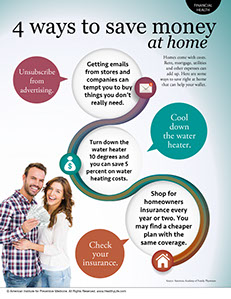
  • 4 Ways To Save Money At Home

    FINANCIAL HEALTH

    Young couple smiling and holding money.

    Homes come with costs. Rent, mortgage, utilities and other expenses can add up. Here are some ways to save right at home that can help your wallet.

    Unsubscribe from advertising.

    Getting emails from stores and companies can tempt you to buy things you don’t really need.

    Cool down the water heater.

    Turn down the water heater 10 degrees and you can save 5 percent on water heating costs.

    Check your insurance.

    Shop for homeowners insurance every year or two. You may find a cheaper plan with the same coverage.

    Source: American Academy of Family Physicians

    © American Institute for Preventive Medicine

  • How To Stop Impulse Buying

    FINANCIAL HEALTH

    Image of women looking at jeans.

    Many people have bought something at the store that they didn’t plan to get. If you buy something simply because you see it and want it, this is called an impulse buy.

    Some estimates show that the average American spends a few thousand dollars a year on impulse buys. These purchases can add up to big spending.

    If you’re trying to save money, take a look at your buying habits. It’s possible that your unplanned impulse purchases are standing in the way of a healthy budget and your long-term financial goals.

    Try not to dwell on past impulse purchases. Instead, look to the future and decide that you will resist the urge to buy things you don’t need.

    Why we impulse buy

    Stores use certain tricks and techniques to make impulse buys happen. Plus, specific things happen in our brains while shopping that can lead to an impulse buy. Some of the reasons we buy things on impulse:

    1.  A love of shopping and new things. Shopping can release feel-good chemicals in the brain. Once we experience this kind of pleasure, it can become a habit that is hard to break.

    2.  Fear of missing a deal. Our desire to save money can lead to impulse buying. We see a deal on something and wonder if we will regret not buying it later.

    3.  Hope that having this item will make our life better. For example, someone may think that buying a new blender means they will make a vegetable smoothie every day. Or, if someone is feeling depressed or angry, they may think this new item will fix their problem.

    How to stop impulse purchases

    If you think impulse buying is affecting you, there are ways to stop. Keep these things in mind when you go shopping:

    *  Stop and think about the price. Ask yourself whether that item is truly worth what it costs. Think about how many hours you would have to work to pay off that item. Is it really worth buying?

    *  Bring a list. Make your shopping list in advance and buy only those items.

    *  Don’t use credit cards. If possible, only shop with cash or a debit card. This means you won’t have seemingly unlimited funds. If that’s not possible, picture next month’s bill with that item on it. That number on your statement may make the item less appealing.

    *  Don’t shop when you’re hungry, stressed, angry or sad. These emotions can prompt you to buy unwanted things.

    © American Institute for Preventive Medicine