
Tag: budget

  • An Annual Financial Review

    FINANCIAL HEALTH

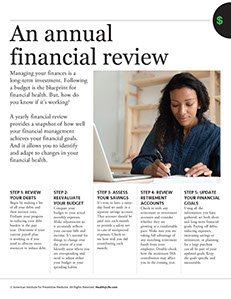
    Women writing on paper with laptop next to her.

    Managing your finances is a long-term investment. Following a budget is the blueprint for financial health. But, how do you know if it’s working?

    A yearly financial review provides a snapshot of how well your financial management achieves your financial goals. And it allows you to identify and adapt to changes in your financial health.

    Step 1: Review your debts

    Begin by making a list of all your debts and their interest rates. Evaluate your progress in reducing your debt burden in the past year. Determine if your current payoff plan is working or if you need to allocate more resources to reduce debt.

    Step 2: Reevaluate your budget

    Compare your budget to your actual monthly expenses. Make adjustments so it accurately reflects your current bills and income. It’s normal for things to change over the course of a year. Identify areas where you are overspending and need to adjust either your budget or your spending habits.

    Step 3: Assess your savings

    It’s wise to have a rainy-day fund set aside in a separate savings account. That account should be paid into each month to provide a safety net in case of unexpected expenses. Check to see how well you did contributing each month.

    Step 4: Review retirement accounts

    Check in with any retirement or investment accounts and consider whether they are growing at a comfortable pace. Make sure you are taking full advantage of any matching retirement funds from your employer. Double-check how the maximum IRA contribution may affect you in the coming year.

    Step 5: Update your financial goals

    Using all the information you have gathered, set both short and long-term financial goals. Paying off debts, reducing expenses, increasing savings or retirement, or planning for a large purchase can all be part of your updated goals. Keep the goals specific and measurable.
    © American Institute for Preventive Medicine

  • Make The Most Of Your Health Care Dollars

    SELF-CARE CORNER

    Image of doctor taking a patient's blood pressure reading.

    So you’ve got that high deductible health plan or flexible spending account. How can you save money-and spend your dollars wisely? Blue Cross Blue Shield of Delaware offers these suggestions:

    *Stay in-network.Make sure your doctors, laboratory, and hospital are a part of your health plan’s provider network so you save on copays and coinsurance amounts.

    *Use alternatives to emergency services.A visit to the hospital ER is generally unnecessary for issues such as the flu, minor cuts and sprains, or urinary tract infections. Overall costs are usually lower at walk-in clinics and urgent care centers. Check your health plan’s provider directory for nearby centers.

    *Take the tests.Receive the screenings, tests, vaccines, and other care that your plan covers, as recommended by your doctor. When you and your family stay healthy, you can avoid doctor visits and time off from work.

    *Take your medicine.To receive the full benefit of your medicine, remember to take the recommended dosage for as long as your doctor prescribes it. People who take their medicine as prescribed need less health care-and less expensive care. If you don’t understand how to take your medicine, ask your doctor or pharmacist.

    *Find the best price for the medication you need.Always ask if a generic prescription drug or an over-the-counter (OTC) drug would be best for you. For any brand-name drug, research the manufacturer before you fill the prescription. Then check its website for any discount coupons or free copay programs that may be available for that drug.

    © American Institute for Preventive Medicine

  • Managing Financial Stress

    FINANCIAL HEALTH

    Image of hands holding money.

    Do finances keep you awake at night? If so, you’re not alone. More than 75 percent of Americans say money is a big source of stress, according to the American Psychological Association (APA).

    Although we can’t always change our financial problems right away, we can learn to cope with this type of stress. This can help you stay healthier and learn to deal with challenges in a positive way.

    If you’re stressed about money, try these tips:

    *Remain calm and make a plan.It can be easy to get caught up in the panic of the moment when a problem arises. A sudden expense needed for an emergency or stories about a “bad economy” in the news can make things feel hopeless. Instead, think about small steps you can take now to improve your budget. This may be writing down a few specific ways you can cut back on expenses. Or, look at your past spending and make a plan to cut back on things you can do without for now.

    *Look at the positive side of being thrifty.Eating meals at home instead of at a restaurant can be a fun family bonding time. Have everyone help prepare the meal or pick out their favorite dish for the weekly menu. Can’t afford a fitness membership? Exercise with a family member or friend at home and make it fun.

    *Be proud of progress.If you saved $5 by making your coffee at home rather than buying it at a coffee shop, that’s a step in the right direction. Think about the little ways you can save money and how they add up over time. These small successes can get you to your goal.

    *If you can’t pay your bills, ask for help.Banks, utilities and credit card companies will often give you extra time to pay if you’re in a financial crisis. It doesn’t hurt to call and ask.

    *Identify unhealthy behaviors.If you deal with stress by drinking alcohol, smoking or gambling, this will often make matters worse. Not only do these habits cost more money, but they can cost you your health, job and relationships. Healthy ways to cope with stress include exercise, deep breathing, eating a balanced diet, listening to music or calling a friend. If you need help with unhealthy behaviors, ask your doctor or look into community support groups.

    Source: American Psychological Association

    © American Institute for Preventive Medicine

  • Piggy Bank Smarts

    FINANCIAL HEALTH

    Image of hand placing a dollar bill into a piggy bank.

    Smart money management begins at home. Washington University researcher Michal Grinstein-Weiss found that teaching kids about money in childhood helps them better manage their mortgage loans as adults. The study was in Social Work Research.

    The professor offers 5 ways parents can teach their kids financial literacy:

    1. Discuss and explain basic finances around the dinner table, especially the difference between needs and wants.

    2. Teach kids how to save and set short-term goals (a new toy) and long-term goals (college). Kids will follow by example if they see you saving for something such as a family vacation.

    3. Open a savings account for your child as early as possible. Even if you bank online, visit the bank with your child to make a deposit because actions reinforce behaviors. Review monthly statements together.

    4. Teach kids budgeting and money-management skills. Help your child figure out how much money to save for how long to reach a goal amount.

    5. Get kids involved in daily activities and decisions about spending. Take them grocery shopping and have them compare prices of different brands. Count out the cash during a sale.

    © American Institute for Preventive Medicine

  • Practically Free Ways To Get Fit

    BE FIT

    Image of women listening to head phones while dancing.

    “Can’t afford to get fit” is one of the top excuses people give when asked why they don’t exercise. That’s about as logical as saying, “I can’t drive because I can’t afford a Mercedes.” Here are penny-wise ways to get fit from University of Alberta exercise experts:

    *  Walk. Most people walk 4,000 to 5,000 steps per day anyway. Aim to add more steps in your daily activities.

    *  Use a pedometer to help keep track of your steps. You can get one for about $10, but sometimes health fairs give them away free.

    *  Take the stairs every chance you get, even if it’s only one flight.

    *  Don’t use your children as an excuse not to exercise. Take them along for a walk or run in a stroller, wagon, or on a bike.

    *  Turn on your radio and dance up a storm for 20 to 30 minutes in the privacy of your own home.

    *  Use the lowest stair or stairs in your home and create your own step workout.

    *  Turn your canned goods into weights. Or pour sand or water into empty milk bottles to create weights.

    *  Grab a chair or the kitchen counter and do some push-ups, squats and leg lifts.

    *  Pair a favorite TV show with some sit-ups. Just hook your toes under the sofa. Stand up and jog during commercials.

    *  Got rope? Jump it for a total body workout.

    *  Check with your company wellness program, community league or local rec center for any exercise classes, walking clubs, or team sports you can join.

    *  Go for a walk or just stand by your workstation and stretch for 5 to 10 minutes every hour.

    © American Institute for Preventive Medicine

  • Save More, Spend Less

    FINANCIAL HEALTH

    Image of women at kitchen counter with groceries and placing money in a piggy bank.

    According to the American Psychological Association, finances are the number one cause of stress in America. Whether it’s meeting the monthly bills or trying to build a retirement fund, financial worries can be difficult to deal with.

    If you’re looking for ways to stretch your monthly budget, the Federal Trade Commission offers some tips that may help you save more and spend less without feeling the pinch.

    Start with a budget.

    This may not be fun, but it doesn’t have to be long and difficult. You can use something as simple as a two-column sheet of paper. In one column, write your net income for the month. In the other column, record all your expenses: basic monthly bills (mortgage, food, transportation), lifestyle choices (entertainment, eating out, personal care, pets), and other expenses. This will give you a clear idea of how much you need to save or cut back on spending. The FTC website offers a free budget worksheet atwww.consumer.ftc.gov/articles/pdf-1020-make-budget-worksheet.pdf.

    Consider direct deposits into savings accounts.

    Have part of your paycheck go directly into a 401 savings or other type of retirement account. Have additional money put into another savings account for an emergency fund and major expenses as needed.

    Pack lunches.

    A daily $6 spent on lunch adds up to $800 a year. Instead, make extra food for dinner and take leftovers or make your own sandwich. Or, purchase healthy frozen meals when they’re on sale.

    Use free community services.

    Most cities have well-stocked libraries that have books, magazines, music, games, and movies. You can check these items out for free.

    Know that every little bit helps.

    Make small, manageable goals to help you save. Even just $1,000 less on your credit card bill could save you hundreds of dollars in interest each year. Eating out one fewer time each week adds up to big savings in a few months. Rather than being discouraged by a goal that seems impossible, look for small, doable ways to save a few dollars here and there.

    © American Institute for Preventive Medicine