
Tag: budgeting

  • Declare Your Independence From Credit Card Overuse

    Financial Health

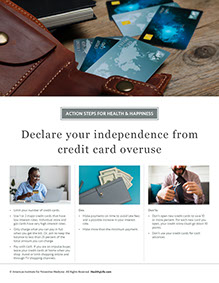
    Credit cards fanned out on table.

    *  Limit your number of credit cards.

    *  Use 1 or 2 major credit cards that have low interest rates. Individual store and gas cards have very high interest rates.

    *  Only charge what you can pay in full when you get the bill. Or, aim to keep the balance to less than 25 percent of the total amount you can charge.

    *  Pay with cash. If you are an impulse buyer, leave your credit cards at home when you shop. Avoid or limit shopping online and through TV shopping channels.

    Dos

    *  Make payments on time to avoid late fees and a possible increase in your interest rate.

    *  Make more than the minimum payment.

    Don’ts

    *  Don’t open new credit cards to save 10 or more percent. For each new card you open, your credit score could go down 10 points.

    *  Don’t use your credit cards for cash advances.
    ays to Well-Being book by the American Institute for Preventive Medicine. www.HealthyLife.com. All rights reserved.

    © American Institute for Preventive Medicine

  • Planning For Health Care Coverage

    Medical Care

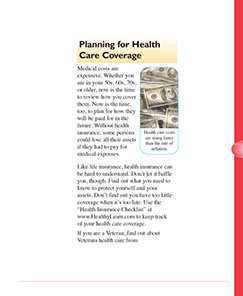
    Image of couple talking to a health care agent.

    Medical costs are expensive. Whether you are in your 50s, 60s, 70s, or older, now is the time to review how you cover them. Now is the time, too, to plan for how they will be paid for in the future. Without health insurance, some persons could lose all their assets if they had to pay for medical expenses.

    Like life insurance, health insurance can be hard to understand. Don’t let it baffle you, though. Find out what you need to know to protect yourself and your assets. Don’t find out you have too little coverage when it’s too late. Use the “Health Insurance Checklist” to keep track of your health care coverage.

    If you are a Veteran, find out about Veterans health care from

    Page from the Health at Home Lifetime book by the American Institute for Preventive Medicine. www.HealthyLife.com. All rights reserved.

    © American Institute for Preventive Medicine
  • Talk Smart About Finances

    FINANCIAL HEALTH

    Image of young couple with laptop and piggy bank.

    Economic flux hurts more than our wallets. Financial woes can lead to emotionally damaging arguments among couples and put unnecessary strain on the family, said Josh Klapow, PhD, a clinical psychologist and professor at the University of Alabama at Birmingham. Dr. Klapow is the author of Living Smart:  5 Essential Skills to Change Your Health Habits Forever.

    He said financial discussions, and even disagreements, can have a positive impact on families struggling through uncertainty. The key is to make those discussions productive, not destructive. Dr. Klapow offers 5 talking tips:

    1.Keep a cool head.When your emotions are high-be it anger, sadness, frustration-thoughts get cloudy. Relax, breathe, wait 2-10 minutes, then start to talk.

    2.Start easy.Arguments often start because of a critical remark or an angry tone. Try to bring up problems and mistakes gently and without blame.

    3.Don’t assume.Talk about your feelings, not what you think your spouse or partner is feeling. Describe your feelings in first person with “I” and explain why.

    4.Think then speak.The goal of the conversation should be to problem-solve, not to win. Remember, once the words are out, you cannot take them back.

    5.Repair and recover.Don’t let the discussion get out of control. End on a positive, or at least neutral, note. Lean on patience, change the topic, or offer a positive comment to let the other person know you’re part of the same team.

    © American Institute for Preventive Medicine