Tag: burnout

  • Prevent Burnout 2

    Work Life

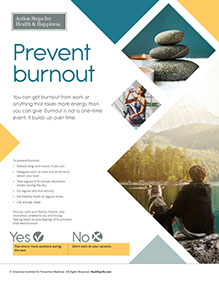
    Man sitting on roack along a lake with his dog.

    You can get burnout from work or anything that takes more energy than you can give. Burnout is not a one-time event. It builds up over time.

    To prevent burnout:

    *  Reduce long work hours, if you can.

    *  Delegate tasks at work and at home to lessen your load.

    *  Take regular 5-10 minute relaxation breaks during the day.

    *  Do regular physical activity.

    *  Eat healthy foods at regular times.

    *  Get enough sleep.

    *  Plan one or more vacations during the year.

    *  Don’t work on your vacation.

    Discuss, with your family, friends, and coworkers, problems you are having. Talking helps to ease feelings of frustration that feed burnout.

    ays to Well-Being book by the American Institute for Preventive Medicine. www.HealthyLife.com. All rights reserved.

    © American Institute for Preventive Medicine

  • Why You Need A Vacation

    WORK LIFE

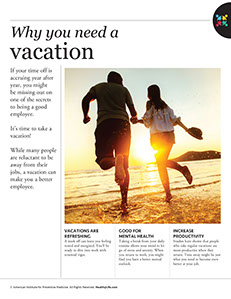
    Couple holding hands running into the ocean.

    If your time off is accruing year after year, you might be missing out on one of the secrets to being a good employee.

    It’s time to take a vacation! While many people are reluctant to be away from their jobs, a vacation can make you a better employee.

    Vacations are refreshing

    A week off can leave you feeling rested and energized. You’ll be ready to dive into work with renewed vigor.

    Good for mental health

    Taking a break from your daily routine allows your mind to let go of stress and anxiety. When you return to work, you might find you have a better mental outlook.

    Increase productivity

    Studies have shown that people who take regular vacations are more productive when they return. Time away might be just what you need to become even better at your job.

    © American Institute for Preventive Medicine

  • Prevent Burnout

    Stress Management

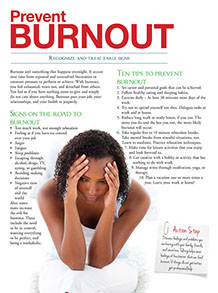
    Image of women with head in her hands.

    Recognize and treat early signs.

    Burnout isn’t something that happens overnight. It occurs over time from repeated and unresolved frustration or constant pressure to perform or achieve. With burnout, you feel exhausted, worn out, and detached from others. You feel as if you have nothing more to give and simply do not care about anything. Burnout puts your job, your relationships, and your health in jeopardy.

    Ten tips to prevent burnout:

    1.  Set career and personal goals that can be achieved.

    2.  Follow healthy eating and sleeping habits.

    3.  Exercise daily – At least 30 minutes most days of the week.

    4.  Try not to spread yourself too thin. Delegate tasks at work and at home.

    5.  Reduce long work or study hours, if you can. The more you do and the less you rest, the more likely burnout will occur.

    6.  Take regular five to 10 minute relaxation breaks. Take mental breaks from stressful situations, too. Learn to meditate. Practice relaxation techniques.

    7.  Make time for leisure activities that you enjoy and look forward to.

    8.  Get creative with a hobby or activity that has nothing to do with work.

    9.  Manage stress through meditation, yoga, or therapy.

    10. Plan a vacation one or more times a year. Leave your work at home!

    Signs on the road to burnout:

    *  Too much work, not enough relaxation

    *  Feeling as if you have no control over your job

    *  Anger

    *  Fatigue

    *  Sleep problems

    *  Escaping through alcohol, drugs, TV, eating, or gambling

    *  Avoiding making decisions

    *  Negative view of yourself and the world

    Also, some traits increase the risk for burnout. These include the need to be in control, wanting everything to be perfect, and being a workaholic.

    Action Step

    Discuss feelings and problems you are having with your family, friends, and coworkers. Talking helps ease feelings of frustration that can feed burnout. If things do not get better, get professional help.

    Page from Ways to Well-Being book by the American Institute for Preventive Medicine. www.HealthyLife.com. All rights reserved.

    © American Institute for Preventive Medicine

  • Manage Job Stress

    Work Life

    Job stress causes a worker to feel overly taxed both mentally and physically. It affects both workers and employers.

    What Causes Job Stress?

    *  Too much work to do. Conflicting expectations.

    *  Lack of support from co-workers and bosses.

    *  Crowded, noisy, unsafe work conditions. Infrequent rest breaks.

    *  Rapid changes for which workers are not prepared. Job insecurity.

    If not dealt with, job stress can lead to health problems.

    Signs & Symptoms of Job Stress

    *  Hard time concentrating. Headache.

    *  Sleep problems. Stomach problems.

    *  Short temper.

    *  Job dissatisfaction. Low morale.

    *  Increase in being late for work or not going to work.

    Ways to Manage Job Stress

    *  Schedule your time and tasks to be done. Use a calendar, planner, “TO DO” lists, etc. Rank order tasks. Break tasks down into steps. Check off items that are done.

    *  Organize your work space to make it easier to find things. Get rid of items and e-mails that you don’t need.

    *  Ask for help from your boss and co-workers, as needed. Ask your boss for the order in which your job tasks need to be done.

    *  Take breaks. Get enough sleep.

    *  Leave work at work. Try not to take work home. If this is not possible, take as little work home as you need to.

    *  Plan for and take vacations that give you a rest from work.

    *  Relax as much as you can.

    Resources

    National Institute for Occupational Safety and Health (NIOSH)

    800.CDC.INFO (232.4636)

    www.cdc.gov/niosh

    Occupational Safety and Health Administration (OSHA)

    800.321.OSHA (321.6742)

    www.osha.gov

    Healthier at Home book by the American Institute for Preventive Medicine. www.HealthyLife.com. All rights reserved.

    © American Institute for Preventive Medicine

  • Stress Relief For Caregivers

    Mature Health: Over Age 50

    Image of a caregiver helping a man in a wheelchair.

    If you’re the primary caregiver for a spouse, parent, or other relative, you face a tough challenge. Here’s what you can do to make the workload easier.

    *  Set up the sickroom on the main floor, so you don’t have to continually go up and down stairs.

    *  Purchase or rent equipment that will make caregiving easier. Examples include an electric hospital bed, an over-bed table, and a walker or wheelchair.

    *  Keep clean bed linens, towels, washcloths, hand lotion, drinking cups, and other supplies in or near the sickroom.

    *  Develop a daily schedule and stick to it.

    To reduce the stress of your ongoing responsibility:

    *  Delegate some tasks to family and friends.

    *  Investigate community services that provide transportation, deliver meals, and provide other kinds of help.

    *  Enlist the services of a home health care agency. The social service or discharge planning department of your hospital, Social Security Administration, local agency on aging, county public health department, or your physician, can refer you to an agency in your area.

    *  Plan to get out of the house to shop or socialize at least one day a week.

    *  Find out if the cost of hiring help to care for someone at home is covered by your medical insurance provider, Medicaid, or Medicare. The Veterans Administration may be able to provide financial assistance for veterans’ medical or nursing care.

    A Year of Health Hints book by the American Institute for Preventive Medicine. www.HealthyLife.com. All rights reserved.

    © American Institute for Preventive Medicine

  • Are You Driving Yourself To Burnout?

    SUCCESS OVER STRESS

    Image of elevated train and cars on road.

    Commuting length, distance, and means are stress factors that can lead to burnout, said Annie Barreck of the University of Montreal’s School of Industrial Relations.

    By car:

    No surprises: the bigger the city, the more stressful the commute, at least for people traveling by car. Passengers are more likely to be stressed out than drivers because carpooling reduces the passenger commuters’ sense of control, which causes them more stress before they’ve even arrived at work.

    By public transit:

    People with long commutes from rural areas via bus or train connections are stressed about uncontrollable delays. The stress carries over into the workplace. But transit users in major urban areas are less likely to have symptoms of burnout.

    By bike or on foot:

    Biking is also a mixed bag that is determined by the area the commuter is working in. Commuting by bike in the suburbs is more stressful than biking in the city where cyclists and walkers have access to safety features such as cycle paths and pedestrian crossings, which increase their sense of control over their commute.

    Study findings show that the risk of burnout increases significantly when a commute lasts more than 20 minutes. Above 35 minutes, all employees are at increased risk of cynicism toward their job. Barreck believes this should lead employers to adopt flexible commuting arrangements.

    © American Institute for Preventive Medicine

  • Caregivers: Take Time For Yourself

    FAMILY LIFE

    Image of elderly female in wheechair with two caregivers.

    There’s no doubt: caregiving is a stressful job. If you help take care of an aging, ill, or disabled loved one, you are a caregiver. And although caregiving may take up a lot of your time, you need to make time for yourself too, says the Family Caregiving Alliance.

    If you’ve been trying to juggle caregiving with your other commitments, it’s time to take a moment and think about your own needs. If you keep doing things for others without taking time for yourself, your health and entire life could suffer. Caregivers of all ages can be prone to the following problems:

    *  Depression or anxiety

    *  High stress levels

    *  Poor quality sleep or not sleeping enough

    *  Unhealthy diet choices

    *  Lack of exercise

    *  Not getting needed health care for themselves

    *  Financial problems

    *  Feeling isolated and alone

    These factors together can create health and personal problems. Before you reach the point of burnout, try to find a way to get a break from caregiving. Think about what would relax you and help you recharge. Is it a lunch date with a friend? An aerobics or yoga class? A walk through the park? A soak in the tub? Whatever it is, you deserve the time to do it.

    How to find the time

    Not sure how to find time for yourself? Talk to others who can help out. Ask friends, neighbors, or family members to step in for just an hour or two so you can have a break. Or, if you can, have your loved one spend some time at an adult day care or respite center. If others have offered to help in any way, learn how to say, “Yes, that would be great,” and accept their offer. Many caregivers mistakenly think they need to do it all themselves – don’t!

    Many people feel guilty leaving their loved one for even a short while. But remember, you need to recharge yourself so you can be the best caregiver possible. You’re doing it for others just as much as for yourself.

    Talk to others

    Many caregiver support groups are available online and in local communities. Connecting with others who understand can go a long way in helping you feel better. The local Area Agency on Aging (AAA) is a good place to start. Some support groups are online, while others offer in-person meetings. Choose what is right for you.

    Remember:Taking time for you is not being selfish. It’s a necessity. You deserve some time to take care of your own needs. It will allow you to be the best you can be in all areas of your life.

    © American Institute for Preventive Medicine