Tag: burns

  • Prevent Firework Injuries

    WELL-BEING

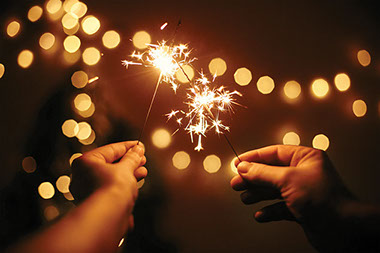
    Two hands holding sparklers.

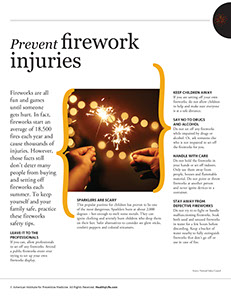
    Fireworks are all fun and games until someone gets hurt. In fact, fireworks start an average of 18,500 fires each year and cause thousands of injuries. However, those facts still don’t deter many people from buying and setting off fireworks each summer. To keep yourself and your family safe, practice these fireworks safety tips.

    Leave it to the professionals

    If you can, allow professionals to set off any fireworks. Attend a public fireworks event over trying to set up your own fireworks display.

    Keep children away

    If you are setting off your own fireworks, do not allow children to help and make sure everyone is at a safe distance.

    Say no to drugs and alcohol

    Do not set off any fireworks while impaired by drugs or alcohol. Or, ask someone else who is not impaired to set off the fireworks for you.

    Handle with care

    Do not hold the fireworks in your hands or set off indoors. Only use them away from people, houses and flammable material. Do not point or throw fireworks at another person and never ignite devices in a container.

    Stay away from defective fireworks

    Do not try to re-light or handle malfunctioning fireworks. Soak both used and unused fireworks in water for a few hours before discarding. Keep a bucket of water nearby to fully extinguish fireworks that don’t go off or use in case of fire.

    Sparklers are scary

    This popular pastime for children has proven to be one of the most dangerous. Sparklers burn at about 2,000 degrees – hot enough to melt some metals. They can ignite clothing and severely burn children who drop them on their feet. Safer alternatives to consider are glow sticks, confetti poppers and colored streamers.

    Source: National Safety Council
    © American Institute for Preventive Medicine
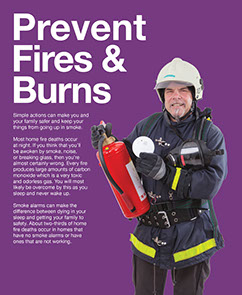
  • Prevent Fires & Burns

    Home Safety

    Do This, Not That

    Simple actions can make you and your family safer and keep your things from going up in smoke.

    Most home fire deaths occur at night. If you think that you’ll be awoken by smoke, noise, or breaking glass, then you’re almost certainly wrong. Every fire produces large amounts of carbon monoxide which is a very toxic and odorless gas. You will most likely be overcome by this as you sleep and never wake up.

    Smoke alarms can make the difference between dying in your sleep and getting your family to safety. About two-thirds of home fire deaths occur in homes that have no smoke alarms or have ones that are not working.

    General Guidelines

    Cooking Safety

    Electrical Safety

    Safe at Home - Do This, Not That Book. Published by the American Institute for Preventive Medicine.

    © American Institute for Preventive Medicine
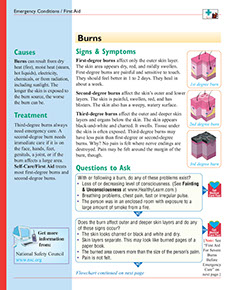
  • Burns

    First Aid

    Signs & Symptoms

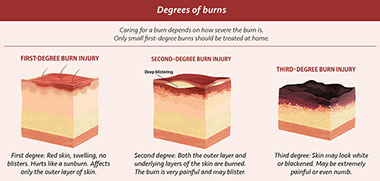
    First-degree burns affect only the outer skin layer. The skin area appears dry, red, and mildly swollen. First-degree burns are painful and sensitive to touch. They should feel better in 1 to 2 days. They heal in about a week.

    Second-degree burns affect the skin’s outer and lower layers. The skin is painful, swollen, red, and has blisters. The skin also has a weepy, watery surface.

    Third-degree burns affect the outer and deeper skin layers and organs below the skin. The skin appears black-and-white and charred. It swells. Tissue under the skin is often exposed. Third-degree burns may have less pain than first-degree or second-degree burns. Why? No pain is felt where nerve endings are destroyed. Pain may be felt around the margin of the burn, though.

    Causes

    Burns can result from dry heat (fire), moist heat (steam, hot liquids), electricity, chemicals, or from radiation, including sunlight. The longer the skin is exposed to the burn source, the worse the burn can be.

    Treatment

    Third-degree burns always need emergency care. A second-degree burn needs immediate care if it is on the face, hands, feet, genitals, a joint, or if the burn affects a large area.Self-Care/First Aidtreats most first-degree burns and second-degree burns.

    Questions to Ask

    Self-Care / Prevention

    For Severe Burns Before Emergency Care

    *  Remove the person from the source of heat. Call 9-1-1! Keep the person’s airway open. Treat for Shock.

    *  Remove hot or burned clothes that come off easily, not if they are stuck to the skin.

    *  Cover the burns loosely with clean cloths. Use direct pressure to control bleeding. Don’t rub.

    *  Stay with the person until medical care arrives.

    *  If lye or a dry chemical gets on the skin, brush off the powder. Then flush with clean water for at least 20 minutes or until EMS arrives. Remove glasses, but not contacts, before treating the eyes.

    For First-Degree and Second-Degree Burns (that are less than 3” in diameter)

    *  Use cold water or cloths soaked in cold water on burned areas for 15 minutes or until the pain subsides. Do not use ice at all. Doing this could result in frostbite.

    *  Cover the area loosely with a dry cloth, such as sterile gauze. Hold it in place by taping only the edges of the gauze. Change the dressing the next day and every 2 days after that.

    *  Don’t use ointments. Aloe vera can be applied over closed skin 3 to 4 times a day. For a more severe burn less than 3” x 2”, use Second Skin Moisture Pads, etc.

    *  Don’t break blisters. If they break on their own, apply an antibacterial spray or ointment or treatment prescribed by your doctor. Keep the area loosely covered with a sterile dressing.

    *  Prop the burned area higher than the rest of the body, if you can.

    Resources

    National Safety Council

    www.nsc.org

    Healthier at Home book by the American Institute for Preventive Medicine. www.HealthyLife.com. All rights reserved.

    © American Institute for Preventive Medicine
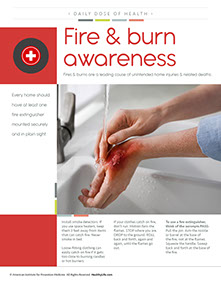
  • Fire & Burn Awareness

    First Aid

    Dental hygiene products, tooth brush, tooth paste, mouth wash, etc.

    Fires & burns are a leading cause of unintended home injuries & related deaths.

    Every home should have at least one fire extinguisher mounted securely and in plain sight.

    Install smoke detectors. If you use space heaters, keep them 3 feet away from items that can catch fire. Never smoke in bed.

    Loose-fitting clothing can easily catch on fire if it gets too close to burning candles or hot burners.

    If your clothes catch on fire, don’t run. Motion fans the flames. STOP where you are. DROP to the ground. ROLL back and forth, again and again, until the flames go out.

    To use a fire extinguisher, think of the acronym PASS:

    Pull the pin. Aim the nozzle or barrel at the base of the fire, not at the flames. Squeeze the handle. Sweep back and forth at the base of the fire.

    Health at Home Lifetime book by the American Institute for Preventive Medicine. www.HealthyLife.com. All rights reserved.

    © American Institute for Preventive Medicine
  • A Burning Issue: How To Handle Household Burns

    SELF-CARE CORNER

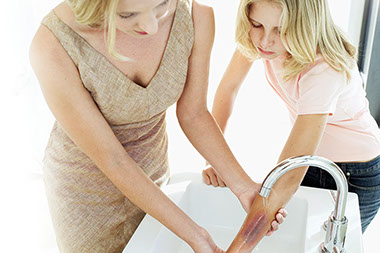
    Image of a mother helping daughter with a burn on the arm.

    Accidental burns can happen just about anywhere in your home, and they’re not always caused by fire. Hot objects or liquids, friction, the sun, electricity, or certain chemicals can also cause burns.

    Each year, about a half-million people nationwide seek medical attention for burns. Household burns lead to nearly 7 of 10 admissions to burn centers. The good news is that the number of deaths from severe burns has dropped by more than half over the past 4 decades, in large part because of treatments developed through NIH-funded research.

    Burns result in skin or tissue damage. The severity of a burn depends on the area it covers and how deep the damage goes. First-degree burns affect only the thin top layer of skin. Second-degree burns include the thick lower layer of skin. A third-degree burn is the most serious; it penetrates the entire thickness of the skin, permanently destroying it and the tissue that’s underneath.

    You can care for most minor burns at home. If the burn is red and painful with mild swelling or little blistering, then it’s a first-degree or minor second-degree burn.

    See a doctor if the burn is dark red and looks glossy with a lot of blistering. These are signs of a deep second-degree burn. Get immediate treatment if the burned skin is dry and leathery, perhaps with white, brown, or black patches. These are signs of a third-degree burn.

    Burns can become infected with bacteria or other germs if protective layers of skin are lost. Burns can also lead to painful inflammation, as your immune system shifts into gear.

    First aid for burns

    For minor burns:

    *  Immerse in fresh, cool water or apply cool compresses for 10 to 15 minutes.

    *  Dry the area with a clean cloth. Cover with sterile gauze or a non-adhesive bandage.

    *  Don’t apply ointments or butter; these may cause infection.

    *  Don’t break blisters.

    *  Over-the-counter pain medications may help reduce inflammation and pain.

    Call emergency services (911) if:

    *  Burns cover a large area of the body

    *  Burns affect the entire thickness of skin

    *  The victim is an infant or elderly

    *  The burn was caused by electricity, which can lead to “invisible” burns

    © American Institute for Preventive Medicine
  • Caring For Minor Burns

    SELF-CARE CORNER

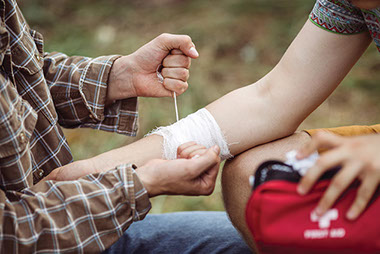
    Image of first aid on a burn to the arm.
    Chart of degree of burns.

    Many people have experienced the pain that even a minor burn can cause. The home can have many burn hazards, such as touching a hot stove, getting splashed with hot water, or even biting into food with hot spots. Children, especially, can be prone to burns when they accidentally touch something hot. Adults need to be careful too: burns are painful – and possibly dangerous –  at any age.

    What to do after a burn

    If you do get a minor (first-degree) burn, know how to care for it at home so it heals as quickly as possible. If the skin isn’t broken, you should:

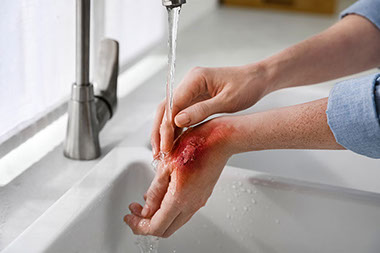
    *  Run cool water over the burn or soak it in cool water. Do not use ice: it’s too harsh. Keep the area under water for at least 5 minutes. You may also use a clean towel or cloth soaked in cold water.

    *  After soaking or rinsing the burn, cover it with a clean, dry bandage or gauze pad.

    *  Pain relievers like ibuprofen (e.g., Advil®) or acetaminophen (e.g., Tylenol®) can help if advised by a doctor.

    What not to do

    Treat burns with care. Do NOT:

    *  Use oil, ointment, butter or other greasy substances on the burn.

    *  Breathe or blow on the burn.

    *  Touch or pop blistered or dead skin.

    When it’s an emergency

    Always call 911 or seek emergency medical care if:

    *  You’re not sure how bad the burn is.

    *  A child gets burned.

    *  Burn is caused by chemicals or electricity.

    *  You think it might be a second or third-degree burn.

    *  It covers a large area of skin, bigger than 2 to 3 inches wide.

    *  The burn is on a hand, foot, face or genitals.

    Sources: American Academy of Family Physicians, American Academy of Pediatrics

    © American Institute for Preventive Medicine