Tag: cardio

  • Up Your Vo2 Max

    BE FIT

    VO2 max measures how much oxygen your body uses when working at a high level of exercise.

    A high VO2 max indicates good cardiovascular fitness, while a low VO2 max means you should consider moving your body more. You don’t have to become an elite athlete. Even a small increase in fitness has significant health benefits. If your doctor clears you to do aerobic exercise, try these workouts to increase VO2 max.

    Interval training:This involves alternating short periods of moderate to high-intensity aerobic exercise with short periods of low-intensity exercise. Alternate 3 minutes of moderate/high-intensity with 2 minutes of low-intensity for 30 minutes.

    High-intensity training:This is a form of interval training that uses short, intense bouts of exercise at your max, followed by a longer rest period.

    Steady-state training:This type of training is long bouts of cardio at a pace you can maintain for at least 30 minutes. Your heart rate should be elevated, but you should still be able to carry on a conversation.

    © American Institute for Preventive Medicine

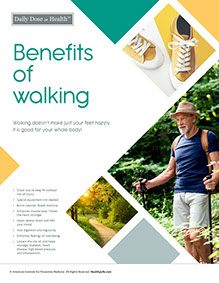
  • Benefits Of Walking

    Fitness

    Couple hiking through trees with walking sticks.

    Walking doesn’t make just your feet happy. It is good for your whole body!

    *  Great way to keep fit without risk of injury.

    *  Special equipment not needed.

    *  Burns calories. Builds stamina.

    *  Enhances muscle tone. Makes the heart stronger.

    *  Helps relieve stress and lifts your mood.

    *  Aids digestion and regularity.

    *  Enhances feelings of well-being.

    *  Lowers the risk of, and helps manage, diabetes, heart disease, high blood pressure, and osteoporosis.

    Page from HealthyLife Weigh book by the American Institute for Preventive Medicine. www.HealthyLife.com. All rights reserved.

    © American Institute for Preventive Medicine

  • Figure Out Your Target Heart Rate

    Fitness

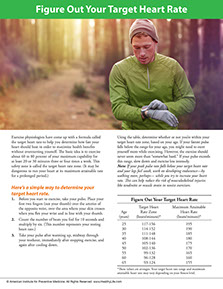
    Image of man checking heart rate.

    Exercise physiologists have come up with a formula called the target heart rate to help you determine how fast your heart should beat in order to maximize health benefits without overexerting yourself. The basic idea is to exercise about 60 to 80 percent of your maximum capability for at least 20 or 30 minutes three or four times a week. This safety zone is called the target heart rate zone. (It may be dangerous to run your heart at its maximum attainable rate for a prolonged period.)

    Here’s a simple way to determine your target heart rate.

    1.  Before you start to exercise, take your pulse. Place your first two fingers (not your thumb) over the arteries of the opposite wrist, over the area where your skin creases when you flex your wrist and in line with your thumb.

    2.  Count the number of beats you feel for 10 seconds and multiply by six. (This number represents your resting heart rate.)

    3.  Take your pulse after warming up, midway through your workout, immediately after stopping exercise, and again after cooling down.

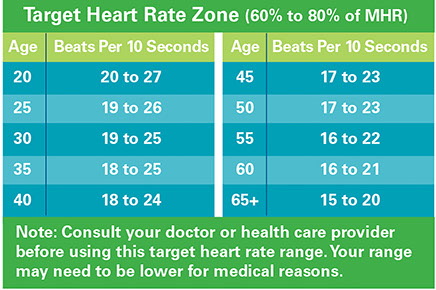
    Using the table below, determine whether or not you’re within your target heart rate zone, based on your age. If your fastest pulse falls below the range for your age, you might need to exert yourself more while exercising. However, the exercise should never seem more than “somewhat hard.” If your pulse exceeds this range, slow down and exercise less intensely.

    Note: If your peak pulse rate falls below your target heart rate and your legs feel weak, work on developing endurance-by walking more, perhaps-while you try to increase your heart rate. This can help reduce the risk of musculoskeletal injuries like tendinitis or muscle strain in novice exercisers.

    Chart showing Target Heart Rate Zones.
    Page image from A Year of Health Hints book by the American Institute for Preventive Medicine. www.HealthyLife.com. All rights reserved.

    © American Institute for Preventive Medicine

  • Pedal For Fitness

    Fitness

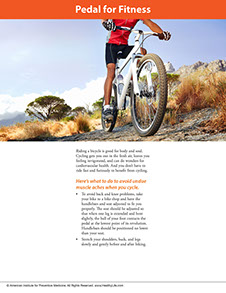
    A closeup image of a bike tire while a cyclist rides through a trail.

    Riding a bicycle is good for body and soul. Cycling gets you out in the fresh air, leaves you feeling invigorated, and can do wonders for cardiovascular health. And you don’t have to ride fast and furiously to benefit from cycling.

    Here’s what to do to avoid undue muscle aches when you cycle.

    *  To avoid back and knee problems, take your bike to a bike shop and have the handlebars and seat adjusted to fit you properly. The seat should be adjusted so that when one leg is extended and bent slightly, the ball of your foot contacts the pedal at the lowest point of its revolution. Handlebars should be positioned no lower than your seat.

    *  Stretch your shoulders, back, and legs slowly and gently before and after biking.

    Page image from A Year of Health Hints book by the American Institute for Preventive Medicine. www.HealthyLife.com. All rights reserved.

    © American Institute for Preventive Medicine

  • Get Into Zone 2

    BE FIT

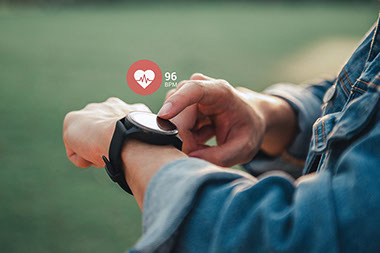
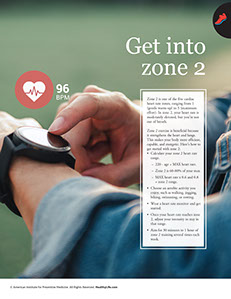
    Close up of man using smart watch with heart beat showing at 96 bpm.

    Zone 2 is one of the five cardiac heart rate zones, ranging from 1 (gentle warm-up) to 5 (maximum effort). In zone 2, your heart rate is moderately elevated, but you’re not out of breath.

    Zone 2 exercise is beneficial because it strengthens the heart and lungs. This makes your body more efficient, capable, and energetic. Here’s how to get started with zone 2:

    *  Calculate your zone 2 heart rate range.

    – 220 – age = MAX heart rate.

    – Zone 2 is 60-80% of your max.

    – MAX heart rate x 0.6 and 0.8 = zone 2 range.

    *  Choose an aerobic activity you enjoy, such as walking, jogging, biking, swimming, or rowing.

    *  Wear a heart rate monitor and get started.

    *  Once your heart rate reaches zone 2, adjust your intensity to stay in that range.

    *  Aim for 30 minutes to 1 hour of zone 2 training several times each week.

    © American Institute for Preventive Medicine

  • How Walking Can Change Your Life

    BE FIT

    Image of couple and pet dog walking along beach.

    Many people don’t exercise because they believe it takes too much time or money. They may think they need to spend an hour at the gym each day to get healthier. These myths could be standing in the way of a healthier life.

    Exercise is a universal way to improve health. We know that physical activity can reduce the risk of heart disease, diabetes and even cancer. It also boosts energy levels and can help you sleep better. But there’s another benefit to exercise that many people may not know about: better mental health.

    If you are thinking about being more active, a walking program is a tried and true favorite form of physical activity. As an exercise, walking is easy to begin and maintain. Plus, it needs no special skills or expensive equipment, and can be done year-round, outdoors and indoors.

    For those who thought they didn’t have time to walk or exercise, there’s good health news. Even a small amount of exercise can help you feel better mentally by reducing feelings of depression and anxiety, and improving cognition.

    Getting a treadmill: Questions to ask

    Treadmills have been a mainstay in gyms for years. Many people also get one for their homes. They’re simple to use and can adjust to your fitness level. But should you buy one? Here’s what to consider:

    How much money do you want to spend?

    A new treadmill can cost hundreds – or even thousands – of dollars. But many people can get used treadmills for a fraction of the cost. If you buy a used one, make sure to test it first to be sure it works. Ask the seller if they have the instruction manual.

    Can you do other indoor exercise?

    You don’t need a treadmill to get a good workout inside. You can turn on music and dance or use a fitness video or interactive game. Consider how many days per year you would need the treadmill because of bad weather. Then, weigh that against the cost.

    Will it “work”  for you?

    Do your research before making the investment. Check out online reviews of the exact treadmill you’re considering. Find out if it’s good for running, walking or both. Will it work with your height? Taller people often need a longer treadmill belt.

    Source: Centers for Disease Control and Prevention

    © American Institute for Preventive Medicine

  • Quick Healthy Heart Habits

    WELL-BEING

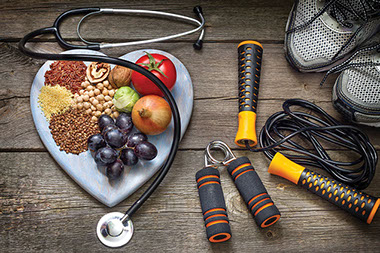
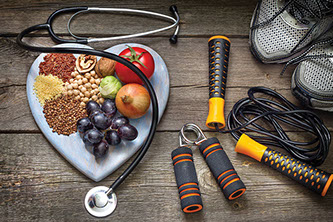
    Image of heart plate with heart healthy foods and fitness gear.

    A heart healthy lifestyle doesn’t have to be overwhelming. These little changes can make a big difference:

    1.  Lower blood pressure with fruits and veggies. High blood pressure is a major risk factor for heart disease. Swap out sweets or deep-fried foods for fruits and vegetables. They contain plenty of potassium, which is a mineral that helps to naturally lower blood pressure. Try to get 2.5 cups of veggies and 2 cups of fruit each day.

    2.  Favor healthy fats. The right kind of fats can be good for your heart. Fatty fish such as salmon contain omega-3 fats, which may prevent sudden death from a heart attack. Olive oil, avocados, nuts and seeds all contain heart healthy unsaturated fat that can help lower bad cholesterol and may raise good cholesterol.

    © American Institute for Preventive Medicine

  • Start Running

    BE FIT

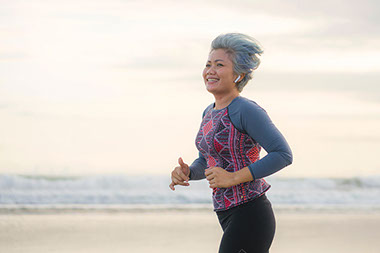
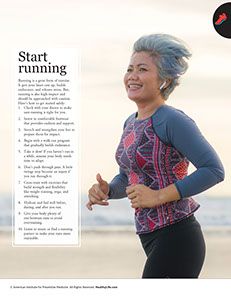
    Middle aged women jogging on beach.

    Running is a great form of exercise. It gets your heart rate up, builds endurance, and releases stress. But, running is also high-impact and should be approached with caution. Here’s how to get started safely:

    1. Check with your doctor to make sure running is right for you.

    2. Invest in comfortable footwear that provides cushion and support.

    3. Stretch and strengthen your feet to prepare them for impact.

    4. Begin with a walk-run program that gradually builds endurance.

    5. Take it slow! If you haven’t run in a while, assume your body needs time to adapt.

    6. Don’t push through pain. A little twinge may become an injury if you run through it.

    7. Cross-train with exercises that build strength and flexibility like weight training, yoga, and stretching.

    8. Hydrate and fuel well before, during, and after you run.

    9. Give your body plenty of rest between runs to avoid overtraining.

    10. Listen to music or find a running partner to make your runs more enjoyable.

    © American Institute for Preventive Medicine

  • Cardio Training

    Healthylife® Weigh

    Part 5

    Man swimming.

    Short for cardiovascular training, “cardio” helps strengthen your heart and other muscles. Cardio also causes the brain to release natural substances, called endorphins, that give you a natural “high.” Aerobic exercise also promotes brain health and challenges your mind.

    Cardio training uses large movements that involve multiple muscle groups, such as your legs, buttocks, and abdominals, all at once. Popular aerobic activities are brisk walking, running, cycling, swimming, and low-impact aerobic dancing.

    Low-Intensity, Steady-State (LISS) Cardio

    Do this type of cardio at a low-to-moderate intensity level. With LISS cardio, you should be breathing at a rate that still allows you to be able to talk to someone. Some examples are walking around your neighborhood or riding a bike at a moderate pace. This type of cardio is most helpful when maintained for 30-45 minutes. Work up to this length of time.

    Group Exercise Classes (e.g., Zumba®, step, kick-boxing, spin)

    *  Find a class through your local community center, YMCA, or another fitness center. Many classes are offered in the mornings and evenings and on weekends to accommodate busy work schedules.

    *  Find an instructor who teaches in a style and tempo you feel comfortable with.

    *  For your first class, arrive early and let the instructor know it is your first time. They may help you set up your equipment or introduce you to someone else in the class who can help you.

    *  High-impact aerobics can strain the knees, hips, and ankles. Step aerobics is lower-impact but should still be avoided by anyone with knee problems.

    *  Modify exercises to a level that you can do comfortably. Ask the instructor for advice.

    Walking

    *  Find a safe place to walk. Your neighborhood, a large shopping mall, or local park may offer safe options. Many fitness centers also have indoor walking tracks or treadmills.

    *  Hold your head up and keep your back straight.

    *  Bend your elbows as you swing your arms.

    *  Take long, easy strides.

    Swimming

    *  Swim in a pool or lake supervised by a lifeguard. If the area is unsupervised, do not swim alone.

    *  Take lessons to learn to swim safely and to improve your technique.

    *  Rest frequently and drink water. It can be harder to notice that you are sweating in the pool and becoming dehydrated.

    *  Wear goggles to protect your eyes.

    *  Wear a swim cap if you have long hair. This will help keep hair out of your face and reduce drag.

    *  Rinse off after swimming and use lotion to keep your skin from drying out.

    High-Intensity Interval Training (HIIT)

    LISS is a good place to start with cardio training. Within a few weeks, start to incorporate HIIT training as well. This type of cardio is much more effective at boosting your metabolism and helping with fat loss.

    To do HIIT, alternate between longer periods of low-intensity exercise and shorter bursts of high-intensity exercise. The high-intensity parts should be short, such a walking as fast as you can for 30 seconds, to get your heart rate up. You should feel like you are working at 90% of your maximum effort. Immediately switch to low-intensity exercise, like walking at a medium pace, for a minute or two to bring your heart rate down. Repeat this pattern several times. Work up to 15 to 20 minutes of HIIT. You can also do intervals of 30 seconds of high-intensity exercise and 30 seconds of low-intensity exercise.

    HIIT revs up your metabolic furnace and you can burn a lot of calories in a short period of time. This may be more interesting and enjoyable than exercising at the same rate for your entire workout.

    You can use the same types of exercises that you enjoy for LISS (like running or biking). Or, you can use other full-body exercises, such as jumping jacks and push-ups. Search “HIIT ideas” online or download an app that provides workouts on a timer.

    Plan a HIIT Workout with Popsicle Sticks

    1. Get at least a dozen popsicle sticks.

    2. Write one short exercise on each popsicle stick. Write exercises you know how to do and enjoy. Ideas:

    – Jumping jacks – Push-ups

    – Lunges – Bicep curls

    – Squats – Side leg lifts

    – Front leg lifts – Mountain climbers

    – Bicycle kicks  – Tricep dips

    – Reverse lunges – Jumping rope (or pretending to)

    3. Put the sticks in a cup or a jar.

    4. Pull out 4 sticks. You will be doing these activities after a short warm up.

    5. Warm up for 5 minutes by briskly walking or doing jumping jacks. Notice that your heart rate is higher.

    6. Set a timer for 15 minutes.

    7. Do the 1st activity as many times as you can in one minute.

    8. Walk for one minute.

    9. Do the 2nd activity as many times as you can for one minute.

    10. Walk for one minute.

    11. Do the 3rd activity as many times as you can for one minute.

    12. Walk for one minute.

    13. Do the 4th activity as many times as you can for one minute.

    14. Walk for one minute.

    15. Repeat steps 7 through 14.

    Ideas Using Your Popsicle Sticks

    Keep your jar of exercise ideas out where you can see it. Pull a stick:

    *  When a commercial break comes on TV or the radio.

    *  In the morning after you wake up.

    *  While studying or reading and you need a break.

    *  When you feel anxious or overwhelmed.

    Do the activity on the stick for one minute. Or, set a goal to do a certain number of that exercise. For example, 25 jumping jacks. Keep your popsicle sticks fresh! Add new ideas and things you like to do. Remove sticks that you dread pulling.

    © American Institute for Preventive Medicine

  • Be Physically Active

    Healthylife® Weigh

    Part 5

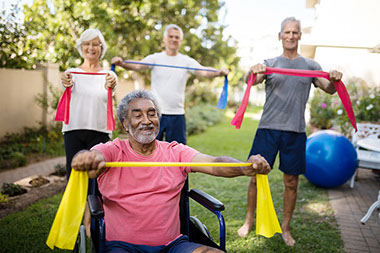
    Group of friends outside exercising.

    All physical activity has benefits for the body and mind. This section will help you find reasons to be active that go beyond weight management. This section will also help you to:

    *  Add variety to the physical activity you already enjoy.

    *  Value different types of activity that have different benefits.

    *  Make a plan to be more physically active.

    *  Manage time and other barriers to do physical activity.

    *  Develop a healthy relationship with your body.

    *  Appreciate what your body is capable of doing.

    HealthyLife® Weigh

    QUICK LINKS: PART 5

    Current Exercise Habits

    Find Reasons to Care About Physical Activity

    Mental Health

    Energy, Learning, Focus

    Physical Health

    Exercise and Sleep

    Reduce Sit-Time

    Do Activities You Enjoy

    Types of Physical Activity

    Cardio Training

    Resistance Training

    Stretching & Rehabilitation

    Yoga

    Massage

    Avoid Injury

    Appreciate the Journey

    Set Fitness Goals

    Plan Physical Activity

    Tackle Limitations

    Injury and Disability

    Manage Your Time

    Set Up for Success

    What Are You Waiting For?

    Responsibility for Change

    Create “If, Then” Plans

    Exercise and Eating

    Eating and Body Image

    How Do You View Your Body?

    Identify Disordered Eating

    Review and Prepare

    © American Institute for Preventive Medicine