Tag: care

  • Choose Benefit Options With Both Cost And Care In Mind

    Medical Care

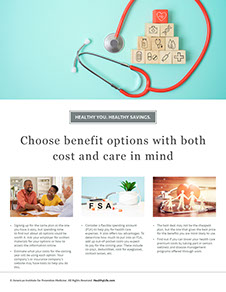
    Wooden blocks with medical icons.

    *  Signing up for the same plan as the one you have is easy, but spending time to find out about all options could be worth it. Ask your employer for written materials for your options or how to access the information online.

    *  Estimate what your costs for the coming year will be using each option. Your company’s or insurance company’s website may have tools to help you do this.

    *  Consider a flexible spending account (FSA) to help pay for health care expenses. It also offers tax advantages. To determine how much to put into an FSA, add up out-of-pocket costs you expect to pay for the coming year. These include co-pays, deductibles, cost for eyeglasses, contact lenses, etc.

    *  The best deal may not be the cheapest plan, but the one that gives the best price for the benefits you are most likely to use.

    *  Find out if you can lower your health care premium costs by taking part in certain wellness and disease management programs offered through work.

    A Year of Health Hints book by the American Institute for Preventive Medicine. www.HealthyLife.com. All rights reserved.

    © American Institute for Preventive Medicine

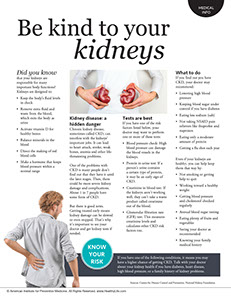
  • Be Kind To Your Kidneys

    MEDICAL NEWS

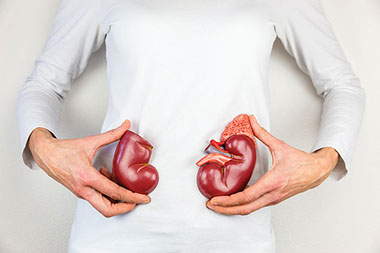
    Image of person holding plastic kidneys.

    Did you know that your kidneys are responsible for many important body functions? Kidneys are designed to:

    *  Keep the body’s fluid levels in check

    *  Remove extra fluid and waste from the blood, which exits the body as urine

    *  Activate vitamin D for healthy bones

    *  Balance minerals in the blood

    *  Direct the making of red blood cells

    *  Make a hormone that keeps blood pressure within a normal range

    Kidney disease: a hidden danger

    Chronic kidney disease, sometimes called CKD, can interfere with the kidneys’ important jobs. It can lead to heart attack, stroke, weak bones, anemia and other life-threatening problems.

    One of the problems with CKD is many people don’t find out that they have it until the later stages. Then, there could be more severe kidney damage and complications. About 1 in 7 people have some form of CKD.

    But there is good news. Getting treated early means kidney damage can be slowed or even stopped. That’s why it’s important to see your doctor and get kidney tests if needed.

    Know your risk

    If you have one of the following conditions, it means you may have a higher chance of getting CKD. Talk with your doctor about your kidney health if you have diabetes, heart disease, high blood pressure, or a family history of kidney problems.

    Tests are best

    If you have one of the risk factors listed below, your doctor may want to perform one or more of these tests:

    *  Blood pressure check: High blood pressure can damage the blood vessels in the kidneys.

    *  Protein in urine test: If a person’s urine contains a certain type of protein, it may be an early sign of CKD.

    *  Creatinine in blood test: If the kidneys aren’t working well, they can’t take a waste product called creatinine out of the blood.

    *  Glomerular filtration rate (GFR) test: This measures creatinine levels and calculates other CKD risk factors too.

    What to do

    If you find out you have CKD, your doctor may recommend:

    *  Lowering high blood pressure

    *  Keeping blood sugar under control if you have diabetes

    *  Eating less sodium (salt)

    *  Not taking NSAID pain relievers like ibuprofen and naproxen

    *  Eating only a moderate amount of protein

    *  Getting a flu shot each year

    Even if your kidneys are healthy, you can help keep them that way by:

    *  Not smoking or getting help to quit

    *  Working toward a healthy weight

    *  Getting blood pressure and cholesterol checked regularly

    *  Annual blood sugar testing

    *  Eating plenty of fruits and vegetables

    *  Seeing your doctor as recommended

    *  Knowing your family medical history

    Sources: Centers for Disease Control and Prevention, National Kidney Foundation

    © American Institute for Preventive Medicine

  • Foot Health Matters With Diabetes

    SELF-CARE CORNER

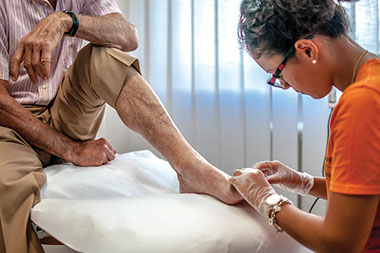
    Patient having his foot examined by a doctor.

    People with diabetes have a higher risk of getting certain foot problems. This usually happens because diabetes can cause nerve damage in the feet. This is known as diabetic neuropathy, which can lead to tingling, burning or weakness in your feet.

    Why does neuropathy matter?

    Diabetic neuropathy isn’t just painful. It also means that you may not feel things like cuts, injuries or heat or cold on your feet. Your feet could get hurt or burned and you wouldn’t know it. Then, with reduced blood flow, your body may not be able to heal the skin very well.

    Keeping skin healthy

    Wash, dry and moisturize the skin on your feet every day. Also, check for problems. Here’s how:

    *  After bathing, dry your feet gently with a towel.

    *  Look for corns, calluses, blisters or cuts. If you notice any of these, call your health care provider. Don’t try to remove corns or calluses yourself.

    *  If your skin looks healthy, you can moisturize. Apply a skin cream to dry areas.

    *  Don’t apply cream between your toes. This can cause fungus to grow. Keep the area between toes clean and dry.

    *  If you can’t trim your toenails easily, have this done by a podiatrist or other health provider.

    Good shoes are your friend

    Poorly fit shoes can cause sores, or ulcers, on your feet. These can lead to infection. Even if you don’t feel pain, see your doctor about any sores on your feet. You should also stay off your feet until your doctor says it’s ok. Don’t walk in your bare feet because this can put your feet at risk.

    You can avoid many foot ulcers by getting comfortable, supportive shoes. A podiatrist or foot specialist may help you find a pair that fits your feet well without rubbing. Wearing socks that wick moisture, such as wool socks, can also help. Wearing wet socks or shoes can lead to fungal infections.

    Helpful ways to avoid foot problems with diabetes:

    1.  Go to regular checkups.

    2.  See your doctor if you have any foot injuries or skin changes on your feet.

    3.  Follow your diabetes plan to keep blood sugar under control.

    4.  Check your feet every day.

    Source: American Diabetes Association

    © American Institute for Preventive Medicine

  • How To Build Strong, Healthy Nails

    SELF-CARE CORNER

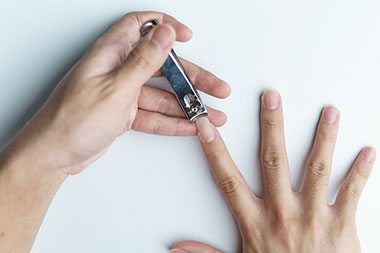
    Close up of hands clipping nails.

    Taking proper care of your nails is more than a matter of looks. Clear, strong nails are a marker of good physical health. They reflect everything from your level of stress to the quality of your diet.

    It may seem like a simple thing, but caring for your nails is an essential part of a comprehensive self-care routine. Healthy nails don’t happen by chance. Here is what you need to know to keep your nails in excellent condition.

    Keep nails trimmed and shaped

    Don’t wait for nails to break or become jagged before giving them a good trim. Fingernails, in particular, need frequent grooming to maintain a healthy shape.

    For best health, cut nails straight across. Then, use an emery board to give them a rounded shape at the tips. This will prevent breakage and minimize the risk of ingrown nails.

    The nails on your fingers grow three times faster than the nails on your toes. Plan to trim and shape them more often than your toenails.

    Care for your cuticles

    The cuticle seals the skin of your finger around the nail. Never trim or move the cuticles as this disrupts the seal and increases your risk of a nail infection. If you go for a manicure, let the technician know to leave the cuticles alone.

    Cuticles benefit from extra moisture, especially in the winter months. You can use a special cuticle moisturizer. Or, even simple hand lotion massaged into the nail area will improve cuticle health.

    Limit manicures and pedicures

    Harsh nail products and regular use of polish weaken your nails. Wearing artificial nails can make your nails thin and brittle, as well as increase the risk of infection.

    Enjoy manicures and pedicures on occasion, but make sure to give your nails a break in between. Letting your nails enjoy time without polish or products will keep them healthy and less prone to breakage.

    If you really love artificial nails, save them for special occasions and opt for a simple french manicure whenever possible.

    Don’t forget your toenails

    Because toenails do not grow as fast, they often don’t get as much care and attention. But don’t fall into the habit of ignoring them.

    Inspect toenails regularly and watch for sharp edges or ingrown nails. Also, keep a close eye out for changes in nail color which could signal a nail problem or even an infection.

    Wear comfortable shoes that don’t pinch the toes and use flip-flops at public showers or pools. These steps will keep the toenails clean and healthy.

    © American Institute for Preventive Medicine

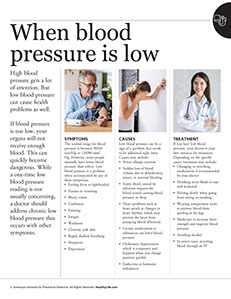
  • When Blood Pressure Is Low

    MEDICAL NEWS

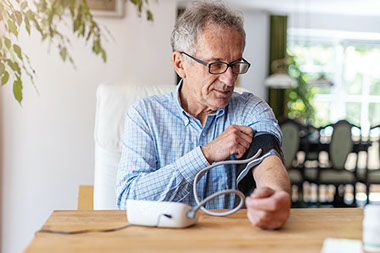
    Man taking his blood pressure at home.

    High blood pressure gets a lot of attention. But low blood pressure can cause health problems as well.

    If blood pressure is too low, your organs will not receive enough blood. This can quickly become dangerous. While a one-time low blood pressure reading is not usually concerning, a doctor should address chronic low blood pressure that occurs with other symptoms.

    Symptoms

    The normal range for blood pressure is between 90/60 mm/Hg to 120/80 mm/Hg. However, some people naturally have lower blood pressure than others. Low blood pressure is a problem when accompanied by any of these symptoms:

    *  Feeling dizzy or lightheaded

    *  Nausea or vomiting

    *  Blurry vision

    *  Confusion

    *  Fainting

    *  Fatigue

    *  Weakness

    *  Clammy, pale skin

    *  Rapid, shallow breathing

    *  Sleepiness

    *  Depression

    Causes

    Low blood pressure can be a sign of a problem that needs to be addressed right away. Causes may include:

    *  Severe allergic reaction

    *  Sudden loss of blood volume due to dehydration, injury, or internal bleeding

    *  Septic shock caused by infection impacts the blood vessels causing blood pressure to drop

    *  Heart problems such as heart attack or changes in heart rhythm, which may prevent the heart from pumping blood efficiently

    *  Certain medications or substances can lower blood pressure

    *  Orthostatic hypotension which is temporary and happens when you change position quickly

    *  Endocrine or hormone imbalances

    Treatment

    If you have low blood pressure, your doctor is your best resource for treatment. Depending on the specific cause, treatment may include:

    *  Changing or switching medications if recommended by your doctor

    *  Drinking more fluids to stay well hydrated

    *  Moving slowly when going from sitting to standing

    *  Wearing compression socks to prevent blood from pooling in the legs

    *  Medicines to increase heart strength and improve blood pressure

    *  Avoiding alcohol

    *  In severe cases, receiving blood through an IV

    © American Institute for Preventive Medicine

  • Birth Defects

    Pregnancy & Prenatal Care

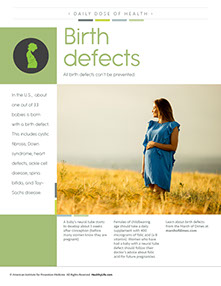
    Pregnant women standing in open field.

    In the U.S., about one out of 33 babies is born with a birth defect. This includes cystic fibrosis, Down syndrome, heart defects, sickle cell disease, spina bifida, and Tay-Sachs disease.

    A baby’s neural tube starts to develop about 3 weeks after conception (before many women know they are pregnant).

    Females of childbearing age should take a daily supplement with 400 micrograms of folic acid (a B vitamin). Women who have had a baby with a neural tube defect should follow their doctor’s advice about folic acid for future pregnancies.

    Learn about birth defects from the March of Dimes atmarchofdimes.com.

    Health at Home Lifetime book by the American Institute for Preventive Medicine. www.HealthyLife.com. All rights reserved.

    © American Institute for Preventive Medicine

  • Eye Irritations & Injuries

    Eye Conditions

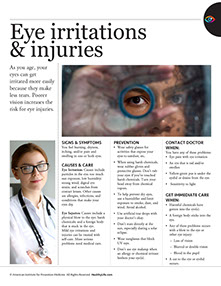
    As you age, your eyes can get irritated more easily because they make less tears. Poorer vision increases the risk for eye injuries.

    Signs & Symptoms

    You feel burning, dryness, itching, and/or pain and swelling in one or both eyes.

    Causes

    For Eye Irritation:

    Causes include particles in the eye; too much sun exposure, low humidity; strong wind; and scratches from contact lenses. Other causes are allergies, infections, and conditions that make your eyes dry.

    For Eye Injuries:

    Causes include a physical blow to the eye; harsh chemicals; and a foreign body that is stuck in the eye.

    Mild eye irritations and injuries can be treated with self-care. More serious problems need medical care.

    Treatment

    *  Wear safety glasses for activities that expose your eyes to sawdust, etc.

    *  When using harsh chemicals, wear rubber gloves and protective glasses. Don’t rub your eyes if you’ve touched harsh chemicals. Turn your head away from chemical vapors.

    *  To help prevent dry eyes, use a humidifier and limit exposure to smoke, dust, and wind. Avoid alcohol.

    *  Use artificial tear drops with your doctor’s okay.

    *  Don’t stare directly at the sun, especially during a solar eclipse.

    *  Wear sunglasses that block UV rays.

    *  Don’t use eye makeup when an allergy or chemical irritant bothers your eye(s).

    Self-Care / Prevention

    To Ease the Discomfort of Dry Eyes:

    With your doctor’s okay, use over-the-counter artificial tear drops, such as Ocu-Lube. Read the label. Refrigerate the solution, if needed. Wash your hands before using.

    To Treat an Insect Bite Without a Severe Allergic Reaction:

    *  Wash the eye(s) with warm water.

    *  Take an antihistamine if okay with your doctor.

    To Remove a Foreign Particle On the White of the Eye or Inside the Eyelids:

    *  Do not remove an object imbedded in the eye, a metal chip, or a foreign body over the colored part of the eye. (See “First Aid for Foreign Body Sticking Into the Eye” on this page.)

    *  Wash your hands.

    *  If the foreign object is under the upper lid, have the person look down and pull the upper lid away from the eyeball by gently grabbing the eyelashes. Press a cotton-tipped swab down on the skin surface of the upper eyelid and pull it up and toward the brow. The upper lid will invert. Touch and remove the debris with the tip of the tissue.

    *  Twist a piece of tissue, moisten the tip with tap water (not saliva) and gently try to touch the speck with the tip. Carefully pass the tissue over the speck, which should cling to the tip.

    *  Do not rub the eye or use tweezers or anything sharp to remove a foreign object.

    *  Gently wash the eye with cool water.

    To Treat a Bruise from a Minor Injury that Surrounds the Eye but Does Not Damage the Eye Itself:

    *  Put a cold compress over the injured area right away. Keep doing this for 15 minutes, every hour, for 48 hours.

    *  Take an over-the-counter medicine

    *  After 48 hours, put a warm compress over the injured area.

    *  Seek medical attention if these measures do not help.

    First Aid for Foreign Body Sticking Into the Eye Before Immediate Care:

    *  Do not remove the object.

    *  Don’t press on, touch, or rub the eye.

    *  Cover the injured eye with a paper cup or other clean object that will not touch the eye or the foreign object. Hold the paper cup in place with tape without putting pressure on the eye or the foreign object.

    *  Gently cover the uninjured eye with a clean bandage and tape, too, to keep the injured eye still.

    First Aid for Harmful Chemicals in the Eye(s) Before Immediate Care:

    *  Flush the eye(s) with water immediately!

    *  Hold the injured eye open with your thumb and forefinger.

    *  At the faucet or with a pitcher or other clean container, flush the eye with a lot of water. Start at the inside corner and pour downward to the outside corner. This lets the water drain away from the body and keeps it from getting in the other eye.

    *  Keep pouring the water for 10 to 30 or more minutes. Flush the eye with water until you get medical help.

    *  If both eyes are injured, pour water over both eyes at the same time or quickly alternate the above procedure from one eye to another. Or, place the victim’s face in a sink or container filled with water. Tell the victim to move his or her eyelids up and down and remove the face from the water at intervals in order to breathe. Use this method on yourself if you are the victim and are alone.

    *  Loosely bandage the eye with sterile cloth and tape. Don’t touch the eye.

    When to Seek Medical Care

    Contact Doctor When:

    You have any of these problems:

    *  Eye pain with eye irritation

    *  An eye that is red and/or swollen

    *  Yellow-green pus is under the eyelid or drains from the eye.

    Get Immediate Care When:

    *  Harmful chemicals have gotten into the eye(s). {Note: Before you get immediate care, give “First Aid for Harmful Chemicals in the Eye(s) Before Immediate Care” on this page.}

    *  A foreign body sticks into the eye. {Note: See “First Aid for Foreign Body Sticking Into the Eye Before Immediate Care” on this page.}

    *  A cut to the eye or eyelid occurs.

    *  Any of these problems occurs with a blow to the eye or other eye injury:

    – Loss of vision

    – Blurred or double vision

    – Blood in the pupil
    Healthier at Home book by the American Institute for Preventive Medicine. www.HealthyLife.com. All rights reserved.

    © American Institute for Preventive Medicine

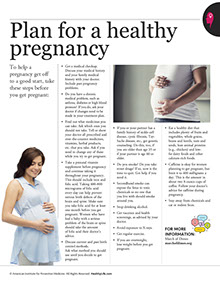
  • Plan For A Healthy Pregnancy

    Women’s Health

    To help a pregnancy get off to a good start, take these steps before you get pregnant:

    *  Get a medical checkup. Discuss your medical history and your family medical history with your doctor.

    *  Do you have a chronic medical problem, such as asthma, diabetes, or high blood pressure? If you do, ask your doctor if changes need to be made in your treatment plan.

    *  Find out what medicines you can take. Ask which ones you should not take. Tell or show your doctor all prescribed and over-the-counter medicines, vitamins, herbal products, etc. that you take. Ask if you need to change any of these while you try to get pregnant.

    *  Take 400 to 800 micrograms (.4 to .8 milligrams) of folic acid every day. This B vitamin can help prevent serious birth defects of the brain and spine. Make sure you take folic acid for at least one month before you get pregnant. Women who have had a baby with a serious problem of the brain or spine should take the amount of folic acid their doctors advise.

    *  Discuss current and past birth control methods.  Ask what method you should use until you decide to get pregnant.

    *  If you or your partner has a family history of sickle-cell disease, Tay-Sachs disease, etc., get genetic counseling. Do this, too, if you are older than age 35 or if your partner is age 60 or older.

    *  Do you smoke? Do you take street drugs? If so, now is the time to quit. Get help if you need it.

    *  Stop or limit alcohol use. This will make it easier to go without it when you are pregnant.

    *  Get vaccines, as advised by your doctor.

    *  Avoid exposure to X-rays.

    *  Caffeine is okay for women planning to get pregnant, but limit it to 400 milligrams a day. This is the amount in about two 8-ounce cups of coffee. Follow your doctor’s advice for caffeine during pregnancy.

    *  Get regular exercise.

    *  If you are overweight, lose weight before you get pregnant.

    *  Eat healthy foods. These include:

    – Fruits and vegetables.

    – Whole grain breads and cereals.

    – Low-fat dairy foods and other calcium-rich foods.

    Resources

    March of Dimes

    www.marchofdimes.com

    Women's Self-Care book by the American Institute for Preventive Medicine. www.HealthyLife.com. All rights reserved.

    © American Institute for Preventive Medicine