Tag: cessation

  • How To Help Me Quit

    Healthylife® QuitWell™

    Part 3

    Friends sitting talking and drinking tea.

    1.Be patient.I am trying to free myself from tobacco/nicotine. Quitting may make me tense, anxious, and prone to sudden mood swings. This is because I am doing without something I was used to having. Soon I will be secure in my ability to manage and I will be better than ever. Please bear with me a little longer.

    2.Be curious.For years I have been using tobacco/nicotine to pass the time, to reward myself, to calm myself, to wake up, to help me think, and to get through stressful events. Now I am coping all on my own. Ask me how I am managing; ask me what my life is like without nicotine. It’s all very new to me and I may want to talk about it.

    3.Be sensitive.All day long I must deal with the urge to use tobacco/nicotine. Sometimes it seems as if just about everything makes me think about it: getting ready for work, talking on the phone, ending a meal… I could really use your help to distract myself from these thoughts. Unless I mention it first, please don’t bring up the subject of my quitting.

    4.Be supportive.I really need someone to root for me right now, someone to be on my side. I enjoy the special attention (like rewarding my first week without tobacco/nicotine with a special treat) that you give me while I am in the “crawling” stage of quitting.

    5.Be positive. Sometimes I feel it is hard to remember all the good things that come with quitting. I like it when you notice the positive changes that you see in me. It means a lot to know that you are proud of me.

    6.Be confident.I want to make it, but sometimes I am not sure that I have what it takes to quit. I need the people around me to believe that I can do it… and to say so.

    What else will be helpful to you? Share this with those who want to support you.

    © American Institute for Preventive Medicine

  • Nicotine Replacement Therapy

    Healthylife® QuitWell™

    Part 3

    Image of nicotine gum to help stop smoking.

    All of these products contain nicotine. Patches, gum, and lozenges are available other-the-counter. The nicotine nasal spray and nicotine inhaler require a prescription.

    © American Institute for Preventive Medicine

  • Smokeless Inhalation

    Healthylife® QuitWell™

    Part 4

    Senior women deep breathing.

    This is one of the best Urge Tamers you will learn. Do this deep breathing when you have an urge.

    1. Breathe in deeply through your nose.

    2. Hold your breath for 3 seconds.

    3. Slowly breathe out through pursed lips to make a “whooshing” sound.

    4. Keep breathing this way until the urge goes away. Sometimes you may need to do the smokeless inhalation 2-3 times, or up to 12-13 times. An increase in oxygen helps you feel relaxed.

    The smoking cycle:

    Avoiding tobacco/nicotine and using smokeless inhalation can help you break the cycle.

    © American Institute for Preventive Medicine

  • Review & Prepare 5

    SleepWell® Program

    Week 2

    Image of women on computer.

    Answer the following.

    *  How did your sleep this week compare to the first week?

    *  What changes did you made to my sleep environment?

    *  What changes did you make to your eating habits?

    *  What Changes did you make to your exercise habits?

    *  What changes will you continue?

    *  What is one S.M.A.R.T. goal you have for next week?

    © American Institute for Preventive Medicine

  • Altering Triggers

    Healthylife® QuitWell™

    Part 4

    A morning cup of coffee.

    Actions, especially habits, are linked. For example, you may light up a cigarette without thinking when you start your car, end a meal, drink coffee, or hear your alarm clock. If you dip or use other forms of tobacco/nicotine, you may have similar triggers.

    Altering triggers can help you break your automatic habits.

    Scrambling

    Scramble your routine to stop the triggers before they happen.

    1. Change your morning routine.

    2. Change your work area and the times of the day you do things.

    3. Change the route you take to work.

    4. Change the way you talk on the phone.

    5. Take a walk with a water bottle instead of a coffee break.

    6. Sit in a new place at the dining room or kitchen table.

    7. What other ways can you change your routines?

    © American Institute for Preventive Medicine

  • I Am Quitting!

    Healthylife® QuitWell™

    Part 1

    Women putting on a patch on arm.

    Maybe you have started this program in the action phase-you are already quitting or have just quit. While you may have a quit date in mind, this phase is more than just one day. This phase usually lasts about six months for any behavior change. It starts when you start putting your plan into place and continues as you go through challenges and practice your new way of living.

    In a few words, describe your current quit plan.

    Who is supporting you?

    Remember, you may be moving back and forth between stages during your quitting process. Some days may be easier than others. It is important to stay very alert during the active phase, as slip-ups are very common. You will probably face many new challenges, from new stressors to different times of the year and holidays.

    Even if you have started this program in the action phase, work through the guide in order. Building a strong foundation will help you get through the first few months of quitting-and beyond.

    © American Institute for Preventive Medicine

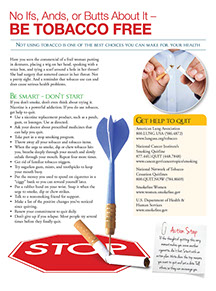
  • No Ifs, Ands, Or Butts About It. Be Tobacco Free.

    Tobacco Cessation

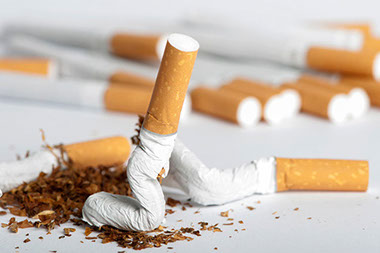
    Image of crushed cigarettes.

    Not using tobacco is one of the best choices you can make for your health.

    Have you seen the commercial of a frail woman putting in dentures, placing a wig on her head, speaking with a voice box, and tying a scarf around a hole in her throat? She had surgery that removed cancer in her throat. Not a pretty sight. And a reminder that tobacco use can and does cause serious health problems.

    Be smart, don’t start.

    If you don’t smoke, don’t even think about trying it. Nicotine is a powerful addiction. If you do use tobacco, get help to quit.

    *  Use a nicotine replacement product, such as a patch, gum, or lozenges. Use as directed.

    *  Ask your doctor about prescribed medicines that  can help you quit.

    *  Take part in a stop smoking program.

    *  Throw away all your tobacco and tobacco items.

    *  When the urge to smoke, dip or chew tobacco hits you, breathe deeply through your mouth and slowly exhale through your mouth. Repeat four more times.

    *  Get rid of familiar tobacco triggers.

    *  Try sugarless gum, mints, and toothpicks to keep your mouth busy.

    *  Put the money you used to spend on cigarettes in a “ciggy” bank so you can reward yourself later.

    *  Put a rubber band on your wrist. Snap it when the urge to smoke, dip or chew strikes.

    *  Talk to a nonsmoking friend for support.

    *  Make a list of the positive changes you’ve noticed since quitting.

    *  Renew your commitment to quit daily.

    *  Don’t give up if you relapse. Most people try several times before they finally quit.

    Bidis – Not a Safe Alternative

    Bidis are thin brown cigarettes made in India and other Southeast Asian countries. They are filled with tobacco flakes and dust and rolled in dried tendu or temburni leaves (plants native to Asia). These unfiltered cigarettes may be tied with a string at one or both ends. To mask the poor quality of tobacco used, flavors are often added. These include cherry, chocolate, mango, and vanilla.

    Bidis are cheaper and easier to buy than regular cigarettes, but have serious health risks.

    *  One bidi produces more than three times the carbon monoxide than one cigarette.

    *  Smoke from an unfiltered bidi has three to five times the amount of nicotine as a regular cigarette. This increases risk for nicotine addiction.

    *  One bidi releases three to five times more tar than a regular cigarette.

    *  Bidi smoke contains more deadly chemicals, such as ammonia than the smoke of one regular cigarette.

    *  Smoking bidis increases the risk for:

    *  Lung cancer, oral cancer, stomach cancer, and cancer of the esophagus

    *  Heart attack and coronary heart disease

    *  Chronic bronchitis and emphysema

    In India, the majority of bids are made by women and children and in their homes. Exposure to particles and dust in the process leads to many health problems. These include:

    *  Asthma

    *  Lung cancer

    *  Tuberculosis

    *  Skin problems

    *  Eye problems

    Resources

    American Lung Association

    800.LUNG.USA (586.4872)

    www.lungusa.org/tobacco

    National Cancer Institute’s Smoking Quitline

    877.44U.QUIT (448.7848)

    www.cancer.gov/cancertopics/smoking

    National Network of Tobacco Cessation Quitlines

    800.QUIT.NOW (784.8669)

    Smokefree Women

    www.women.smokefree.gov

    U.S. Department of Health & Human Services

    www.smokefree.gov

    www.surgeongeneral.gov/tobacco

    Action Step

    If the thought of quitting this very moment makes you crave another cigarette, don’t fret. Start with an action plan. Write down the top reasons you want to quit and set a date. Tell others so they can encourage you.

    Page from Ways to Well-Being book by the American Institute for Preventive Medicine. www.HealthyLife.com. All rights reserved.

    © American Institute for Preventive Medicine

  • Smokeless Tobacco & Your Health

    Healthylife® QuitWell™

    Part 1

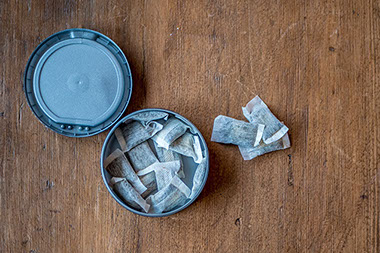
    Image of chewing tobacco.

    Smokeless tobacco includes chewing tobacco, which may also be called oral tobacco or spit tobacco. Smokeless tobacco also includes both moist and dry snuff, snus, and dissolvable tobacco products. Smokeless tobacco is not a safe form of tobacco, even if that is often how it is marketed by tobacco companies. Smokeless tobacco carries many serious risks.

    Smokeless tobacco can cause cancers of the:

    *  Mouth, tongue, cheek & gums

    *  Esophagus

    *  Pancreas

    Smokeless tobacco can also cause:

    *  Sores in the mouth called leukoplakia that can become cancer

    *  Stained teeth

    *  Bad breath

    *  Gum disease, cavities, tooth decay, and tooth loss

    *  Bone loss around the teeth

    *  Heart disease

    *  High blood pressure

    *  Increased risk of heart attack and stroke

    *  Pregnancy complications and low birth weight

    © American Institute for Preventive Medicine

  • Review & Prepare 6

    SleepWell® Program

    Week 3

    Image of man sleeping.

    Look at your pattern of sleep over the past week. Compare it to your sleep patterns over the past few weeks of tracking.

    Answer the following:

    *  I fall asleep more quickly now.

    *  I have more daytime energy.

    *  I wake up fewer times during the night.

    *  If or when I do wake up, I am able to fall asleep again more quickly.

    *  Changes I made to my bedtime and waking routines.

    *  Changes I made to what I do in bed or in the bedroom.

    *  Are you ready for another week of attention to your sleep?

    Shift Your Bedtime

    If you think your sleep has improved during the past week, you can begin to shift your bedtime earlier. Do this gradually. Only make a shift when your sleep quality is high. This means:

    *  You are able to fall asleep within 15 minutes of getting into bed.

    *  You are rarely waking up during sleep.

    *  If you do wake up, you are able to go back to sleep within 15 minutes.

    *  You stay asleep until your planned wake time.

    *  You wake feeling refreshed.

    If your sleep quality has not improved, maintain the original schedule for another week. When you are ready, shift your bedtime 15 minutes earlier. Keep the same wake time. This will give you more time to sleep as your body becomes trained to sleep in bed.

    © American Institute for Preventive Medicine

  • Balance Of Choice 2

    Healthylife® QuitWell™

    Part 2

    Man's hand touching an abstract no smoking.

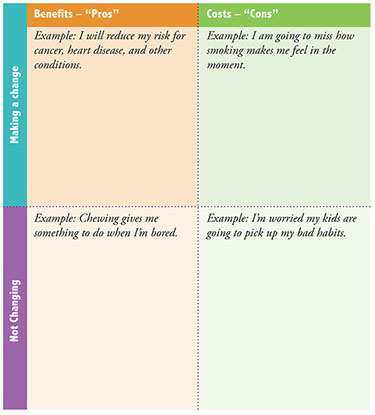
    Learn what is pulling you toward your goal and what is holding you back. All thoughts and feelings are valid. Is your goal more important to you than the challenges to achieve it? Are you pursuing this goal just because someone said you “should” do it? Complete the chart below as well as you can. If you think of something later, come back to this page to add another point to one of the boxes.

    Chart to fill out your choices.

    © American Institute for Preventive Medicine