
Tag: chair

  • Ergonomics For The Home Office

    WORK LIFE

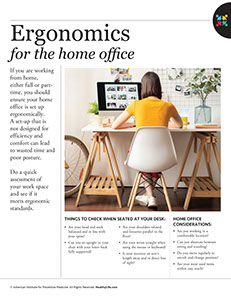
    Women sitting at desk working on computer.

    If you are working from home, either full or part-time, you should ensure your home office is set up ergonomically. A set-up that is not designed for efficiency and comfort can lead to wasted time and poor posture.

    Do a quick assessment of your work space and see if it meets ergonomic standards.

    Things to check when seated at your desk:

    *  Are your head and neck balanced and in line with your spine?

    *  Can you sit upright in your chair with your lower back fully supported?

    *  Are your shoulders relaxed and forearms parallel to the floor?

    *  Are your wrists straight when using the mouse or keyboard?

    *  Is your monitor an arm’s length away and in direct line of sight?

    Home office considerations:

    *  Are you working in a comfortable location?

    *  Can you alternate between sitting and standing?

    *  Do you move regularly to stretch and change position?

    *  Are your most used items within easy reach?
    © American Institute for Preventive Medicine
  • The Right Work Posture For You

    WORK LIFE

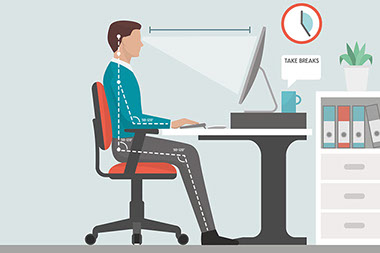
    Illustration of correct posture while sitting at a desk.

    Many people sit at a computer as part of their daily job. If a chair, desk or workstation isn’t working for you, it can cause sore muscles and joints and even an injury. To stay safe and healthy at the computer, follow these ergonomics guidelines.

    Remember to get up and move whenever possible! A walk during your lunch break, taking the stairs or doing stretches at your desk can help you feel energized and burn a few extra calories. Look for ways to get your body moving, even if it’s only for five to 10 minutes. A little exercise is better than none at all.

    Monitor:Monitor should be at eye level or slightly below. Monitor to eye distance:  20 to 40 inches

    Arms:Armrests should allow shoulders to relax. Elbows should be close to the body. Minimal bend at the wrist.

    Chair:Backrest should conform to the spine. Chair should have lumbar (lower back) support.

    Legs:Thighs parallel to the floor.

    Feet:Feet should be flat on the floor. Use a footrest if needed.

    Take breaks:Every 20-25 minutes

    Source: Occupational Safety and Health Administration

    © American Institute for Preventive Medicine