Tag: change

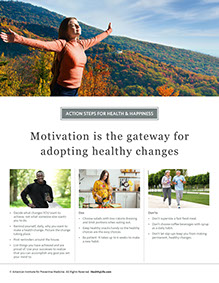
  • Motivation Is The Gateway For Adopting Healthy Changes

    Weight Control

    Female standing outside with arms open taking in the fresh air.

    *  Decide what changes YOU want to achieve, not what someone else wants you to do.

    *  Remind yourself, daily, why you want to make a health change. Picture the change taking place.

    *  Post reminders around the house.

    *  List things you have achieved and are proud of. Use your successes to realize that you can accomplish any goal you set your mind to.

    Dos

    *  Choose salads with low-calorie dressing and limit portions when eating out.

    *  Keep healthy snacks handy so the healthy choices are the easy choices.

    *  Be patient. It takes up to 6 weeks to make a new habit.

    Don’ts

    *  Don’t supersize a fast food meal.

    *  Don’t choose coffee beverages with syrup as a daily habit.

    *  Don’t let slip-ups keep you from making permanent, healthy changes.

    Page from HealthyLife Weigh book by the American Institute for Preventive Medicine. www.HealthyLife.com. All rights reserved.

    © American Institute for Preventive Medicine

  • New Year, New You

    Weight Control

    Smiling man.

    Take action now to reach your resolution to lose weight.

    *  Set an exercise goal you can reach. For example, by the end of this month, I will walk at least 20 minutes a day, five days a week.

    *  When you reach a goal, give yourself a nonfood reward, such as a new workout video or a new lunch bag.

    *  Substitute water for sweetened beverages.

    *  Eat fruits and veggies for snacks instead of candy, chips, and cookies.

    Action Step:Chew food slowly to give your body time to send a signal to your brain that you’ve had enough. You’ll enjoy your food more and eat less.

    Choose foods that won’t sabotage your goals.

    Page from HealthyLife Weigh book by the American Institute for Preventive Medicine. www.HealthyLife.com. All rights reserved.

    © American Institute for Preventive Medicine

  • Breaking Bad Habits Now

    WELL-BEING

    Doctor holding an apple in hand wrap with a tape measure.

    If you’re hoping to make a change, these tips may help:

    Avoid.If certain places or people make you want to engage in unhealthy habits, try your best to stay away.

    Replace.Focus on what you can do instead of the bad habit. For instance, take a walk or drink a glass of water.

    Plan.If you know you’ll be tempted with a bad habit, practice what you can do. Picture yourself not giving in. Have a plan for yourself.

    Buddy up.Ask a friend or family member to support you. They can cheer you on and encourage you when you need it.

    Source: National Institutes of Health

    © American Institute for Preventive Medicine

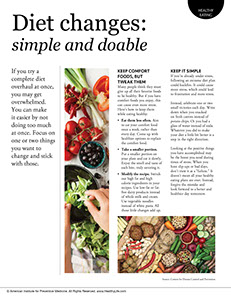
  • Diet Changes: Simple And Doable

    HEALTHY EATING

    Hand over table with bowls of different, healthy ingredients.

    If you try a complete diet overhaul at once, you may get overwhelmed. You can make it easier by not doing too much at once. Focus on one or two things you want to change and stick with those.

    Keep comfort foods, but tweak them

    Many people think they must give up all their favorite foods to be healthy. But if you have comfort foods you enjoy, this can cause even more stress. Here’s how to keep them while eating healthy:

    *Eat them less often.Aim to eat your comfort food once a week, rather than every day. Come up with healthier options to replace the comfort food.

    *Take a smaller portion.Put a smaller portion on your plate and eat it slowly. Enjoy the smell and taste of each bite, truly savoring it.

    *Modify the recipe.Switch out high fat and high calorie ingredients in your recipes. Use low-fat or fat-free dairy products instead of whole milk and cream. Use vegetable noodles instead of white pasta. All those little changes add up.

    Keep it simple

    If you’re already under stress, following an extreme diet plan could backfire. It could cause more stress, which could lead to frustration and more stress.

    Instead, celebrate one or two small victories each day. Write down when you snacked on fresh carrots instead of potato chips. Or you had a glass of water instead of soda. Whatever you did to make your diet a little bit better is a step in the right direction.

    Looking at the positive things you have accomplished may be the boost you need during times of stress. When you have slip-ups or bad days, don’t view it as a “failure.” It doesn’t mean all your healthy eating plans are over. Instead, forgive the mistake and look forward to a better and healthier day tomorrow.

    Source: Centers for Disease Control and Prevention

    © American Institute for Preventive Medicine

  • Change Is Your Choice

    Healthylife® Weigh

    Part 3

    Elderly couple eating dinner.

    The decision to make changes is up to you. You can decide which changes you want to make, how long it takes you to make them, and who you tell.

    Check in with yourself daily. Pick one of your action steps from Part 2 or a new one. Answer the following:

    *  What do I want to do? Am I willing to do this?

    *  If there is something I am unable to do, what do I need to do to get there?

    *  What am I going to do right now?

    Check in with Your Values

    Remember those values you identified in Part 1?

    *  How will continuing this journey help me live another one of my values?

    *  How have I cared for myself today?

    © American Institute for Preventive Medicine

  • Breaking Bad Habits

    WELL-BEING

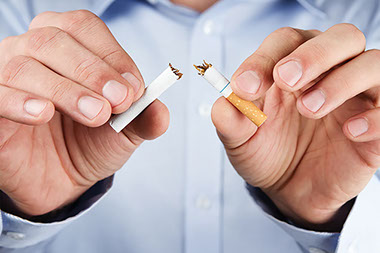
    Close-up image of a person breaking a cigarette in half.

    Bad habits may be hard to change, but it can be done. Smoking, for example, can be stopped. So can alcohol abuse.

    If you could only … but why don’t you? Scientists at the NIH study what happens in your brain as habits form. They come about through repetition. Brushing your teeth in the morning is a good habit. Reaching for a cigarette-bad habit.

    Habits trigger pleasure centers in your brain. First, focus on becoming more aware of your bad habits. Then try these strategies to counteract them:

    *  Avoid tempting situations. If you don’t buy candy bars, it won’t be as easy to eat one.

    *  Prepare mentally. Think about how you want to handle it and mentally practice what you plan.

    *  Enlist support. Ask friends, family, and coworkers to support your efforts to change.

    *  Replace unhealthy bad habits with healthy ones. Exercise or try a new hobby.

    *  Reward yourself for small steps.

    © American Institute for Preventive Medicine

  • New You

    WELL-BEING

    Image of smiling man.

    Why wait to create a new you? Live your best life now. This advice comes from researchers at Washington University:

    *Learn something new.Take a class in a subject you enjoy or are curious about. Check your community colleges for noncredit continuing education classes. Rekindle your love of learning.

    *Volunteer.It’s good for your physical and mental health whether you’re building a house for someone, ladling out soup for the homeless, or collecting canned goods. You’ll make valuable community connections.

    *Get your social media house in order.The Internet and social media have opened up exciting new avenues to connect with others and new vistas to share preferences in films, books, and music. Have fun. But be cautious. Check your default privacy settings. Log out and see what your profile looks like to the outside world. Make sure passwords are complex – Use upper and lowercase letters and a special character, such as $. Don’t use the same password for all social media accounts.

    *Rediscover the library.The digital revolution has changed your local library. You can often download books online. Consider how much your library offers: novels and nonfiction works for all ages, how-to books, music CDs, movies on DVD or videotape, maps and reference works. Read the latest magazines or journals.

    *Step away from your desk.Physical activity improves health, lowers stress, and increases productivity. And if those weren’t reasons enough, research shows that exercise reduces the risk of diseases such as breast cancer, colon cancer, and Alzheimer’s.

    *Pay down your credit card debt.Put extra money toward the loans with the highest interest rates. Consolidate several small debts.

    *Use your smartphone to quit smoking.You can tap into apps for messages of support and access websites that give step-by-step encouragement.

    *Kick the car habit.Leave the SUV in the garage and try alternate means of transportation such as the bus or train, bicycling, walking, or park-and-ride commuting.

    *Parents:Make every day count. Happy, well-adjusted children need happy, well-adjusted parents.

    *Get more sleep.

    *Consume more culture.The arts not only educate and entertain, they help us to better understand ourselves and others. Visit your local museums, galleries, theaters, dance companies, and music halls.

    © American Institute for Preventive Medicine

  • Thinking About A New Job?

    WORK LIFE

    Concept image of women writing a career outline.

    Boredom. Anxiety. Restlessness. If these terms describe your feelings at work, don’t be afraid to make a change, said Amy Gregor, coordinator of career services at Indiana University.

    “Career change is a natural life progression. Most studies show that the average job seeker will change careers-not just jobs-several times over the course of his or her lifetime,” she said.

    But before you turn in your resignation, take some time to carefully assess the situation. It is very difficult to find satisfaction if you don’t know what you need. Gregor offers the following suggestions:

    *  Take a hard look. Start with a self-assessment of likes and dislikes about your current position. Are there certain aspects that you do enjoy? Get specific about your list of grievances. Are the hours too long? Are you bored? Is the pay too low? Do you wish you had a healthier balance between work and family life? You might find that some of the negatives can be addressed within your current position. “It is possible that your boss has no idea you are unhappy and would be perfectly willing to change things if you propose a new plan,”  Gregor said.

    *  Bad habits? Certain habits tend to make people unhappy at their jobs regardless of the circumstances. “If you never take a lunch, have poor time management skills, and never use your vacation time, most people will burn out. If you bring that approach to another job or career you may continue to have the same levels of dissatisfaction,” she said.

    *  Don’t put it off. Once you’re certain you need to leave, start taking steps to transition as soon as possible, Gregor said. “Don’t wait until you are at the point where you are so frustrated you’re willing to burn bridges,” she said.

    *  Rediscover your passion. Think of times when you felt most successful. Ask yourself what you really love to do. What do you do for fun? Answering these questions can help you get a sense of what career path to pursue.

    *  Still not sure? “If you’ve analyzed your likes and dislikes, but you’re still not sure what career path to take, consider taking a career assessment. The key is investing in the time to rediscover yourself, and using your self-assessment to steer your new career search,” Gregor said.

    *  Network. Don’t just dive into the help wanted ads. Test the waters by talking with people who work in various career fields. Talk about your dreams. “During this time it may be helpful to talk about your plan with the people you trust most, such as your family, friends, alumni contacts, pastor, trusted counselor, financial advisors, and maybe even your doctor,” Gregor said. “It will be important to gain support during any times of transition.”

    © American Institute for Preventive Medicine