Tag: check

  • Collecting Unclaimed Funds

    FINANCIAL HEALTH

    Young couple holding a jar with money in it.

    Could you have money waiting for you? Learn about unclaimed money or property from bank accounts, tax refunds, insurance policies or wages and pensions.

    You can find your unclaimed money for free. Here’s how:

    *  Search in every state where you have lived. Look up each state’s unclaimed property office. You can also try contacting the state treasurer’s office.

    *  Search the FDIC database. If your bank or credit union closed, you could have unclaimed deposits. You can also check out the National Credit Union Administration (NCUA) atwww.ncua.gov/support-services.

    *  Current or former VA life insurance holders can check for unclaimed life insurance funds. Go toinsurance.va.gov/UnclaimedFunds.

    *  Look for tax refunds from an FHA-insured mortgage. If you earned income but your wages were below the tax filing requirement, you might have a refund waiting. Go toirs.gov/refunds to check. If you bought mortgage insurance from the Federal Housing Administration (FHA), you might have a refund. Go toentp.hud.gov/dsrs/refunds.

    *  Do you have unclaimed back wages or pension money from a past employer? Go to the Workers Owed Wages (WOW) website atwebapps.dol.gov/wow. You can also check the Pension Benefit Guaranty Corporation atpbgc.gov.

    Notice that these websites include “gov.” They don’t have a “com” or “org.” The “gov” means it’s an official U.S. Government website. You should never have to pay any money to find or claim your unclaimed money. It’s FREE. Watch out for scammers and people who want to charge you for this service.

    Source: usa.gov

    © American Institute for Preventive Medicine

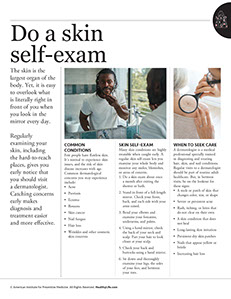
  • Do A Skin Self-Exam

    SELF-CARE CORNER

    Man looking at himself in mirror.

    The skin is the largest organ of the body. Yet, it is easy to overlook what is literally right in front of you when you look in the mirror every day.

    Regularly examining your skin, including the hard-to-reach places, gives you early notice that you should visit a dermatologist. Catching concerns early makes diagnosis and treatment easier and more effective.

    Common conditions

    Few people have flawless skin. It’s normal to experience skin issues, and the risk of skin disease increases with age. Common dermatological concerns you may experience include:

    *  Acne

    *  Psoriasis

    *  Eczema

    *  Rosacea

    *  Skin cancer

    *  Nail fungus

    *  Hair loss

    *  Wrinkles and other cosmetic skin concerns

    Skin Self-exam

    Many skin conditions are highly treatable when caught early. A regular skin self-exam lets you examine your whole body and monitor any moles, blemishes, or areas of concern.

    1.  Do a skin exam about once a month after exiting the shower or bath.

    2.  Stand in front of a full-length mirror. Check your front, back, and each side with your arms raised.

    3.  Bend your elbows and examine your forearms, underarms, and palms.

    4.  Using a hand mirror, check the back of your neck and scalp. Part your hair to look closer at your scalp.

    5.  Check your back and buttocks using a hand mirror.

    6.  Sit down and thoroughly examine your legs, the soles of your feet, and between your toes.

    When to seek care

    A dermatologist is a medical professional specially trained in diagnosing and treating hair, skin, and nail conditions. Regular visits to a dermatologist should be part of routine adult healthcare. But, in between visits, be on the lookout for these signs:

    *  A mole or patch of skin that changes color, size, or shape

    *  Severe or persistent acne

    *  Rash, itching, or hives that do not clear on their own

    *  A skin condition that does not heal

    *  Long-lasting skin irritation

    *   Persistent dry skin patches

    *  Nails that appear yellow or brittle

    *  Increasing hair loss

    © American Institute for Preventive Medicine