Tag: child

  • Child Passenger Safety

    Child Safety

    Yound child in a car seat laughing.

    Child safety seats help protect your child from injury and death.

    Children aged 12 and under should sit properly restrained in the back seat.

    When you install a child safety or booster seat, use the instructions that come with it and the vehicle owner’s manual.

    A rear-facing infant child safety seat should never be placed in front of a passenger seat air bag.

    If you must transport a child in the front seat of a vehicle with an active air bag or near any passenger seat with a side air bag, install an on-off switch and press “off.”

    Have a certified child passenger safety technician check to see that the safety seat has been installed the right way. Find a technician or an inspection center near you fromnhtsa.gov/equipment/car-seats-and-booster-seats.

    A Year of Health Hints book by the American Institute for Preventive Medicine. www.HealthyLife.com. All rights reserved.

    © American Institute for Preventive Medicine

  • Child Safety

    Child Safety

    Do This, Not That

    According to the Centers for Disease Control and Prevention (CDC):

    *  Injuries are the leading cause of death in children and teens.

    *  Each year, nearly 9 million children aged 0 to 19 years are seen in emergency departments for injuries. More than 9,000 children die as a result of being injured.

    *  Injury treatment is the leading cause of medical spending for children.

    The leading causes of injury death differed by age group.

    *  For children less than 1 year of age, 2/3rds of injury deaths were due to suffocation.

    *  Drowning was the leading cause of injury death for those 1 to 4 years of age.

    *  For children 5 to 19 years of age, the most injury-related deaths were due to being an occupant in a motor vehicle traffic crash.

    Most child injures are preventable. Use the tips in this section to keep your children safe at home.

    General Guidelines

    Safe at Home - Do This, Not That Book. Published by the American Institute for Preventive Medicine. www.HealthyLife.com. All rights reserved.

    © American Institute for Preventive Medicine

  • Bed-Wetting

    Children’s Health

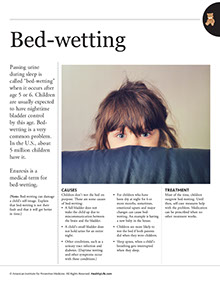
    Passing urine during sleep is called “bed-wetting” when it occurs after age 5 or 6. Children are usually expected to have nighttime bladder control by this age. Bed-wetting is a very common problem. In the U.S., 5 to 7 million children have it.

    Enuresis is a medical term for bed-wetting. {Note: Bed-wetting itself, can’t be prevented, but damage to a child’s self- image can. Explain that bed-wetting is not his or her fault and that it will get better in time.}

    Causes

    Children don’t wet the bed on purpose. These are causes of bed-wetting:

    *  A lot of urine is made in the evening and during the night. A full bladder does not wake the child up.

    *  A child’s small bladder does not hold urine for an entire night.

    *  Other conditions, such as a urinary tract infection and diabetes. (Daytime wetting and other symptoms occur with these conditions.)

    *  For children who have been dry at night for 6 or more months, sometimes, emotional upsets and major changes can cause bed-wetting. An example is having a new baby in the house.

    *  Children are more likely to wet the bed if both parents did when they were children.

    Treatment

    Most of the time, children outgrow bed-wetting. Until then, self-care measures help with the problem. Medication can be prescribed when no other treatment works.

    Questions to Ask

    Self-Care / Prevention

    Be patient and give your child lots of support. Children who wet the bed can’t help it. Getting angry only makes the problem worse.

    Until Your Child Outgrows Bed-Wetting

    *  Do not blame or punish your child for wetting the bed.

    *  Limit fluids in the evening, especially 2 hours before bedtime. Ask your child’s doctor how much your child should drink. Don’t give drinks with caffeine, such as colas.

    *  Have your child urinate in the toilet right before getting into bed.

    *  See that your child can easily get to the toilet during the night. Keep the path clear. Use night lights, etc. If needed, put a portable potty close to your child’s bed. Assign a place the potty can be moved to for daytime, if your child wants to do this.

    *  Tell other members of the household that “teasing” about bed-wetting is not allowed. Respect your child’s privacy and feelings.

    *  You may want your child to use pull-up (training) pants when he or she sleeps away from home, camps, etc. On a regular basis, encourage your child to wake up to use the toilet.

    *  Keep a change of pajamas, a flannel covered pad, clean sheets, dry towels, etc., near your child’s bed. Show your child how to use these when he or she wets the bed. Include your child in the clean-up process.

    *  Have your child rehearse getting up from bed and using the toilet. Do this at bedtime. Do it during the day when your child gets the urge to urinate. Have your child lay down in his or her bed, wait a few minutes, and then get up to urinate in the toilet.

    *  If your child is 5 years old or older and he or she agrees to it, get a bed-wetting alarm. The child wears the alarm on his or her underwear. The first drop makes the alarm buzz. This wakes the child up. After awhile, the child learns to wake up when he or she has to urinate. Some of these alarms help prevent wet beds 85 to 90 percent of the time.

    Resources

    National Kidney Foundation

    888.WAKE.DRY (925.3379)

    www.kidney.org

    Healthier at Home book by the American Institute for Preventive Medicine. www.HealthyLife.com. All rights reserved.

    © American Institute for Preventive Medicine

  • Objects In The Ear Or Nose

    First Aid

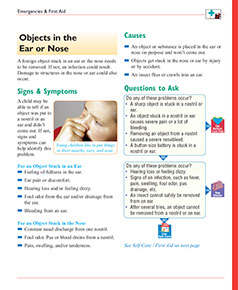
    A foreign object stuck in an ear or the nose needs to be removed. If not, an infection could result. Damage to structures in the nose or ear could also occur.

    Signs & Symptoms

    A child may be able to tell if an object was put in a nostril or an ear and didn’t come out. If not, signs and symptoms can help identify this problem.

    For an Object Stuck in an Ear

    *  Feeling of fullness in the ear.

    *  Ear pain or discomfort.

    *  Hearing loss and/or feeling dizzy.

    *  Foul odor from the ear and/or drainage from the ear.

    *  Bleeding from an ear.

    For an Object Stuck in the Nose

    *  Constant nasal discharge from one nostril.

    *  Foul odor. Pus or blood drains from a nostril.

    *  Pain, swelling, and/or tenderness.

    Causes

    *  An object or substance is placed in the ear or nose on purpose and won’t come out.

    *  Objects get stuck in the nose or ear by injury or by accident.

    *  An insect flies or crawls into an ear.

    Treatment

    Medical care is needed for foreign objects that can’t be removed with self-care. After an object is removed, an antibiotic may be needed if an infection is present. Small, button-sized batteries need to be removed to prevent burns.

    Questions to Ask

    Self-Care / Prevention

    To Remove an Insect from an Ear

    *  Kill the insect before you try to remove it. To do this, tilt the person’s head to put the ear with the insect in an upward position. Pour warm (not hot) mineral, olive, or baby oil into the ear. As you pour the oil, straighten the ear canal. In a child, pull the earlobe gently backward and downward; backward and upward in an adult.

    *  The goal is to suffocate the insect and cause it to float out.

    To Remove Objects Other Than Insects

    *  Don’t use oil.

    *  Tilt the head toward the side with the foreign object. Gently shake the head toward the floor to try to get the object out. Do not shake a baby. Gently pull the ear up and back.

    *  Don’t use a sharp tool, cotton swab, etc., to try to locate and remove the object. This risks pushing the object farther into the ear. Doing this could damage the middle ear.

    *  Remove the object with blunt tweezers if it is easily seen and can be grasped and pulled out.

    To Remove Objects in the Nose

    *  Don’t use a sharp tool, cotton swab, etc., to try to locate and remove the object.

    *  Breathe through the mouth until the object is removed.

    *  Apply gentle pressure to close the other nostril and gently try to blow the object out.

    *  Remove the object with blunt tweezers, if it is easily seen and can be grasped and pulled out.

    Healthier at Home book by the American Institute for Preventive Medicine. www.HealthyLife.com. All rights reserved.

    © American Institute for Preventive Medicine