Tag: Children’s Health Conditions

  • Bed-Wetting

    Children’s Health

    Passing urine during sleep is called “bed-wetting” when it occurs after age 5 or 6. Children are usually expected to have nighttime bladder control by this age. Bed-wetting is a very common problem. In the U.S., 5 to 7 million children have it.

    Enuresis is a medical term for bed-wetting. {Note: Bed-wetting itself, can’t be prevented, but damage to a child’s self- image can. Explain that bed-wetting is not his or her fault and that it will get better in time.}

    Causes

    Children don’t wet the bed on purpose. These are causes of bed-wetting:

    *  A lot of urine is made in the evening and during the night. A full bladder does not wake the child up.

    *  A child’s small bladder does not hold urine for an entire night.

    *  Other conditions, such as a urinary tract infection and diabetes. (Daytime wetting and other symptoms occur with these conditions.)

    *  For children who have been dry at night for 6 or more months, sometimes, emotional upsets and major changes can cause bed-wetting. An example is having a new baby in the house.

    *  Children are more likely to wet the bed if both parents did when they were children.

    Treatment

    Most of the time, children outgrow bed-wetting. Until then, self-care measures help with the problem. Medication can be prescribed when no other treatment works.

    Questions to Ask

    Self-Care / Prevention

    Be patient and give your child lots of support. Children who wet the bed can’t help it. Getting angry only makes the problem worse.

    Until Your Child Outgrows Bed-Wetting

    *  Do not blame or punish your child for wetting the bed.

    *  Limit fluids in the evening, especially 2 hours before bedtime. Ask your child’s doctor how much your child should drink. Don’t give drinks with caffeine, such as colas.

    *  Have your child urinate in the toilet right before getting into bed.

    *  See that your child can easily get to the toilet during the night. Keep the path clear. Use night lights, etc. If needed, put a portable potty close to your child’s bed. Assign a place the potty can be moved to for daytime, if your child wants to do this.

    *  Tell other members of the household that “teasing” about bed-wetting is not allowed. Respect your child’s privacy and feelings.

    *  You may want your child to use pull-up (training) pants when he or she sleeps away from home, camps, etc. On a regular basis, encourage your child to wake up to use the toilet.

    *  Keep a change of pajamas, a flannel covered pad, clean sheets, dry towels, etc., near your child’s bed. Show your child how to use these when he or she wets the bed. Include your child in the clean-up process.

    *  Have your child rehearse getting up from bed and using the toilet. Do this at bedtime. Do it during the day when your child gets the urge to urinate. Have your child lay down in his or her bed, wait a few minutes, and then get up to urinate in the toilet.

    *  If your child is 5 years old or older and he or she agrees to it, get a bed-wetting alarm. The child wears the alarm on his or her underwear. The first drop makes the alarm buzz. This wakes the child up. After awhile, the child learns to wake up when he or she has to urinate. Some of these alarms help prevent wet beds 85 to 90 percent of the time.

    Resources
    National Kidney Foundation

    888.WAKE.DRY (925.3379)

    www.kidney.org

    Healthier at Home book by the American Institute for Preventive Medicine. www.HealthyLife.com. All rights reserved.

    © American Institute for Preventive Medicine
  • Colic

    Children’s Health

    Babies cry when they are hungry, sick, too hot, etc. In general, babies start to have colic when they are about three weeks old. The colic worsens at around six weeks of age and stops by 3 months of age. Colic does not harm babies, but is very hard on parents and caretakers.

    Signs & Symptoms

    *  Fussy crying occurs for no known reason. The baby is not hungry, sick, in pain, etc. The crying lasts for minutes to hours at a time.

    *  The baby may pull his or her knees up to the stomach.

    *  Colic episodes often occur in the evening.

    Causes

    The exact cause is not known. Babies with colic are very, very sensitive to stimulation. Noises in the house bother them. Also, they may need to be cuddled more than babies without colic.

    Bottle feeding too fast (less than 20 minutes) or giving too much formula can trigger colic episodes. So can foods the breast-feeding mother eats (e.g., caffeine, dairy products, and nuts).

    Treatment

    After other medical problems are ruled out, colic is treated by finding out and getting rid of colic triggers and giving comfort to the baby.

    Questions to Ask

    Self-Care / Prevention

    *  Be sure the baby has enough to eat. Check with the baby’s doctor about trying a new formula.

    *  Try different bottle nipples. Make the hole bigger if it is too small. Cut across the hole that is already there. (You will make an X- shaped hole.) Here’s how to find out if the hole is too small:

    –  Put cold formula in the bottle.

    –  Turn the bottle upside down.

    –  Count the drops of formula that fall out. If the drops come out slower than 1 drop per second, the hole is too small.

    *  Don’t allow smoking in your home.

    *  Do not give fruit juice (e.g., apple juice, pear juice) to infants younger than 6 months old.

    *  Hold the baby up for feeding. Keep holding the baby up for awhile after feeding.

    *  Burp the baby after each ounce of formula or every few minutes when breast-feeding.

    *  Use a pacifier, but never put a pacifier on a string around the baby’s neck.

    *  Give the baby a warm bath and a massage.

    *  Wrap or swaddle the baby snugly in a soft blanket. Rock him or her or use a baby swing.

    *  Try the “colic carry.” Lay the baby on his or her stomach across your arm. Put the baby’s face in your hand and let the legs straddle your inner elbow. Hold the baby’s back with your other hand so he or she won’t fall. Walk around like this for awhile.

    *  Carry the baby while you vacuum. Use a baby carrier that you wear on your back or chest.

    *  Play soft, gentle music.

    *  Take your baby for a stroller or car ride.

    *  Run the dryer or dishwasher. Buckle your baby in a baby seat. Lean the seat against the side of the dryer or on the counter near the dishwasher. The sounds from these machines may help the baby fall asleep. Stay with your baby. Make sure the heat or steam won’t hurt the baby.

    *  Don’t give the baby antacids like Maalox or simethicone drops unless a doctor tells you to.

    *  Let your baby cry himself or herself to sleep if nothing else helps and your baby has been fed within 2-1/2 hours. Do call the doctor if the baby cries for more than 2 hours without stopping.

    *  Get someone else to take care of your baby if you get too stressed. Get some rest.

    Resources

    American Academy of Pediatrics

    www.aap.org

    Healthier at Home book by the American Institute for Preventive Medicine. www.HealthyLife.com. All rights reserved.

    © American Institute for Preventive Medicine
  • Croup

    Children’s Health

    Croup causes swelling around vocal cords and airways. Children usually get croup between 3 months and 5 years of age. It is a scary, but not usually dangerous condition. Croup often occurs several days after a child has mild symptoms of a cold.

    Signs & Symptoms

    *  A cough that sounds like a seal’s bark.

    *  Hoarseness.

    *  A harsh, crowing noise with breathing in.

    Symptoms of croup can also be like symptoms of more serious problems. These include:

    *  Something can be stuck in your child’s windpipe.

    *  Epiglottitis. This is a bacterial infection that can cause the back of the throat to swell up. If the throat is blocked, breathing in is very difficult. Severe respiratory distress can result. Signs of epiglottitis are:

    – Drooling.

    – Hanging the head down.

    – Sticking out the jaw to breathe.

    – Fever.

    Causes

    Croup is usually caused by a certain virus. Other viruses, allergies, bacteria, and inhaled foreign objects, can mimic croup.

    Treatment

    Self-care measures can treat symptoms. Croup usually goes away in 3 to 7 days. It is usually worse at night. Emergency care is needed for severe problems breathing.

    Questions to Ask

    Self-Care / Prevention

    *  Don’t panic. You can help your child stay calm if you stay calm. Hold your child to comfort him or her. The windpipe may open up a little if your child relaxes. Call your child’s doctor or get immediate care if you are not sure what to do.

    *  Go into the bathroom with your child and close the door.

    –  Turn on the hot water in the sink and shower. Let the steam fill the room.

    –  Don’t put your child in the shower. Sit with your child. (Don’t sit on the floor.) Read a book or play a game with your child. This will help pass the time.

    –  Open the window to let cool air in. This helps make more steam.

    –  Stay in the bathroom about 10 to 15 minutes.

    *  If it is cold outside, instead of using the bathroom to make steam, put a coat, etc. on your child and take him or her outside to breathe the cold night air.

    *  Use a humidifier in your child’s room. Use warm, distilled water, not tap water. Clean the humidifier every day. Put a humidifier on your furnace. Change the filter often.

    *  Give your child a clear liquid. Warm it first. Warm liquids may help loosen the mucus. Give babies under 6 months old water or electrolyte water, such as Pedialyte, if okay with your child’s doctor. Give water, apple juice, etc. to a child who is 6 months old or older.

    *  Try to keep your child calm. Croup symptoms tend to get worse if your child is crying and upset.

    To Help Prevent Croup and Other Infections

    *  See that your child’s immunizations for diphtheria (DTaP), measles (MMR), and H. influenzae type b (Hib) are up-to-date.

    *  Follow prevention measures inColds & Flu.

    Resources

    The American Academy of Pediatrics

    www.aap.org

    Healthier at Home book by the American Institute for Preventive Medicine. www.HealthyLife.com. All rights reserved.

    © American Institute for Preventive Medicine
  • Eye Problems

    Children’s Health

    Signs, Symptoms & Causes

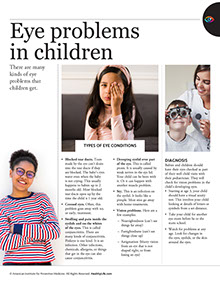
    There are many kinds of eye problems that children get. Here are some of them:

    *  Blocked tear ducts. Tears made by the eye can’t drain into the tear ducts if they are blocked. The baby’s eyes water even when the baby is not crying. This usually happens to babies up to 2 months old. Most blocked tear ducts open up by the time the child is 1 year old.

    *  Crossed eyes. Often, this problem goes away with no treatment.

    *  Swelling and pain inside the eyelids and on the whites of the eyes. This is called conjunctivitis. There are many kinds of conjunctivitis. Pinkeye is one kind. It is an infection. Other infections, chemicals, allergens, or things that get in the eye can also cause conjunctivitis.

    *  Drooping eyelid over part of the eye. This is called ptosis. It is usually caused by weak nerves in the eye lid. Your child can be born with it. Or it can happen with another muscle problem.

    *  Sty. This is an infection on the eyelid. It looks like a pimple. Most sties go away with home treatments.

    *  Vision problems. Here are a few examples:

    – Nearsightedness (can’t see things far away).

    – Farsightedness (can’t see things close up).

    – Astigmatism (blurry vision from an eye that is not shaped right, or from losing an eye).

    It’s hard to know if your child has vision problems until he or she is 3 years old. (The eye is still developing until then.)

    *  Take your child for their first  eye exam at 3 years old.

    *  Take your child for another eye exam before he or she starts school.

    *  Watch for problems at any age. Look for changes in the eyes, eyelids, or the skin around the eyes.

    Questions to Ask

    Self-Care

    A doctor should treat a hurt or infected eye. But you can treat some eye problems at home.

    *  For a blocked tear duct:

    1. Wash your hands.

    2. Press gently on the inner corner of the eye with a cotton swab. Press up, not down, for a few seconds to a few minutes.

    *  For dry eyes, try over-the-counter “tears.” Some kinds are Ocu-Lube®, Refresh®, or Liquifilm®. Wash your hands before you put drops in the eyes. If your child’s eyes don’t get better, take him or her to the doctor.

    *  To help with an insect bite, gently wash the eyes with warm water.

    *  To help the pain of a hurt eye that is not infected:

    – Put a warm (not hot), wet wash cloth on the eye for 5 minutes. Do this 2 or 3 times a day.

    – Use over-the-counter eye drops.

    – Don’t  let your child wear contact lenses or makeup until the eye is better.

    *  If the eye is infected:

    – Wash your hands and your child’s hands every time you touch the eye. (Pinkeye is very easy to catch.)

    – Don’t  share a towel with someone who has pinkeye.

    – Keep your child away from light if he or she got pinkeye from the measles.

    – Don’t  cover the eye. This can make the infection worse.

    *  Here’s how to get something out of your child’s eye: (Make sure you can see the speck before you try to get it out.)

    1. Wash your hands.

    2. Drip clean water into the eye to rinse it.

    3. Twist a piece of tissue at each end. Wet the tip with tap water, not spit. Gently touch the speck with the tip. The speck should stick to the tip.

    – Tell your child to look down if the speck is under the upper lid. Pull the upper lid away from the eye. Do this by gently pulling on the eyelashes. When you can see the speck, try to touch it with the tissue.

    – Don’t  rub the eye. And never use anything sharp to touch your child’s eye.

    4. Gently wash the eye with cool water.

    *  To help with pain from a sty:

    – Put a warm (not hot), wash cloth on the sty 3 or 4 times a day for 5 or 10 minutes each time.

    – Keep your child away from dust and dirt that can get in his or her eyes.

    – Don’t poke or squeeze the sty!

    Children's Self-Care book by the American Institute for Preventive Medicine. www.HealthyLife.com. All rights reserved.

    © American Institute for Preventive Medicine
  • Lice

    Children’s Health

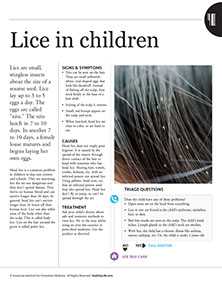
    Lice are small, wingless insects about the size of a sesame seed. Lice lay up to 3 to 5 eggs a day. The eggs are called “nits.” The nits hatch in 7 to 10 days. In another 7 to 10 days, a female louse matures and begins laying her own eggs.

    Head lice is a common problem in children in day- care centers and schools. Head lice only affect humans. They thrive on human blood and can survive longer than 30 days. In general, head lice can’t survive longer than 24 hours off their human host. Lice can also infest areas of the body other than the scalp. This is called body lice. Lice on the hair around the groin is called pubic lice.

    Signs & Symptoms

    For Head Lice

    *  Nits can be seen on the hair. They are small yellowish-white, oval-shaped eggs that look like dandruff. Instead of flaking off the scalp, they stick firmly to the base of a hair shaft.

    *  Itching of the scalp is intense.

    *  Small, red bumps appear on the scalp and neck.

    *  When hatched, head lice are clear in color, so are hard to see.

    Causes

    Head lice does not imply poor hygiene. It is caused by the spread of the insects through direct contact of the hair or head with someone who has head lice. Sharing hats, towels, combs, helmets, etc. with an infected person can spread lice. Using pillows, head rests, etc. that an infected person used may also spread lice. Head lice don’t fly or jump, so can’t be spread through the air.

    Treatment

    Ask your child’s doctor about safe and nontoxic methods to treat lice. He or she may advise using an over-the-counter or prescribed medicine. Use the product as directed.

    Questions to Ask

    Self-Care / Prevention

    Check everyone in your home for lice and nits. Treat only those who have lice. Lice-killing products won’t prevent lice.

    *  Use an over-the-counter shampoo, lotion, or cream made to get rid of lice and nits. Follow the directions on the package.

    *  Wear plastic or latex gloves. Don’t use too much shampoo. Doing this will make the child’s head too dry.

    Things to Tell Your Child

    *  Don’t share hats, brushes, or combs. If you must share helmets, wipe them with a damp towel and wear a baseball cap under the helmet.

    *  Don’t lie on a pillow that another child uses.

    *  Wash your hair and bathe often.

    To Remove the Nits

    *  Shine a flashlight on the hair roots. Nits are gray and hard to see, especially in blond hair.

    *  Start at one spot and go row by row or even strand by strand. Use the nit comb that comes in the package. Dip the comb in vinegar first. This will help loosen the nits.

    *  Comb the hair from the roots to the ends. Check the comb for nits after each pass, or, break the hair up into 4 or 5 sections with hair clips. Lift about an inch of hair up and out. Put the comb against your child’s head. Comb all the way to the tips of the hair. Keep going until you’ve done the whole head.

    *  Soak all combs, brushes, hair clips, and barrettes for 1 to 2 hours in the insecticidal shampoo. Or, soak them for 1 hour in soap and water, rubbing alcohol, or Lysol.

    *  Check for nits every 2 to 3 days for 2 to 3 weeks until all lice and nits are gone.

    *  A week to 9 days later, use the shampoo for lice again to kill any newly hatched nits. You don’t have to remove nits after treatment is finished except for cosmetic reasons.

    Other Things You Should Do

    *  Vacuum all mattresses, pillows, rugs, and furniture made of cloth, especially where children play. Use the long, thin attachment to suck the lice or nits out of car seats, toys, etc. Put the vacuum cleaner bags outside in the trash.

    *  Wash bedding and clothes right away in water 130ºF or hotter. Put them in the dryer on high for 30 minutes. Heat kills the lice and nits. Dry-clean clothes and hats that you can’t wash.

    *  Don’t use bug spray on lice, furniture, stuffed animals, etc.

    *  As soon as you know your child has lice, call your child’s school, child-care center, parents of your child’s friends, etc.

    *  Check your children for head lice and nits once a week. Check more often if your child scratches his or her head. Look for nits behind the ears and on the back of the neck. Spread hairs apart using a nit comb to look for the nits on the hair shafts.

    Resources

    National Pediculosis Association

    www.headlice.org

    Healthier at Home book by the American Institute for Preventive Medicine. www.HealthyLife.com. All rights reserved.

    © American Institute for Preventive Medicine
  • Nutrition For Children

    Children’s Health

    Image of toddler eating a strawberry.

    Birth to 2 Years Old

    *  Breast-feed your baby from birth to 6 months of age. Breast-feed for the first year, if you can. If you can’t breast-feed or don’t want to, give iron-enriched formula (not cow’s milk) for the first 12 months. After that and up to age 2, use whole cow’s milk to replace formula or breast milk. Don’t limit fat for the first 2 years of life.

    *  Follow your child’s doctor’s advice on breast-feeding and what formula and vitamins to give your baby. Breast-fed babies who do not get regular exposure to sunlight may need vitamin D supplements.

    *  Start solid foods as advised by your baby’s doctor. It is common to do this at 4 to 6 months of age. Iron-enriched infant rice cereal is usually the first food given.

    *  Start new foods one at a time. Wait 1 week before adding each new cereal, vegetable, or other food. Doing this makes it easier to find out which foods your baby has a problem with.

    *  Use iron-rich foods, such as grains, iron-enriched cereals, and meats.

    *  Do not give honey to infants during the first 12 months of life.

    *  Don’t let a baby fall asleep with a bottle that has formula, juice, or milk. The sugars in these can cause tooth decay.

    Two Years and Older

    *  Give a variety of healthy foods for meals and snacks. Follow guidelines from theChooseMyPlate.gov/kidsWeb site. Let your child choose which healthy foods and how much to eat to satisfy his or her hunger.

    *  Help your child maintain a healthy weight. Give proper foods. Promote regular exercise. Lead by example. Children learn from what they see parents do, as well as, from what parents say. Eat with your children. Be a role model for good eating. Exercise, too.

    *  Let your child help plan meals and snacks, shop for food, and prepare foods.

    *  Don’t force your child to eat certain foods. Don’t use food to reward or punish behavior.

    *  Don’t give foods that can lead to choking, such as hard candies and whole grapes.

    *  Teach healthy behaviors in a fun way. For ideas to help get children to eat well and be more active, access the Web sites under “Resources”.

    Resources

    5-2-1-0 Let’s Go!

    www.letsgo.org

    ChooseMyPlate.gov

    www.choosemyplate.gov/kids/index.html

    We Can!™ Ways to Enhance Children’s  Activity & Nutrition

    www.nhlbi.nih.gov/health/educational/wecan

    Page from Healthier at Home book by the American Institute for Preventive Medicine. www.HealthyLife.com. All rights reserved.

    © American Institute for Preventive Medicine
  • Signs Of Reye’S Syndrome

    Children’s Health

    Be on the lookout for Reye’s Syndrome after the flu or chickenpox. Reye’s Syndrome does not happen very often. But you should know about it. Look for these signs:

    *  Vomiting over and over again. Or vomiting that does not stop.

    *  Loss of pep and energy.

    *  Acting very, very sleepy.

    *  Acting very, very cranky.

    *  Striking out at others.

    *  Acting strange.

    *  Convulsions.

    (Note: If your child shows signs of Reye’s Syndrome, get medical care fast!)

    Children's Self-Care book by the American Institute for Preventive Medicine. www.HealthyLife.com. All rights reserved.

    © American Institute for Preventive Medicine
  • Self-Care Medicines & Supplies For Children

    Children’s Health

    Here is a list of medicines and other things you should keep at home.

    *  Store items in a handy, dry place, but out of children’s reach.

    *  Check the expiration dates often. Throw away and replace outdated items.

    *  Find out what kind and how much of each medicine you can give your child. Ask your child’s doctor. Ask the pharmacist. Read and understand the medicine’s label. Brand names are often listed. Store brands are just as good.

    Over-the-Counter Medicines

    *  Acetaminophen. An example is Children’s Tylenol®. Or have ibuprofen. Examples are Children’s Advil® and Children’s Motrin®. Stock the right kind for your child’s weight.

    *  Antihistamine tablets or syrup. An example is Benadryl®.

    *  Cough medicine. Ask your child’s doctor which one(s) you should stock.

    *  Decongestant tablets or liquid. Do not give to children under 2 years old. An example is Dimetapp®.

    Basic Supplies

    *  Antibiotic ointment.

    *  Antiseptic ointment or wipes.

    *  Bandages of different sizes.

    *  Eye dropper.

    *  Medicine spoon & dropper.

    *  Cold pack.

    *  Cotton-tipped swabs.

    *  Elastic wrap and closures.

    *  Flashlight.

    *  Roll of adhesive tape.

    *  Rubbing alcohol.

    *  Sterile gauze pads and a roll of gauze.

    *  Sunscreen with an SPF of 15 or higher.

    *  Thermometer (digital or ear).

    *  Tongue depressor.

    *  Toothache medicine. An example is Anbesol®.

    *  Tweezers.

    *  Vaporizer (cool mist).

    Children's Self-Care book by the American Institute for Preventive Medicine. www.HealthyLife.com. All rights reserved.

    © American Institute for Preventive Medicine
  • Too Sick For School?

    SELF-CARE CORNER

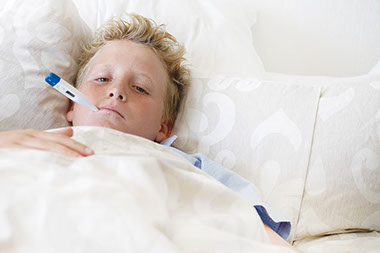
    Image of sick boy in bed.

    Colds? Flu? What to do? Sending a sick child to school can make matters worse and spread the illness to others. Follow these guidelines from pediatrician Dr. Jacqueline Kaari, University of Medicine and Dentistry of New Jersey, who said, “Parents need to be able to quickly assess their child and determine if he or she is well enough to go to school or needs to stay home, or if it’s time to call the pediatrician. Sometimes, parents will guess wrong, but if there’s one rule of thumb, it should be to always err on the side of caution.”

    Colds.What to do: Use over-the-counter saline nose drops or spray and a cool mist humidifier to relieve symptoms. Because colds are caused by viruses, antibiotics are not effective. Instead, the cold just needs to run its course until the child recovers. Contact your child’s doctor if a cough suddenly worsens or a fever develops.

    Fever.What to do: Give acetaminophen or ibuprofen for fevers. Encourage the child to drink lots of fluids and avoid fatty or fried foods that are hard to digest because fevers decrease stomach activity. Keep children at home if their fever is above 100.4ºF. Call a doctor if a high fever lasts more than 24 hours or does not respond to medication, or if the child’s condition worsens.

    Flu.Striking more suddenly and more intensely than a cold, the flu causes a sudden, high fever with body aches. What to do: Have your child vaccinated early in the flu season to protect against this illness. A child who comes down with the flu should stay home for several days, rest, and drink lots of fluids.

    Conjunctivitis (“pink eye”).A red, weeping eye(s) with a thick discharge that could become crusty when sleeping. What to do: Contact your child’s doctor for treatment, which may include antibiotic eye drops. Conjunctivitis can be highly contagious. Follow the doctor’s advice. Children can usually return to school 24 to 48 hours after treatment begins. Check with the school’s policy.

    Head lice.Tiny, crawling bugs that live on the scalp and feed on blood. Itching and sores on the scalp can be signs of head lice. The insects cannot jump or fly and are spread by human contact. What to do. Under bright light, check the entire scalp closely for lice or tiny white eggs (called nits), starting at the upper neck and behind the ears. Lotions and shampoos that can kill the lice are available at the drug store. Keep the child home from school until the lice have completely gone away.

    Sore throat.What to do: Have the child drink a few sips of water. If that relieves the symptoms, you are likely dealing with, at worst, a viral infection that will go away with a few days of rest, plenty of liquids, and pain relievers. If you suspect strep throat, follow the fever guidelines and contact your child’s doctor.

    Stomach ache.What to do: Keep children who have been vomiting home from school. Wait an hour after the child vomits and encourage small drinks of water. Gradually introduce clear liquids and bland foods throughout the day. Contact your doctor if vomiting lasts beyond 24 hours, occurs with worsening pain at the belly button or lower right abdomen, or if the child vomits blood or green or yellow matter.

    © American Institute for Preventive Medicine