Tag: choices

  • 10 Ways To Avoid Holiday Weight Gain

    HEALTHY EATING

    Image of women wearing a santa hat while taking her waist measurement.

    It can be especially hard to avoid extra pounds when there’s holiday food everywhere you turn. Stick to the basics of healthy eating so you can make it to the new year without regrets.

    1.Drink more water:Drinking water before you eat may help you feel fuller and eat less.

    2.Skip the soda, hot cocoa and high-sugar coffee drinks:Replacing sugary drinks with water can help you lose weight.

    3.Get exercise:Even just a few minutes a day has health benefits and can help you burn calories.

    4.Eat fruits and vegetables:These foods are generally packed with nutrition and low in calories.

    5.Get enough sleep:Lack of sleep can cause more cravings for unhealthy foods.

    6.Listen to your body:Stop eating when you start to feel full, not when you’re stuffed.

    7.Start with small portions:Start with smaller amounts of food on your plate, and wait to see if you need more later.

    8.Keep a food diary:This helps you get a clear picture of what you’ve eaten.

    9.Don’t eat and watch TV:This can lead to mindless eating and consuming too many calories.

    10.Build muscle:Muscles help your body burn more calories, even when resting.

    © American Institute for Preventive Medicine

  • Choosing Healthy Nut Butters

    HEALTHY EATING

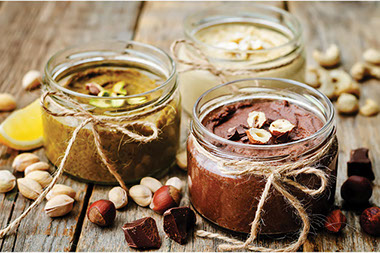
    Image of 3 different nut butter spreads.

    For many years, people thought they should avoid fats to be healthy. But the Academy of Nutrition and Dietetics says eating the right kinds of fat is good for you, and may even be good for your heart.

    Nut butters can be a healthy way to get some of these fats. But with so many different types, how do you choose? Each offers different benefits, so try  eating a variety.

    *Peanut butter:This popular nut butter contains plenty of monounsaturated fat, which has been shown to help lower bad cholesterol. This can reduce your risk of heart disease and stroke.

    *Almond butter:Almonds are an excellent source of vitamin E, which is an important nutrient for your heart and immune system, according to the National Institutes of Health. It also contains an even higher amount of monounsaturated fat than peanut butter.

    *Walnut butter:Although this can be harder to find, some health food stores carry walnut butter. It contains a high amount of polyphenols, which help reduce the risk of heart disease. It also contains omega-3 fats, which reduce inflammation in the body. This is especially good for people with diseases like Crohn’s disease, multiple sclerosis and rheumatoid arthritis.

    Although nut butters are healthy, they are high in calories. Be careful about portion sizes and avoid eating too much. Choose nut butters that have no added sugar or salt listed in the ingredients.

    Source: American Heart Association; USDA National Nutrient Database

    © American Institute for Preventive Medicine

  • Eat Out, Eat Healthy: Here’S How

    HEALTHY EATING

    Image of sign that says 'Eating Out'

    Many people find that eating at restaurants can be hard on the diet. Restaurants usually offer an array of high-fat, high-sugar, and deep fried foods that can be tough to resist. But, eating out doesn’t have to be off limits.

    Before choosing what to eat, you need to decide where to eat. One of the best ways to stay on the healthy track is to do some research first. Many restaurants offer calorie counts and other nutrition information on their website. Check out which foods fall within your diet with regards to calories and fat. This can help you steer clear of foods that may seem healthy, such as certain salads, but are actually loaded with calories.

    And, making changes to dishes is a good way to get exactly what you want. Think about whether the restaurant:

    *  Will allow you to make substitutions without hassle or extra cost

    *  Uses healthier cooking methods, such as broiling, grilling, and baking instead of frying

    Once you’ve chosen your place, it’s time to pick your plate. Follow these guidelines for a healthy and enjoyable meal:

    *Don’t be afraid to ask questions.Ask the server about how a dish is prepared and what comes with it. Does it come with butter or oil? Can these items be placed on the side or taken off completely?

    *Eat slowly and watch portion sizes.Many restaurant portions are big enough for two meals. Consider splitting your meal with another person if this is allowed. Or, ask the waiter to box half of your meal right away.

    *If possible, ask for no salt to be added to your food.And, just say “no” to the salt shaker on the table.

    *Skip the pre-meal bread that often spoils your diet and appetite.Ask for no bread to be brought to the table.

    *Choose foods that taste good without being fried, such as grilled chicken, seafood, and fresh vegetables.

    *Watch out for drinks.Many beverages, such as lemonade, juices, and alcoholic drinks, are high in calories. Stick to water and drink plenty of it before and during the meal. This may help stave off hunger.

    *Be creative with dessert.Don’t look at the tempting dessert menu. Instead, ask for a bowl of fresh fruit if you’re craving something sweet. Or, keep sugar-free mints or gum with you to pop in your mouth after dinner.

    Source: American Diabetes Association

    © American Institute for Preventive Medicine
  • How To Eat Healthy At Holiday Parties

    HEALTHY EATING

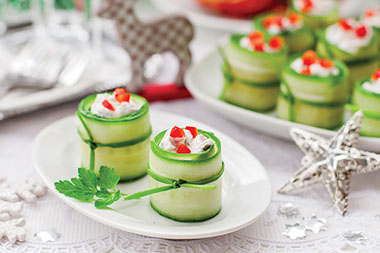
    Image of holiday treat on small plate.

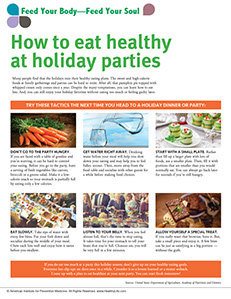
    Many people find that the holidays ruin their healthy eating plans. The sweet and high-calorie foods at family gatherings and parties can be hard to resist. After all, that pumpkin pie topped with whipped cream only comes once a year. Despite the many temptations, you can learn how to eat less. And, you can still enjoy your holiday favorites without eating too much or feeling guilty later.

    Try these tactics the next time you head to a holiday dinner or party:

    Don’t go to the party hungry.If you are faced with a table of goodies and you’re starving, it can be hard to control your eating. Before you go to the party, have a serving of fresh vegetables like carrots, broccoli or a greens salad. Make it a low-calorie snack so your stomach is partially full by eating only a few calories.

    Get water right away.Drinking water before your meal will help you slow down your eating and may help you to feel fuller, sooner. Then, move away from the food table and socialize with other guests for a while before making food choices.

    Start with a small plate.Rather than fill up a larger plate with lots of foods, use a smaller plate. Then, fill it with portions that are smaller than you would normally eat. You can always go back later for seconds if you’re still hungry.

    Eat slowly.Take sips of water with every few bites. Put your fork down and socialize during the middle of your meal. Chew each bite well and enjoy how it tastes before you swallow.

    Listen to your belly.When you feel almost full, that’s the time to stop eating. It takes time for your stomach to tell your brain that you’re full. Chances are, you will be very full in a few minutes.

    Allow yourself a special treat. If you really want that brownie, have it. But, take a small piece and enjoy it. A few bites can be just as satisfying as a big portion – without the guilt.

    If you do eat too much at a party this holiday season, don’t give up on your healthy eating goals. Everyone has slip-ups on diets once in a while. Consider it as a lesson learned or a minor setback. Come up with a plan to eat healthier at your next party. You can start fresh tomorrow!

    Sources: United States Department of Agriculture, Academy of Nutrition and Dietetics

    © American Institute for Preventive Medicine

  • Menu Secrets

    HEALTHY EATING

    Image of women at a resturant talking to the waitor about the menu.

    When dining out, two things that affect your menu choices the most are what you see on the menu and how you imagine it will taste.

    But what you order may have less to do with what you want and more to do with a menu’s layout and descriptions, according to a Cornell study in the International Journal of Hospitality Management.

    First,any food item that attracts attention (with bold, highlighted or colored font or set apart in a text box) makes us more likely to order that food item rather than the item listed next to it. “In most cases, these are the least healthy items on the menu,” said lead author, Brian Wansink, author of Slim by Design: Mindless Eating Solutions for Everyday Life.

    Second,menu names with descriptive items sell better and lead you to believe that they taste better. The researchers cite a study where they changed the names of restaurant menu items to make them more descriptive; the seafood filet became Succulent Italian Seafood Filet and red beans and rice became Cajun Red Beans and Rice. Sales of these items went up by 28%, and they were rated as tastier, even though the recipe was identical. Diners were also willing to pay an average of 12% more money for a menu item with a descriptive name.

    The best solutionto healthier restaurant dining may be an easy one. “Just ask your server,” said Wansink, “Ask, ‘What are your two or three lighter  entrées that get the most compliments?’ or ‘What’s the best thing on the menu if a person wants a light dinner?’”

    Eating Out Tip

    Before you choose restaurants, check out their websites. Read menu options and nutrition information, if provided, to help you make healthy choices. When you are at a restaurant, ask if you can make healthier substitutes, such as having a vegetable in place of French fries.

    © American Institute for Preventive Medicine