Tag: cholesterol

  • Cracking The Benefits Of Eggs

    HEALTHY EATING

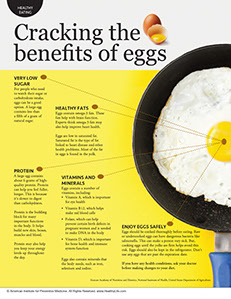
    Image of an egg in a frying pan.

    Very low sugar

    For people who need to watch their sugar or carbohydrate intake, eggs can be a good option. A large egg contains less than a fifth of a gram of natural sugar.

    Protein

    A large egg contains about 6 grams of high-quality protein. Protein can help you feel fuller, longer. This is because it’s slower to digest than carbohydrates.

    Protein is the building block for many important functions in the body. It helps build new skin, bones, muscles and blood.

    Protein may also help you keep your energy levels up throughout the day.

    Healthy fats

    Eggs contain omega-3 fats. These fats help with brain function. Experts think omega-3 fats may also help improve heart health.

    Eggs are low in saturated fat. Saturated fat is the type of fat linked to heart disease and other health problems. Most of the fat in eggs is found in the yolk.

    Vitamins and minerals

    Eggs contain a number of vitamins, including:

    *  Vitamin A, which is important for eye health

    *  Vitamin B12, which helps make red blood cells

    *  Folate, which can help prevent certain birth defects in pregnant women and is needed to make DNA in the body

    *  Vitamin D, which is important for bone health and immune system function

    Eggs also contain minerals that the body needs, such as iron, selenium and iodine.

    Enjoy eggs safely

    Eggs should be cooked thoroughly before eating. Raw or undercooked eggs can have dangerous bacteria like salmonella. This can make a person very sick. But, cooking eggs until the yolks are firm helps avoid this risk. Eggs should also be kept in the refrigerator. Don’t use any eggs that are past the expiration date.

    If you have any health conditions, ask your doctor before making changes to your diet.

    Sources: Academy of Nutrition and Dietetics, National Institutes of Health, United States Department of Agriculture

    © American Institute for Preventive Medicine

  • Go Nuts For A Healthy Heart

    HEALTHY EATING

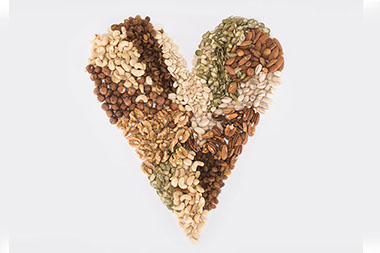
    Variety of nuts shaped into a heart.

    Nuts often get a reputation as being unhealthy. We add them to cookies and ice cream. People eat them by the handful at parties. But do nuts deserve a bad rap?

    Concerns about calories

    For years, many people avoided nuts because they are high in calories and fat. However, newer research finds that nuts can be an important part of a healthy diet. They contain many nutrients needed for body functions.

    The key is to eat nuts in moderation. This means you may need to eat smaller portions. Then, you can avoid eating too many calories from nuts.

    Look at the serving size on a package of nuts to get an idea of how much to eat. One serving may be quite small (2-4 tablespoons).

    Some Fats are Healthy

    Yes, most nuts are high in total fat. But these fats found in nuts actually promote good health! Most are high in healthy monounsaturated or polyunsaturated fats.

    Monounsaturated and polyunsaturated fats can help lower bad cholesterol, which can lower the risk of heart disease and stroke. The American Heart Association recommends people eat more of these fats from healthy sources like nuts and seeds.

    Protein packed

    Nuts are a good source of plant-based protein. Protein is an essential nutrient that the body needs for building muscle, repairing tissues and making hormones.

    It takes longer for the body to digest proteins than carbohydrates. That’s why eating some protein could help you feel less hungry than if you ate only carbohydrates, like crackers or bread.

    The Dietary Guidelines for Americans recommend that people eat healthy sources of protein, like those that come from nuts and seeds, and plant foods.

    Which types to eat

    Of course, there are many different kinds of nuts. Each type tastes different and may contain a variety of nutrients. As long as you’re not coating nuts with sugar and salt, any type can be healthy.

    Take a look at your favorite nut’s nutrition facts and go from there. For instance, macadamia nuts are one of the highest in calories and fat per ounce. But take those calories into account, and eat them instead of chips or cookies.

    Replace unhealthy, processed foods with nuts. You’ll get more nutrients and might even feel more full.

    Sources: Academy of Nutrition and Dietetics, National Institutes of Health, U.S. Department of Agriculture

    © American Institute for Preventive Medicine

  • Control Your Cholesterol & Triglycerides

    Nutrition

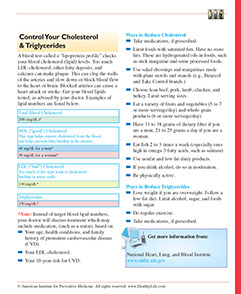
    A blood test called a “lipoprotein profile” checks your blood cholesterol (lipid) levels. Too much LDL-cholesterol, other fatty deposits, and calcium can make plaque. This can clog the walls of the arteries and slow down or block blood flow to the heart or brain. Blocked arteries can cause a heart attack or stroke. Get your blood lipids tested, as advised by your doctor. Examples of lipid numbers are listed below.

    *Note: Instead of target blood lipid numbers, your doctor will discuss treatment which may include medication, (such as a statin), based on:

    *  Your age, health conditions, and family history of premature cardiovascular disease (CVD).

    *  Your LDL-cholesterol.

    *  Your 10-year risk for CVD.

    Ways to Reduce Cholesterol

    *  Take medications, if prescribed.

    *  Limit foods with saturated fats. Have no trans fats. These are hydrogenated oils in foods, such as stick margarine and some processed foods.

    *  Use salad dressings and margarines made with plant sterols and stanols (e.g., Benecol and Take Control brands.)

    *  Choose lean beef, pork, lamb, chicken, and turkey. Limit serving sizes.

    *  Eat a variety of fruits and vegetables (5 to 7 or more servings/day) and whole-grain products (6 or more servings/day).

    *  Have 31 to 38 grams of dietary fiber if you are a man; 21 to 25 grams a day if you are a woman.

    *  Eat fish 2 to 3 times a week (especially ones high in omega-3 fatty acids, such as salmon).

    *  Use nonfat and low-fat dairy products.

    *  If you drink alcohol, do so in moderation.

    *  Be physically active.

    Ways to Reduce Triglycerides

    *  Lose weight if you are overweight. Follow a low-fat diet. Limit alcohol, sugar, and foods with sugar.

    *  Get regular exercise.

    *  Take medications, if prescribed.

    Resources

    National Heart, Lung, and Blood Institute

    www.nhlbi.nih.gov

    Page from Healthier at Home book by the American Institute for Preventive Medicine. www.HealthyLife.com. All rights reserved.

    © American Institute for Preventive Medicine

  • Strategies For Reducing Fats And Cholesterol

    Nutrition

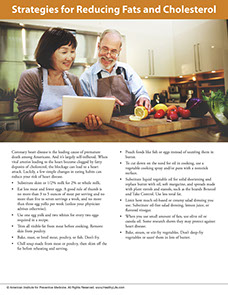
    Image of couple cooking in kitchen.

    Coronary heart disease is the leading cause of premature death among Americans. And it’s largely self-inflicted. When vital arteries leading to the heart become clogged by fatty deposits of cholesterol, the blockage can lead to a heart attack. Luckily, a few simple changes in eating habits can reduce your risk of heart disease.

    *  Substitute skim or 1/2% milk for 2% or whole milk.

    *  Eat less meat and fewer eggs. A good rule of thumb is no more than 3 to 5 ounces of meat per serving and no more than five to seven servings a week, and no more than three egg yolks per week (unless your physician advises otherwise).

    *  Use one egg yolk and two whites for every two eggs required in a recipe.

    *  Trim all visible fat from meat before cooking. Remove skin from poultry.

    *  Bake, roast, or broil meat, poultry, or fish. Don’t fry.

    *  Chill soup made from meat or poultry, then skim off the fat before reheating and serving.

    *  Poach foods like fish or eggs instead of sautéing them in butter.

    *  To cut down on the need for oil in cooking, use a vegetable cooking spray and/or pans with a nonstick surface.

    *  Substitute liquid vegetable oil for solid shortening and replace butter with oil, soft margarine, and spreads made with plant sterols and stanols, such as the brands Benecol and Take Control. Use less total fat.

    *  Limit how much oil-based or creamy salad dressing you use. Substitute oil-free salad dressing, lemon juice, or flavored vinegar.

    *  When you use small amount of fats, use olive oil or canola oil. Some research shows they may protect against heart disease.

    *  Bake, steam, or stir-fry vegetables. Don’t deep-fry vegetables or sauté them in lots of butter.

    Page from A Year of Health Hints book by the American Institute for Preventive Medicine. www.HealthyLife.com. All rights reserved.

    © American Institute for Preventive Medicine

  • Can You Lower Triglycerides Naturally?

    SELF-CARE CORNER

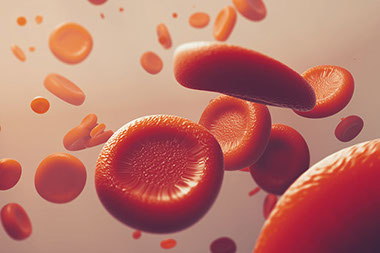
    Illustration of blood cells.

    Triglycerides are a type of lipid, or fat, in your blood. Everyone has some triglycerides. But high triglycerides, when combined with high “bad” cholesterol and low “good” cholesterol, could be bad for heart health.

    How do I know my triglyceride levels?

    High triglycerides have no signs or symptoms. The only way to know whether you have high triglycerides is through a blood test.

    Ask your doctor how often you should get this test. Most adults need a cholesterol or “lipid” test at least every four to six years. But if you have a family history of heart disease or other risk factors, your doctor may recommend the test more often.

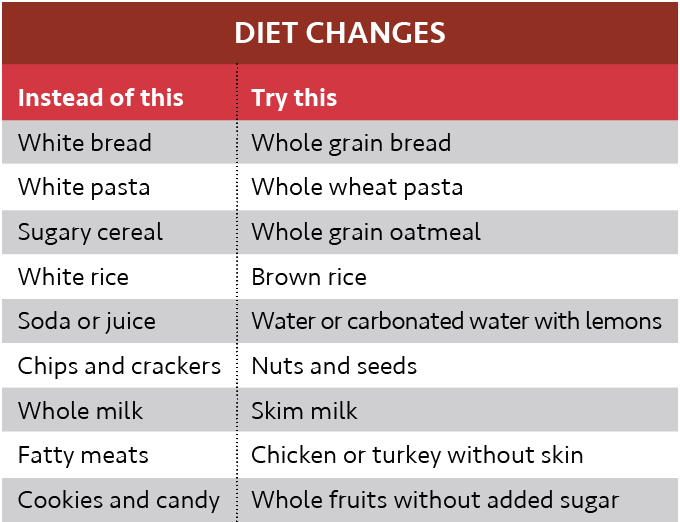
    If your cholesterol tests shows that triglyceride levels are high, you may be able to bring them down by making some lifestyle changes.

    Chart of Diet Changes - Try this instead of this.

    Heart healthy changes are key

    Talk to your doctor about your triglyceride levels. Your doctor may recommend making certain diet and exercise changes to improve your heart health. If you have diabetes, ask your doctor how you can keep blood sugar levels under good control.

    Exercise and weight loss

    Exercise is great for overall health, and it can lower your triglycerides. Try to walk or do another exercise you enjoy for 30 minutes, five days a week.

    Even a small amount of weight loss can improve triglyceride levels. Losing just 5 percent of your weight can boost your health and lower heart disease risk. Ask your doctor or nutritionist for tips on how to lose excess weight.

    Limit or Avoid Alcohol

    Your doctor may also recommend you limit or avoid alcohol to lower your triglyceride levels.

    Prescription Medicine

    In addition to making lifestyle changes, prescription medicines may also be recommended to bring triglycerides down.

    Sources: Centers for Disease Control and Prevention, National Lipid Association

    © American Institute for Preventive Medicine

  • Cholesterol: To Eat Or Not To Eat?

    HEALTHY EATING

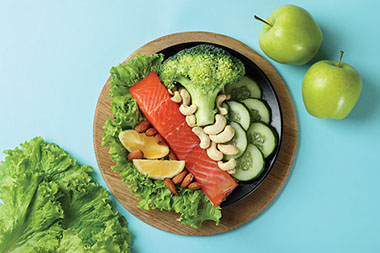
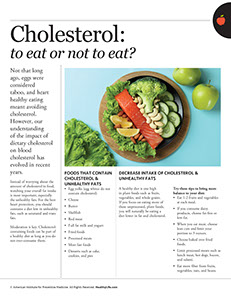
    Bowl with salman, nuts, cucumbers.

    Not that long ago, eggs were considered taboo, and heart healthy eating meant avoiding cholesterol. However, our understanding of the impact of dietary cholesterol on blood cholesterol has evolved in recent years.

    Instead of worrying about the amount of cholesterol in food, watching your overall fat intake is most important, especially the unhealthy fats. For the best heart protection, you should consume a diet low in unhealthy fats, such as saturated and trans fats.

    Moderation is key. Cholesterol-containing foods can be part of a healthy diet as long as you do not over-consume them.

    Foods that contain cholesterol & unhealthy fats

    *  Egg yolks (egg whites do not contain cholesterol)

    *  Cheese

    *  Butter

    *  Shellfish

    *  Red meat

    *  Full fat milk and yogurt

    *  Fried foods

    *  Processed meats

    *  Most fast foods

    *  Desserts such as cake, cookies, and pies

    Decrease intake of cholesterol & unhealthy fats

    A healthy diet is one high in plant foods such as fruits, vegetables, and whole grains. If you focus on eating more of these unprocessed, plant foods, you will naturally be eating a diet lower in fat and cholesterol.

    Try these tips to bring more balance to your diet:

    *  Eat 1-2 fruits and vegetables at each meal.

    *  If you consume dairy products, choose fat-free or low-fat.

    *  When you eat meat, choose lean cuts and limit your portion to 3 ounces.

    *  Choose baked over fried foods.

    *  Limit processed meats such as lunch meat, hot dogs, bacon, and salami.

    *  Eat more fiber from fruits, vegetables, oats, and beans.

    © American Institute for Preventive Medicine

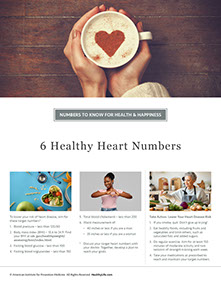
  • 6 Healthy Heart Numbers

    Heart & Circulation Problems

    Women smiling while making hands into a heart shape.

    To lower your risk of heart disease, aim for these target numbers*:

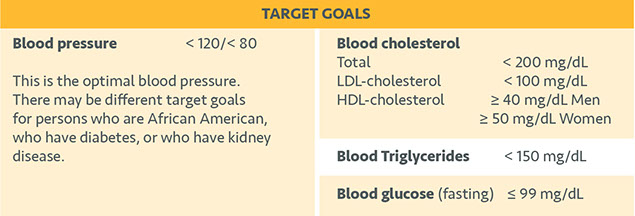
    1.  Blood pressure – less than 120/80

    2.  Body mass index (BMI) – 18.6 to 24.9. Find your BMI atcdc.gov/healthyweight/assessing/bmi/index.html.

    3.  Fasting blood glucose – less than 100

    4.  Fasting blood triglycerides – less than 150

    5.  Total blood cholesterol – less than 200

    6.  Waist measurement of:

    – 40 inches or less if you are a man

    – 35 inches or less if you are a woman

    * Discuss your target heart numbers with your doctor. Together, develop a plan to reach your goals.

    Take Action: Lower Your Heart Disease Risk

    1.  If you smoke, quit. Don’t give up trying!

    2.  Eat healthy foods, including fruits and vegetables and limit others, such as saturated fats and added sugars.

    3.  Do regular exercise. Aim for at least 150 minutes of moderate activity and two sessions of strength training each week.

    4.  Take your medications as prescribed to reach and maintain your target numbers.

    Health at Home Lifetime book by the American Institute for Preventive Medicine. www.HealthyLife.com. All rights reserved.

    © American Institute for Preventive Medicine

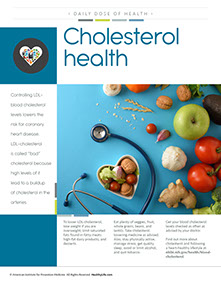
  • Cholesterol Health

    Heart & Circulation Problems

    Heart shape plate filled with walnuts, tomatoes, apple, garlic, etc.

    Controlling LDL-blood cholesterol levels lowers the risk for coronary heart disease. LDL-cholesterol is called “bad” cholesterol because high levels of it lead to a buildup of cholesterol in the arteries.

    To lower LDL-cholesterol, lose weight if you are overweight; limit saturated fats found in fatty meats high-fat dairy products, and desserts.

    Eat plenty of veggies, fruit, whole grains, beans, and lentils. Take cholesterol lowering medicine as advised. Also, stay physically active, manage stress, get quality sleep, avoid or limit alcohol, and quit tobacco.

    Get your blood cholesterol levels checked as often as advised by your doctor.

    Find out more about cholesterol and following a heart-healthy lifestyle atnhlbi.nih.gov/health/blood-cholesterol.

    Health at Home Lifetime book by the American Institute for Preventive Medicine. www.HealthyLife.com. All rights reserved.

    © American Institute for Preventive Medicine

  • Heart Disease

    Heart & Circulation Problems

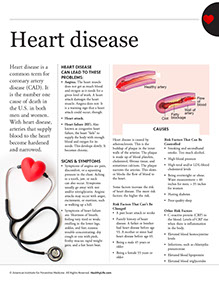
    Heart disease is a common term for coronary artery disease (CAD). It is the number one cause of death in the U.S. in both men and women. With heart disease, arteries that supply blood to the heart become hardened and narrowed. Heart disease can lead to these problems:

    *  Angina. With this, the heart muscle does not get as much blood and oxygen as it needs for a given level of work. A heart attack damages the heart muscle. Angina does not. It is a warning sign that a heart attack could occur, though.

    *  Heart attack.

    *  Heart failure (HF). With this, the heart “fails” to supply the body with enough blood and oxygen for its needs. This develops slowly. It becomes chronic.

    Signs & Symptoms

    *  Symptoms of angina are pain, discomfort, or a squeezing pressure in the chest. Aching in a tooth, jaw, or neck can also occur. Symptoms usually go away with rest and/or nitroglycerin. Angina attacks may occur with anger, excitement, or exertion, such as walking up a hill.

    *  Symptoms of a heart attack.

    *  Symptoms of heart failure are: Shortness of breath; feeling very tired or weak; swelling in the lower legs, ankles, and feet; dry cough or one with pink, frothy mucus; rapid weight gain; and a fast heart beat.

    Causes

    Illustration of healthy artery vs a clogging artery.

    Heart disease is caused by atherosclerosis. This is the buildup of plaque in the inner walls of the arteries. The plaque is made up of blood platelets, cholesterol, fibrous tissue, and sometimes calcium. The plaque narrows the arteries. This slows or blocks the flow of blood to the heart.

    Some factors increase the risk of heart disease. The more risk factors; the higher the risk.

    Risk Factors That Can’t Be Changed

    *  A past heart attack or stroke.

    *  Being a male 45 years or older.

    *  Being a female 55 years or older.

    *  Family history of heart disease:

    – A father or brother had heart disease before age 55.

    – A mother or sister had heart disease before age 65.

    Risk Factors That Can Be Controlled

    *  High blood pressure.

    *  High-risk blood cholesterol levels.

    *  Smoking.

    *  Being overweight or obese.

    *  Lack of physical activity.

    *  Having diabetes and high total and/or LDL (bad) cholesterol.

    *  Using cocaine or amphetamines.

    *  Metabolic syndrome.

    Other Factors that May Play a Role in Heart Disease

    *  Waist measurement > 40 inches for men; > 35 inches for women.

    *  C-reactive protein (CRP) in the blood. Levels of CRP rise when there is inflammation in the body.

    *  Elevated blood homocysteine levels.

    *  Infections, such as chlamydia pneumoniae.

    *  Elevated blood lipoprotein (a).

    *  Elevated blood triglycerides.

    Treatment

    The goals of treatment are to relieve symptoms, control or reduce risk factors, stop or slow further damage to the arteries, and prevent and treat cardiac events. Treatment includes:

    *  Self-Care / Prevention measures on this page.

    *  Medications.

    *  Procedures to open blocked or narrowed arteries or bypass them.

    *  Cardiac rehabilitation (rehab).

    Questions to Ask

    Self-Care / Prevention

    *  Have regular medical checkups. Get your blood pressure checked at each office visit or or as advised by your doctor. Get your blood cholesterol tested regularly, as advised by your doctor.

    *  Don’t smoke. If you smoke, quit.

    *  Get to or stay at a healthy weight.

    *  Take all medications as prescribed.

    *  If you are 50 to 69 years old, ask your doctor about the benefits and harms of aspirin therapy (e.g., 1 low-dose aspirin daily) to help prevent cardiovascular disease.

    *  See your doctor if you have any of the Signs & Symptoms of Diabetes.

    *  Follow a diet low in saturated fats, trans fats, and cholesterol. Limit sodium to 1,500 to 2,400 milligrams per day. Follow theDASH Eating Plan.

    *  Get regular exercise. Follow your doctor’s advice.

    *  Manage stress. Practice relaxation techniques.

    *  If you drink alcohol, do so in moderation. Too much alcohol can raise the risk for high blood pressure, heart disease, stroke, and other health problems. Moderate drinking, may be linked to a lower risk of coronary heart disease in some persons. Moderation means no more than 2 drinks a day for men; 1 drink a day for women and persons age 65 and older. One drink = 5 oz. of wine; 12 oz. of beer; or 1-1/2 oz. of 80-proof liquor.

    *  Ask your doctor how much, if any, alcohol you should drink.

    *  Get your doctor’s advice about taking vitamins, minerals, and herbal products.

    Metabolic Syndrome

    Metabolic Syndrome is having at least three of these five conditions:

    1.  Abdominal obesity. Waist measurement for this varies according to sex and ethnic group. Ask your doctor.

    2.  High triglycerides:* ≥ 150 mg/dL

    3.  Low HDL-cholesterol:* < 40 mg/dL for males; < 50 mg/dL for females

    4.  High blood pressure:* ≤ 140 mm Hg systolic and/or ≤ 90 mm Hg diastolic

    5.  High fasting glucose:* ≥ 100 mg/dL

    * Or taking medication to treat this condition.

    Resources

    The American Heart Association

    800.AHA.USA1 (242.8721)

    www.heart.org/HEARTORG

    National Heart, Lung, and Blood Institute (NHLBI)

    www.nhlbi.nih.gov

    Healthier at Home book by the American Institute for Preventive Medicine. www.HealthyLife.com. All rights reserved.

    © American Institute for Preventive Medicine

  • Know Your Health Numbers

    General Health Conditions

    Stethoscope shaped into a heart.

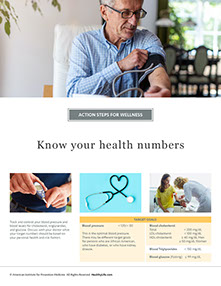
    Track and control your blood pressure and blood levels for cholesterol, triglycerides, and glucose. Discuss with your doctor what your target numbers should be based on your personal health and risk factors.

    Health at Home Lifetime book by the American Institute for Preventive Medicine. www.HealthyLife.com. All rights reserved.

    © American Institute for Preventive Medicine