Tag: claims

  • Collecting Unclaimed Funds

    FINANCIAL HEALTH

    Young couple holding a jar with money in it.

    Could you have money waiting for you? Learn about unclaimed money or property from bank accounts, tax refunds, insurance policies or wages and pensions.

    You can find your unclaimed money for free. Here’s how:

    *  Search in every state where you have lived. Look up each state’s unclaimed property office. You can also try contacting the state treasurer’s office.

    *  Search the FDIC database. If your bank or credit union closed, you could have unclaimed deposits. You can also check out the National Credit Union Administration (NCUA) atwww.ncua.gov/support-services.

    *  Current or former VA life insurance holders can check for unclaimed life insurance funds. Go toinsurance.va.gov/UnclaimedFunds.

    *  Look for tax refunds from an FHA-insured mortgage. If you earned income but your wages were below the tax filing requirement, you might have a refund waiting. Go toirs.gov/refunds to check. If you bought mortgage insurance from the Federal Housing Administration (FHA), you might have a refund. Go toentp.hud.gov/dsrs/refunds.

    *  Do you have unclaimed back wages or pension money from a past employer? Go to the Workers Owed Wages (WOW) website atwebapps.dol.gov/wow. You can also check the Pension Benefit Guaranty Corporation atpbgc.gov.

    Notice that these websites include “gov.” They don’t have a “com” or “org.” The “gov” means it’s an official U.S. Government website. You should never have to pay any money to find or claim your unclaimed money. It’s FREE. Watch out for scammers and people who want to charge you for this service.

    Source: usa.gov

    © American Institute for Preventive Medicine

  • Know Your Rights With Rebates

    FINANCIAL HEALTH

    Person holding a bag of gifts.

    The holiday shopping season is here, and with it comes big sales and big purchases. Some stores and companies advertise big rebate offers to get you to buy. These offers may promise you a certain amount of money back, either immediately or after you send in a form.

    Usually, you buy the item, fill out and send in some paperwork, and wait for the rebate money to come in the mail. You probably need the sales receipt, a form and the packaging from the item. Sometimes you get a rebate within a month, but many rebates take longer – up to 12 weeks.

    The Federal Trade Commission says people should beware of rebates that take too long to show up – or never come at all. Companies are required by law to send the rebate within the promised timeframe. If there’s no timeframe listed, the timeframe is usually 30 days.

    Follow these tips if you buy a product with a rebate:

    *  Make sure you follow all the steps on the rebate form. Enclose all of the required paperwork.

    *  Make a copy of all your paperwork. You’ll want these records if your rebate doesn’t show up or if there’s a problem.

    *  Keep track of the date you sent the rebate. Contact the company if your rebate doesn’t show up when they promised it.

    If your rebate is late or never shows up, you can file a complaint. Contact the Federal Trade Commission, your state Attorney General or your local Better Business Bureau.

    © American Institute for Preventive Medicine

  • Disability Insurance

    Medical Care

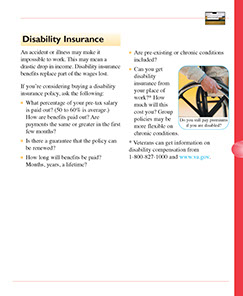
    Image of nurse with wheelchair bound women.

    An accident or illness may make it impossible to work. This may mean a drastic drop in income. Disability insurance benefits replace part of the wages lost.

    If you’re considering buying a disability insurance policy, ask the following:

    *  What percentage of your pre-tax salary is paid out? (50 to 60% is average.) How are benefits paid out? Are payments the same or greater in the first few months?

    *  Is there a guarantee that the policy can be renewed?

    *  How long will benefits be paid? Months, years, a lifetime?

    *  Are pre-existing or chronic conditions included?

    *  Can you get disability insurance from your place of work?* How much will this cost you? Group policies may be more flexible on chronic conditions.

    * Veterans can get information on disability compensation from 1-800-827-1000 andwww.va.gov.

    Page from the Health at Home Lifetime book by the American Institute for Preventive Medicine. www.HealthyLife.com. All rights reserved.

    © American Institute for Preventive Medicine

  • Save If You Have Insurance

    Medical Care

    Image of doctor and piggy bank.

    Know health insurance terms and plans.

    This allows you to make wise choices. Read “Questions and Answers About Health Insurance – A Consumer Guide” fromwww.ahrq.gov/consumer/insuranceqaandwww.healthdecisions.org.

    If you can get health insurance through work, do it.

    More often than not, it will cost you less than if you buy it on your own. If you can choose from more than one plan, compare the options. The best deal may not be the cheapest plan. It is the one that gives the best price for the benefits you need and are most likely to use. If you need help to understand the options, ask your employer. Get facts from the insurance company’s Web site and/or customer service representative, too.

    Raise your deductible.

    Your deductible is the amount you must pay before your health insurance kicks in. Like car insurance, monthly premiums cost less if you pay a higher deductible. Healthy adults can usually save money with this option.

    Check into a Consumer Driven Health Plan.

    This gives you greater control over how you use your health care benefits. You pay a high deductible. You pay for your health care costs from a tax-exempt health account. If you expect to be healthy, this may be a good choice for you.

    Read your health plan.

    Read what products and services are covered before you pay for them on your own. Take advantage of covered services, such as dental checkups and cleanings twice a year. You may find out that your health plan covers some of the costs for flu vaccines and other services.

    Student health insurance.

    Find out about student health insurance from your child’s school or college, especially if your child plans to study abroad.

    Be Medicare aware.

    Medicare is the U.S. government’s health insurance for persons age 65 or older. It also covers people under age 65 who have disabilities. Find out when you will be eligible for Medicare fromwww.medicare.govor by calling 800.MEDICARE (633.4227).

    *  When you are enrolled in Medicare, you get Medicare Part A. This covers medical costs when you are in the hospital.

    *  Medicare Part B covers things that  Part A does not. Examples are doctors’ fees, outpatient hospital costs, physical therapy, etc. You pay a monthly premium for this.

    *  Medicare Part D helps cover the cost of prescribed medicines.

    Fill in the gaps.

    Find ways to pay for services not covered by your insurance plan.

    *  If you have Medicare, you can buy Medigap, Medicare Select, or Medicare Advantage HMO insurance to help pay for services not covered by Medicare. Contact your state health insurance department to find out about your choices for each of these health plans. You need only one of these. For free help choosing a Medicap policy, call your State Health Insurance Assistance Program.

    *  Look into extra coverage from providers, such as Aflac.

    Pay premiums on time.

    If you don’t, your coverage could be cancelled.

    Know about COBRA.

    This stands for Consolidated Omnibus Budget Reconciliation Act. COBRA is temporary health insurance. It applies to former employees, retirees, spouses, former spouses, and dependent children who are no longer covered under an employer health insurance plan. It lets you keep the same health insurance for 18 months (sometimes longer) if you pay for it yourself. Find out more about COBRA fromwww.dol.gov/dol/topic/health-plans/cobra.htm. Know, too, that it may cost you less to buy your own health insurance than to pay what COBRA will cost you, especially if you are in good health and have no pre-existing health problems.

    Find out who to contact when the insurance company denies a claim.

    Sometimes claims are rejected by mistake. When this happens, you can usually clear up the mistake by calling or writing a letter to your insurance company. Keep copies of all bills, letters, and notes from phone calls. Put your policy and claim numbers on all letters or e-mails. Call your insurance company if you don’t get an answer within a few weeks.

    Keep up-to-date.

    Find out how you learn about updates and changes in your health plan. Do you get notified by mail or by e-mail? Do you need to check the health plan’s Web site? How do you add a new dependent to the plan? Also, find out when you can change the plan you have. Often, you can only do this during open enrollment.

    Know before you go.

    Call your health insurance company before you have a medical service. Some services are only covered if the insurance company approves them first and/or if they are done at certain locations or by certain providers.

    One may be enough.

    If both you and your spouse both have health insurance through work, choose the plan that works best. Decide if it is better to keep separate plans or if it would cost less for either of you to join the other’s plan. Your employer may let you take cash or other benefits instead of health insurance. Keep the better policy if you can and “cash in” on the other one. Also, find out which policy covers your children better. Think about future needs, too. For prenatal and delivery costs to be covered, a woman may need to be a member of the plan for nine or more months before she gets pregnant.

    Take advantage of FSAs.

    Find out if your employer offers a Flexible Spending Account (FSA). This lets you set aside some money for medical expenses for the year. You could choose to set aside $1,000. This is usually taken out of your paycheck, but you don’t pay federal income tax or Social Security tax on this money. But be careful how much you put into your FSA. You lose any money you don’t spend on health care in the year. Look at last year’s health care expenses for a ballpark figure on what you think you will likely spend. Don’t count any money that is taken from your paycheck for insurance premiums. Do count deductibles, co-pays, and treatments your insurance doesn’t cover.

    Use it before you lose it!

    If you are going to lose your health insurance, you are part of a growing trend in the U.S. Schedule doctor visits and other health care services before expenses will no longer be covered.

    Before you travel, check out your health insurance coverage.

    Are you covered where you are going? If not, ask your health insurance provider how to get coverage while you are gone. You can also find out about travel health insurance fromwww.travelrinsurance.com.


    Cover image to the Healthy Savings book by the American Institute for Preventive Medicine. www.HealthyLife.com. All rights reserved.

    © American Institute for Preventive Medicine

  • Be A Wary Weight Loss Consumer

    Healthylife® Weigh

    Part 7

    Pills in glasses with tape measure.

    Be wary of miracle pills and quick fixes, even if offered by a “doctor” or someone claiming to be an expert. At many commercial weight loss centers, the staff may not have medical credentials or any advanced training in nutrition. They are often salespeople calling themselves “counselors,” without any medical training. Be wary of any center that pushes products and supplements over real food.

    Avoid injections or pills that advertise being able to block certain nutrients, like fat or carbohydrates. Avoid “fat burners” and anything claiming to target specific parts of your body for fat loss. These are likely a waste of money and can be dangerous.

    Having someone create your meal plan for you may help you get started, but be sure to learn how to do it yourself. Learn to make your own healthy choices. Avoid weight loss programs and schemes that encourage dependence on special products.

    © American Institute for Preventive Medicine

  • Look Past Advertising

    Healthylife® Weigh

    Part 3

    Man grocery shopping.

    Advertising can help point out healthy qualities in a food or drink. Advertising can also distract you from less healthy ingredients and nutrition facts. Check the nutrition facts and ingredients list to get the real scoop on what’s in the product. The drawbacks may outweigh the benefits advertised on the package.

    “Made With…”Example: Whole Grains, Real Fruit

    What it Means: At one point, the real ingredient (e.g., whole grain, fruit) was part of the product. That ingredient may have been processed further, causing it to lose nutrients. This claim does not tell you anything about how much of the whole food is in the end product.

    “Sugar Free”

    What it Means: A sugar free food has less than 0.5 grams of sugar per serving. What is in the food is more important than what the food is claiming to be free from. Check to see if extra saturated fat or artificial sweeteners have been added to make up for taste. Avoid foods high in saturated fat or foods containing artificial sweeteners.

    “Fat Free”

    What it Means: This food contains less than 0.5 grams of fat per serving (of any kind). If a food is fat free, make sure sugars or starches haven’t been added to replace the flavor and structure that fat gives food. Remember, unsaturated fat is an important part of a healthy diet and helps keep you feeling full.

    “Contains…”Example: Whole Grains, Real Fruit

    What it Means: This product contains some amount of this ingredient, but that amount may be very small. For example, a fruit drink that “contains real fruit” may be 10% real fruit juice and 90% added water and sugar. If you want more of the ingredient, like a whole grain or fruit, look for it to appear high on the list of ingredients.

    “Contains Zero Trans Fat”

    What it Means: There is no safe amount of trans fats, but a food label can say it contains zero trans fats if the trans fat content is below 0.5 grams per serving. To find trans fats, you will need to look at the ingredients. Avoid ingredients that are “hydrogenated” or “partially hydrogenated.”

    Organic, Grass-Fed, Cage-Free, Free-Range, Non-GMO

    Learn more about these marketing claims and labeling standards inPart 7of this guide.

    © American Institute for Preventive Medicine

  • Apple Cider Vinegar: A Miracle Cure?

    HEALTHY EATING

    Image of apple cider vinegar.

    The belief that apple cider vinegar is a “cure-all” has been circulating in recent years on numerous websites and promoted by natural health groups. But, can it really cure diseases and keep you healthy?

    Some say apple cider vinegar helps you lose weight, control blood sugar and improve digestion. Unfortunately, these health claims have not been proven by any valid research study. And, using it in place of medications or healthy lifestyle changes can be downright dangerous.

    In addition, people with heartburn or gastroesophageal reflux disease (GERD) may find that vinegar actually makes their reflux worse. Drinking too much of it can also damage tooth enamel.

    The bottom line: Most healthy people can enjoy apple cider vinegar in food without any problems. But, don’t use it, or any natural remedy, to cure diseases. Always ask your doctor before you try any natural remedy or supplement to be sure it’s safe for you.

    © American Institute for Preventive Medicine