Tag: clarity

  • Move For Mental Health

    BE FIT

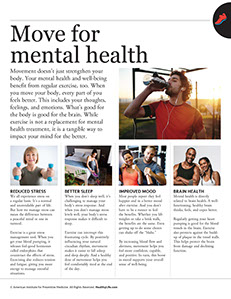
    Man in workout clothes, drinking water with headphones on.

    Movement doesn’t just strengthen your body. Your mental health and well-being benefit from regular exercise, too. When you move your body, every part of you feels better. This includes your thoughts, feelings, and emotions. What’s good for the body is good for the brain. While exercise is not a replacement for mental health treatment, it is a tangible way to impact your mind for the better.

    Reduced stress

    We all experience stress on a regular basis. It’s a normal and unavoidable part of life. But how we manage stress can mean the difference between a peaceful mind or one in turmoil.

    Exercise is a great stress management tool. When you get your blood pumping, it releases feel-good hormones called endorphins that counteract the effects of stress. Exercising also reduces tension and fatigue, giving you more energy to manage stressful situations.

    Better sleep

    When you don’t sleep well, it’s challenging to manage your body’s stress response. And when you don’t manage stress levels well, your body’s stress response makes it difficult to sleep.

    Exercise can interrupt this frustrating cycle. By positively influencing your natural circadian rhythm, movement makes it easier to fall asleep and sleep deeply. And a healthy dose of movement helps you feel comfortably tired at the end of the day.

    Improved mood

    Most people report they feel happier and in a better mood after exercise. And you don’t have to be a runner to feel the benefits. Whether you lift weights or take a brisk walk, the benefits are the same. Even getting up to do some chores can shake off the “blahs.”

    By increasing blood flow and alertness, movement helps you feel more confident, capable, and positive. In turn, this boost in mood supports your overall sense of well-being.

    Brain Health

    Mental health is directly related to brain health. A well-functioning, healthy brain thinks, feels, and copes better.

    Regularly getting your heart pumping is good for the blood vessels in the brain. Exercise also protects against the build-up of plaque in the vessel walls. This helps protect the brain from damage and declining function.
    © American Institute for Preventive Medicine
  • How Aging Affects The Eyes

    Eye Conditions

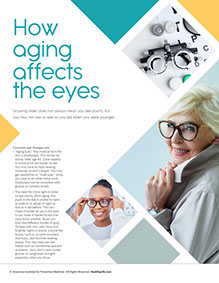
    Growing older does not always mean you see poorly. But you may not see as well as you did before. Common changes that affect your eyes are:

    *  “Aging Eyes.” The medical term for this is presbyopia (prez-bee-OH-pea-ah). This comes on slowly after age 40. Close objects or small print are harder to see. You may have to hold reading materials at arm’s length. You may get headaches or “tired eyes” while you read or do other close work. Presbyopia can be corrected with glasses or contact lenses.

    *  The need for more light in order to see clearly. With aging, the pupil in the eye is unable to open as wide or to adapt to light as fast as it did before. This can make it harder to see in the dark. It can make it harder to tell one color from another. Blues can look like different shades of gray. To help with this, add more and brighter lights in places around the house, such as at work counters, stairways, and favorite reading places. This may help you see better and can sometimes prevent accidents. Also, don’t wear tinted glasses or sunglasses at night, especially when you drive.

    Signs & Symptoms and What It Could Be

    Signs & Symptoms: Sudden loss of all or part of vision, especially in one eye with sudden weakness or numbness on one side.

    What It Could Be: Stroke

    What to Do: Get immediate care. Call 9-1-1.

    Signs & Symptoms: Vision loss after head or eye injury. Sudden vision loss or blurred vision, and seeing dark spots, or flashes of light all of a sudden.

    What It Could Be: Detached or torn retina.

    What to Do: Get immediate care.

    Signs & Symptoms: Severe pain in and above the eye. Eye redness, swollen upper eyelid. Dilated and fixed pupil. Very blurred vision, halos around lights.

    What It Could Be: Angle-closure glaucoma.

    What to Do: Get immediate care.

    Signs & Symptoms: Object or chemical in the eye.

    What It Could Be: Eye irritation or injury.

    See “Eye Irritations & Injuries” for more information.

    Signs & Symptoms: Gradual loss of side vision. Blurred vision. Halos around lights. Poor night vision.

    What It Could Be: Open-angle or chronic glaucoma.

    See “Glaucoma” for more information.

    Signs & Symptoms: Dark or blind spot in center of vision. Blurred or cloudy vision. Straight lines look wavy.

    What It Could Be: Macular degeneration.

    See “Macular Degeneration” for more information.

    Signs & Symptoms: Cloudy, fuzzy, foggy, or filmy vision. Halos around lights. Problems with glare from lamps or the sun.

    What It Could Be: Cataract.

    See “Cataracts” for more information.

    Signs & Symptoms: Pus discharge from the eye; the white of the eye and eyelid are red; crusting of the eyelid in the morning; feeling of sand in the eye

    What It Could Be: Conjunctivitis (“Pink Eye”).

    See “Conjunctivitis (Pink Eye)” for more information.

    Signs & Symptoms: Firm lump on eyelid or tender pimple on the edge of the eyelid.

    What It Could Be: Stye.

    See “Stye” for more information.

    Signs & Symptoms: Seeing spots, specks, wavy lines, or streaks of light.

    What It Could Be: Floaters and/or flashes.

    See “Floaters and/or flashes” for more information.

    Signs & Symptoms: Blurred vision when you look at close objects; headaches; eyestrain.

    What It Could Be: “Aging Eyes” or presbyopia.

    What to Do: Call eye doctor for an appointment and advice.

    Health at Home Lifetime book by the American Institute for Preventive Medicine. www.HealthyLife.com. All rights reserved.

    © American Institute for Preventive Medicine
  • Help For Hearing Loss

    Mature Health: Over Age 50

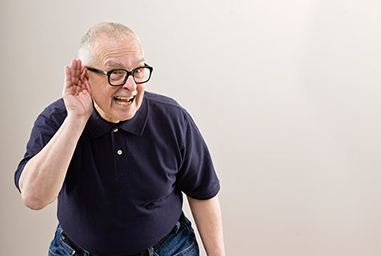
    Image of mature man with hand up to his ear trying to hear.

    Do people seem to mumble a lot lately? Do you have trouble hearing in church or theaters? Do you lose the thread of conversation at the dinner table or at family gatherings? Does your family repeatedly ask you to turn down the volume on the TV or radio?

    These are signs of gradual, age-related hearing loss called presbycusis. High-pitched sounds are especially difficult to discern. Another way to detect this problem is to hold a watch to your ear. If you can’t hear it ticking, see an otolaryngologist (a physician who treats disorders of the ear, nose, and throat) or an otologist (a physician who specializes in ear disorders).

    You should also get help if one or both ears ring continuously, or if loud noises cause pain in your ears.

    Hearing loss from presbycusis cannot be restored, but hearing aids. along with the following self-help methods, are helpful.

    *  Ask people to speak clearly, distinctly, and in a normal tone.

    *  Look at people when they are talking to you. Watch their expressions to help you understand what they are saying. Ask them to face you.

    *  Try to limit background noise when having a conversation.

    *  In a church or theater, sit near, but not in the front row. Sit in the third or fourth row with people sitting around you.

    *  To rely on sight instead of sound, install a buzzer, flasher, or amplifier on your telephone, door chime, and alarm clock.

    Also, an audiologist (hearing therapist) may be able to show you other techniques for “training” yourself to hear better.

    A Year of Health Hints book by the American Institute for Preventive Medicine. www.HealthyLife.com. All rights reserved.

    © American Institute for Preventive Medicine
  • Practice Assertiveness

    Healthylife® Weigh

    Part 4

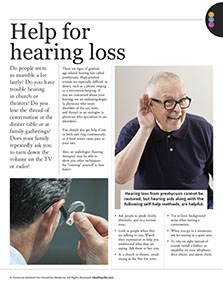
    Group friends enjoying a meal at home.

    Practice responding to common scenarios. Below are sample responses to a few statements and situations.

    “One piece of chocolate cake won’t hurt you.”

    You’re right, but a whole cake of pieces will! Since I’m not eating chocolate cake as often, I’ll enjoy a couple of bites with you. -OR-  I’m not eating chocolate cake as often. I’ll have a piece another time.

    “I made it just for you.”

    Wow, I really appreciate you thinking of me! I’m cutting back on how much I eat that treat right now. Can I have just a taste?

    “What’s the matter? Don’t you like it?”

    I am enjoying it, but since I’m changing how I eat, I’m eating the amount that’s just right for me.

    “You’ve been on every diet there is. This one won’t work either.”

    I appreciate your concern for my success, but this time my goal is a healthy lifestyle change and the weight loss is secondary. I’m doing things differently this time.

    Someone takes you on a “surprise” trip to the ice cream parlor.

    What a surprise! I’m going to enjoy a kiddie-size ice cream. Next time, maybe we could go for a walk, go someplace different, etc.

    Someone asks you to do something during planned physical activity time.

    Thanks for the invite, but I have plans to go to the gym today. How about we take a look at our schedules and find a time that works for both of us to do something in the future. Or, would you like to join me?

    You look great! You don’t need to change anything you’re doing!

    Thanks for the compliment! But, I want to look and FEEL my best so it’s important for me to keep implementing healthier lifestyle choices for myself.

    © American Institute for Preventive Medicine

  • Tips For Rational Thinking

    Healthylife® Weigh

    Part 4

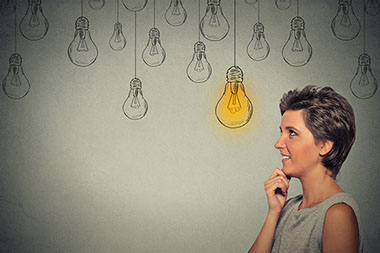
    Concept of women thinking with drawing of lightbulbs.

    Use these tips to decide if an alternate thought is helpful for problem-solving. You can allow your thoughts and actions to cause anxiety. Or, you can view them as part of everyday life choices that you can manage.

    1. Ask: Is your thought based on facts?

    2. Identify what you are trying to do. Know your purpose.

    3. Consider many different outcomes and their effects.

    4. View the situation from many perspectives.

    5. Don’t assume a situation will have the same outcome as it did in the past.

    6. Have good evidence for a generalization before you make it.

    7. Avoid assuming one event caused another just because they happened at the same time.

    © American Institute for Preventive Medicine
  • Exercise Is Healthy For Your Mind

    BE FIT

    Image of older Asian couple brisk walking.

    Regular exercise offers many health benefits. You may already know it helps you stay strong and healthy, and can help you lose weight. It can also help prevent heart disease, diabetes, arthritis, and other diseases. But exercise is doing good for another vital organ in your body: your brain.

    Studies are now showing that regular aerobic exercise can help your brain work better. This includes:

    * Better memory

    * Ability to switch tasks

    * Ability to plan activities and stay organized

    * Possible reduced risk of Alzheimer’s disease

    Although researchers don’t know exactly why exercise helps the mind, there are some possibilities. It increases blood supply to the brain, and helps it form connections. These connections are responsible for forming memories and thinking about future activities. Exercise also improves an area of the brain that remembers and learns.

    Source: National Institute on Aging

    © American Institute for Preventive Medicine