Tag: clot

  • Heart Attack

    First Aid

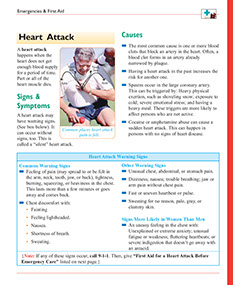
    A heart attack happens when the heart does not get enough blood supply for a period of time. Part or all of the heart muscle dies.

    Signs, Symptoms & Causes
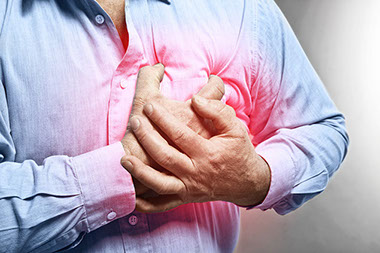
    Close up image of man holding chest in pain.

    A heart attack may have warning signs. It can occur without signs, too. This is called a “silent” heart attack.

    Causes

    *  The most common cause is one or more blood clots that block an artery in the heart. Often, a blood clot forms in an artery already narrowed by plaque.

    *  Having a heart attack in the past increases the risk for another one.

    *  Spasms occur in the large coronary artery. This can be triggered by: Heavy physical exertion, such as shoveling snow; exposure to cold; severe emotional stress; and having a heavy meal. These triggers are more likely to affect persons who are not active.

    *  Cocaine or amphetamine abuse can cause a sudden heart attack. This can happen in persons with no signs of heart disease.

    Warning Signs

    Note: If any of these signs occur, call 9-1-1.

    Common Warning Signs

    *  Feeling of pain (may spread to or be felt in the arm, neck, tooth, jaw, or back), tightness, burning, squeezing, or heaviness in the chest. This lasts more than a few minutes or goes away and comes back.

    *  Chest discomfort with:

    – Fainting

    – Feeling lightheaded.

    – Nausea.

    – Shortness of breath.

    – Sweating.

    Other Warning Signs

    *  Unusual chest, abdominal, or stomach pain.

    *  Dizziness; nausea; trouble breathing; jaw or arm pain without chest pain.

    *  Fast or uneven heartbeat or pulse.

    *  Sweating for no reason, pale, gray, or clammy skin.

    Signs More Likely in Women Than Men

    An uneasy feeling in the chest with: Unexplained or extreme anxiety; unusual fatigue or weakness; fluttering heartbeats; or severe indigestion that doesn’t go away with an antacid.

    Treatment

    A heart attack is a medical emergency! Treatment works best when it is given within 1 to 2 hours after symptoms start. Treatment includes:

    *  Medicine(s) to keep blood from clotting.

    *  “Clot busters” to dissolve blood clots in heart arteries.

    *  Tests to diagnose the status of the heart and arteries.

    *  Angioplasty, stents, or bypass surgery, if needed.

    Prevention

    *  Follow prevention measures in Heart Disease.

    *  Take medications, as prescribed.

    *  Don’t shovel snow or carry heavy objects, especially if you are not physically fit.

    *  Don’t use amphetamines and/or cocaine.

    Questions to Ask

    Self-Care / Prevention

    Call 9-1-1 or your local rescue squad right away! Call when warning signs start. Don’t wait to see if the pain goes away.

    First Aid for a Heart Attack Before Emergency Care

    *  CHECK for a response. Do CPR, as needed.

    *  If the person uses and has nitroglycerin, place one tablet under the tongue. Give as many as 3 tablets in 10 minutes.

    *  Give the person a regular (325 mg.) aspirin or 4 children’s chewable aspirins (81 mg. each) to chew on. Give the aspirin after calling 9-1-1. Ask the 9-1-1 dispatcher if aspirin should be taken.

    {Note: Don’t use aspirin if the person is allergic to it or has a condition that makes using it risky.}

    *  If you can’t call 9-1-1, drive the person to the hospital right away. If you are having heart attack signs, don’t drive yourself unless you have no other choice.

    *  Loosen clothing around the neck, chest, and waist. Don’t let the person lie down, especially if he or she has breathing problems. A half-sitting position is better. Put the legs up. Bend them at the knees. Put a pillow or rolled towel under the knees. Support the back.

    *  Reassure the person that you have called for medical help and will stay with him or her until it arrives.

    *  After a heart attack, follow the doctor’s treatment plan.
    Healthier at Home book by the American Institute for Preventive Medicine. www.HealthyLife.com. All rights reserved.

    © American Institute for Preventive Medicine
  • Phlebitis & Thrombosis

    Heart & Circulation Problems

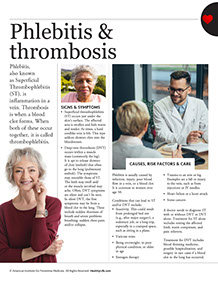
    Phlebitis is inflammation in a vein. Thrombosis is when a blood clot forms. When both of these occur together, it is called thrombophlebitis.

    Signs & Symptoms

    *  Superficial phlebitis (SP) occurs just under the skin’s surface. The affected area is swollen and feels warm and tender. At times, a hard ropy vein is felt. This type seldom showers clots into the bloodstream.

    *  Deep-vein thrombosis (DVT) occurs within a muscle mass (commonly the leg). It is apt to release showers of clots (emboli) that often go to the lung (pulmonary emboli). The symptoms may resemble those of SP; the limb may swell and/or the muscle involved may ache. Often, DVT symptoms are silent and can’t be seen. In silent DVT, the first symptoms may be from a blood clot to the lung. These include sudden shortness of breath and severe problems breathing; sudden chest pain; and/or collapse.

    Causes, Risk Factors & Care

    Phlebitis is usually caused by infection, injury, or poor blood flow in a vein. It is common in women over age 50. Conditions that can lead to SP and/or DVT include:

    *  Inactivity. This could result from prolonged bed rest, a sedentary job, or a long trip, especially in a cramped space, such as sitting in the economy class section of a plane.

    *  Varicose veins

    *  Being overweight, in poor physical condition, or older in age

    *  Estrogen therapy

    *  Trauma to an arm or leg. Examples are a fall or injury to the vein, such as from injections or IV needles.

    *  Heart failure or a heart attack

    *  Some cancers

    A doctor needs to diagnose SP with or without DVT or DVT alone. Treatment for SP alone includes resting the affected limb, warm compresses, and pain relievers.

    Treatment for DVT includes blood thinning medicine, possible hospitalization, and surgery if a blood clot to the lung has occurred.

    Prevention

    *  Avoid sitting or standing for long periods without moving around.

    *  Inform your doctor if you have a history of varicose veins, superficial phlebitis (SP), or deep-vein thrombosis (DVT) and take estrogen.

    *  Don’t sit with your legs crossed. Don’t wear tight garments below the waist, such as knee-high hosiery.

    *  On trips, drink a lot of fluids (no alcohol) and move about at least every hour. While sitting, exercise the legs.

    *  If you’re confined to a bed or a chair, stretch often. Push with the feet, pretending you’re pressing on a gas pedal and then release it. Do this with one foot, then the other.

    *  Avoid tobacco.

    Self-Care

    It is best to let your doctor diagnose if you have phlebitis or thrombosis. If SP is diagnosed, you may be told to follow these self-care measures:

    *  Wear elastic support stockings as prescribed by your doctor.

    *  Rest the affected limb as advised. Elevate it when you rest.

    *  Apply moist, warm compresses to the area of pain.

    *  Take an over-the-counter medicine for pain and inflammation. Take the one your doctor advises.

    *  Don’t massage or rub the limb.

    *  Don’t sit or stand for long periods of time. When you sit, elevate the limb. Continue with your regular activities, though, as much as you can.

    *  Follow “Prevention” measures in this topic.

    When to Seek Medical Care

    Contact Doctor When:

    You have 1 or more of these problems:

    *  Redness, pain, and a burning feeling in the leg

    *  Swelling and the feeling of a cordlike vein beneath the skin along the length of the vein

    Get Immediate Care When:

    *  You have symptoms of a blood clot to the lung:

    –  Sudden onset of chest pain with calf pain

    –  Sudden shortness of breath and severe problems breathing

    –  Rapid heartbeat

    –  Cough with bloody sputum (sometimes)

    –  Chest pain in a person who has had a recent operation or illness that has kept them in bed

    *  You have symptoms of deep-vein thrombosis (DVT):

    –  Swelling and warmth in the leg

    –  Pain in the ankle, calf, or thigh that does not go away with rest

    –  The affected skin area is red and tender.

    Health at Home Lifetime book by the American Institute for Preventive Medicine. www.HealthyLife.com. All rights reserved.

    © American Institute for Preventive Medicine
  • Stroke (Brain Attack)

    First Aid

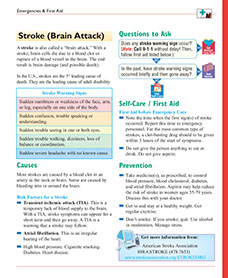
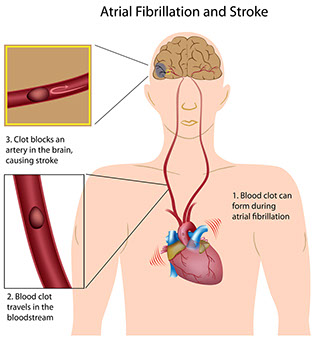
    A stroke is also called a “brain attack.” With a stroke, brain cells die due to a blood clot or rupture of a blood vessel in the brain. The end result is brain damage (and possible death).

    In the U.S., strokes are the 3rd leading cause of death. They are the leading cause of adult disability.

    Signs & Symptoms

    *  Sudden numbness or weakness of the face, arm, or leg, especially on one side of the body.

    *  Sudden confusion, trouble speaking or understanding.

    *  Sudden trouble seeing in one or both eyes.

    *  Sudden trouble walking, dizziness, loss of balance or coordination.

    *  Sudden severe headache with no known cause.

    Causes

    Most strokes are caused by a blood clot in an artery in the neck or brain. Some are caused by bleeding into or around the brain.

    Risk Factors for a Stroke

    *  Previous stroke or transient ischemic attack (TIA)-a temporary lack of blood supply to the brain.

    *  Atrial fibrillation. This is an irregular beating of the heart.

    *  High blood pressure. Cigarette smoking. Diabetes. Coronary artery disease.

    *  Being a male over age 70.

    Illustration of how a stroke is caused.

    Prevention

    *  Take medicine(s), as prescribed, to control blood pressure, blood cholesterol, diabetes, and atrial fibrillation. Aspirin may help reduce the risk of stroke in women ages 55-79 years. Discuss this with your doctor.

    *  Get to and stay at a healthy weight. Get regular exercise.

    *  Don’t smoke. If you smoke, quit. Use alcohol in moderation. Manage stress.

    Questions to Ask

    Self-Care / Prevention

    First Aid before Emergency Care

    *  Note the time when the first sign(s) of stroke occurred. Report this time to emergency personnel. For the most common type of strokes, a clot-busting drug should to be given within 3 hours of the start of symptoms.

    *  Do not give the person anything to eat or drink. Do not give aspirin.

    Healthier at Home book by the American Institute for Preventive Medicine. www.HealthyLife.com. All rights reserved.

    © American Institute for Preventive Medicine