Tag: cold

  • Covid-19, Cold, Flu, Or Allergy?

    SELF-CARE CORNER

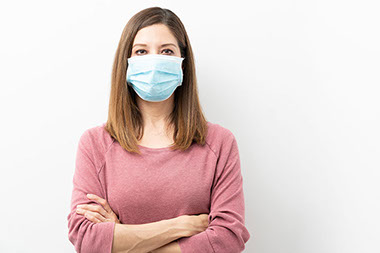
    Women wearing a face mask.

    Know the difference

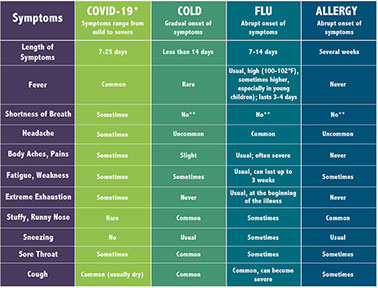
    You’re feeling pretty lousy. You’ve got sniffles, sneezing, and a sore throat. Is it COVID-19, a cold, flu, or allergies? It can be hard to tell them apart because they share so many symptoms. But understanding the differences will help you choose the best treatment.

    Comparison chart of symptoms between COVID-19, Cold, Flu and Allergies.

    © American Institute for Preventive Medicine

  • Make A Cold Care Kit

    SELF-CARE CORNER

    Women siting at table with a box and medicine.

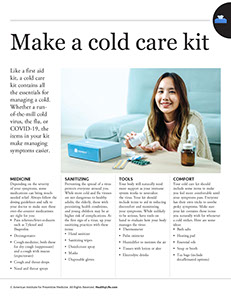
    Like a first aid kit, a cold care kit contains all the essentials for managing a cold. Whether a run-of-the-mill cold virus, the flu, or COVID-19, the items in your kit make managing symptoms easier.

    Medicine

    Depending on the severity of your symptoms, some medications can bring much-needed relief. Always follow the dosing guidelines and talk to your doctor to make sure these over-the-counter medications are right for you:

    *  Pain relievers/fever-reducers such as Tylenol and Ibuprofen

    *  Decongestants

    *  Cough medicine, both those for dry cough (suppressant) and a cough with mucus (expectorant)

    *  Cough and throat drops

    *  Nasal and throat sprays

    Sanitizing

    Preventing the spread of a virus protects everyone around you. While most cold and flu viruses are not dangerous to healthy adults, the elderly, those with preexisting health conditions, and young children may be at higher risk of complications. At the first sign of a virus, up your sanitizing practices with these items:

    *  Hand sanitizer

    *  Sanitizing wipes

    *  Disinfectant spray

    *  Masks

    *  Disposable gloves

    Tools

    Your body will naturally need more support as your immune system works to neutralize the virus. Your kit should include items to aid in reducing discomfort and monitoring your symptoms. While unlikely to be serious, have tools on hand to evaluate how your body manages the virus:

    *  Thermometer

    *  Pulse oximeter

    *  Humidifier to moisten the air

    *  Tissues with lotion or aloe

    *  Electrolyte drinks

    Comfort

    Your cold care kit should include some items to make you feel more comfortable until your symptoms pass. Everyone has their own tricks to soothe pesky symptoms. Make sure your kit contains those items you naturally wish for whenever a cold strikes. Here are some ideas:

    *  Bath salts

    *  Heating pad

    *  Essential oils

    *  Soup or broth

    *  Tea bags (include decaffeinated options)

    © American Institute for Preventive Medicine

  • Stop The Spread Of Respiratory Infections

    MEDICAL NEWS

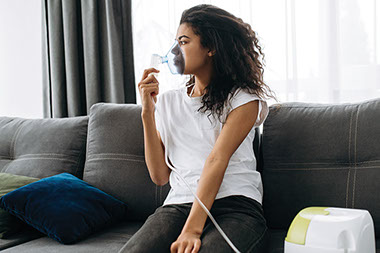
    Women sitting with a portable oxygen mask.

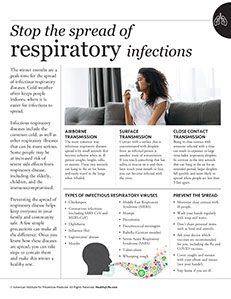
    The winter months are a peak time for the spread of infectious respiratory diseases. Cold weather often keeps people indoors, where it is easier for infections to spread.

    Infectious respiratory diseases include the common cold, as well as other respiratory illnesses that can be more serious. Some people may be at increased risk of severe side effects from respiratory disease, including the elderly, children, and the immunocompromised.

    Preventing the spread of respiratory disease helps keep everyone in your family and community safe. A few simple precautions can make all the difference. Once you know how these diseases are spread, you can take steps to contain them and make this winter a healthy one.

    Airborne transmission

    The most common way infectious respiratory diseases spread is by small aerosols that become airborne when an ill person coughs, laughs, talks, or sneezes. These tiny aerosols can hang in the air for hours and easily travel to the lungs when inhaled.

    Surface transmission

    Contact with a surface that is contaminated with droplets from an infected person is another route of transmission. If you touch something that has saliva or mucus on it and then later touch your mouth or face, you can become infected with the virus.

    Close contact transmission

    Being in close contact with someone infected with a virus can result in exposure to large virus-laden respiratory droplets. In contrast to the tiny aerosols that can hang in the air for an extended period, larger droplets fall quickly and most likely to spread when people are less than 3 feet apart.

    Types of infectious respiratory viruses

    *  Chickenpox

    *  Coronavirus infections (including SARS-CoV and MERS-CoV)

    *  Diphtheria

    *  Influenza (flu)

    *  Legionnaires’ disease

    *  Measles

    *  Middle East Respiratory Syndrome (MERS)

    *  Mumps

    *  Pneumonia

    *  Pneumococcal meningitis

    *  Rubella (German measles)

    *  Severe Acute Respiratory Syndrome (SARS)

    *  Tuberculosis

    *  Whooping cough

    Prevent the spread

    *  Minimize close contact with ill people.

    *  Wash your hands regularly with soap and water.

    *  Don’t share personal items such as food and utensils.

    *  Ask your doctor which vaccines are recommended for you, including the flu and COVID vaccines.

    *  Cover coughs and sneezes with your elbow and tissues (not your hands!).

    *  Stay home if you are ill.

    © American Institute for Preventive Medicine

  • The Causes Of Coughing

    SELF-CARE CORNER

    Man holding his throat and head.

    It’s the season for colds and flu – and that means coughing. Coughing is an important function in your body. It helps clear your airways. Many times, a mild cough will go away on its own. But when should you see a doctor about a cough?

    Common cold

    A common cold may cause some coughing. When you have a runny nose, the fluids drain down your throat. This causes your cough reflex to kick in. It’s a way your body protects your lungs. Although a cough from a cold can be annoying, it usually goes away quickly. Antibiotics won’t help with a cough related to a cold.

    Bronchitis

    Bronchitis is an inflammation in the tiny tubes in the lungs. These tubes are called bronchioles. Viruses and bacteria can get into the bronchioles and make you sick. Chemicals and toxins like tobacco smoke can also invade the bronchioles and lead to bronchitis.

    Symptoms of bronchitis include:

    *  Coughing, especially with mucus

    *  Wheezing or feeling short of breath

    *  Low fever

    *  Chest pain

    Bronchitis is most often caused by a virus so antibiotics will not help. Rest, drinking more fluids and a humidifier can help you feel better.

    Pneumonia

    Pneumonia is an infection in the air sacs inside the lungs. These sacs are called alveoli. Pneumonia can range from mild to serious. If you have pneumonia, you may notice:

    *  Cough with greenish, yellow or bloody mucus

    *  Fever, sweating and chills

    *  Trouble breathing

    *  Stabbing chest pain that hurts when you cough or take a deep breath

    *  Loss of appetite

    *  Feeling weak or tired

    *  Nausea and vomiting (common in small children)

    Many times, a doctor will give you antibiotics for pneumonia. Be sure to take them exactly as your doctor tells you. Pneumonia can be life-threatening if it is not treated effectively.

    Pertussis (Whooping cough)

    Pertussis is very contagious. It may seem like a cold at first. People may have a runny nose or mild cough.

    As it gets worse, pertussis causes a severe cough that can last weeks or even months. The cough makes a high-pitched “whoop” sound. It’s especially dangerous for babies and people with weak immune systems.

    The best way to protect against pertussis is to get vaccinated. If you aren’t sure whether you’re vaccinated, ask your doctor. Pertussis is treated with antibiotics.

    Sources: American Lung Association, Centers for Disease Control and Prevention, National Heart, Lung, and Blood Institute

    © American Institute for Preventive Medicine

  • Frostbite & Hypothermia

    First Aid

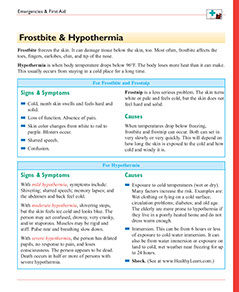
    Frostbite freezes the skin. It can damage tissue below the skin, too. Most often, frostbite affects the toes, fingers, earlobes, chin, and tip of the nose.

    Hypothermia is when body temperature drops below 96ºF. The body loses more heat than it can make. This usually occurs from staying in a cold place for a long time.

    Frostbite & Frostnip

    Signs & Symptoms

    *  Cold, numb skin swells and feels hard and solid.

    *  Loss of function. Absence of pain.

    *  Skin color changes from white to red to purple. Blisters occur.

    *  Slurred speech.

    *  Confusion.

    Frostnip is a less serious problem. The skin turns white or pale and feels cold, but the skin does not feel hard and solid.

    Causes

    When temperatures drop below freezing, frostbite and frostnip can occur. Both can set in very slowly or very quickly. This will depend on how long the skin is exposed to the cold and how cold and windy it is.

    Hypothermia

    Signs & Symptoms

    With mild hypothermia, symptoms include: Shivering; slurred speech; memory lapses; and the abdomen and back feel cold.

    With moderate hypothermia, shivering stops, but the skin feels ice cold and looks blue. The person may act confused, drowsy, very cranky, and/or stuporous. Muscles may be rigid and stiff. Pulse rate and breathing slow down.

    With severe hypothermia, the person has dilated pupils, no response to pain, and loses consciousness. The person appears to be dead. Death occurs in half or more of persons with severe hypothermia.

    Causes

    *  Exposure to cold temperatures (wet or dry). Many factors increase the risk. Examples are: Wet clothing or lying on a cold surface; circulation problems; diabetes; and old age. The elderly are more prone to hypothermia if they live in a poorly heated home and do not dress warm enough.

    *  Immersion. This can be from 6 hours or less of exposure to cold water immersion. It can also be from water immersion or exposure on land to cold, wet weather near freezing for up to 24 hours.

    *  Shock.

    Treatment

    Self-care measures can treat frostnip. Prompt emergency medical care is needed for frostbite to keep the area affected from getting infected and to prevent the loss of a limb. Hypothermia needs emergency medical care.

    Wind Chill Temperature

    As the wind increases, the body is cooled at a faster rate. This causes the skin temperature to drop. Wind chill temperature combines outdoor air temperature and wind speed to give a temperature of what it “feels like” on the skin. The National Weather Service has a “Wind Chill Chart” that shows temperatures, wind speeds, and exposure times that cause frostbite. To get this, accesswww.nws.noaa.gov/om/windchill.

    Questions to Ask

    {Note: The damage from exposure to the cold may not be noted for 72 hours.}

    Self-Care / First Aid

    First Aid for Frostbite and Hypothermia Before Emergency Care

    *  Gently move the person to a warm place and Call 9-1-1!

    *  Check for a response. Give Rescue Breaths or CPR, as needed.

    *  Loosen or remove wet and/or tight clothing. Remove jewelry.

    *  Don’t rub the area with snow or soak it in cold water.

    *  Warm the affected area by soaking it in a tub of warm water (101ºF to 104ºF) and an antiseptic solution, such as Betadine.

    *  Stop when the affected area becomes red, not when sensation returns. This should take about 45 minutes. If done too fast, thawing can be painful and blisters may develop.

    *  If warm water is not available, cover the person with blankets, coats, etc., or place the frostbitten body part in a warm body area, such as an armpit or on the abdomen (human heat) or use a blow dryer, if available.

    *  Keep exposed areas elevated, but protected.

    *  Don’t rub or massage a frostbitten area.

    *  Protect the exposed area from the cold. It is more sensitive to re-injury.

    *  Don’t break blisters.

    First Aid for Frostnip

    *  Warm the affected area. This can be done a number of ways:

    – Place cold fingers in armpits.

    – Place cold feet onto another person’s warm stomach.

    – Put the affected area in warm water (101ºF to 102ºF).

    After warming the area, the skin may be red and tingling. If it is not treated, frostnip can lead to frostbite.

    *  Protect the exposed area from the cold. It is more sensitive to re-injury.

    To Prevent Frostbite and Outdoor Hypothermia

    *  Stay indoors, as much as possible, when it is very cold and windy.

    *  Wear clothing made of wool or polypropylene. These fabrics stay warm even when wet. Layer clothing. Wear 2 or 3 pairs of socks instead of 1 heavy pair. Wear roomy shoes. Do not wear items that constrict the hands, wrists, or feet.

    *  Wear a hat that keeps your head and ears warm. A major source of heat loss is through the head.
    Healthier at Home book by the American Institute for Preventive Medicine. www.HealthyLife.com. All rights reserved.

    © American Institute for Preventive Medicine

  • Cold, Flu, Or Allergy?

    SELF-CARE CORNER

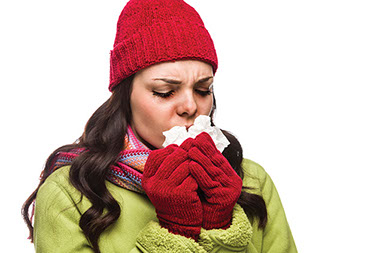
    Image of young women dressed warmly coughing into a tissue.

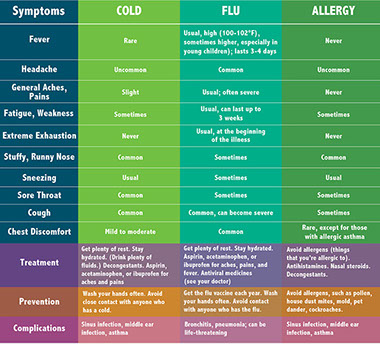
    You’re feeling pretty lousy. You’ve got sniffles, sneezing, and a sore throat. Is it a cold, flu, or allergies? It can be hard to tell them apart because they share so many symptoms. But understanding the differences will help you choose the best treatment, advises the NIH News in Health.

    Chart showing symptoms of a cold vs the flu vs an allergy.

    © American Institute for Preventive Medicine

  • If You Have A Cold, Should You Exercise?

    BE FIT

    Image of women sick in bed.

    Yes and no. Moderate exercise (30 minutes a day, on most, if not all, days of the week) actually lowers your risk for respiratory infections, said David C. Nieman from the American College of Sports Medicine. But prolonged, intense exercise, on the other hand, can weaken your immune system and allow viruses to gain a foothold and spread. If you’re already sick with a respiratory infection (common cold or flu), approach exercise cautiously during your illness. To help you decide whether to hit the gym or stay in bed, Dr. Nieman says this:

    DOexercise moderately if your cold symptoms are confined to your head. If you’re dealing with a runny nose or sore throat, moderate exercise is okay. Intense exercise can be continued a few days after symptoms go away (in cases of the common cold).

    DON’Tsweat out your illness. Exercise during an illness does NOT help cure it.

    DOstay in bed if your illness has spread beyond your head. Respiratory infections, fever, swollen glands, and extreme aches and pains all indicate that you should rest up, not work out.

    DON’Tjump back in too soon. If you’re recovering from a more serious bout of cold or flu, gradually ease back into exercise after at least 2 weeks of rest.

    “In general, if your symptoms are from the neck up, go ahead and take a walk,” said Dr. Nieman. “But if you have a fever or general aches and pains, rest up and let your body get over the illness.”

    © American Institute for Preventive Medicine

  • Using Decongestants Safely

    SELF-CARE CORNER

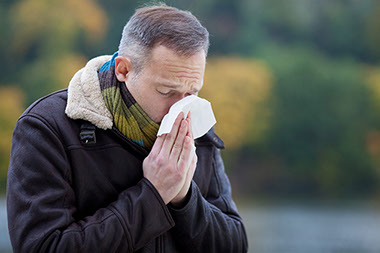
    Image of man sneezing into a tissue.

    As we approach the peak season for colds and flu, many people turn to over-the-counter medicines for relief. And if you have a stuffy nose (known as nasal congestion), you may be thinking about taking a decongestant.

    What are decongestants?

    Decongestants are medicines designed to relieve stuffiness and pressure in the nose and sinuses. The two over-the-counter decongestants available are phenylephrine (i.e., Sudafed PE) and pseudoephedrine. Pseudoephedrine are stocked behind a pharmacy counter, but you don’t need a prescription. Both medicines work by shrinking blood vessels in the nose, allowing air to pass through more easily.

    Are decongestants safe?

    Decongestants are safe when they are used properly. Here’s what to know before you take one:

    *  Read the label and be sure you understand how much you can take and how often to take it. If you’re not sure, ask your pharmacist or doctor.

    *  Know the active ingredients. Many cold and flu products contain several active ingredients. They are listed on the drug facts label at the top. Be sure you don’t accidentally take too much of one ingredient. For instance, many cold products contain acetaminophen, a pain reliever that can be toxic in high doses. If you’ve already taken a pain reliever with acetaminophen and you take the cold medicine too, you could take too much acetaminophen.

    *  Talk to your doctor before taking a decongestant if you have diabetes, heart conditions, high blood pressure, glaucoma, prostate problems or thyroid disease.

    *  If you take other over-the-counter or prescription medicines, ask your doctor if decongestants can be safely taken with your other medicines.

    *  Do not give decongestants or any cough or cold product to kids under 4 years of age. Ask your child’s pediatrician before giving them any medicines.

    *  Talk to your doctor if you need to take a decongestant for longer than a week.

    What about nasal sprays?

    Saline nasal sprays with no medicine in them are safe to use daily, as often as needed. These can help flush out allergens and mucus so you can breathe easier. Not sure if it’s just saline? Look at the drug facts label and be sure it contains only sodium chloride as the active ingredient.

    But, decongestant sprays that contain active ingredients are not safe to take for more than three days in a row. This is because your body can become dependent on them. When this happens, your nose may become even stuffier over time, and you’ll have to use more and more spray to get relief.

    Medicines can help you cope with bothersome cold and flu symptoms. But, be safe and savvy before you take them – and keep them in a locked cabinet out of children’s reach!

    Sources: American Academy of Family Physicians, Food and Drug Administration

    © American Institute for Preventive Medicine