Tag: comfort

  • Ways To Relieve Dental Anxiety

    Dental & Mouth Concerns

    Image of smiling dentist.

    If you dread going to the dentist, ask about anxiety-reducing techniques you can use to help stay calm and relaxed. Some effective strategies follow.

    *  Tell your dentist how you feel. Some dentists are trained in helping anxious patients overcome fear of dental procedures.

    *  Ask if you can listen to soothing music or relaxation CDs played on a stereo headset. Ask if the dentist offers a hand-held device that allows you to press a button to stop the dentist’s drill.

    *  If your dentist is skilled at hypnosis, consider being hypnotized.

    *  If your anxiety is more than you can handle, see a psychotherapist who specializes in treating dental anxiety and other phobias.

    Have a routine cleaning and checkup every six months. Preventive care will minimize the need for more painful and lengthy treatment.

    A Year of Health Hints book by the American Institute for Preventive Medicine. www.HealthyLife.com. All rights reserved.

    © American Institute for Preventive Medicine

  • Hospice Care

    Mature Health: Over Age 50

    Hospice care is for people with a terminal illness. To enter a hospice program (and to receive Medicare benefits), a doctor’s diagnosis is required stating that life expectancy is no more than about 6 months. No efforts are made to prolong life or to hasten death. The patient is kept comfortable and pain free. Hospice eases the process of dying. Most referrals for hospice come from doctors. Hospice care may be provided in:

    *  The home. Eighty percent of persons enrolled in hospice are cared for at home.

    *  A hospital

    *  A nursing home

    *  A hospice facility

    The bulk of care, especially with home hospice, is usually given by family members and friends. It is supported by a hospice care team which includes doctors, social workers, therapists, volunteers, clergy, nurses, and family members. The team plans care that ensures quality of life. {Note: VA offers Hospice & Palliative Care.}

    Most health insurance plans include the option of hospice care. Medicare and Medicaid cover the costs if the facility or hospice organization is certified by them. Under Medicare, the length of stay is two 90 day benefit periods. This may be followed by a 30 day period. Extensions are available. Persons must be certified to be terminally ill at the start of each period.

    Sometimes patients are charged if they do not qualify for reimbursement. Hospice care is based on need. No one is rejected for lack of finances.

    Some advantages to hospice care include:

    *  Availability of 24 hour a day, 7 day a week assistance. This is true for hospice care in hospitals, nursing homes, and hospice facilities. Find out if the home hospice program offers this service.

    *  Respite for family caretakers when care is given in the home

    *  Emotional comfort and support by trained hospice staff and volunteers

    *  Bereavement counseling

    Resources

    The National Hospice and Palliative Care Organization

    1-703-837-1500

    www.nhpco.org

    Health at Home Lifetime book by the American Institute for Preventive Medicine. www.HealthyLife.com. All rights reserved.

    © American Institute for Preventive Medicine

  • How To Choose A Quality Hospice

    FAMILY LIFE

    Image of male nurse and elderly man on a laptop.

    When a loved one is diagnosed with a serious or life-limiting illness, the questions facing an individual or a family can be overwhelming. The National Hospice and Palliative Care Organization recommends that people learn more about hospice as an important option before they are faced with a medical crisis.

    Hospice is not a place but a kind of care for people who have a life-limiting illness and are making the choice to focus on quality and comfort if more conventional treatments have become burdensome.

    Hospices provide high-quality care that is tailored to your loved one’s needs and that supports family caregivers.

    Your doctor and other health care providers or your company’s EAP may recommend hospice providers in your area. You can also get a list of hospice providers and more information about hospice from the National Hospice and Palliative Care Organization atwww.nhpco.org.

    Important questions in choosing a quality hospice include:

    *  Is the hospice Medicare certified?

    *  What services should I expect from the hospice?

    *  How are services provided after hours?

    *  How and where does hospice provide short-term inpatient care?

    *  What services do volunteers offer?

    *  How long does it typically take the hospice to enroll someone once the request for services is made?

    When should hospice care begin?

    Every patient and family must decide that based upon their unique needs. Professionals encourage people to learn about care options long before they think they may need them.

    © American Institute for Preventive Medicine

  • Telling Kids About Tragedy

    FAMILY LIFE

    Image of parents talking to their child.

    Talking to kids about scary events and disasters is important when they’re old enough to understand. Kids may have more fear of an event if they don’t know any details. They may imagine something much worse than what happened.

    Although telling kids some details may help, the American Academy of Pediatrics says it’s important that you filter the information you give your child. Think about the child’s age, personality and what they will be able to cope with. These steps can get the conversation started:

    *Ask the child what they know about the event.This can help you separate facts from fiction. It gives you a way to explain the things they already know in a way that is direct but not scary.

    *Avoid any graphic details.Although the media may share lots of details that are graphic and scary, children should be shielded from these things.

    *Don’t be too vague.Saying “something happened that was bad” doesn’t give enough information. Instead, name the place where it happened and tell them that some people were hurt. The police/firemen/ government, etc. are helping people and working to keep us safe.

    *Keep it open ended.Tell them if they have any questions, they can ask you.

    Is your child coping?

    After a disaster, some children have a hard time coping. These red flags may be a sign that your child needs help:

    *  Trouble sleeping, nightmares or being very tired all the time

    *  Unusual aches and pains, such as headache or feeling “sick” often

    *  Appetite changes

    *  Social changes, such as aggression or being clingy

    *  Frequent feelings of sadness or fear

    Talk to your child’s doctor if you notice any of these changes.

    © American Institute for Preventive Medicine

  • The Right Work Posture For You

    WORK LIFE

    Illustration of correct posture while sitting at a desk.

    Many people sit at a computer as part of their daily job. If a chair, desk or workstation isn’t working for you, it can cause sore muscles and joints and even an injury. To stay safe and healthy at the computer, follow these ergonomics guidelines.

    Remember to get up and move whenever possible! A walk during your lunch break, taking the stairs or doing stretches at your desk can help you feel energized and burn a few extra calories. Look for ways to get your body moving, even if it’s only for five to 10 minutes. A little exercise is better than none at all.

    Monitor:Monitor should be at eye level or slightly below. Monitor to eye distance:  20 to 40 inches

    Arms:Armrests should allow shoulders to relax. Elbows should be close to the body. Minimal bend at the wrist.

    Chair:Backrest should conform to the spine. Chair should have lumbar (lower back) support.

    Legs:Thighs parallel to the floor.

    Feet:Feet should be flat on the floor. Use a footrest if needed.

    Take breaks:Every 20-25 minutes

    Source: Occupational Safety and Health Administration

    © American Institute for Preventive Medicine

  • Babies, Pacifiers & Thumb Sucking

    FAMILY LIFE

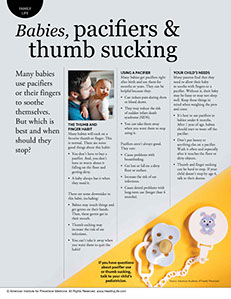
    Baby sucking his thumb as father holds him.

    Many babies use pacifiers or their fingers to soothe themselves. But which is best and when should they stop?

    The thumb and finger habit

    Many babies will suck on a favorite thumb or finger. This is normal. There are some good things about this habit:

    *  You don’t have to buy a pacifier. And, you don’t have to worry about it falling on the floor and getting dirty.

    *  A baby always has it when they need it.

    There are some downsides to this habit, including:

    *  Babies may touch things and get germs on their hands. Then, these germs get in their mouth.

    *  Thumb sucking may increase the risk of ear infections.

    *  You can’t take it away when you want them to quit the habit!

    Using a pacifier

    Many babies get pacifiers right after birth and use them for months or years. They can be helpful because they:

    *  Can reduce pain during shots or blood draws.

    *  They may reduce the risk of sudden infant death syndrome (SIDS).

    *  You can take them away when you want them to stop using it.

    Pacifiers aren’t always good. They can:

    *  Cause problems with breastfeeding.

    *  Get lost or fall on a dirty floor or surface.

    *  Increase the risk of ear infections.

    *  Cause dental problems with long-term use (longer than 6 months).

    Your child’s needs

    Many parents find that they need to allow their baby to soothe with fingers or a pacifier. Without it, their baby may be fussy or may not sleep well. Keep these things in mind when weighing the pros and cons:

    *  It’s best to use pacifiers in babies under 6 months. After 1 year of age, babies should start to wean off the pacifier.

    *  Don’t put honey or anything else on a pacifier. Wash it often and especially after it touches the floor or dirty objects.

    *  Thumb and finger sucking can be hard to stop. If your child doesn’t stop by age 4, talk to their doctor.

    If you have questions about pacifier use or thumb sucking, talk to your child’s pediatrician.

    Source: American Academy of Family Physicians

    © American Institute for Preventive Medicine