
Tag: conflict

  • Dealing With Family Arguments

    FAMILY LIFE

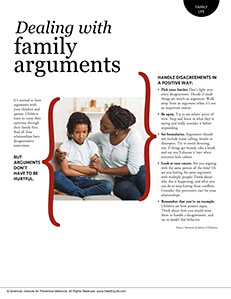
    Mother comforting her young son who's upset.

    It’s normal to have arguments with your children and spouse. Children learn to voice their opinions through their family first. And all close relationships have disagreements sometimes.

    But arguments don’t have to be hurtful.

    Handle disagreements in a positive way:

    *Pick your battles:Don’t fight over every disagreement. Decide if small things are worth an argument. Walk away from an argument when it’s not an important matter.

    *Be open.Try to see others’ point of view. Stop and listen to what they’re saying and really consider it before responding.

    *Set boundaries.Arguments should not include name calling, insults or disrespect. Try to avoid shouting, too. If things get heated, take a break and say you’ll discuss it later when everyone feels calmer.

    *Look at root causes.Are you arguing with the same person all the time? Or are you having the same argument with multiple people? Think about why this is happening, and what you can do to stop having these conflicts. Consider this preventive care for your relationships.

    *Remember that you’re an example.Children see how parents argue. Think about how you would want them to handle a disagreement, and try to model that behavior.

    Source: American Academy of Pediatrics
    © American Institute for Preventive Medicine

  • Difficult People In The Workplace

    WORK LIFE

    Image of a business man looking off the distance.

    A manager rushes into his employee’s office at 4:30 p.m., drops a pile of papers on her desk, and barks, “I need these read, edited, and finalized by 8:30 a.m.”

    A woman calls in sick. She is shivering, coughing, and has a fever.  Her supervisor screams, “I don’t care what illness you have. If you’re not in the office today, I’ll take it as your resignation!”

    These are real examples of workplace bullying that cause stress, depression, and anxiety. The National Mental Health Association estimates that each year more than one billion sick days can be due to mental health disorders caused by work stress. That’s $193 billion a year in lost earnings.

    Psychology Professor Katerina Bezrukova studies the psychological effect of workplace injustices and intergroup relations at Santa Clara University.

    She says there are 4 kinds of co-workers and supervisors to look out for:

    1.Narcissistic.These types have fragile self-esteem. They may become outraged when someone challenges them. Bezrukova says avoid criticizing them. Document your own work, too, so you have a record of everything you do.

    2.Aggressive.To them, everyone is a predator or prey. That’s why they like to intimidate others and even bully them. They also tend to act frantic when a project comes in or a deadline is fast approaching. Bezrukova advises victims to stay out of the way. If they can, show them how management-by-hysteria can be inefficient.

    3.Rigid.These types won’t try anything new. They manage with viewpoint of “It’s my way or the highway.” This stems from fears of being pushed around. Bezrukova says let them feel like they are a part of the decision.

    4.Impaired.These people have ADD, anxiety, depression, burnout, or substance abuse issues. They need professional help. Employee Assistance Programs or other kinds of intervention are best.

    “People, who suffer from a workplace injustice of some sort, develop anger, frustration, anxiety, insomnia, headaches. These relationships, coupled with the connection between long-term, chronic psychological distress and increased risk of physical health problems such as cardiovascular disease, make this a crucial dollars and cents issue for business,” says Bezrukova.

    © American Institute for Preventive Medicine

  • Politics & Family: Agree To Disagree

    FAMILY LIFE

    Image of family around the dinner table.

    Politics can be hard to discuss. Often, the conversations turn into arguments or people getting upset because the other person doesn’t agree. When we feel strongly about something, it’s normal to want others to see our side of things.

    Family gatherings are common during the holidays. And, sometimes politics or touchy subjects come up, even when we try to avoid them. How do you handle it when you’re trying to keep the peace?

    *Find common ground.Even if you disagree about something, there’s probably areas where you both agree. For instance, you may have different opinions on gun control. But, you both agree you want your kids to be safe.

    *Don’t attack.Using insults or strong language can damage relationships. Remember that words have the power to harm others. State your point without hurting the other person or showing disrespect by calling them names.

    *Be prepared.If you know that Uncle Tim always says something that offends you, be ready. Think about how you can take deep breaths before responding. Sometimes, it’s better to walk away or change the subject, rather than argue.

    *Know that you probably won’t change the other person’s mind.When we care about something, we want others to agree. We want them to support our views. But, it may be best to accept that no matter how good your argument is, the other person may not change their view.

    *Think about a positive goal.Use disagreements to learn how others feel about something. Be open-minded and listen to their side.

    *Find other things to do.Remember that family gatherings are supposed to bring people together. Plan a fun family game or activity. This can keep people away from having tense discussions.

    *Be okay with different views.You can care about someone and have different views from them. Tell yourself it is okay to agree to disagree.

    *End the discussion when needed.Sometimes, people keep arguing because they’re trying to find a resolution. But, a resolution isn’t always possible. Instead, tell the person you appreciate their views, but you think it’s best to move on. Ask them about their personal interests or job. Share a funny story. Do something to break the tension and stop talking about the disagreement.

    Source: American Psychological Association

    © American Institute for Preventive Medicine