Tag: consistency

  • Start A Walking Group

    BE FIT

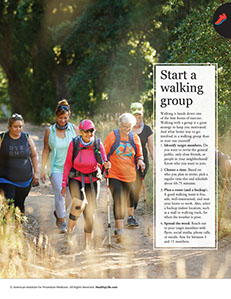
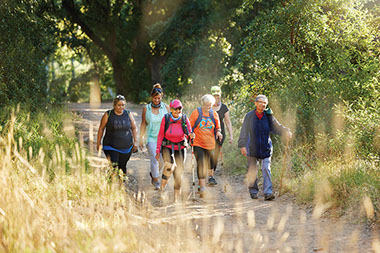
    Group of friends walking on a trail.

    Walking is hands down one of the best forms of exercise. Walking with a group is a great strategy to keep you motivated. And what better way to get involved in a walking group than to start one yourself!

    1. Identify target members. Do you want to invite the general public, only close friends, or people in your neighborhood? Know who you want to join.

    2. Choose a time. Based on who you plan to invite, pick a regular time slot and schedule about 60-75 minutes.

    3. Plan a route (and a backup). A good walking route is free, safe, well-maintained, and near your home or work. Also, select a backup indoor location, such as a mall or walking track, for when the weather is poor.

    4. Spread the word. Reach out to your target members with flyers, social media, phone calls, or emails. Aim for between 5 and 15 members.

    © American Institute for Preventive Medicine

  • Stop Making Excuses

    Fitness

    Take control of your health.

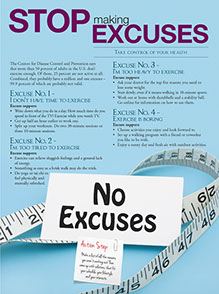
    The Centers for Disease Control and Prevention says that more than 50 percent of adults in the U.S. don’t exercise enough. Of those, 25 percent are not active at all. Combined, they probably have a million and one excuses – 99.9 percent of which are probably not valid.

    Excuse No. 1 – I don’t have time to exercise.

    Excuse zappers:

    *  Write down what you do in a day. How much time do you spend in front of the TV? Exercise while you watch TV.

    *  Get up half an hour earlier to work out.

    *  Split up your workouts. Do two 30-minute sessions or three 10-minute sessions.

    Excuse No. 2 – I’m too tired to exercise.

    Excuse zappers:

    *  Exercise can relieve sluggish feelings and a general lack of energy.

    *  Something as easy as a brisk walk may do the trick.

    *  Do yoga or tai chi to feel physically and mentally refreshed.

    Excuse No. 3 – I’m too heavy to exercise.

    Excuse zappers:

    *  Ask your doctor for the top five reasons you need to lose some weight.

    *  Start slowly, even if it means walking in 10-minute spurts.

    *  Work out at home with dumbbells and a stability ball. Go online for information on how to use them.

    Excuse No. 4 – Exercise is boring.

    Excuse zappers:

    *  Choose activities you enjoy and look forward to.

    *  Set up a walking program with a friend or coworker you like to be with.

    *  Enjoy a sunny day and fresh air with outdoor activities.

    Action Step

    Make a list of all the reasons you aren’t working out. Then come up with solutions that fit your schedule, your lifestyle, and your interests.

    Page image from the Ways to Well-Being book by the American Institute for Preventive Medicine. www.HealthyLife.com. All rights reserved.

    © American Institute for Preventive Medicine

  • Be Strong At Any Age

    BE FIT

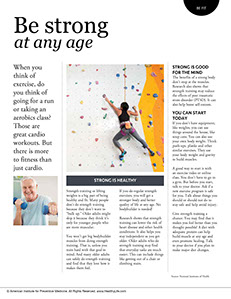
    Older man using weights.

    When you think of exercise, do you think of going for a run or taking an aerobics class? Those are great cardio workouts. But there is more to fitness than just cardio.

    Strong is healthy

    Strength training or lifting weights is a big part of being healthy and fit. Many people don’t do strength training because they don’t want to “bulk up.” Older adults might skip it because they think it’s only for younger people who are more muscular.

    You won’t get big bodybuilder muscles from doing strength training. That is, unless you train hard with that goal in mind. And many older adults can safely do strength training and find that they love how it makes them feel.

    If you do regular strength exercises, you will get a stronger body and better quality of life at any age. No bodybuilder is needed!

    Research shows that strength training can lower the risk of heart disease and other health conditions. It also helps you stay independent as you get older. Older adults who do strength training may find that everyday tasks are much easier. This can include things like getting out of a chair or climbing stairs.

    Strong is good for the mind

    The benefits of a strong body don’t stop at the muscles. Research also shows that strength training may reduce the effects of post traumatic stress disorder (PTSD). It can also help boost self-esteem.

    You can start today

    If you don’t have equipment, like weights, you can use things around the house, like soup cans. You can also use your own body weight. Think push-ups, planks and other similar exercises. They use your body weight and gravity to build muscles.

    A good way to start is with an exercise video or online class. You don’t have to go to a gym. But before you start, talk to your doctor. Ask if a new exercise program is safe for you. Talk about things you should or should not do to stay safe and help avoid injury.

    Give strength training a chance. You may find that it makes you feel better than you thought possible! A diet with adequate protein can help build muscle at any age and even promote healing. Talk to your doctor if you plan to make major diet changes.

    Source: National Institutes of Health

    © American Institute for Preventive Medicine

  • Exercise When You Travel

    BE FIT

    Group of people hiking.

    How you exercise may look different when traveling, but it’s still worthwhile. In fact, mixing things up when you’re away from home keeps your workouts fresh and interesting. Try these tips:

    *Bring resistance bands along.Easily packable and super lightweight, resistance bands give you the flexibility to exercise anywhere. Bring a few different types for the most exercise options.

    *Book a hotel with a gym.Many hotels offer fitness rooms. The equipment is often fairly basic, but you can usually depend on a treadmill or bike and a set of free weights.

    *Use your bodyweight.All you really need for a good sweat session is your body! Movements like push-ups, tricep dips, squats, and lunges can be combined in a challenging circuit.

    *Get outside.What better way to get the most out of your travel than to explore on foot. And all that walking counts as exercise!

    © American Institute for Preventive Medicine

  • Positive Parenting Hacks

    FAMILY LIFE

    Parents with son, smile.

    Don’t focus on mistakes or bad behavior. Catch your child doing good things and point them out.

    Chores don’t have to be a punishment. Chores at home can help children learn life skills and independence.

    Spend a little time connecting each day. Take a few minutes to talk to your child without phones or screens.

    © American Institute for Preventive Medicine

  • The Importance Of Chores

    FAMILY LIFE

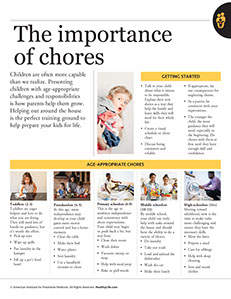
    Child holding a load of clothes in her arms.

    Children are often more capable than we realize. Presenting children with age-appropriate challenges and responsibilities is how parents help them grow. Helping out around the house is the perfect training ground to help prepare your kids for life.

    Getting started

    *  Talk to your child about what it means to be responsible. Explain their new duties as a way they help the family and learn skills they will need for their whole life.

    *  Create a visual schedule or chore chart.

    *  Discuss being consistent and reliable.

    *  If appropriate, lay out consequences for neglecting chores.

    *  As a parent, be consistent with your expectations.

    *  The younger the child, the more guidance they will need, especially in the beginning. Do chores with them at first until they have enough skill and confidence.

    Age-appropriate chores

    Toddlers (2-3)

    Toddlers are eager helpers and love to do what you are doing. They will need lots of hands-on guidance, but it’s worth the effort.

    *  Pick up toys

    *  Wipe up spills

    *  Put laundry in the hamper

    *  Fill up a pet’s food bowl

    Preschoolers (4-5)

    At this age, more independence may develop as your child gains more motor control and has a better memory.

    *  Clear the table

    *  Make their bed

    *  Water plants

    *  Sort laundry

    *  Use a handheld vacuum to clean

    Primary schoolers (6-9)

    This is the age to reinforce independence and consistency with chore expectations. Your child may begin to push back a bit, but stay firm.

    *  Clean their room

    *  Wash dishes

    *  Vacuum, sweep, or mop

    *  Help with meal prep

    *  Rake or pull weeds

    Middle schoolers (10-13)

    By middle school, your child can truly help with tasks around the house and should have the ability to do a variety of chores.

    *  Do laundry

    *  Take out trash

    *  Load and unload the dishwasher

    *  Wash the car

    *  Make their lunch

    High-schoolers (14+)

    Moving toward adulthood, now is the time to make tasks more challenging and ensure they have the necessary skills.

    *  Mow the lawn

    *  Prepare a meal

    *  Care for siblings

    *  Help with deep cleaning

    *  Iron and mend clothes
    © American Institute for Preventive Medicine

  • Weekly Family Meetings

    FAMILY LIFE

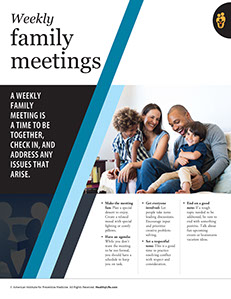
    Young family smiling and laughing togething.

    A weekly family meeting is a time to be together, check in, and address any issues that arise.

    *  Make the meeting fun: Plan a special dessert to enjoy. Create a relaxed mood with special lighting or comfy pillows.

    *  Have an agenda: While you don’t want the meeting to be too formal, you should have a schedule to keep you on task.

    *  Get everyone involved: Let people take turns leading discussions. Encourage input and prioritize creative problem-solving.

    *  Set a respectful tone: This is a good time to practice resolving conflict with respect and consideration.

    *  End on a good note: If a tough topic needed to be addressed, be sure to end with something positive. Talk about fun upcoming events or brainstorm vacation ideas.

    © American Institute for Preventive Medicine

  • 7 Daily Health Habits

    General Health Conditions

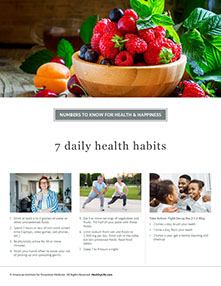
    A wooden bowl filled with berries.

    1.  Drink at least 6 to 8 glasses of water or other unsweetened fluids.

    2.  Spend 2 hours or less of non-work screen time (laptops, video games, cell phones, etc.).

    3.  Be physically active for 30 or more minutes.

    4.  Wash your hands often to lower your risk of picking up and spreading germs.

    5.  Eat 5 or more servings of vegetables and fruits. Fill half of your plate with these foods.

    6.  Limit sodium from salt and foods to 2,300 mg per day. Omit salt at the table. Eat less processed foods. Read food labels.

    7.  Sleep 7 to 9 hours a night.

    Take Action: Fight Decay the 2-1-2 Way

    *  2 times a day, brush your teeth

    *  1 time a day, floss your teeth

    *  2 times a year, get a dental cleaning and checkup

    Health at Home Lifetime book by the American Institute for Preventive Medicine. www.HealthyLife.com. All rights reserved.

    © American Institute for Preventive Medicine

  • Appreciate The Journey

    Healthylife® Weigh

    Part 5

    Two women enjoying a run together.

    Know why you are being physically active. This will help get you motivated to start and to keep going.

    1.Connect with your interests.If you enjoy hiking, find a new trail to explore. If you are in a new place, plan a day with lots of walking to learn about your new neighborhood. You may find you can be active for much longer when you have distracting, interesting scenery around you.

    2.Be reflective.Take time to reflect as part of your workout or your cool-down. Appreciate your abilities and strengths. Express gratitude for those who encourage and guide you.

    3.Have fun.Find an organized fun run or “Couch to 5k” program in your community. Fun runs often have a theme, like color runs, glow-in-the-dark runs, and obstacle courses. Many can be done as a team. Having a goal that is bigger than the physical activity itself can motivate you, keep you accountable, and keep you moving longer than you may have otherwise!

    4.Connect with others.Make memories with your friends and family that revolve around being active. Have tough conversations while on a long walk or hike. You may be more likely to find a solution or think more clearly while being active.

    5.Listen to music.Music can be inspiring and distract you from a tough workout. It can also help you keep up your pace.

    © American Institute for Preventive Medicine

  • Be Persistent

    Healthylife® Weigh

    Part 7

    Man at gym holding a water bottle and apple.

    You may be reading this page well before you reach your goal. That’s okay. Understand that weight loss takes time. Continue to build on what you do each day. Remember, it isn’t a single healthy meal or workout that will get you to your goal. It’s also not a single poor choice or skipped workout that will derail you.

    *  Build trends of healthy choices.

    *  Know and live your values.

    *  Treat your thoughts and actions with compassion.

    *  Don’t settle with just what you know now. Keep learning.

    *  Create a web of support.

    © American Institute for Preventive Medicine