Tag: cost

  • Improve Your Home

    FINANCIAL HEALTH

    Couple looking at paint swatches.

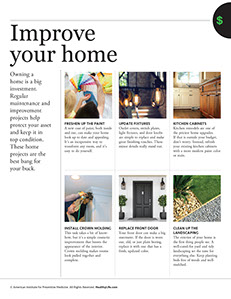
    Owning a home is a big investment. Regular maintenance and improvement projects help protect your asset and keep it in top condition. These home projects are the best bang for your buck.

    Freshen up the paint

    A new coat of paint, both inside and out, can make your home look up to date and appealing. It’s an inexpensive way to transform any room, and it’s easy to do yourself.

    Update fixtures

    Outlet covers, switch plates, light fixtures, and door knobs are simple to replace and make great finishing touches. These minor details really stand out.

    Kitchen cabinets

    Kitchen remodels are one of the priciest home upgrades.  If that is outside your budget, don’t worry. Instead, refresh your existing kitchen cabinets with a more modern paint color or stain.

    Install crown molding

    This task takes a bit of know-how, but it’s a simple cosmetic improvement that boosts the appearance of the interior. Crown molding makes rooms look pulled together and complete.

    Replace front door

    Your front door can make a big statement. If the door is worn out, old, or just plain boring, replace it with one that has a fresh, updated color.

    Clean up the landscaping

    The exterior of your home is the first thing people see. A well-cared-for yard and tidy landscaping set the tone for everything else. Keep planting beds free of weeds and well-mulched.
    © American Institute for Preventive Medicine
  • Save Money On Prescriptions

    FINANCIAL HEALTH

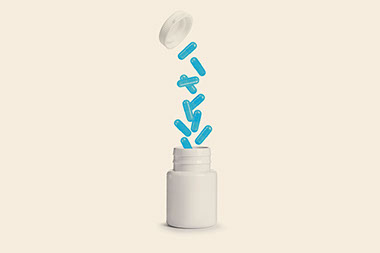
    Pills dropping into bottle.

    FACT: New drugs are protected by patents. After the patent expires, other companies can make a generic version of the drug.

    Knowing about generic drugs can save you money on prescriptions. Tell your doctor or pharmacist you want a generic drug if possible.

    If your prescription is expensive, speak up. Sometimes there’s an alternative that costs less but is still safe.

    Be wary of places that promise free or cheap prescriptions. It may be a scam. Your doctor or pharmacist can tell you about free or low-cost prescription programs.

    © American Institute for Preventive Medicine

  • Choose Benefit Options With Both Cost And Care In Mind

    Medical Care

    Wooden blocks with medical icons.

    *  Signing up for the same plan as the one you have is easy, but spending time to find out about all options could be worth it. Ask your employer for written materials for your options or how to access the information online.

    *  Estimate what your costs for the coming year will be using each option. Your company’s or insurance company’s website may have tools to help you do this.

    *  Consider a flexible spending account (FSA) to help pay for health care expenses. It also offers tax advantages. To determine how much to put into an FSA, add up out-of-pocket costs you expect to pay for the coming year. These include co-pays, deductibles, cost for eyeglasses, contact lenses, etc.

    *  The best deal may not be the cheapest plan, but the one that gives the best price for the benefits you are most likely to use.

    *  Find out if you can lower your health care premium costs by taking part in certain wellness and disease management programs offered through work.

    A Year of Health Hints book by the American Institute for Preventive Medicine. www.HealthyLife.com. All rights reserved.

    © American Institute for Preventive Medicine

  • Save By Staying Healthy. Prevention Is Worth More Than A Pound Of Cure.

    Medical Care

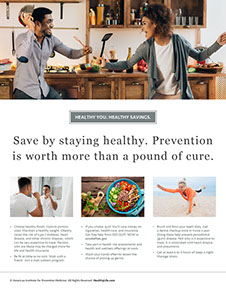
    Couple play dueling in the kitchen, laughing.

    *  Choose healthy foods. Control portion sizes. Maintain a healthy weight. Obesity raises the risk of type 2 diabetes, heart disease, and other chronic diseases, which can be very expensive to treat. Persons who are obese may be charged more for life and health insurance.

    *  Be fit at little or no cost. Walk with a friend.  Join a mall walkers program.

    *  If you smoke, quit! You’ll save money on cigarettes, health care, and insurance. Get free help from 800.QUIT. NOW orsmokefree.gov.

    *  Take part in health risk assessments and health and wellness offerings at work.

    *  Wash your hands often to lessen the chance of picking up germs.

    *  Brush and floss your teeth daily. Get a dental checkup once or twice a year. Doing these help prevent periodontal (gum) disease. Not only is it expensive to treat, it is associated with heart disease and pneumonia.

    *  Get at least 6 to 8 hours of sleep a night. Manage stress.

    A Year of Health Hints book by the American Institute for Preventive Medicine. www.HealthyLife.com. All rights reserved.

    © American Institute for Preventive Medicine
  • Save Money On Medications

    Medication

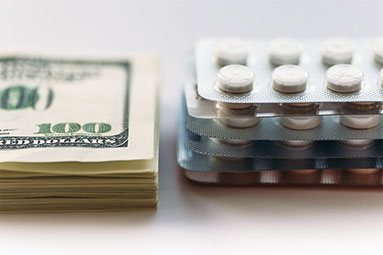
    Small stack of money next to a small stack of pills.

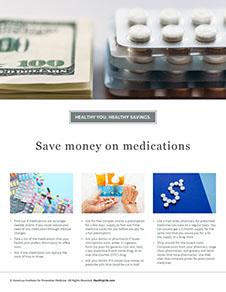
    *  Find out if medications are no longer needed and/or if you could reduce your need of any medication through lifestyle changes.

    *  Take a list of the medications that your health plan prefers (formulary) to office visits.

    *  Ask if one medication can replace the work of two or three.

    *  Ask for free samples and/or a prescription for a few days’ supply to find out if the medicine works for you before you pay for a full prescription.

    *  Ask your doctor or pharmacist if lower-cost options exist, either in a generic form (co-pays for generics cost less, too), a less expensive brand-name drug, or an over-the-counter (OTC) drug.

    *  Ask your doctor if it would save money to prescribe pills that could be cut in half.

    *  Use a mail order pharmacy for prescribed medicines you take on a regular basis. You can usually get a 3-month supply for the same cost that you would pay for a 30 day supply at a drug store.

    *  Shop around for the lowest costs. Compare costs from your pharmacy, large chain pharmacies, and grocery and retail stores that have pharmacies. Use Web sites that compare prices for prescription medicines.

    A Year of Health Hints book by the American Institute for Preventive Medicine. www.HealthyLife.com. All rights reserved.

    © American Institute for Preventive Medicine