Tag: Cost-Saving Tips

  • Planning For Health Care Coverage

    Medical Care

    Image of couple talking to a health care agent.

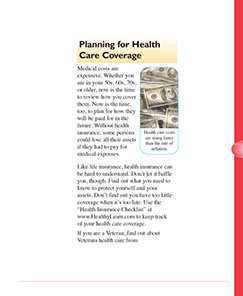
    Medical costs are expensive. Whether you are in your 50s, 60s, 70s, or older, now is the time to review how you cover them. Now is the time, too, to plan for how they will be paid for in the future. Without health insurance, some persons could lose all their assets if they had to pay for medical expenses.

    Like life insurance, health insurance can be hard to understand. Don’t let it baffle you, though. Find out what you need to know to protect yourself and your assets. Don’t find out you have too little coverage when it’s too late. Use the “Health Insurance Checklist” to keep track of your health care coverage.

    If you are a Veteran, find out about Veterans health care from

    Page from the Health at Home Lifetime book by the American Institute for Preventive Medicine. www.HealthyLife.com. All rights reserved.

    © American Institute for Preventive Medicine

  • Save By Being A Wise Consumer

    Medical Care

    What price, health care?

    It is more common to know the price of a car than the price of health care services. It is also more common to take more time looking for a car than a doctor. To be prepared to take care of your health and health care costs, plan ahead:

    *  Don’t wait until you get sick to find a doctor. Having a doctor can save the expense of having to go to an urgent care center or emergency room.

    *  Know what costs your health plan covers and what you need to pay.

    *  Post a list of places your health plan approves for treatment. When you need care, use them instead of out-of-plan ones, which could cost you extra money.

    *  If you have a yearly deductible, budget for this with the rest of your bills.

    Check credentials.

    You can’t afford to trust your health to just anyone. Find out about doctors from:

    *  American Board of Medical Specialties (ABMS) at 866.ASK.ABMS (275.2267) orwww.abms.org.

    *  DocFinder atwww.docboard.org/docfinder.html.

    *  The Federation of State Medical Boards at 888.ASK.FCVS (275.3287) orwww.fsmb.org.

    *  Health Grades atwww.healthgrades.com.

    Look for quality.

    Check out the track records of health plans, hospitals, and doctors. Contact the Agency for Health Care Research and Quality atwww.ahrq.gov.

    Protect yourself from medical errors.

    These could cost extra money and can even cost you your life. Be your own watch dog. Take an active role in every decision about your health care. If needed, have a family member or friend oversee your care.

    Know about tax breaks.

    Medical and dental expenses are tax deductible if they exceed 7.5% of your adjusted gross income. If you are self-employed, you may be allowed to deduct 45% of the cost of your health insurance premium. Find out fromwww.irs.gov.

    Cover image to the Healthy Savings book by the American Institute for Preventive Medicine. www.HealthyLife.com. All rights reserved.

    © American Institute for Preventive Medicine

  • Save By Being A Wise Health Care Consumer

    Medical Care

    Close up of hand using a tablet.

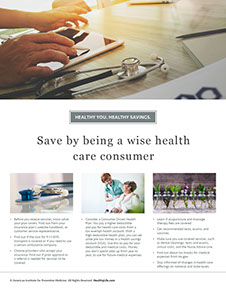
    *  Before you receive services, know what your plan covers. Find out from your insurance plan’s website handbook, or customer service representative.

    *  Find out if the cost for 9-1-1 EMS transport is covered or if you need to use a certain ambulance company.

    *  Choose providers who accept your insurance. Find out if prior approval or a referral is needed for services to be covered.

    *  Consider a Consumer Driven Health Plan. You pay a higher deductible and pay for health care costs from a tax-exempt health account. With a high-deductible health plan, you can set aside pre-tax money in a health savings account (HSA). Use this to pay for your deductible and medical costs. Money you don’t spend adds up from year to year, to use for future medical expenses.

    *  Learn if acupuncture and massage therapy fees are covered.

    *  Get recommended tests, exams, and vaccines.

    *  Make sure you use covered services, such as dental cleanings, tests and exams, virtual visits, and the Nurse Advice Line.

    *  Find out about tax breaks for medical expenses fromirs.gov.

    *  Stay informed of changes in health care offerings on national and state levels.

    A Year of Health Hints book by the American Institute for Preventive Medicine. www.HealthyLife.com. All rights reserved.

    © American Institute for Preventive Medicine

  • Save By Staying Healthy

    Medical Care

    An ounce of prevention is worth more than a pound of cure. The healthier you are, the less you will need to pay for medical care. Also, the state of your health is one of the main factors in setting the cost of health and life insurance.

    Don’t send money up in smoke.

    Cigarette smoking is bad for your health. It’s bad for your wallet, too. A person who smokes two packs a day spends over $3,000 a year just on cigarettes. Hundreds of dollars more are spent on extra dental and medical costs. The cost of health, life, and disability insurance is about 30% higher for persons who smoke.

    Weight does matter.

    Obesity is a leading cause of preventable death. Losing weight can lower the risk for type 2 diabetes, heart disease, and other chronic diseases. These can cost you and your employer a lot of money to treat. Obese persons who buy health insurance on their own may have to pay more. Insurance companies may even turn them down.

    Be fit at little or no cost.

    Take part in fitness programs at work. Join a mall walkers program. Walk with a friend. Follow along with fitness programs on TV. Or, if you have a stationary bike, ride it while you watch TV. Being active every day is a huge investment in your health.

    Look at your genes.

    Find out what health problems both sides of your family have or had. Start with your parents, brothers, and sisters. Then find out about ones your grandparents, uncles, aunts, and first cousins have or had. Once you know what health problems run in your family, talk with your doctor. He/she can suggest ways to lower your risk of getting them.

    Don’t back quacks.

    Find out about products and treatments that don’t work or could cause harm fromwww.quackwatch.organdwww.fda.gov. Don’t waste money on things that don’t help.

    Be savvy about AD-vice.

    Check with your doctor before you follow advice from Web sites and ads that promote products. Many are costly and give little or no benefit.

    Detect to protect.

    Have screening tests and exams that can help detect health problems in early stages when they are easier and less costly to treat. Follow your doctor’s advice.

    Money well spent.

    If you have no health insurance or your health plan does not pay for screening tests or doctor visits, it is still important to have them. Paying for these now could save you thousands in medical costs in the future. Tests may cost less than you think.

    Know thy “health self.”

    The more you know about your health problems, the easier it is to make informed choices about how to take care of them. Find out what you need to do from your doctor. Get reliable facts, too, from trusted sources.

    Follow your doctor’s treatment plan.

    This helps to improve your health. It helps keep problems from getting worse. For example, keeping blood pressure under control can reduce the risk of having a stroke or a heart attack.

    A shot in the arm for your health.

    Get vaccines, as needed, to prevent illnesses. This applies to children, as well as adults. The Centers for Disease Control and Prevention give guidelines for vaccines every year. Find out what they are atwww.cdc.gov/vaccines. Also, if you plan to travel to other countries, find out what vaccines you should get. Find out fromwww.cdc.gov/travel.

    Know about the Vaccines for Children (VFC) Program.

    Your children may be able to get free or low-cost vaccines. Find out fromwww.cdc.gov/vaccines/programs/vfc/default.htm.

    Cover image to the Healthy Savings book by the American Institute for Preventive Medicine. www.HealthyLife.com. All rights reserved.

    © American Institute for Preventive Medicine

  • Save By Staying Healthy. Prevention Is Worth More Than A Pound Of Cure.

    Medical Care

    Couple play dueling in the kitchen, laughing.

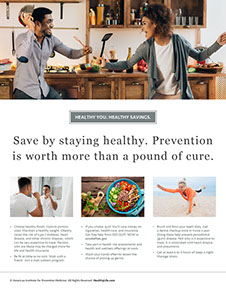
    *  Choose healthy foods. Control portion sizes. Maintain a healthy weight. Obesity raises the risk of type 2 diabetes, heart disease, and other chronic diseases, which can be very expensive to treat. Persons who are obese may be charged more for life and health insurance.

    *  Be fit at little or no cost. Walk with a friend.  Join a mall walkers program.

    *  If you smoke, quit! You’ll save money on cigarettes, health care, and insurance. Get free help from 800.QUIT. NOW orsmokefree.gov.

    *  Take part in health risk assessments and health and wellness offerings at work.

    *  Wash your hands often to lessen the chance of picking up germs.

    *  Brush and floss your teeth daily. Get a dental checkup once or twice a year. Doing these help prevent periodontal (gum) disease. Not only is it expensive to treat, it is associated with heart disease and pneumonia.

    *  Get at least 6 to 8 hours of sleep a night. Manage stress.

    A Year of Health Hints book by the American Institute for Preventive Medicine. www.HealthyLife.com. All rights reserved.

    © American Institute for Preventive Medicine

  • Save If You Have Insurance

    Medical Care

    Image of doctor and piggy bank.

    Know health insurance terms and plans.

    This allows you to make wise choices. Read “Questions and Answers About Health Insurance – A Consumer Guide” fromwww.ahrq.gov/consumer/insuranceqaandwww.healthdecisions.org.

    If you can get health insurance through work, do it.

    More often than not, it will cost you less than if you buy it on your own. If you can choose from more than one plan, compare the options. The best deal may not be the cheapest plan. It is the one that gives the best price for the benefits you need and are most likely to use. If you need help to understand the options, ask your employer. Get facts from the insurance company’s Web site and/or customer service representative, too.

    Raise your deductible.

    Your deductible is the amount you must pay before your health insurance kicks in. Like car insurance, monthly premiums cost less if you pay a higher deductible. Healthy adults can usually save money with this option.

    Check into a Consumer Driven Health Plan.

    This gives you greater control over how you use your health care benefits. You pay a high deductible. You pay for your health care costs from a tax-exempt health account. If you expect to be healthy, this may be a good choice for you.

    Read your health plan.

    Read what products and services are covered before you pay for them on your own. Take advantage of covered services, such as dental checkups and cleanings twice a year. You may find out that your health plan covers some of the costs for flu vaccines and other services.

    Student health insurance.

    Find out about student health insurance from your child’s school or college, especially if your child plans to study abroad.

    Be Medicare aware.

    Medicare is the U.S. government’s health insurance for persons age 65 or older. It also covers people under age 65 who have disabilities. Find out when you will be eligible for Medicare fromwww.medicare.govor by calling 800.MEDICARE (633.4227).

    *  When you are enrolled in Medicare, you get Medicare Part A. This covers medical costs when you are in the hospital.

    *  Medicare Part B covers things that  Part A does not. Examples are doctors’ fees, outpatient hospital costs, physical therapy, etc. You pay a monthly premium for this.

    *  Medicare Part D helps cover the cost of prescribed medicines.

    Fill in the gaps.

    Find ways to pay for services not covered by your insurance plan.

    *  If you have Medicare, you can buy Medigap, Medicare Select, or Medicare Advantage HMO insurance to help pay for services not covered by Medicare. Contact your state health insurance department to find out about your choices for each of these health plans. You need only one of these. For free help choosing a Medicap policy, call your State Health Insurance Assistance Program.

    *  Look into extra coverage from providers, such as Aflac.

    Pay premiums on time.

    If you don’t, your coverage could be cancelled.

    Know about COBRA.

    This stands for Consolidated Omnibus Budget Reconciliation Act. COBRA is temporary health insurance. It applies to former employees, retirees, spouses, former spouses, and dependent children who are no longer covered under an employer health insurance plan. It lets you keep the same health insurance for 18 months (sometimes longer) if you pay for it yourself. Find out more about COBRA fromwww.dol.gov/dol/topic/health-plans/cobra.htm. Know, too, that it may cost you less to buy your own health insurance than to pay what COBRA will cost you, especially if you are in good health and have no pre-existing health problems.

    Find out who to contact when the insurance company denies a claim.

    Sometimes claims are rejected by mistake. When this happens, you can usually clear up the mistake by calling or writing a letter to your insurance company. Keep copies of all bills, letters, and notes from phone calls. Put your policy and claim numbers on all letters or e-mails. Call your insurance company if you don’t get an answer within a few weeks.

    Keep up-to-date.

    Find out how you learn about updates and changes in your health plan. Do you get notified by mail or by e-mail? Do you need to check the health plan’s Web site? How do you add a new dependent to the plan? Also, find out when you can change the plan you have. Often, you can only do this during open enrollment.

    Know before you go.

    Call your health insurance company before you have a medical service. Some services are only covered if the insurance company approves them first and/or if they are done at certain locations or by certain providers.

    One may be enough.

    If both you and your spouse both have health insurance through work, choose the plan that works best. Decide if it is better to keep separate plans or if it would cost less for either of you to join the other’s plan. Your employer may let you take cash or other benefits instead of health insurance. Keep the better policy if you can and “cash in” on the other one. Also, find out which policy covers your children better. Think about future needs, too. For prenatal and delivery costs to be covered, a woman may need to be a member of the plan for nine or more months before she gets pregnant.

    Take advantage of FSAs.

    Find out if your employer offers a Flexible Spending Account (FSA). This lets you set aside some money for medical expenses for the year. You could choose to set aside $1,000. This is usually taken out of your paycheck, but you don’t pay federal income tax or Social Security tax on this money. But be careful how much you put into your FSA. You lose any money you don’t spend on health care in the year. Look at last year’s health care expenses for a ballpark figure on what you think you will likely spend. Don’t count any money that is taken from your paycheck for insurance premiums. Do count deductibles, co-pays, and treatments your insurance doesn’t cover.

    Use it before you lose it!

    If you are going to lose your health insurance, you are part of a growing trend in the U.S. Schedule doctor visits and other health care services before expenses will no longer be covered.

    Before you travel, check out your health insurance coverage.

    Are you covered where you are going? If not, ask your health insurance provider how to get coverage while you are gone. You can also find out about travel health insurance fromwww.travelrinsurance.com.

    Cover image to the Healthy Savings book by the American Institute for Preventive Medicine. www.HealthyLife.com. All rights reserved.

    © American Institute for Preventive Medicine

  • Save If You Have No Insurance

    Medical Care

    Image of nurse standing in front of the nurse station.

    Look into getting some.

    Insurance costs money, but having none may end up costing you more. Medical costs from a chronic illness, surgery, etc. could erase any savings you have and may cause you to file for bankruptcy. Discuss your health needs and ability to pay for premiums with an insurance broker. Find out about health insurance in your state fromwww.naic.org/state_web_map.htm.

    You may need short-term coverage.

    If you are between jobs, a recent college graduate, etc., contact an insurance broker about short-term health insurance. This has a low monthly cost and high coverage limits for most (especially healthy) people. Read about COBRA in tip number 60, too.

    Look into group coverage.

    Find out if you can get health insurance from groups you belong to, such as AARP. Your costs are likely to be cheaper than if you buy an individual policy. If you are a veteran or a dependent of a veteran, find out if you are eligible for health care fromwww.va.gov/health/index.aspor from 800.827.1000.

    Look into an HSA.

    This is a Health Savings Account. It is also called a Medical Savings Account (MSA). It is like an IRA, but is used for medical costs. Instead of paying the costs for a fee-for-service health plan, you pay the cost for two things. One is a high deductible policy. The other is a tax-deductible savings account. You take money out of the savings account for medical costs when they are needed. Money not used from the savings account grows interest on a tax-sheltered basis and can be used to add funds to your retirement. Find out more about HSAs fromwww.msainfo.netandwww.consumerdrivenhealthcare.us. An MSA is a kind of Consumer Driven Health Plan.

    Know about “Insure Kids Now!”

    Infants, children, and teens may be able to get free or low-cost health insurance from your state. Find out from  877.KIDS NOW (543.7669) orwww.insurekidsnow.com.

    Honesty is the best policy.

    If you give false information on insurance forms, your coverage could be cancelled. Before you sign the dotted line, read the fine print. Find out if any conditions would limit or cancel your coverage.

    Know about clinical trials.

    You may be able to get expert medical care if you take part in a clinical trial. Find out what clinical trials are and which ones you could qualify for fromwww.clinicaltrials.gov. Find out about studies on mental health and disorders fromwww.nimh.nih.gov/health/ trials/index.shtml.

    If you are on a very limited income, find out if you qualify for Medicaid.

    Contactwww.cms.hhs.gov. Medicaid is a state sponsored health care program.

    If you cannot pay for health care.

    Contact the Bureau of Primary Health Care. Use the Web sitewww.findahealthcenter.hrsa.govto find a clinic in your area that will give you medical care at a reduced cost or for free. Search the Internet, too, for “National Free Clinic Directory.” Also, contact a social worker at your local hospital or community health agency to recommend resources that can help with medical problems.

    Opt for medical coverage with your auto insurance plan.

    This can cover expenses for medical services if you and passengers are injured in an accident.

    Find out about free and low-cost cancer screening.

    *  The American Cancer Society at 800.227.2345 orwww.cancer.org.

    *  The National Comprehensive Cancer Control Program atwww.cdc.gov/cancer/screening.htm.

    Find out if you have a health credit report.

    Before you buy a health insurance plan, contact the Medical Information Bureau (MIB). The MIB keeps track of medical information on persons who have applied for individual disability, health or life insurance in the past seven years. You can get a copy of your record fromwww.mib.comor by calling 866.692.6901.

    Cover image to the Healthy Savings book by the American Institute for Preventive Medicine. www.HealthyLife.com. All rights reserved.

    © American Institute for Preventive Medicine

  • Save Money On Prescriptions

    FINANCIAL HEALTH

    Pills dropping into bottle.

    FACT: New drugs are protected by patents. After the patent expires, other companies can make a generic version of the drug.

    Knowing about generic drugs can save you money on prescriptions. Tell your doctor or pharmacist you want a generic drug if possible.

    If your prescription is expensive, speak up. Sometimes there’s an alternative that costs less but is still safe.

    Be wary of places that promise free or cheap prescriptions. It may be a scam. Your doctor or pharmacist can tell you about free or low-cost prescription programs.

    © American Institute for Preventive Medicine

  • Save Money On Medications

    Medication

    Small stack of money next to a small stack of pills.

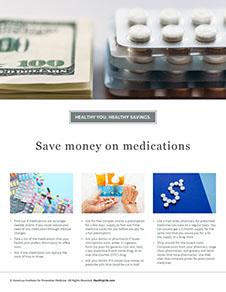
    *  Find out if medications are no longer needed and/or if you could reduce your need of any medication through lifestyle changes.

    *  Take a list of the medications that your health plan prefers (formulary) to office visits.

    *  Ask if one medication can replace the work of two or three.

    *  Ask for free samples and/or a prescription for a few days’ supply to find out if the medicine works for you before you pay for a full prescription.

    *  Ask your doctor or pharmacist if lower-cost options exist, either in a generic form (co-pays for generics cost less, too), a less expensive brand-name drug, or an over-the-counter (OTC) drug.

    *  Ask your doctor if it would save money to prescribe pills that could be cut in half.

    *  Use a mail order pharmacy for prescribed medicines you take on a regular basis. You can usually get a 3-month supply for the same cost that you would pay for a 30 day supply at a drug store.

    *  Shop around for the lowest costs. Compare costs from your pharmacy, large chain pharmacies, and grocery and retail stores that have pharmacies. Use Web sites that compare prices for prescription medicines.

    A Year of Health Hints book by the American Institute for Preventive Medicine. www.HealthyLife.com. All rights reserved.

    © American Institute for Preventive Medicine

  • Save On Prescriptions

    FINANCIAL HEALTH

    Pills and bottle on top of a money.

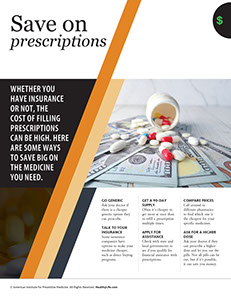
    Whether you have insurance or not, the cost of filling prescriptions can be high. Here are some ways to save big on the medicine you need.

    Go generic

    Ask your doctor if there is a cheaper generic option they can prescribe.

    Talk to your insurance

    Some insurance companies have options to make your medicine cheaper, such as direct buying programs.

    Get a 90-day supply

    Often it’s cheaper to get more at once than to refill a prescription multiple times.

    Apply for assistance

    Check with state and local governments to see if you qualify for financial assistance with prescriptions.

    Compare prices

    Call around to different pharmacies to find which one is the cheapest for your specific medicines.

    Ask for a higher dose

    Ask your doctor if they can prescribe a higher dose and let you cut the pills. Not all pills can be cut, but if it’s possible, it can save you money.

    © American Institute for Preventive Medicine