Tag: cough

  • Bronchitis

    Respiratory conditions

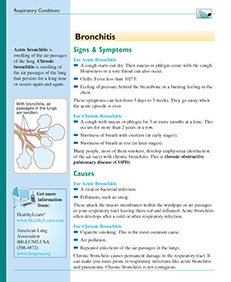
    Acute bronchitis is swelling of the air passages of the lung. Chronic bronchitis is swelling of the air passages of the lung that persists for a long time or occurs again and again.

    Acute Bronchitis

    Signs & Symptoms

    *  A cough starts out dry. Then mucus or phlegm come with the cough. Hoarseness or a sore throat can also occur.

    *  Chills. Fever less than 102ºF.

    *  Feeling of pressure behind the breastbone or a burning feeling in the chest.

    These symptoms can last from 3 days to 3 weeks. They go away when the acute episode is over.

    Causes

    *  A viral or bacterial infection.

    *  Pollutants, such as smog.

    These attack the mucus membranes within the windpipe or air passages in your respiratory tract leaving them red and inflamed. Acute bronchitis often develops after a cold or other respiratory infection.

    Treatment

    Most of the time, this type is caused by a virus and goes away without treatment. Sometimes, a doctor may prescribe:

    *  Bronchodilators. These medicines open up air passages in the lungs.

    *  An antibiotic if you smoke, are older than age 40, or if you have a condition or take medication that makes it hard for you to fight infections.

    Chronic Bronchitis

    Signs & Symptoms

    *  A cough with mucus or phlegm for 3 or more months at a time. This occurs for more than 2 years in a row.

    *  Shortness of breath with exertion (in early stages).

    *  Shortness of breath at rest (in later stages).

    Many people, most of them smokers, develop emphysema (destruction of the air sacs) with chronic bronchitis. This is chronic obstructive pulmonary disease (COPD).

    Causes

    *  Cigarette smoking. This is the most common cause.

    *  Air pollution.

    *  Repeated infections of the air passages in the lungs.

    Chronic bronchitis causes permanent damage to the respiratory tract. It can make you more prone to respiratory infections like acute bronchitis and pneumonia. Chronic bronchitis is not contagious.

    Treatment

    *  Not smoking. Avoiding secondhand smoke.

    *  Avoiding or reducing exposure to air pollution, chemical irritants, and cold, wet weather.

    *  Medical treatment as needed, for airway infections and heart problems.

    *  Oxygen, as prescribed.

    Questions to Ask

    Self-Care / Prevention

    *  Don’t smoke. Avoid secondhand smoke.

    *  Reduce your exposure to air pollution. Use air conditioning, air filters, and a mouth and nose filter mask if you have to. Stay indoors during episodes of heavy air pollution.

    *  Rest. Drink plenty of liquids.

    *  Breathe air from a cool-mist vaporizer. Bacteria grows in vaporizers, so clean your unit after each use. Breathing in mist with bacteria can make bronchitis worse. Use distilled (not tap) water in the vaporizer.

    *  Take an over-the-counter medicine for fever, pain, and/or inflammation as directed.

    *  Instead of cough suppressants, use expectorants.

    *  Use bronchodilators and/or take antibiotics as prescribed by your doctor.

    Resources
    American Lung Association

    800.LUNG.USA (586.4872)

    www.lungusa.org

    Healthier at Home book by the American Institute for Preventive Medicine. www.HealthyLife.com. All rights reserved.

    © American Institute for Preventive Medicine
  • Choking

    First Aid

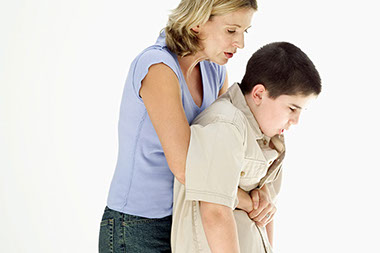
    Image of an adult women giving the heimlich maneuver to a child who's choking.

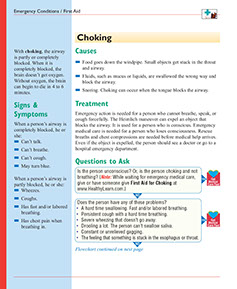
    With choking, the airway is partly or completely blocked. When it is completely blocked, the brain doesn’t get oxygen. Without oxygen, the brain can begin to die in 4 to 6 minutes.

    Signs & Symptoms

    When a person’s airway is completely blocked, he or she:

    *  Can’t talk.

    *  Can’t breathe.

    *  Can’t cough.

    *  May turn blue.

    When a person’s airway is partly blocked, he or she:

    *  Wheezes.

    *  Coughs.

    *  Has fast and/or labored breathing.

    *  Has chest pain when breathing in.

    Causes

    *  Food goes down the windpipe. Small objects get stuck in the throat and airway.

    *  Fluids, such as mucus or liquids, are swallowed the wrong way and block the airway.

    *  Snoring. Choking can occur when the tongue blocks the airway.

    Treatment

    Emergency action is needed for a person who cannot breathe, speak, or cough forcefully. The Heimlich maneuver can expel an object that blocks the airway. It is used for a person who is conscious. Emergency medical care is needed for a person who loses consciousness. Rescue breaths and chest compressions are needed before medical help arrives. Even if the object is expelled, the person should see a doctor or go to a hospital emergency department.

    Questions to Ask

    Self-Care / First Aid

    First Aid for Choking When Able to Breathe and Speak (or an infant or child can cry)

    *  Cough to clear the airway.

    *  Take a slow, deep breath to get a lot of air into the lungs.

    *  Give a deep, forceful cough. Breathe in deeply enough to be able to cough out 2 or 3 times in a row before taking a second breath.

    *  Don’t slap a person on the back. Doing this can drive the object down deeper.

    *  Have the person sit or stand. Bending forward may cause the object to fall against the vocal cords. Get emergency care right away!

    Prevention

    *  Chew all foods well before swallowing. Eat at a slow pace.

    *  Limit alcoholic drinks before you eat. This lessens the chance of swallowing large pieces of food.

    *  If you wear dentures, make sure they fit well. Since your mouth sensation is lessened, you are at a higher risk of choking. Eat slower. Chew food more thoroughly.

    *  Try not to laugh and eat at the same time. Laughing can draw food into the windpipe.

    *  Don’t run or play sports with objects in the mouth.

    *  For children under 5 years old, cut hot dogs, sausages, seedless grapes, and caramels into small pieces before you give these to them. And don’t give them nuts; popcorn; foods with pits, (e.g., cherries); gum (especially bubble gum); hard candy, throat lozenges, and cough drops.

    *  Don’t let your child chew or suck on rubber balloons or pieces of them.

    *  Keep small, solid objects, such as paper clips, away from children 3 years old and younger. Make sure, too, that they don’t get toys that have small parts, such as eyes on stuffed animals, game pieces, dice, etc. A young child should not play with any object smaller than his or her closed fist.

    *  Put childproof latches on cupboards that have harmful items.

    *  Store all medicines and vitamins out of children’s reach and in containers with childproof lids. Keep these items in locked cabinets, if needed.

    *  Remove plastic labels and decals from baby walkers and other kiddy furniture before children can peel them off.

    Healthier at Home book by the American Institute for Preventive Medicine. www.HealthyLife.com. All rights reserved.

    © American Institute for Preventive Medicine
  • Colds & Flu

    Children’s Health

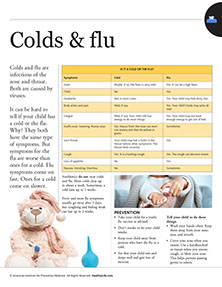
    Colds and flu are infections of the nose and throat. Both are caused by viruses.

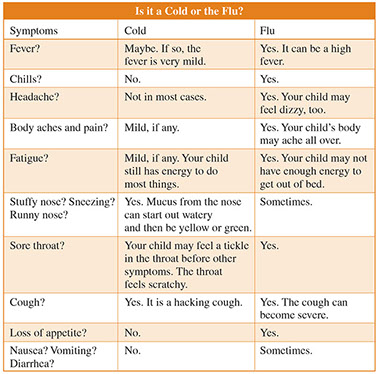
    It can be hard to tell if your child has a cold or the flu. Why? They both have the same type of symptoms. But symptoms for the flu are worse than ones for a cold. Flu symptoms come on fast. Ones for a cold come on slower.

    Signs & Symptoms

    Chart showing symptoms of a cold vs a flu.

    Prevention

    Antibiotics do not treat colds and flu. Most colds clear up in about a week. Sometimes, a cold lasts up to 2 weeks.

    Fever and most flu symptoms usually go away after 5 days, but coughing and feeling weak can last up to 2 weeks.

    To Help Prevent Colds and Flu

    *  Take your child for a yearly flu vaccine as advised.

    *  Don’t smoke or let your child smoke.

    *  Keep your child away from persons who have the flu or a cold.

    *  See that your child eats and sleeps well and gets lots of exercise.

    Tell your child to do these things:

    *  Wash your hands often. Keep them away from your nose, eyes, and mouth.

    *  Cover your nose when you sneeze. Use a handkerchief or tissues when you sneeze, cough, or blow your nose. This helps prevent passing germs to others.

    Questions to Ask

    Self-Care

    Have your child do these things:

    *  Rest.

    *  Drink lots of liquids. They help clear out the respiratory tract. This can help prevent other problems, like bronchitis.

    *  Eat chicken soup. It helps clear out mucus.

    If your child’s throat is sore, have him or her do these things:

    *  Gargle every few hours with 1/4 teaspoon of salt in 1/2 cup of warm water, if able to. (A child can usually do this starting at age 6.)

    *  Suck on a piece of hard candy or cough drop once in a while. (Don’t  give these to children under 5 years old.)

    Things you can do:

    *  Try to clear your child’s nose. This is very important in babies under 6 months old, because some can’t breathe through their mouths yet. Also, they can’t breast or bottle-feed if they can’t breathe through the nose. To clear your child’s nose:

    – Use an over-the-counter spray or drops for the nose made of salt and water. An example is Ocean® brand. Follow the label’s advice or that of your child’s doctor.

    – For a baby who can’t blow his or her nose, leave the salt drops in for 1 minute. Then use a soft rubber suction bulb to draw out the mucus. Lie the baby on his or her back. Aim the bulb straight down, not at an angle! (You can get a suction bulb at the drug store.) Or use a cotton swab to wipe the mucus out. Don’t put the suction bulb or cotton swab too far into the nose. You could cause a nosebleed.

    – For a child who can blow his or her own nose, have the child do it 1 minute after the salt drops are in.

    *  Put a cool-mist vaporizer or humidifier in your child’s room. Use distilled (not tap) water. Clean it every day.

    *  For fever and muscle aches, give your child acetaminophen or ibuprofen. Make sure you give the right kind and dose for your child’s weight. (Note: Do not give aspirin. Aspirin and other medicines that have salicylates have been linked to Reye’s Syndrome.

    *  Check with your child’s doctor about using over-the-counter medicines for colds and flu for children under  age 2.

    *  Call your child’s doctor if he or she gets a fever after a cold or after the flu has gone away.

    *  Washing the hands often helps stop spreading the flu. Have your child wash his or her hands:

    – After playing with others.

    – When he or she gets home from school.

    – After blowing his or her nose.

    – After touching toys or other people’s things.

    Signs of Reye’s Syndrome

    Be on the lookout for Reye’s Syndrome after the flu or chickenpox. Reye’s Syndrome does not happen very often. But you should know about it. Look for these signs:

    *  Vomiting over and over again. Or vomiting that does not stop.

    *  Loss of pep and energy.

    *  Acting very, very sleepy.

    *  Acting very, very cranky.

    *  Striking out at others.

    *  Acting strange.

    *  Convulsions.

    (Note: If your child shows signs of Reye’s Syndrome, get medical care fast!)

    Children's Self-Care book by the American Institute for Preventive Medicine. www.HealthyLife.com. All rights reserved.

    © American Institute for Preventive Medicine
  • Coughs

    Respiratory conditions

    Image of man coughing into elbow.

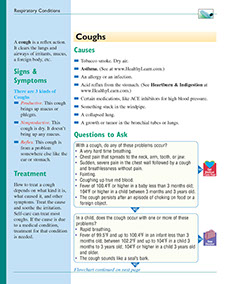
    A cough is a reflex action. It clears the lungs and airways of irritants, mucus, a foreign body, etc.

    Signs & Symptoms

    There are 3 kinds of Coughs

    *  Productive. This cough brings up mucus or phlegm.

    *  Nonproductive. This cough is dry. It doesn’t bring up any mucus.

    *  Reflex. This cough is from a problem somewhere else like the ear or stomach.

    Causes

    *  Tobacco smoke. Dry air.

    *  Asthma.

    *  An allergy or an infection.

    *  Acid reflux from the stomach.

    *  Certain medications, like ACE inhibitors for high blood pressure.

    *  Something stuck in the windpipe.

    *  A collapsed lung.

    *  A growth or tumor in the bronchial tubes or lungs.

    Treatment

    How to treat a cough depends on what kind it is, what caused it, and other symptoms. Treat the cause and soothe the irritation. Self-care can treat most coughs. If the cause is due to a medical condition, treatment for that condition is needed.

    Questions to Ask

    Self-Care / Prevention

    For Coughs that Bring Up Mucus

    *  Drink plenty of liquids.

    *  Don’t smoke. Avoid secondhand smoke.

    *  Use a cool-mist vaporizer, especially in the bedroom. Put a humidifier on the furnace.

    *  Take a shower. The steam helps thin mucus.

    *  Use an over-the-counter expectorant medicine, as directed. This helps you spit out phlegm or mucus. Try a decongestant for postnasal drip.

    For Coughs that Are Dry

    *  Drink lots of liquids. Hot drinks like tea with lemon and honey soothe the throat.

    *  Suck on cough drops or hard candy. (Don’t give these to children under age 5.)

    *  Take an over-the-counter cough medicine that has dextromethorphan.

    *  Make your own cough medicine. Mix 1 part lemon juice and 2 parts honey. (Don’t give this to children less than 1 year old.)

    Other Tips

    *  Don’t smoke. Avoid secondhand smoke. Avoid chemical gases that can hurt your lungs.

    *  Don’t give children under age 5 small objects that can easily get caught in the throat or windpipe. Examples are buttons, balloons, peanuts, and popcorn. Even adults should be careful to chew and swallow foods slowly so they don’t “go down the wrong way.”

    *  If you cough and have heartburn symptoms when you lie down, try a liquid antacid. Don’t lie down for 2 to 3 hours after you eat.

    Resources

    American Lung Association

    800.LUNG.USA (586.4872)

    www.lungusa.org

    Healthier at Home book by the American Institute for Preventive Medicine. www.HealthyLife.com. All rights reserved.

    © American Institute for Preventive Medicine
  • First Aid For Choking

    First Aid

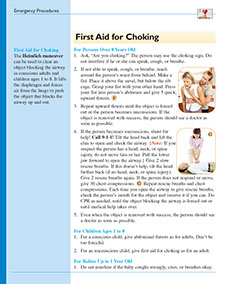
    The Heimlich maneuver can be used to clear an object blocking the airway in conscious adults and children ages 1 to 8. It lifts the diaphragm and forces air from the lungs to push the object that blocks the airway up and out.

    Persons Over 8 Years Old

    1. Ask, “Are you choking?”

    The person may use the choking sign. Do not interfere if he or she can speak, cough, or breathe.

    2. If not able to speak, cough, or breathe, reach around the person’s waist from behind.

    Make a fist. Place it above the navel, but below the rib cage. Grasp your fist with your other hand. Press your fist into person’s abdomen and give 5 quick, upward thrusts. See image A.

    Image of giving a person first aid for choking.

    Image A

    3. Repeat upward thrusts until the object is forced out or the person becomes unconscious.

    If the object is removed with success, the person should see a doctor as soon as possible.

    4. If the person becomes unconscious, shout for help! Call 9-1-1!

    Tilt the head back and lift the chin to open and check the airway. {Note: If you suspect the person has a head, neck, or spine injury, do not move him or her. Pull the lower jaw forward to open the airway.} Give 2 slow rescue breaths. If this doesn’t help, tilt the head further back (if no head, neck, or spine injury). Give 2 rescue breaths again. If the person does not respond or move, give 30 chest compressions. See image B. Repeat rescue breaths and chest compressions. Each time you open the airway to give rescue breaths, check the person’s mouth for the object and remove it if you can. Do CPR as needed, until the object blocking the airway is forced out or until medical help takes over.

    Image of adult chest compressions.

    Image B

    5. Even when the object is removed with success, the person should see a doctor as soon as possible.

    Children Ages 1 to 8

    1.  For a conscious child, give abdominal thrusts as for adults. Don’t be too forceful.

    2.  For an unconscious child, give first aid for choking as for an adult.

    Babies Up to 1 Year Old

    1.  Do not interfere if the baby coughs strongly, cries, or breathes okay.

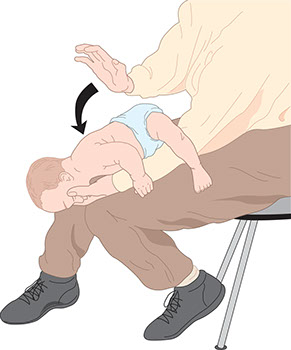
    2.  If the baby is conscious, hold the baby’s head (face down) in one hand. Straddle the baby over your forearm. Rest your forearm on your leg for support. Keep the baby’s head lower than the rest of his or her body.

    3.  With the heel of your free hand, give up to 5 quick, forceful blows on the baby’s back between the shoulder blades. See image C. If the object still blocks the airway, go to step 4.

    4.  Turn the baby over (face up). Cradle the baby on your forearm. Support the head with one hand. Keep the baby’s head lower than the rest of his or her body. Rest your arm on your leg for support. Place 2 fingers 1/2 inch below and in between the nipples on the baby’s chest. Give 5 quick downward thrusts. Depress the sternum about 1-1/2 inches with each thrust.

    5.  Repeat steps 3 and 4 until the object is removed or the baby is unconscious.

    6.  If the baby is unconscious, shout for help. Have someone call 9-1-1! If no one calls 9-1-1, give first aid for 1 minute, stop to call 9-1-1, then resume rescue efforts.

    7.  Put the baby on his/her back. Keep the head tilted back with one hand and give 30 chest compressions using 2 fingers on your other hand. Give 2 slow rescue breaths. If the object is expelled, stop. If not, give cycles of 30 compressions and 2 slow rescue breaths until the object is removed or help arrives.

    8.  Check for and remove the object in the airway, if visible. Repeat steps 7 and 8 as needed.

    9.  Don’t give up! Give CPR until medical help takes over or until the object is removed. Even if it is, get medical care right away.

    Illustration on giving a baby first aid when choking.

    Image C

    Healthier at Home book by the American Institute for Preventive Medicine. www.HealthyLife.com. All rights reserved.

    © American Institute for Preventive Medicine

  • Near-Drowning

    First Aid

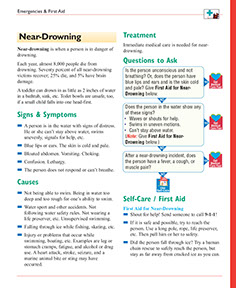
    Near-drowning is when a person is in danger of drowning. Each year, almost 8,000 people die from drowning. Seventy percent of all near-drowning victims recover; 25% die, and 5% have brain damage.

    A toddler can drown in as little as 2 inches of water in a bathtub, sink, etc. Toilet bowls are unsafe, too, if a small child falls into one head-first.

    Signs & Symptoms

    *  A person is in the water with signs of distress. He or she can’t stay above water, swims unevenly, signals for help, etc.

    *  Blue lips or ears. The skin is cold and pale.

    *  Bloated abdomen. Vomiting. Choking.

    *  Confusion. Lethargy.

    *  The person does not respond or can’t breathe.

    Causes

    *  Not being able to swim. Being in water too deep and too rough for one’s ability to swim.

    *  Water sport and other accidents. Not following water safety rules. Not wearing a life preserver, etc. Unsupervised swimming.

    *  Falling through ice while fishing, skating, etc.

    *  Injury or problems that occur while swimming, boating, etc. Examples are leg or stomach cramps, fatigue, and alcohol or drug use. A heart attack, stroke, seizure, and a marine animal bite or sting may have occurred.

    Prevention

    For Children

    *  Never leave an infant or child alone in any type of bathtub. Supervise young children in the bathroom.

    *  Never leave a child alone near water, swimming pools, etc. Lock gates to keep children from getting near swimming pools.

    *  Have a phone near outdoor pools, etc.

    *  Teach children to swim. Tell them not to swim alone and not to swim too far from shore without a lifeguard or other adult swimmer.

    *  Put a personal floatation device on each child when near the water or on a boat.

    *  Tell children to check the depth of water before diving in. It should be at least 9 feet deep.

    *  Do not allow children to go on untested ice.

    *  Take CPR and water safety courses.

    For Adults

    *  Learn to swim. Never swim alone at the beach or in a swimming pool. A lifeguard or other adult swimmer should be nearby in case you suffer a leg cramp or other problem.

    *  Wear a personal floatation device when you are on a boat, when you fish, etc.

    *  Check the depth of the water before diving in. It should be at least 9 feet deep. Never dive into an above-ground pool.

    *  Do not use a hot tub or jacuzzi if you’ve had any alcoholic drinks. You could fall asleep, slip under the surface, and drown.

    *  Take CPR and water safety courses.

    Questions to Ask

    Self-Care / First Aid

    First Aid for Near-Drowning

    *  Shout for help! Send someone to call 9-1-1!

    *  If it is safe and possible, try to reach the person. Use a long pole, rope, life preserver, etc. Then pull him or her to safety.

    *  Did the person fall through ice? Try a human chain rescue to safely reach the person, but stay as far away from cracked ice as you can.

    *  If you must swim to the person, be sure you are strong and capable enough. Take a flotation device with you. Approach the person from behind in a calm manner. Grab a piece of the person’s clothing. Or, cup one hand under the person’s chin.

    *  When getting the person out of the water, support the head and neck. (Suspect a neck injury, especially with diving or water sports.)

    *  CHECK for a response. Give Rescue Breaths and CPR, as needed. If you suspect a spinal injury, use jaw thrust instead of chin-lift for rescue breaths.

    *  Once out of the water, keep checking the person for a response. Give first aid, as needed.

    *  Put the person in the Recovery Position. Immobilize the person as much as possible. If the person is vomiting, clear his or her mouth of it.

    *  Remove cold, wet clothes. Cover the person with a blanket, etc.

    Healthier at Home book by the American Institute for Preventive Medicine. www.HealthyLife.com. All rights reserved.

    © American Institute for Preventive Medicine
  • Sick Kid?

    FAMILY LIFE

    Image of mother and child at the doctor's office.

    For many reasons, a child being home from school while sick can be stressful. Parents worry about the severity of their child’s illness and about the child missing school, all while trying to shuffle work schedules to be home.

    But when should kids stay home from school? Dr. Hannah Chow-Johnson, pediatrician at Loyola University Health System, gives some guidelines to help parents make that decision.

    Pinkeye.

    Extremely contagious and is usually caused by a virus. One of the first signs of pinkeye is discomfort. Other symptoms include a sticky discharge that can cause the eyelids to stick together, and the area around the eye can look red and swollen. Stay home until the redness is gone.

    Stomach problems.

    Gastroenteritis or the stomach flu can cause vomiting and diarrhea. Most often, it is caused by a virus. A child needs to rest and take gradual fluids to recover. Stay home until the vomiting and diarrhea are gone for 24 hours.

    Fevers.

    Most schools have a policy that a child can’t attend if they have a fever higher than 100 degrees F and the child needs to be fever-free for 24 hours before returning to school. Stay home and rest.

    Coughing.

    If a child has a steady cough, a hacking cough, or coughing fits, he or she should stay home. It’s also important for children and adults to be vaccinated against pertussis (whooping cough). Go back to school with a minor cough, but practice good coughing skills such as coughing into a tissue or elbow and washing hands often.

    Sore throat.

    Many parents think sore throat means strep throat, but in 70% of the cases the pain is caused by a virus. Symptoms of strep also include headache, stomachache, and fever. Sometimes there is a sunburn-like rash on the throat. Stay home if the doctor has given an antibiotic and the child has been on it for 24 hours. If the sore throat is viral, return to school when the child feels better.

    Lice.

    Unfortunately those stubborn bugs mean no school for kids. They can quickly spread through a classroom. Children need lice treatment and combing to remove all nits.

    © American Institute for Preventive Medicine