Tag: coverage

  • Check Your Health Insurance Coverage

    Healthy Travel

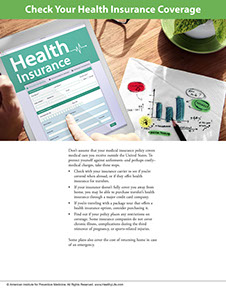
    Image of Health Insurance form on tablet.

    Don’t assume that your medical insurance policy covers medical care you receive outside the United States. To protect yourself against unforeseen-and perhaps costly-medical charges, take these steps.

    *  Check with your insurance carrier to see if you’re covered when abroad, or if they offer health insurance for travelers.

    *  If your insurance doesn’t fully cover you away from home, you may be able to purchase traveler’s health insurance through a major credit card company.

    *  If you’re traveling with a package tour that offers a health insurance option, consider purchasing it.

    *  Find out if your policy places any restrictions on coverage. Some insurance companies do not cover chronic illness, complications during the third trimester of pregnancy, or sports-related injuries.

    Some plans also cover the cost of returning home in case of an emergency.

    Page image from A Year of Health Hints book by the American Institute for Preventive Medicine. www.HealthyLife.com. All rights reserved.

    © American Institute for Preventive Medicine

  • Disability Insurance

    Medical Care

    Image of nurse with wheelchair bound women.

    An accident or illness may make it impossible to work. This may mean a drastic drop in income. Disability insurance benefits replace part of the wages lost.

    If you’re considering buying a disability insurance policy, ask the following:

    *  What percentage of your pre-tax salary is paid out? (50 to 60% is average.) How are benefits paid out? Are payments the same or greater in the first few months?

    *  Is there a guarantee that the policy can be renewed?

    *  How long will benefits be paid? Months, years, a lifetime?

    *  Are pre-existing or chronic conditions included?

    *  Can you get disability insurance from your place of work?* How much will this cost you? Group policies may be more flexible on chronic conditions.

    * Veterans can get information on disability compensation from 1-800-827-1000 andwww.va.gov.

    Page from the Health at Home Lifetime book by the American Institute for Preventive Medicine. www.HealthyLife.com. All rights reserved.

    © American Institute for Preventive Medicine

  • Planning For Health Care Coverage

    Medical Care

    Image of couple talking to a health care agent.

    Medical costs are expensive. Whether you are in your 50s, 60s, 70s, or older, now is the time to review how you cover them. Now is the time, too, to plan for how they will be paid for in the future. Without health insurance, some persons could lose all their assets if they had to pay for medical expenses.

    Like life insurance, health insurance can be hard to understand. Don’t let it baffle you, though. Find out what you need to know to protect yourself and your assets. Don’t find out you have too little coverage when it’s too late. Use the “Health Insurance Checklist” to keep track of your health care coverage.

    If you are a Veteran, find out about Veterans health care from

    Page from the Health at Home Lifetime book by the American Institute for Preventive Medicine. www.HealthyLife.com. All rights reserved.

    © American Institute for Preventive Medicine

  • Save If You Have Insurance

    Medical Care

    Image of doctor and piggy bank.

    Know health insurance terms and plans.

    This allows you to make wise choices. Read “Questions and Answers About Health Insurance – A Consumer Guide” fromwww.ahrq.gov/consumer/insuranceqaandwww.healthdecisions.org.

    If you can get health insurance through work, do it.

    More often than not, it will cost you less than if you buy it on your own. If you can choose from more than one plan, compare the options. The best deal may not be the cheapest plan. It is the one that gives the best price for the benefits you need and are most likely to use. If you need help to understand the options, ask your employer. Get facts from the insurance company’s Web site and/or customer service representative, too.

    Raise your deductible.

    Your deductible is the amount you must pay before your health insurance kicks in. Like car insurance, monthly premiums cost less if you pay a higher deductible. Healthy adults can usually save money with this option.

    Check into a Consumer Driven Health Plan.

    This gives you greater control over how you use your health care benefits. You pay a high deductible. You pay for your health care costs from a tax-exempt health account. If you expect to be healthy, this may be a good choice for you.

    Read your health plan.

    Read what products and services are covered before you pay for them on your own. Take advantage of covered services, such as dental checkups and cleanings twice a year. You may find out that your health plan covers some of the costs for flu vaccines and other services.

    Student health insurance.

    Find out about student health insurance from your child’s school or college, especially if your child plans to study abroad.

    Be Medicare aware.

    Medicare is the U.S. government’s health insurance for persons age 65 or older. It also covers people under age 65 who have disabilities. Find out when you will be eligible for Medicare fromwww.medicare.govor by calling 800.MEDICARE (633.4227).

    *  When you are enrolled in Medicare, you get Medicare Part A. This covers medical costs when you are in the hospital.

    *  Medicare Part B covers things that  Part A does not. Examples are doctors’ fees, outpatient hospital costs, physical therapy, etc. You pay a monthly premium for this.

    *  Medicare Part D helps cover the cost of prescribed medicines.

    Fill in the gaps.

    Find ways to pay for services not covered by your insurance plan.

    *  If you have Medicare, you can buy Medigap, Medicare Select, or Medicare Advantage HMO insurance to help pay for services not covered by Medicare. Contact your state health insurance department to find out about your choices for each of these health plans. You need only one of these. For free help choosing a Medicap policy, call your State Health Insurance Assistance Program.

    *  Look into extra coverage from providers, such as Aflac.

    Pay premiums on time.

    If you don’t, your coverage could be cancelled.

    Know about COBRA.

    This stands for Consolidated Omnibus Budget Reconciliation Act. COBRA is temporary health insurance. It applies to former employees, retirees, spouses, former spouses, and dependent children who are no longer covered under an employer health insurance plan. It lets you keep the same health insurance for 18 months (sometimes longer) if you pay for it yourself. Find out more about COBRA fromwww.dol.gov/dol/topic/health-plans/cobra.htm. Know, too, that it may cost you less to buy your own health insurance than to pay what COBRA will cost you, especially if you are in good health and have no pre-existing health problems.

    Find out who to contact when the insurance company denies a claim.

    Sometimes claims are rejected by mistake. When this happens, you can usually clear up the mistake by calling or writing a letter to your insurance company. Keep copies of all bills, letters, and notes from phone calls. Put your policy and claim numbers on all letters or e-mails. Call your insurance company if you don’t get an answer within a few weeks.

    Keep up-to-date.

    Find out how you learn about updates and changes in your health plan. Do you get notified by mail or by e-mail? Do you need to check the health plan’s Web site? How do you add a new dependent to the plan? Also, find out when you can change the plan you have. Often, you can only do this during open enrollment.

    Know before you go.

    Call your health insurance company before you have a medical service. Some services are only covered if the insurance company approves them first and/or if they are done at certain locations or by certain providers.

    One may be enough.

    If both you and your spouse both have health insurance through work, choose the plan that works best. Decide if it is better to keep separate plans or if it would cost less for either of you to join the other’s plan. Your employer may let you take cash or other benefits instead of health insurance. Keep the better policy if you can and “cash in” on the other one. Also, find out which policy covers your children better. Think about future needs, too. For prenatal and delivery costs to be covered, a woman may need to be a member of the plan for nine or more months before she gets pregnant.

    Take advantage of FSAs.

    Find out if your employer offers a Flexible Spending Account (FSA). This lets you set aside some money for medical expenses for the year. You could choose to set aside $1,000. This is usually taken out of your paycheck, but you don’t pay federal income tax or Social Security tax on this money. But be careful how much you put into your FSA. You lose any money you don’t spend on health care in the year. Look at last year’s health care expenses for a ballpark figure on what you think you will likely spend. Don’t count any money that is taken from your paycheck for insurance premiums. Do count deductibles, co-pays, and treatments your insurance doesn’t cover.

    Use it before you lose it!

    If you are going to lose your health insurance, you are part of a growing trend in the U.S. Schedule doctor visits and other health care services before expenses will no longer be covered.

    Before you travel, check out your health insurance coverage.

    Are you covered where you are going? If not, ask your health insurance provider how to get coverage while you are gone. You can also find out about travel health insurance fromwww.travelrinsurance.com.

    Cover image to the Healthy Savings book by the American Institute for Preventive Medicine. www.HealthyLife.com. All rights reserved.

    © American Institute for Preventive Medicine

  • Navigate Open Enrollment

    WELL-BEING

    Image of 2 people talking.

    Make the most of your benefit plan, especially during open enrollment periods. Here are money-saving tips from HighRoads, a benefits management company.

    *Get your plan materials.Some companies are giving you a Summary Plan Description online, via mobile apps, as well as on paper. It’s good to know how you can access this information during open enrollment and throughout the year, in case you want to review it again when you are in need of a particular medical service. Take time to read the plan.

    *Calculate your costs.Many employers provide cost calculators to help project your total cost for the coming plan year. The total cost includes the premium you pay as well as your share of the deductible and coinsurance. Take the time during open enrollment to think through your potential medical needs and calculate your anticipated expenses before selecting a plan. It may save you hundreds in the long run.

    *Consider an account.Your employer may offer you the option of a health care account, whether it is a flexible spending account, a health reimbursement account, or a health savings account. These accounts can help you save money on qualified medical expenses that aren’t covered by your health care plan, such as deductibles and coinsurance. Each account has a different set of rules about how and when you can spend the money, but each is worth considering because the savings you’ll see can add up quickly.

    *Is prevention covered?One of the benefits of health care reform is an extended list of preventive care benefits that must be offered by new health care plans for free. Preventive services such as colonoscopy screenings, Pap smears and mammograms for women, well-child visits, and flu shots for all children and adults must be offered without out-of-pocket costs. However, these benefits are only for new health plans and don’t apply to “grandfathered” plans that haven’t significantly changed in a few years.

    *Use wellness incentives.More employers than ever before are offering incentives such as premium discounts, low deductibles, gym memberships, or prizes to employees and their family members for health improvement.

    *Know your deadlines.No matter what changes you may make, if any, during this year’s open enrollment period, don’t let your selection deadlines slip by without action.

    © American Institute for Preventive Medicine

  • Preparing For A Vacation From Work

    WORK LIFE

    Image of family looking out of an airport window.

    To help make the most of your time off, be sure you’ve prepared for your absence at work. These steps can help you get ready for your well-deserved break:

    *Give people advance notice.As soon as you have plans, tell your supervisor and colleagues. If you have key clients or customers, be sure to tell them too.

    *Set up an out-of-office reply and voicemail.These basics let everyone know when you’ll get back with them. If possible, list a colleague’s name and number for urgent needs, but ask them first if this is okay.

    *Make a list of important tasks to complete before you leave.Then, stick to the list and make sure you get it done. This will help your colleagues and you’ll be able to rest easier on vacation.

    *Decide how you can be reached and let people know.If you don’t want phone calls or emails, let co-workers know. Some people want to take a complete break from work, while others like checking in. Or, you may tell people to call only if it’s urgent. It may depend on your job responsibilities and your preference.

    Traveling and spending

    In 2016, people in the U.S. spent $836.6 billion on domestic travel. This made up 84 percent of all travel expenditures. The money spent on travel in the U.S. directly supported over 7 million American jobs.

    Travelers spent $248.5 billion on food services. This accounted for 25 percent of travel expenses. It surpassed lodging expenses, which were 21.3 percent, or $210.8 billion, of total travel expenses.

    Source: U.S. Travel Association

    © American Institute for Preventive Medicine